Get in touch with Blue Membrane Company

Portable Desalination Units, Factory-Direct Seawater RO Systems for Marine, Island & Off-Grid Use
Portable desalination plant makes seawater drinkable at any point the water line ends-and Blue Membrane builds the reverse osmosis membrane in the desalinator, not just the housing.
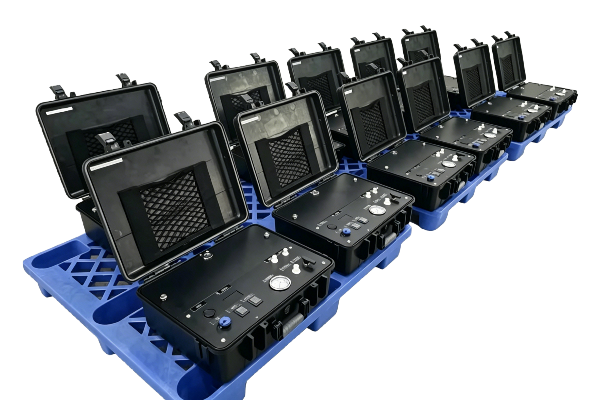
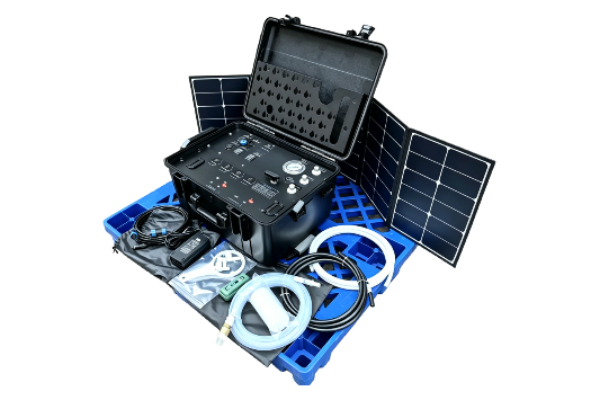
What is a portable desalination unit? It is a compact seawater reverse osmosis (RO) system that forces seawater through a semipermeable membrane to remove salt and produce fresh water on demand. Blue Membrane builds these units around our own H-series seawater RO membranes, rated at 99.8% salt rejection per our datasheet.
VIEW PORT
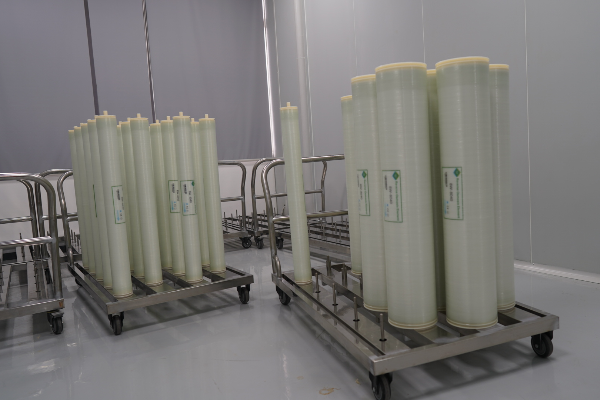
The RO principle, in one line
When seawater flows through a reverse osmosis membrane at high pressure, only water molecules go through the barrier, leaving dissolved salts and impurities behind to flow away as brine. Every bit of the difference between a good or bad portable desalinator relies on two things: the RO membrane and the pump.
Reliable Freshwater Where the Grid Ends
Portable desalination units address the core difficulty that offshore crews, islanders and expeditions can’t reach fresh water in the areas where water shipped by tanker or via water pipe is inaccessible. These groups have water all around them, with TDS up to 45,000 ppm that needs treatment (USGS: saline water & salinity).
Perhaps one counter-intuitive point of departure is that any relatively compact seawater desalination unit is intended to reject almost everything pumped. The recovery rate for single-pass seawater RO operating at 800 psi (5.52 MPa) involves an unavoidable tradeoff with rejection, and in reality a marine desalinator may yield only 10% product water with 90% brine. If you see anything greater than 70% recovery, it is for an industrial plant.
Blue Membrane engineers the BM-SWRO200-1 to accommodate that reality, so its 8-15% product recovery rate is typical for this type and class of unit — not a limitation.
RO filtering to 0.0001 micron ensures effective removal of salt, heavy metals, bacteria and viruses with a single-pass.
The output conforms to national drinking water regulations, as well as the World Health Organization’s standard for drinking water (under 1,000 ppm TDS).
Blue Membrane Portable Desalination Units, Models & the Capacity Ladder
The BM-SWRO200-1, our most versatile portable desalinator, is an automatic, waterproof, suitcase desalination machine designed for emergency, marine and expeditionary applications. It serves as the first rung of a complete product line, each using the same, matched reverse osmosis membrane, extending all the way up to container-based systems.
SPECIFICATIONS BM-SWRO200-1 — Technical Parameters [Manufacturer datasheet]
| Parameter | Specification |
|---|---|
| Fresh water output | 8–12 L/H |
| Rated power | 300 W |
| Recovery rate | 8–15% |
| Feed water TDS | ≤ 35,000 ppm (seawater) |
| Output water TDS | ≤ 700 ppm |
| Desalination rate | ≥ 98% |
| Filtration accuracy | 0.0001 micron |
| Power supply | AC100–240V (50/60Hz), DC24V |
| Design | Waterproof suitcase, one-button automatic |
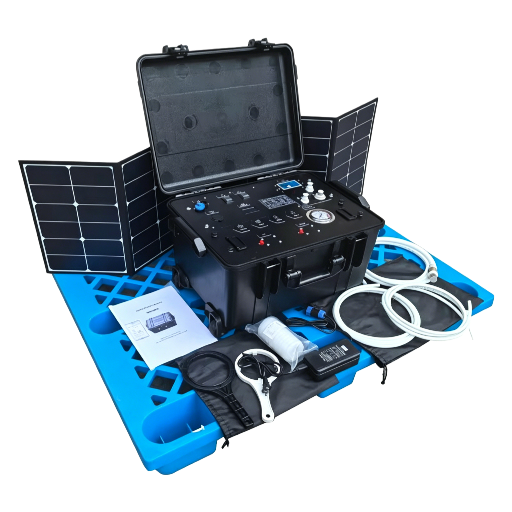
The Blue Membrane Capacity Ladder
“Is 8-12 L/h sufficient?” is the wrong question. Better to ask yourself, Where on this scale are you right now? Each step up the product family, using identical seawater RO technology, allows you to expand capacity while continuing to use Blue Membrane products (desalination capacity context: University of Florida IFAS).
SYSTEM LINEUP Authority Hook — Blue Membrane Capacity Ladder [Manufacturer product line]
| Tier | Model | Output | Power | Best-fit application |
|---|---|---|---|---|
| Portable | BM-SWRO200-1 | 8–12 L/H (~200 L/day) | 300W · AC/DC24V/solar | Backup, small craft, emergency, expedition |
| Marine DC | BM-SF700-1 | 700 L/day | 800W · DC24V | Solar/battery sailboats, off-grid yachts |
| Marine AC | BM-SF700-2 / 1400-2 / 2000-2 | 700–2,000 L/day | 1.6kW · AC220V | Yachts, fishing vessels, small crews |
| Skid SWRO | 45 & 200 m³/day | 45,000–200,000 L/day | 690VAC · BV class | FPSO, offshore platforms, resorts |
| Containerized | 65 TPD | 65,000 L/day | AC380V · SUS316L | Islands, coastal municipalities, camps |
Contrary to what you might expect, it is much cheaper to expand a water production system than most buyers anticipate. Across our marine RO products, a capacity increase from 475 GPD to 1,800 GPD (+279%) adds only about 26% to the total cost, because scaling the pumps and framework is not nearly as costly as expanding water output. While single-system suppliers tie your options, our stepped product line let you begin with a small, portable desalinator and expand with time by using ever-larger systems with exactly the same technology.
Buyer note, matching output to demand
Most portable unit owners are intermittent – it is typical for them to run for about 2.5 hours out of every 3 days. For example, one popular compact unit, the Katadyn 40E, only pumps out ~5.7 L/H. The BM-SWRO200-1, by comparison, at 8-12 L/H, will out produce the best-selling multi-year rig in its class.
Off-Grid Power Flexibility for Seawater Desalination, AC, DC, Solar, Wind & Generator
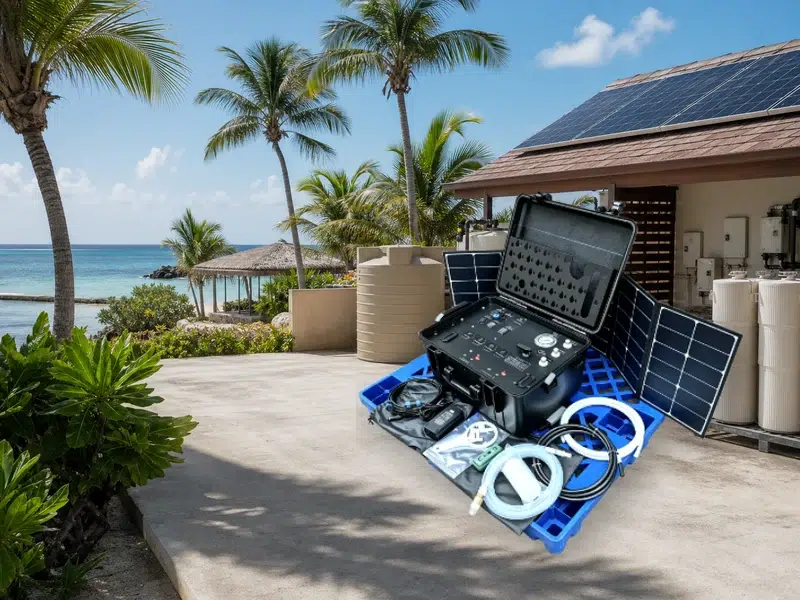
The first criterion for many buyers of compact systems is power draw. As one long-term liveaboard, commenting on a favourite compact rig, put it, the 40E only draws 4 amps — “you can run it all day if it’s sunny”. In a mobile off-grid situation, there will be multiple power sources available: a wall socket, solar, a generator, and batteries. And Blue Membrane is designed to integrate any and all of these using the same cabinet and power supply.
Fixed-installation water makers may benefit from energy recovery, which can significantly reduce power consumption per gallon – a 2025 peer-reviewed study found a 25.7% reduction in RO energy consumption when using an ERD (staged RO energy-reduction method: USPTO US20170349467A1). The factory’s skid and containerised systems use integrated energy recovery for this reason, but Blue Membrane deliberately sacrifices some energy efficiency in the portable unit for plug-and-play mobility.
Honest energy trade-off
While an AC/DC suitcase portable unit may not be the most power-efficient method for producing water on a per-gallon basis – the more complex and specialised tuned DC system can be more efficient at about 34.6 W/gal – it delivers universal power flexibility and installation-free convenience. Simply plug it in wherever power is available, whether it’s a house socket, batteries, a generator, or a solar panel.
Authority Hook — Power-Source Compatibility Matrix [Manufacturer spec]
- Power source Supported models Best scenario
- Solar PV / battery BM-SWRO200-1 (DC24V), BM-SF700-1 Silent daytime production off-grid, no fuel
- DC 24V BM-SWRO200-1, BM-SF700-1 Small craft house banks, expedition kits
- AC 100–240V (50/60Hz) BM-SWRO200-1, BM-SF AC series Shore power, resort mains, universal voltage
- Petrol / diesel generator All portable & marine models High-demand bursts, no shore power
- Wind BM-SWRO200-1 (via DC/charge) Remote coastal and platform sites
The Membrane Advantage, Why We Manufacture Our Own Seawater RO Membranes
Blue Membrane stands out from typical survival equipment brands and from most marine equipment manufacturers for one reason alone: the factory builds its own H1/H2 Reverse Osmosis membrane, which is the workhorse of any desalination process (portable membrane-filtration patent art: USPTO US12251663B2). Other portable desalination makers assemble units around off-the-shelf, third-party membranes.
01
Our membrane
99.8% salt rejectionH1/H2 seawater elements rated at 99.8% stabilized rejection at 32,000 ppm and 800 psi (5.52 MPa), per our datasheet.
02
Supply security
No proprietary lock-inBecause we produce the membrane, replacement supply is not held hostage to one brand’s parts catalogue.
03
Consumable cost
The hidden line itemThe membrane, not the pump, is the part that fouls and eventually gets replaced, so its price and availability decide your real cost of owner ship.
Portable Desalination Unit vs. the Alternatives, Performance & Total Cost
It is not brand vs. brand when it comes to clean water on a boat or offsite. Instead, it is a question of method vs. method. How does a direct-from-factory portable RO water maker compare with the other methods of producing potable water, ranging from a hand-pumped desalination device to ordering it in cases? (submersible seawater RO method: USPTO US20080290032A1)
Method comparison — how fresh water actually reaches a remote site
| Dimension | Blue Membrane portable RO | Manual survival pump | Bottled / tanker water | Premium marine integrated unit |
|---|---|---|---|---|
| Output | 8–12 L/H automated | ~5–7 L/H by hand | Whatever you carry/ship | 20–140 L/H |
| Power | AC/DC/solar/generator | Human effort | None (logistics) | Usually 12/24V DC installed |
| Salt rejection | ≥98% (≤700 ppm out) | ~97% | n/a | ≥98% (often <500 ppm) |
| Recurring cost | Own-membrane replacement | Cartridge replacement | €5–20/m³ forever | Brand membrane markup ~3.4× |
| Install | None (suitcase) | None | None | Hull fittings, plumbing |
| Best for | Backup, small craft, off-grid | Life raft, grab-bag | Short trips only | Full-time high-volume cruising |
The math quick-turns against tanker water: in the Bahamas it is about $0.40 per gallon to go without a watermaker, and coastal homes buy tanker water at €5–20 per m³.
18–24 mo
Typical break-even for onboard/on-site desalination versus tanker delivery. A 50 m³/day resort paying €8/m³ spends ~€146,000/yr on tanker water — over €760,000 in five years.
Source: Elemental Water Makers TCO analysis (solar desalination vs tanker delivery). Membrane life 5–7 yr; figures are industry TCO context, not a Blue Membrane price quote.
Ready to size this against your own water bill?
Get a capacity & TCO estimate →Field Applications, Marine Vessels, Island Resorts, Offshore Platforms & Emergency Relief
A portable unit becomes viable when transport is expensive and generation onsite is cheap — just what we build our portable and marine water makers for. As portable desalination units for boats and shore camps, they turn seawater into safe drinking water, sized by the liters of water per person per day a crew needs.
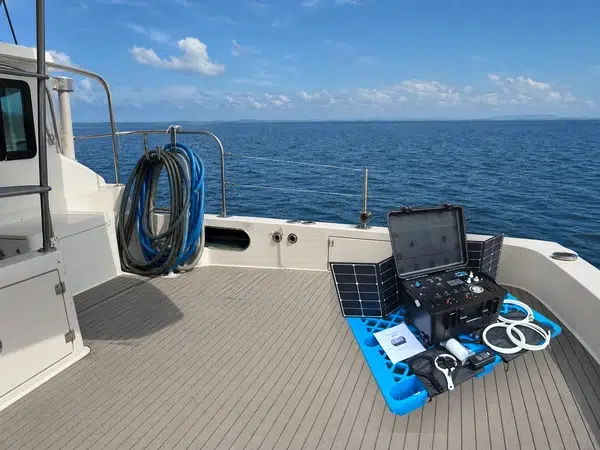
Ships, yachts, fishing vessels
Marine & boats
⤹ VIEW SPEC
Marine & boats
Emergency and underway freshwater without hull-drilling; our portable desalination unit for boats runs on the 12 volt marine water makers many sailors already trust, integrating directly with solar and battery banks.
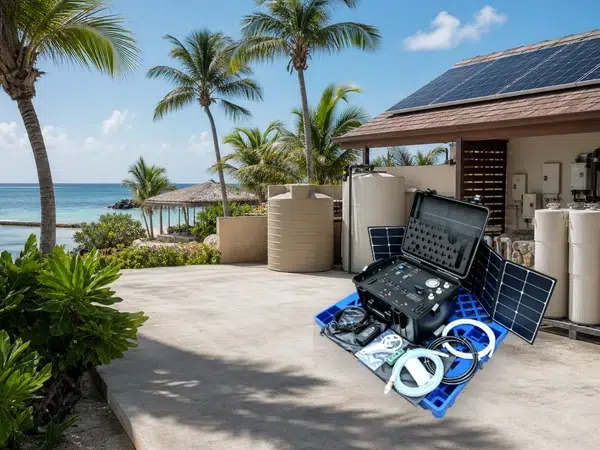
Remote hospitality
Island resorts
⤹ VIEW SPEC
Island resorts
Cut dependence on tanker deliveries; step up the ladder to a skid 45–200 m³/day system when a property scales.
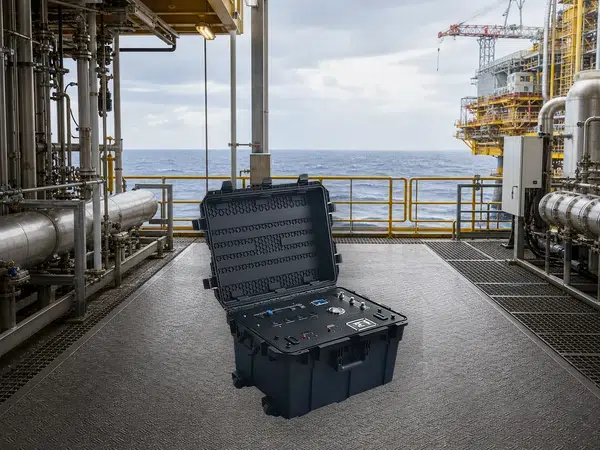
Rigs & FPSO topside
Offshore platforms
⤹ VIEW SPEC
Offshore platforms
Modular RO for drilling platforms and aquaculture; our 45/200 m³/day skids carry BV classification for marine service.
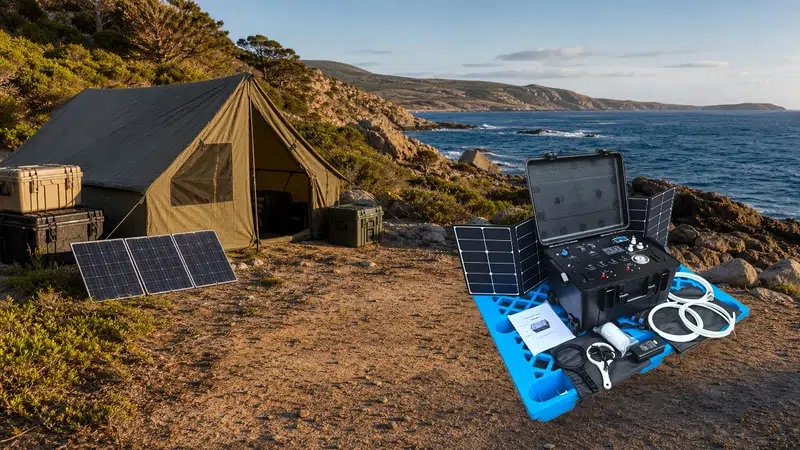
Coastal camps, saline lakes
Off-grid & expedition
⤹ VIEW SPEC
Off-grid & expedition
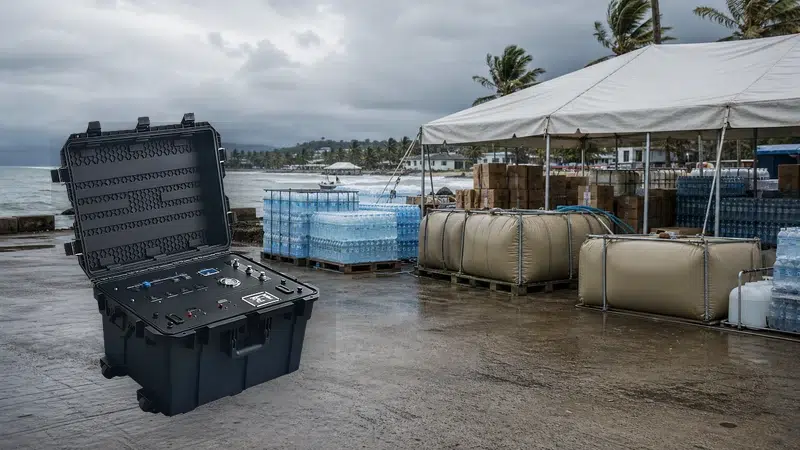
Solar, wind, and generator input make the suitcase unit a genuine off grid desalination system, a portable seawater desalination system for remote locations and resource-limited sites.
Disaster response
Emergency relief
⤹ VIEW SPEC
Emergency relief
A plug-and-play emergency desalination kit gives disaster-affected coastal areas clean drinking water within minutes of arrival, no installation — critical when emergency guidance calls for one gallon of water per person per day.
Certifications, Material Quality & Membrane Testing
Our systems line up against international benchmarks for water quality and performance standards. This should give the careful buyer more comfort than an abstract “brand” value – and eliminate a quietly-failed audit.
WHO-Potable
Output ≤700 ppm TDS vs WHO <1,000 ppm safe threshold
Marine-Grade
316 stainless frame on BM-SF series; SUS316L on containerized
BV Class
45/200 m³/day skid systems carry BV classification
One-Button PLC
Automatic control with high/low-pressure protection
Honest water-quality disclosure
Our portable unit produces water at up to 700 ppm TDS. That is comfortably inside the WHO potable limit of 1,000 ppm and meets national drinking water standards, but it is above the <500 ppm US EPA taste guideline that premium marine units target.
The membrane itself is where our quality story is strongest — and also where we are careful with words. Unlike a brand that rounds its numbers up, Blue Membrane delivers the 99.8% rejection figure for H1/H2 as a manufacturer datasheet spec measured at 800 psi (5.52 MPa), because it is consistent with the premium seawater-membrane band — but we do not present it as third-party verified.
Procurement Guide, Factory-Direct Supply, OEM, MOQ & Lead Time
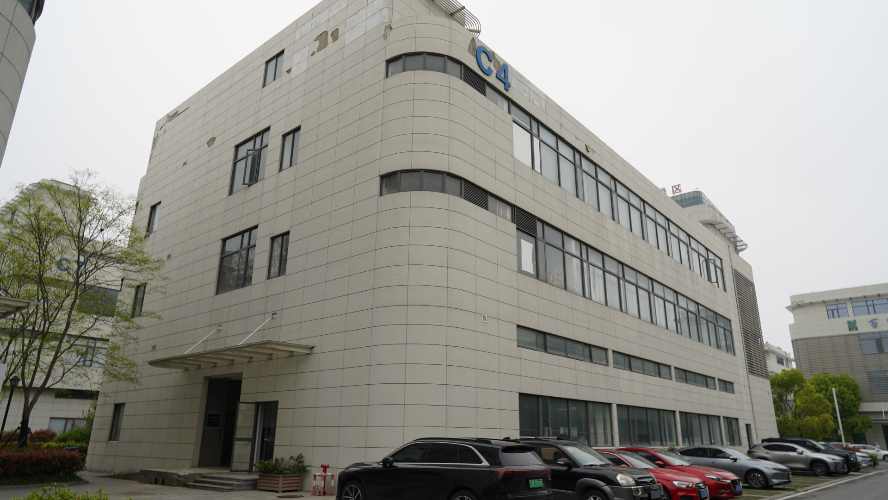
Blue Membrane is the manufacturer, we don’t pass a resellers “markup” to you on any part or machine, and what impacts price is how you use it, not some price list. Factory quality management follows ISO 9001 principles.
Pricing Factors Framework
Here’s what drives a seawater system quote, instead of just one number:
- 01 Tier (portable, marine, skid, or container)
- 02 Power type and configuration (solar, generator-ready, AC with ER for large units)
- 03 Membrane count and spares (number of membranes, spare kit size)
- 04 Certification scope standard build versus BV-classified marine skid.
- 05 Integration OEM branding, system integration, or distributor volume.
How we work with buyers
We sell direct to OEMs, distributors and systems integrators. Send us your source water, target capacity, location (vessel or project), and preferred power and we send back a factory-direct technical proposal.
Smart buyers know the cost of the parts, with many sailors noting “I built a watermaker from scratch – about $2K in parts”. So the fair factory direct price isn’t one hiding behind a brand name.
With the same facility producing the membrane as the finished system, replacement elements ship at factory direct pricing – no brand surcharge year after purchase and the source of our product line’s cost advantage.
Interactive Planning Tools — Size, Cost & Power
Three quick calculators to move from “roughly right” to a specific model before you request a quote. All estimates use the public specs on this page; a Blue Membrane engineer confirms the final sizing.
FAQ: Portable Desalination Units — Frequently Asked Questions
The BM-SWRO200-1 produces 8–12 L/H (about 200 L/day). Compact units are designed for intermittent runs, and this already out-produces a multi-year small-boat favorite like the Katadyn 40E (~5.7 L/H). When demand grows, the same family scales to 700–2,000 L/day marine units and 45–200 m³/day skids.
Yes. Output is ≤700 ppm TDS with ≥98% salt rejection, inside the WHO potable limit of 1,000 ppm and compliant with national drinking water standards. Premium marine units often target <500 ppm, so we state 700 ppm honestly rather than round it down.
AC100–240V (50/60Hz), DC24V, plus petrol/diesel generators, solar, and wind. The DC24V option connects directly to solar panels and battery banks for silent, fuel-free daytime production off-grid.
Yes, this is the core difference. We manufacture the H1/H2 seawater RO membranes (99.8% rejection per datasheet) inside our units, while most brands assemble with third-party membranes. That means replacement supply without a proprietary brand markup.
No. For compact marine RO, roughly 10% product / 90% brine is the industry norm; the >70% recovery figures apply to large plants, not portable units. Blue Membrane’s 8–15% brackets and slightly exceeds the compact-unit norm.
Price depends on capacity tier, power configuration, membrane count, certification scope, and OEM/integration needs. We sell factory-direct, so there is no reseller markup on either the unit or its replacement membranes. Send your requirements for a specific quotation.
Every RO membrane fouls and is eventually replaced (typically every 5–7 years). Because we manufacture the element, you avoid the brand markup owners report elsewhere, for example, a same-spec marine membrane priced at $565 from a brand versus $165 from an independent supplier.
Yes. We work with OEM partners, distributors, and system integrators, and customize capacity from the portable BM-SWRO200-1 up through containerized 65 TPD plants. Membrane sizes are also customizable to application requirements.
Trending now