Get in touch with Blue Membrane Company

Industrial Membrane Separation — Jiangsu Blue Technology Co., Ltd.
Request AR-NF Datasheet & Pricing
Alkali-Resistant Nanofiltration Membrane Elements for Extreme-pH Industrial Separation
Blue Membrane AR-NF elements operate from pH 2 to 13 continuously, and survive pH 14 CIP cycles. Standard polyamide membranes can’t. These do.
Tested at pH 12–12.5 · 2,000 ppm MgSO₄ · 96.5–98.5% rejection · 4 element sizes
pH 2–13 Continuous
Up to 10,000 GPD (8040)
96.5–98.5% MgSO₄ Rejection
34-mil Feed Spacer
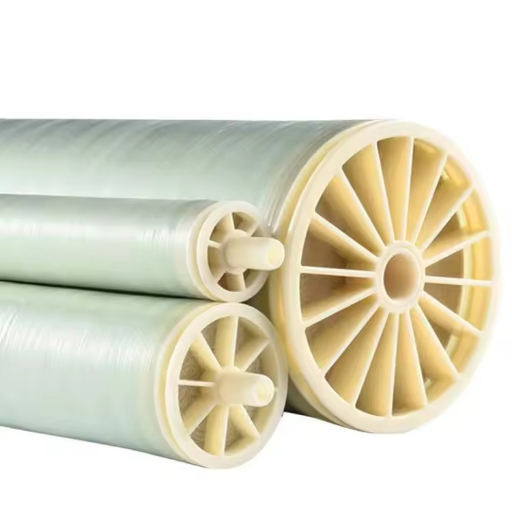
AR-NF Membrane Technology: Stable Separation at pH 2–13
TECHNOLOGY OVERVIEW
An alkali-resistant nanofiltration (AR-NF) membrane is a spiral-wound, pressure-driven filtration element engineered to maintain stable divalent ion rejection in highly alkaline process streams (pH 2–13 continuous; pH 14 for CIP) where standard polyamide TFC membranes degrade. Unlike conventional NF elements rated for pH 4–9, AR-NF elements use a modified polyamide chemistry that resists hydrolysis at extreme pH, enabling continuous operation through caustic cleaning cycles without rejection loss.
At pH 12–12.5, Blue Membrane AR-NF elements deliver 96.5–98.5% MgSO₄ rejection, consistent with performance across the full pH 2–13 operating range. Standard thin-film composite (TFC) polyamide elements can’t achieve this: rated pH 4–9, they lose rejection and exhibit flux increase above pH 10 as the active layer hydrolyzes. Understanding the mechanism require knowing where NF sits in the pressure-driven separation spectrum.
Nanofiltration is positioned between ultrafiltration (UF) and reverse osmosis (RO) on the filtration spectrum.
Typical MWCO of a NF element is between 200 and 1,000 Da, yielding rejection of divalent salts such as Ca, Mg and SO in the 96-99% range while partially allowing monovalent salts (e.g., NaCl, KCl) to pass through. This selectivity profile is ideal for caustic recovery, dye separation and hardness removal applications at a 50-150 psi pressure range vs 150-800 psi range of RO.
THE pH CHALLENGE
The challenge is pH. Standard thin-film composite (TFC) polyamide membranes are cast for near-neutral conditions.
Patent CN112755811B (2021) “the applicable pH range of the current polyamide composite NF membrane is very narrow (2–10), and it’s neither acid-resistant nor alkali-resistant.”
AR-NF elements address this through modified interfacial polymerization chemistry that stabilizes the amide bond against nucleophilic attack by OH⁻ ions, maintaining ≥96.5% MgSO₄ rejection from pH 2 to pH 13.
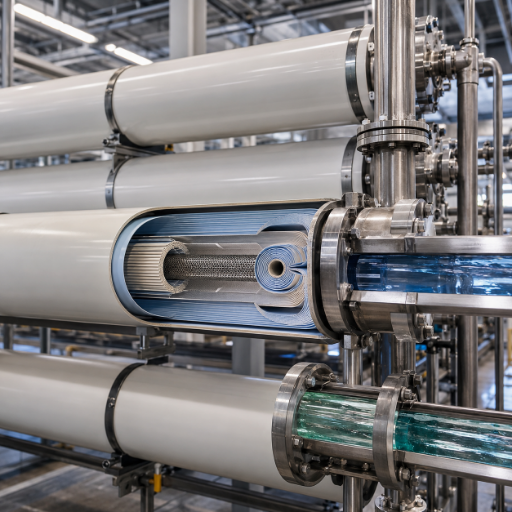
STANDARDIZED TESTING
All Blue Membrane AR-NF elements are tested under standardized conditions per the methodology aligned with ISO 25175:2026 (RO and NF membrane element test methods) and ASTM D4194-23.
- Test Solution2,000 ppm MgSO₄
- Pressure100 psi (0.69 MPa)
- Temperature25°C
- pH12–12.5
- Recovery15%
Testing at pH 12–12.5 is the critical disclosure, most manufacturers test at neutral pH 7–8 and never publish data for the alkaline conditions buyers actually operate in.
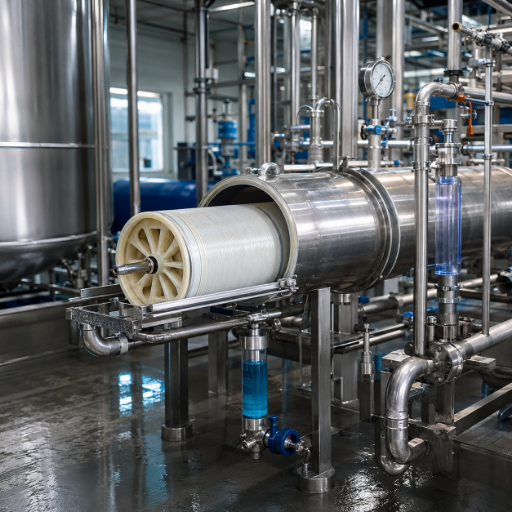
SPECIFICATIONS & REFERENCE
For reference, nanofiltration membrane pore size spans 0.1–10 nm (100–1,000 Dalton MWCO) which places NF between ultrafiltration (UF) and reverse osmosis (RO) membranes. It’s this pore size that dictates the selective NF rejection of divalent ions (e.g. 96.5%) while allowing monovalent salts to pass through which allows it to be preferred technology to replace RO for hardness removal and caustic recovery.
Questions regarding the AR-NF membrane technology and application in your range? Ask our engineers!
Contact our NF Engineering Team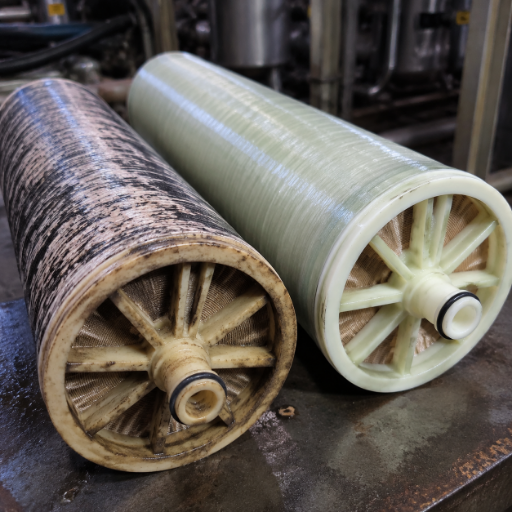
The Alkaline Threshold Problem
Every standard polyamide NF membrane has an alkaline threshold, the pH at which its performance degrades at a rapid pace, moving beyond manageable and toward irreversible. This threshold is commonly pH 10 for many commercial TFC NF membranes. Push beyond this threshold during the CIP cycle a few times, and you’ll likely see your service life plummet from 24 months to under 90 days.
The problem is inherent in the active layer. It’s formed by the interfacial polymerization of an amine and an acyl chloride. The polyamide structure has an amide linkage (-CO-NH-) which is susceptible to base-catalyzed hydrolysis. When pH reaches 10 or above, there are enough OH ions in the system to catalyze the reaction faster than the active layer can withstand. This results in a breakdown of the amide linkage, causing swelling of the active layer and consequently reduced divalent ion rejection with a corresponding surge in permeate flux-clear signs of membrane failure.
Literature baseline: Standard polyamide composite NF membranes rated pH 2–10 show measurable rejection loss above pH 11, and membranes exposed to pH 13 environments without alkali resistance typically require replacement within 30–90 days.
Source: CN104548970B — Nanofiltration membrane degradation under extreme pH conditions
Industries most affected by the Alkaline Threshold Problem:
- Textile dyeing & mercerization:Spent NaOH at 12-14pH for mercerization and 13pH CIP
- Pharmaceutical CIP/SIP:pH 12-13 Cleaning procedures are typical for GMP plants
- Chemical Processing:Caustic Soda Production, KOH concentration, Black Liquor in Kraft pulp processes are commonly at pH 12-13
- Mining Leachate:Leach circuits often operated at pH 10-13 for mineral recovery
The direct cost isn’t just the membrane element itself (~$500–2,000 per 8040 element) — it’s the system downtime, flush sequences, installation labor, and process interruption that multiply the total replacement cost. AR-NF moves the replacement clock from quarterly to annual in caustic service.
AR-NF Performance Specifications vs. Competitor Elements
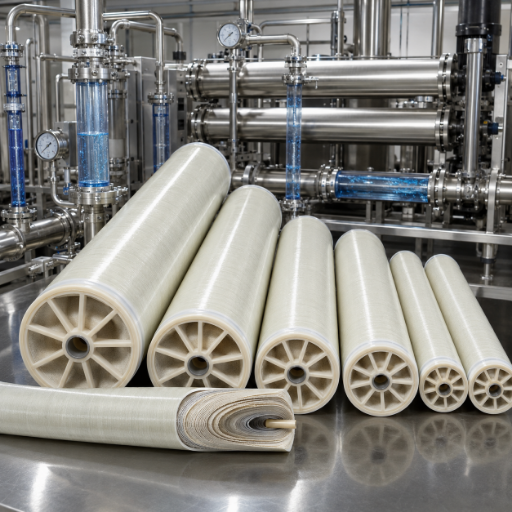
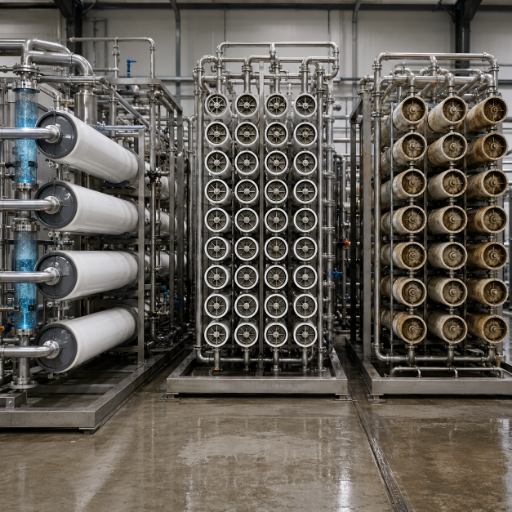
Blue Membrane AR-NF — Full Model Line Specifications
SYS.DATA_V1
| Model | Max Flow GPD (m³/d) | MgSO₄ Rejection | Feed Spacer | Max Pressure |
|---|---|---|---|---|
| N1AR-8040 | 10,000 (37.8) | 96.5–98.5% | 34-mil | 600 psi (4.14 MPa) |
| N2AR-8040 | 10,000 (37.8) | 96.5–98.5% | 34-mil | 600 psi (4.14 MPa) |
| NFAR-4040 (V1) | ~2,500 (9.5) | 96.5–98.5% | 34-mil | 600 psi (4.14 MPa) |
| NFAR-4040 (V2) | ~2,500 (9.5) | 96.5–98.5% | 34-mil | 600 psi (4.14 MPa) |
| NAR-2540 (V1) | ~500 (1.9) | 96.5–98.5% | 34-mil | 600 psi (4.14 MPa) |
| NAR-2540 (V2) | ~500 (1.9) | 96.5–98.5% | 34-mil | 600 psi (4.14 MPa) |
Blue Membrane AR-NF vs. Vontron Alkalistab vs. Standard NF
SYS.COMPARE_V2
| Parameter | Blue Membrane AR-NF | Vontron Alkalistab NF | Standard NF (PA TFC) |
|---|---|---|---|
| pH Continuous | 2–13 | 5–14 | 4–9 |
| pH Cleaning (CIP) | 2–14 | Not stated | 1–12 (limited) |
| 8040 Max Flow | 10,000 GPD (37.8 m³/d) | 3,600 GPD (13.6 m³/d) | ~6,000 GPD |
| MgSO₄ Rejection | 96.5–98.5% | 97% (stable) | 97–99% |
| Feed Spacer | 34-mil (fouling-resistant) | Customizable | 28–34 mil |
| Max Pressure | 600 psi (4.14 MPa) | Not disclosed | 150–600 psi |
| Test pH Disclosed? | Yes — pH 12–12.5 | No | pH 7–8 (neutral) |
| Acid Side (pH <5) | Yes (pH 2 minimum) | No (pH 5 minimum) | No |
| 4040 Max Flow | ~2,500 GPD | 800 GPD | ~1,500 GPD |
TEST CONDITIONS / SPECIFICATIONS
Standardized test conditions (per ISO 25175 / ASTM D4194 methodology): 2,000 ppm MgSO₄ | 100 psi (0.69 MPa) | 25°C | pH 12-12.5 | 15% system recovery. All Blue Membrane AR-NF elements are tested under actual caustic service conditions not neutral pH. Datasheet on request. Element chemistry per CN112755811B (Jiangsu Blue Technology; modified polyamide interfacial polymerization for alkali-stable TFC membranes).
Operating limits (all models): pH 2-13 continuous / pH 2-14 CIP | Max pressure 600 psi (4.14 MPa) | Max temperature 45°C (113°F) | Free chlorine <0.1 ppm | Max SDI 5 | Max pressure drop per element 15 psi (0.1 MPa).
3 Industrial Applications for Alkali-Resistant NF Membranes
Unlike standard polyamide NF elements that fail within 30–90 days at pH >12, AR-NF elements address this challenge at the polymer level, modified interfacial polymerization chemistry maintains divalent rejection through continuous alkaline service. The nanofiltration membrane for water treatment and industrial caustic recovery applications must be rated for the actual process pH, not the neutral test conditions that standard datasheets assume. Three industrial applications represent the highest commercial activity for AR-NF membranes:
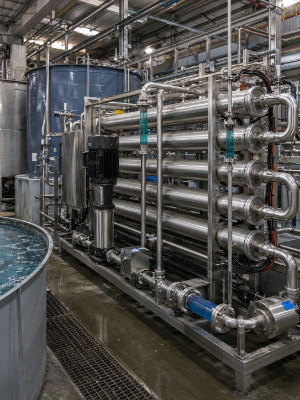
Application 1 — Highest Commercial Activity
Click DetailsCaustic Recovery in Textile Dyeing & Mercerization
Mercerization, a textile process using concentrated NaOH (pH 12-14) for increased sheen and dye uptake, consumes vast amounts of caustic soda discharged as highly alkaline wastewater. AR-NF concentrates the rinse water’s spent NaOH, allowing direct reuse to decrease new caustic purchase and discharge volume.
Why 34-mil: Textile wastewater contains dye particles and fiber fragments that cause fouling. Blue Membrane AR-NF elements with 34-mil open feed spacer have more open channels than 28-mil standard NF elements, which reduce particle bridging and extend cleaning frequency for the severe conditions of a caustic stream.
Commercial application: In 2021, NX Filtration deployed 102 membrane modules in a Jetpur CETP (Gujarat, India) caustic recovery plant, where wastewater from a textile dyeing facility was treated to recover NaOH for use in cellulosic fiber purification. WaterOnline, August 2021
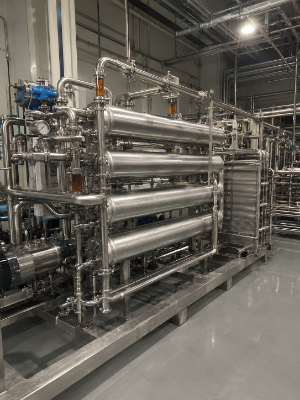
Application 2 — GMP / Regulated Facilities
Click DetailsPharmaceutical & Biotech Facility Wastewater (CIP/SIP)
In GMP-compliant production, the 12–14 pH NaOH used in Clean-In-Place (CIP) cycles eliminates microbials. The typical standard NF membrane employed in CIP return systems can’t tolerate this caustic chemistry, requiring frequent membrane replacement every 60-90 days. This results in the costly disruption of validated system integrity.
AR-NF elements that carry the “pH 2-14 CIP” rating will reject through out multiple full caustic CIP cleaning cycles while maintaining performance. The extended interval maintains continuous documentation support for GMP records and avoids repeated revalidations following membrane replacement. Hot CIP (up to 45°C) used in certain processes is also feasible with AR-NF.
Note: Free chlorine in feed water must be kept to a minimum, preferably below 0.1 ppm. For municipal feeds, a pre-treatment dechlorination step is a standard requirement.
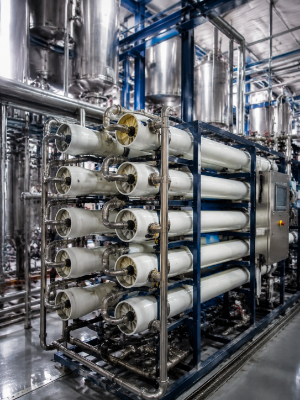
Application 3 — Dual-Extreme Conditions
Click DetailsKraft Pulp Black Liquor & Mining Alkaline Leachate
Named Concept: The Dual-Extreme Operating Window
When a process requires both the 12-13 pH and 40-45°C temperature conditions simultaneously, conventional NF membranes often struggle. Blue Membrane AR-NF elements are designed for this harsh combination – 2-13 pH continuous at up to 45°C.
When a process requires both the 12-13 pH and 40-45°C temperature conditions simultaneously, conventional NF membranes often struggle. Blue Membrane AR-NF elements are designed for this harsh combination – 2-13 pH continuous at up to 45°C.
Kraft pulp black liquor is a very harsh application for NF systems operating between pH 12-13 and 40-80°C. The AR-NF thin film composite membrane has sufficient alkali resistance, although upstream heat exchangers are necessary to reduce feed temperatures entering the system to 45°C.
AR-NF elements also perform well for the concentration of alkaline mine leachates (pH 9-13) to recover dissolved metals while withstanding the alkaline conditions that degrade the active thin-film layer of standard membranes.
TCO Advantage Card — Silver Level / Membrane-Based Caustic Recovery: Operational Economics
Up to 85%Caustic recovery rate with NF membrane technology
Up to 90%Water reuse reduction in caustic wastewater treatment
2.6–4.2 yrTypical payback for membrane-based treatment upgrades in pharma/food sectors
Estimated based on averages across peer-reviewed membrane studies. Actual results vary with feed characteristics, facility scale, and local caustic pricing. Send your water analysis for a site-specific ROI calculation.
Do you’ve a high pH caustic waste stream? Let’s help you identify the right membrane solution.
Submit Wastewater AnalysisNF vs. AR-NF vs. Acid-Resistant NF vs. RO, The pH × Pressure Decision Matrix
The challenge when specifying membrane technology for high-pH service is the trade-off between operating cost and rejection selectivity, a problem that standard NF procurement frameworks don’t address.
Unlike RO, which provides >99% TDS rejection at 150–800 psi, AR-NF delivers selective divalent rejection at 50–600 psi while allowing monovalent pass-through, at lower energy cost (150–800 psi for RO vs. 50–600 psi for NF).
Because the trade-off between NF selectivity and RO total rejection drives procurement decisions for every caustic recovery and textile wastewater project, Blue Membrane provides engineering support to size the right technology for the right process stream. The decision matrix below maps the four primary membrane options against the parameters that determine suitability for extreme-pH service:
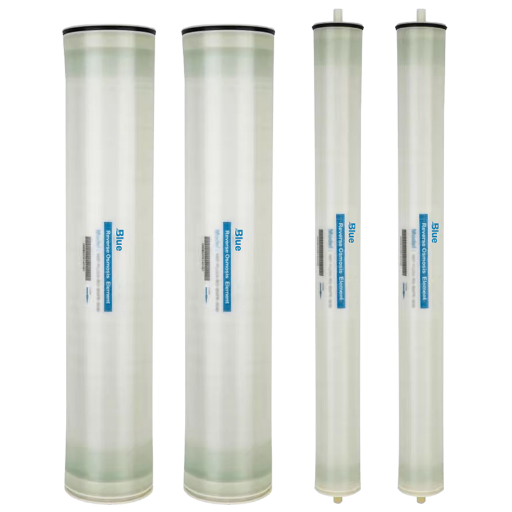
The pH × Pressure Decision Matrix — Selecting the Right Membrane for Alkaline Separation
SPECIFICATION.MATRIX_V3
| Factor | Standard NF | AR-NF (Blue Membrane) | Acid-Resistant NF | Reverse Osmosis |
|---|---|---|---|---|
| Operating pH Range | 4–9 | 2–13 (CIP: 2–14) | 2–8 | 3–10 (limited CIP) |
| Divalent Rejection | 97–99% | 96.5–98.5% | 95–98% | >99% |
| Operating Pressure | 50–150 psi | 50–600 psi | 50–150 psi | 150–800 psi |
| Monovalent (NaCl) Pass | Partial (60–80%) | Partial (60–80%) | Partial | Minimal (<5%) |
| Caustic CIP (pH 13–14) | ✗ No | ✓ Yes (rated pH 14) | ✗ No | ✗ Limited |
| Acid CIP (pH 2) | ✗ No | ✓ Yes (rated pH 2) | ✓ Yes | ✗ Limited |
| Energy Cost | Low | Low-Medium | Low | High |
| Best For | Clean water, dairy, soft water | Caustic streams, textile, pharma CIP, mining | Acid mine drainage (pH 2–5) | Maximum TDS removal, seawater |
DIRECT ANSWER: NF VS. RO
Nanofiltration filters out divalent ions like Ca, Mg, and SO, but lets monovalent salts like NaCl and KCl pass through in part, typically running at 50 to 150 psi. Reverse osmosis filters out more than 99% of the dissolved solids in feed water, including all monovalent salts, but needs a pressure range of 150 to 800 psi. Operating costs for nanofiltration are lower than for RO and the membrane preserves its selectivity for divalent specific separation. You’d select NF when removing divalent ions is key to your process or for recovering caustic solutions, but you’d choose RO if minimizing TDS is the priority, regardless of energy costs.
TECHNICAL NOTE
One technical note for alkaline NF applications: research published on ResearchGate documents that NF permeate pH can be higher than feed pH in bicarbonate-containing streams. As sodium (monovalent) passes through the NF membrane, bicarbonate ions follow to maintain charge balance, which can raise permeate pH above feed pH. Process engineers designing alkaline NF systems should account for this in downstream neutralization steps.
SYS.ENGINEERING_SUPPORT
Confused about which membrane technology works best with your project’s target pH and flow rate?
Consult Engineering Team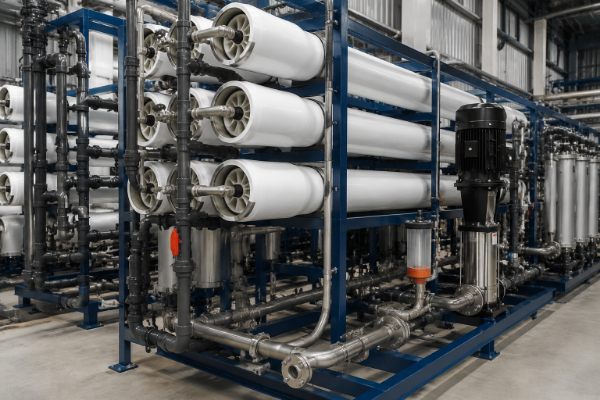
AR-NF Element Sizing and System Design Considerations
The challenge with sizing AR-NF systems for alkaline service: unlike standard NF or RO sizing tools calibrated for neutral pH, AR-NF operating parameters at high pH require adjustment because elevated OH⁻ concentration affects osmotic pressure and fouling rate simultaneously. The mistake engineers make is applying unmodified NF system design software to alkaline-stream projects without correcting for pH-dependent flux behavior, the result is undersized systems that fail to meet target recovery at operating pH. Blue Membrane delivers application engineering guidance for system sizing, CIP frequency estimation, and array staging based on specific feed composition and recovery target.
Element Size Selection
AR-NF Element Size Guide — Matching Scale to Application
| Format | Max Flow | Typical Use Case & Vessels |
|---|---|---|
| 8040 (N1AR, N2AR) | 10,000 GPD | Full-scale industrial; caustic recovery; standard 300 psi vessels |
| 4040 (NFAR) | ~2,500 GPD | Pilot systems; process validation; 4-inch vessels |
| 4021 | — | Compact skid systems; 4-inch short-format vessels |
| 2540 (NAR) | ~500 GPD | Lab-scale; feed water qualification; 2.5-inch test vessels |
The 34-mil Advantage
Named Concept34-mil Advantage: Open Channel, Fewer Fouling Shutdowns
The fixed 34-mil feed spacer in all Blue Membrane AR-NF elements is 6 mils larger than the typical 28-mil space found on standard NF elements. For tough industrial applications where feed water contains colloidal organics, suspended particles, and leftover surfactants from textile operations, a wider space create a more open flow path. The narrow points in a feed channel are where particle buildup starts first, and 6 mils more room between membranes can extend cleaning cycles substantially.
Pre-Treatment Requirements
- SDI (Silt Density Index): ≤5 (Pre-treatment via sand filtration or MF/UF recommended for turbid industrial streams; see EPA Membrane Filtration Guidance).
- Free chlorine: Less than 0.1 ppm. Dechlorination is required when treating municipally treated water; typically achieved with GAC or sodium bisulfite dosing.
- pH adjustment: In most caustic service applications, feed pH falls within the AR-NF 2–13 operating range and no adjustment is needed before the membrane stage.
- Temperature: Feed temperature should be no higher than 45°C (113°F). Note: Each 1°C below 25°C (77°F) will reduce permeate flux by roughly 3%. Plan for colder climates accordingly.
Staging & Array Design
For system recoveries above 50%, a 2-stage array (2:1 element ratio) is standard. Each element accepts a maximum transmembrane pressure of 600 psi (4.14 MPa) and a maximum pressure differential per element of 15 psi (0.1 MPa).
For high-recovery caustic concentration service, consult with Blue Membrane application engineering to specify array staging, interstage boosting, and CIP frequency based on feed TDS and target concentration factor.
Unsure of which element size or staging you need for your application?
Why Blue Membrane for Alkali-Resistant NF? Specialized Manufacturing, Transparent Data
SYS.FACILITY_OVERVIEW
Jiangsu Blue Technology Co., Ltd. is located in Nantong, Jiangsu Province, China, one of the well-known specialty membrane manufacturing hubs in eastern China. The Blue Membrane product line is centered on alkali and acid resistant spiral wound NF elements, with dedicated production lines for AR-NF membrane chemistry. To prevent cross-contamination during the complex casting and curing process for AR-NF membranes’ alkali-resistant active layer, the AR-NF and standard polyamide membrane products are made in separate facilities.
Why Transparent Test Conditions Matter for Procurement
The honest comparison: most NF membrane datasheets publish rejection data at neutral pH 7–8, where rejection is highest and the element look best on paper. Blue Membrane tests AR-NF elements at pH 12–12.5 — the actual conditions in caustic service, and publishes that number instead. For each nanofiltration membrane manufacturer USA procurement teams and international buyers evaluate, test pH transparency is the first qualification criterion that separates suppliers who can support alkaline applications from those who can’t.
Blue Membrane AR-NF elements are tested at pH 12–12.5, 2,000 ppm MgSO₄, 100 psi, 25°C, the same conditions present in caustic service. That is the number you should compare against, and it is the number we publish.
DOC.ISO9001_CRITERIA
Per guidance from ISO 9001 membrane supplier qualification frameworks and membrane industry best practice, key criteria for evaluating a nanofiltration membrane manufacturer include: standardized test conditions (2,000 ppm MgSO₄, defined pH and pressure), documented rejection and flow data per model, and disclosed operating limits including CIP pH range. Blue Membrane publishes all four on its product datasheet.
| Supplier Qualification Criterion | Blue Membrane AR-NF | Vontron Alkalistab | Standard NF Suppliers |
|---|---|---|---|
| Test pH disclosed in datasheet? | ✓ Yes — pH 12–12.5 | ✗ Not disclosed | ✗ pH 7–8 only |
| Full model line with specs? | ✓ 8040, 4040, 4021, 2540 | ✓ 8040, 4040, 2540 | ✓ Various |
| CIP pH rating stated? | ✓ pH 2–14 | ✗ Not stated | ✗ Limited |
| Acid side (pH <5) rated? | ✓ pH 2 continuous | ✗ pH 5 minimum | ✗ No |
| OEM / custom configurations? | ✓ Available on inquiry | ✗ Not stated | Varies |
Engineering & Sizing Tools
Access our technical resources to determine precise element sizing, verify pH compatibility, and calculate operational cost savings for your specific industrial application.
TOOL 01
AR-NF Element Sizing Calculator
Calculate precise array staging, CIP frequency, and target recovery for severe alkaline service conditions.
TOOL 02pH × Membrane Technology Selection Guide
Match feed stream pH and temperature profiles against standard and AR-NF membrane operating windows.
TOOL 03Caustic Recovery ROI Calculator
Evaluate caustic recovery rates, water reuse reduction, and estimated payback periods for facility upgrades.
Request AR-NF Datasheet, Pricing & Technical Support
The initial step involve a technical discussion with a Blue Membrane application engineer to understand your process stream details, including pH range, flow requirements, target rejection, and CIP protocols. Our engineers will respond within 24 hours to facilitate system sizing and provide further guidance.
Technical Support
Frequently Asked Questions, Alkali-Resistant Nanofiltration Membranes
What is the maximum pH for AR-NF membrane continuous operation?
Blue Membrane AR-NF elements are rated for pH 2–13 continuous operation and pH 2–14 for chemical cleaning (CIP). This exceeds standard polyamide NF membranes, which are typically rated pH 4–9. The pH 14 CIP rating accommodates full-concentration NaOH cleaning without element damage.
What MgSO₄ rejection does AR-NF achieve at pH 12?
In standard testing at pH 12-12.5, 2,000 ppm MgSO₄, 100 psi, 25°C, and 15% system recovery, Blue Membrane AR-NF elements demonstrate 96.5-98.5% MgSO₄ rejection. Importantly, tests are conducted under simulated actual caustic service conditions – not neutral pH – delivering relevant performance data for alkaline process design.
How does AR-NF compare to standard NF membranes in caustic service?
Standard polyamide TFC nanofiltration membranes begin to degrade at elevated pH levels above 10, showing a significant loss of rejection and an increase in flux within 30-90 days at pH 12-13. In contrast, AR-NF maintains consistent rejection throughout the 2-13 pH range, attributed to a modified interfacial polymerization chemistry that effectively resists base-catalyzed amide bond hydrolysis.
What is the maximum flow rate for the 8040 AR-NF element?
The Blue Membrane 8040 AR-NF element, available in models N1AR-8040 and N2AR-8040, provides a maximum permeate flow of 10,000 GPD (37.8 m³/d), which is 2.78 times greater than that of the Vontron Alkalistab NF-8040 (3,600 GPD / 13.6 m³/d). Increased permeate per element reduces pressure vessel count and overall system footprint for equivalent production volumes.
What pretreatment is required before AR-NF elements?
Required feed water characteristics for Blue Membrane AR-NF elements include SDI ≤5 (consider sand filter or UF prefiltration for high turbidity), free chlorine <0.1 ppm (dechlorinate with GAC or sodium bisulfite), and a temperature of up to 45°C (113°F). pH adjustment is usually unnecessary for applications within the continuous 2-13 range during caustic service.
Are custom configurations or OEM supply available?
Yes, Blue Membrane offers a wide range of element sizes, including standard 8040, 4040, 4021, and 2540, and welcomes OEM and custom configuration inquiries. Contact sales@bluemembrane.com or call +86 150 1356 6276 to discuss your application requirements and minimum order quantity (MOQ).
Can AR-NF membranes handle dye wastewater from textile operations?
Yes. AR-NF elements are a preferred solution for textile dyeing wastewater applications where the high pH (10-13), presence of suspended dye particles, and requirement for caustic recovery necessitate performance beyond standard NF membranes. The 34-mil open feed spacer design offers improved fouling resistance for high TDS dye liquor streams compared to 28-mil standard elements. To confirm AR-NF compatibility, please submit a detailed analysis of your wastewater.
What is the nanofiltration membrane price for AR-NF elements?
Nanofiltration membrane pricing varies based on element size, configuration, and order volume. Blue Membrane AR-NF 8040 elements are priced competitively with other international NF suppliers, with special volume discounts available for EPC and OEM projects. To receive a formal quote within 24 hours, please provide your project specifications to sales@bluemembrane.com.
Trending now