Get in touch with Blue Membrane Company

Seawater RO Membrane Elements · H1 / H2 Series
Seawater RO Membrane Elements
Seawater RO Membrane Elements That Cross-Reference to DuPont, Hydranautics & Toray, Verified Spec-for-Spec
Manufacturer-direct SWRO elements engineered to drop into your existing 8″ pressure vessels – with published rejection and flow specs you can hold us to on your own feed water.
99.8%
Stable salt rejection (H1 Series)
9,000 GPD
Peak permeate flow (MB-H2-8040)
1,200 psi
Max operating pressure
4
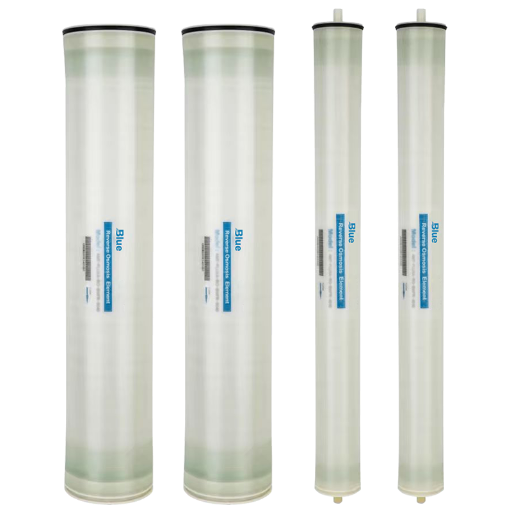
Sizes: 8040 / 4040 / 4021 / 2540
SDI₁₅ ≤ 5
Feed fouling tolerance
OEM
Private-label & custom sizing
The Real Cost of the Wrong Seawater RO Membrane Isn’t the Purchase Price
A seawater ro membrane – the seawater reverse osmosis membrane element at the heart of any seawater desalination system – is the pressure-driven barrier that separates potable permeate from a feed carrying 32,000+ ppm of total dissolved solids. Its salt rejection, permeate flow and fouling behavior decide your energy bill and your compliance margin for years.
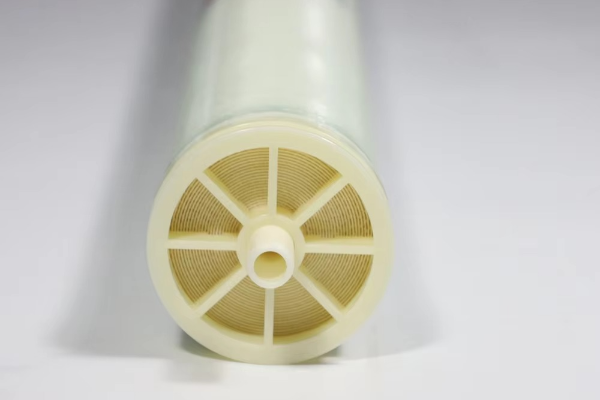
Product View
01
Boron pain
sea water averages 4.5 mg/L boron, and a single reverse osmosis pass removes only 65-85% of it – leaving 0.9-1.8 mg/L against the WHO guideline of 2.4 mg/L.
02
Energy pain
seawater reverse osmosis overcomes feed osmotic pressure at high pressure of 55-75 bar, so specific energy consumption runs 4-5 kWh/m³ – dropping below 2 kWh/m³ only with energy recovery.
03
Trust pain
“same-spec” seawater desalination membranes are quoted anywhere from $340 to $740 per element – buyers openly admit they don’t know who to believe.
Buyers rarely fail on the headline spec – they fail on the gap between the datasheet and the field, and on matching the reverse osmosis membrane to their feed water quality. This page answers each failure with a specific artifact: a verified cross-reference matrix, a two-series membrane selection framework, and a field test you run on a sample before you commit.
Where this element sits in our line
Blue Membrane builds spiral-wound elements across seawater ro, brackish water RO, nanofiltration and ultrafiltration. This page covers the seawater desalination membrane line – the H1 and H2 series – sold manufacturer-direct to system integrators, OEM partners and distributors worldwide.
The 2-Series Selection Framework:
Max-Rejection (H1) vs Energy-Saving (H2)
Here’s the assumption that costs plants money: buy the highest salt rejection you can afford. Field data contradicts it.
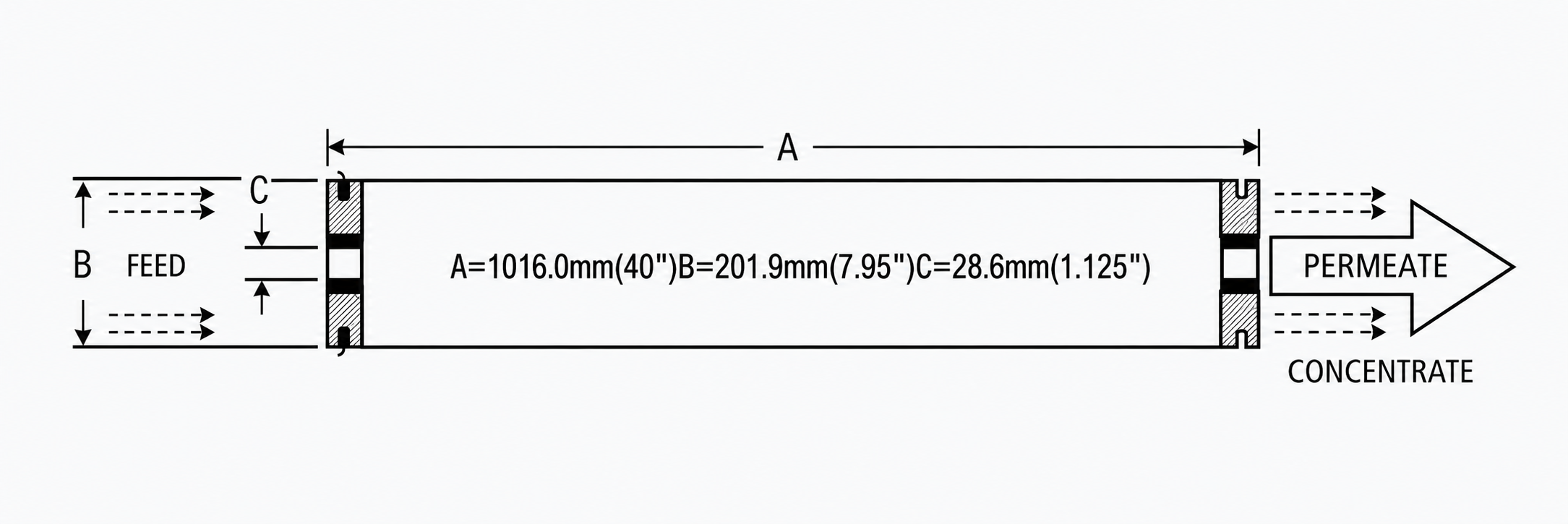
H1 Series, Maximum Salt Rejection
H1 targets the highest-salinity, tightest-permeate duty at 99.8% stable and 99.7% minimum salt rejection. Choose it when a single pass must hit a hard total dissolved solids or boron target and you’d trade energy for compliance headroom.
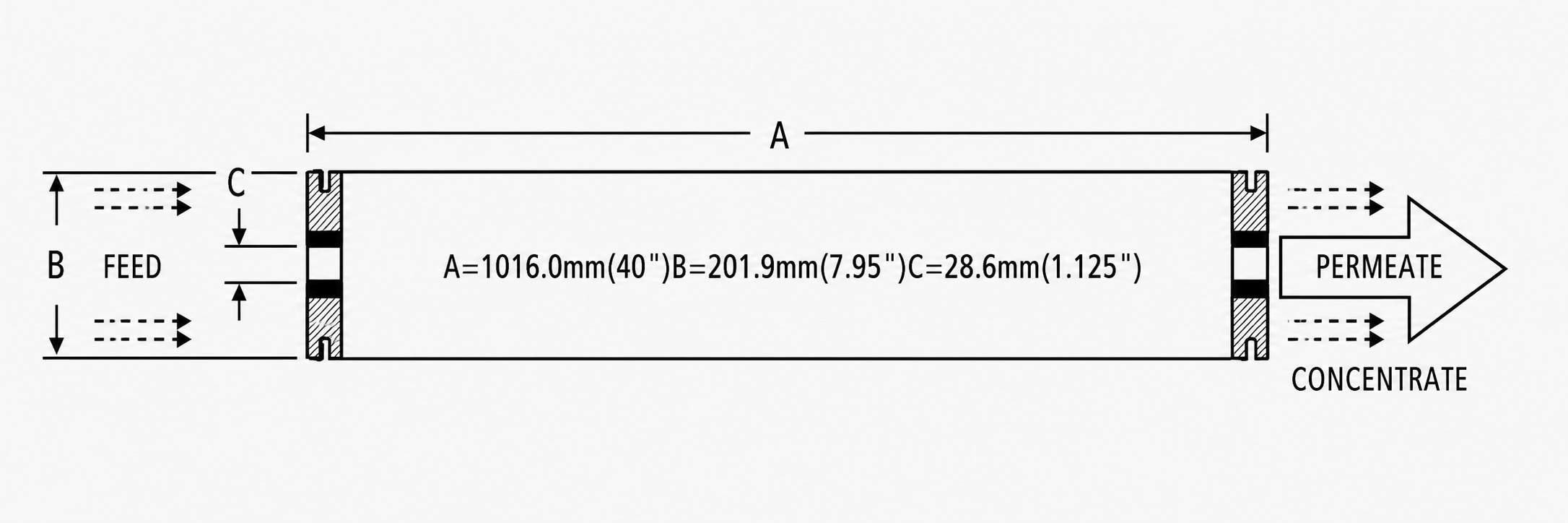
H2 Series, Energy-Efficient High Flow
H2 offers 20% higher permeate flow than H1 with 99.7% stable rejection – an element ideal for high productivity and low-energy performance on cooler and lower salinity feeds. H1 and H2 contain one TFC membrane chemistry, offering you consistent and predictable performance as you build out the size of your system.
why “higher rejection” is not a default
Across published SWRO test data, a top-rejection element and an ultra-high-flow element can differ by only 0.03 percentage points of rejection while the higher-flow element runs 5 bar lower pressure. A lower-rejection, higher-flow membrane produces permeate with higher salinity but at meaningfully lower operating pressure.
On low-temperature or lower-salinity feeds, that trade favors the energy-saving element; on feeds where high rejection deletes an entire second pass for boron or TDS, the high-rejection element becomes the lowest total capital cost. Neither extreme is universally right – which is why we split the line into two purpose-built series rather than selling one “best” element.
The six models have a common operating window, so the choice of membrane is duty not surprise:
- max 1,200 psi (8.28 MPa)
- max 45C
- SDI of feed 5
- feed with <0.1 ppm of free chlorine
- pH continuous between 3-10 (2-11 during cleaning)
- feed spacer thickness 34-mil
reading rejection specs across brands
The rejection number on any datasheet is a test-condition-created measurement that varies directly with the rate of flux at which the test is conducted (most common condition: 800 psi, 8-10% recovery, 25C). Do not blindly compare head-line-numbered data on different brands-always compare them at equal test conditions, and then verify on your feed.
the mistake that strands capital
Many will mistakenly treat salt rejection as a 1-axis, buying more than they need, at considerable expense. Since the energy base load is established by the osmotic pressure and not by the membrane, the honest version is that rejection versus energy is a trade-off: the Blue Membrane team will size your series on your feed – not on a cover title.
Unlike a single-line spec sheet this is not always a “pick the highest number” call, since the trade-off flips, – in reality a 25C feed at 32,000ppm can sometimes run less costly in production on the H2 than H1 element.
Get Instant QuoteFeed Water Quality & Operating Envelope, What Actually Protects the Element
What costs the most on a replacement membrane isn’t the membrane – it’s the pretreatment required to feed any reverse osmosis membrane. Fouling, not geography, wears out any of these systems and it’s the quality of the feed water that helps prevent premature membrane wear and tear and extend the desalination membrane materials to their rated service life.
Unlike systems that can market themselves on the basis of permeate flow alone, we put the operating envelope first.
Element Overview
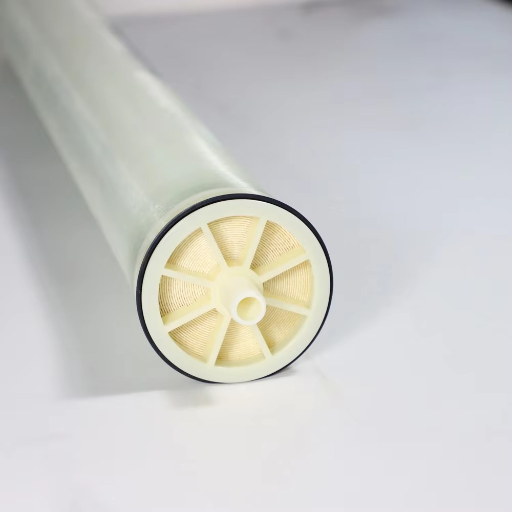
Buyer Advisory
Buyer Advisory, sizing to feed, not to catalog
One plant recorded production yields dropped 30% before the culprit was discovered to be element sizing and quality against actual feed water. Given pretreatment and TFC membrane materials – not the badge – are what determines lifetime, Blue Membrane engineers check your water before you order a vessel full.
Brackish water, high-salinity seawater and reuse feeds each require different element characteristics; a bigger element is not always the safer one.
For brackish or high-fouling industrial feedwater, Blue Membrane also builds fouling-resistant RO elements; for drinking-water and low-pressure point-of-use systems, see our residential RO membrane elements.
Unsure your feed is in-spec?
Send feed water analysis for check →
Feed Conditioning Matrix
Feed conditioning checklist (best practices)
Chemistry cross-check
Seawater feed carries sodium chloride, barium, and other dissolved salts, so cartridge filters and membrane filtration protect membranes and hold system performance.
Solids
Feed SDI 5 (target <3) on cartridges ahead of feed pumps, seawater carries dissolved salts that can cause scaling and fouling.
Temperature & pressure
SWRO operate at high pressure of 55-70 bar; permeation flux increases as the feed temperature gets warmer.
Chemistry
Free chlorine <0.1ppm ensures to protect TFC membrane chemistry; Maintain ongoing pH of 3-10; Cleaning pH range is 2-11.
Hydraulics
Maintain element pressure drop below 15 psi; set frequency and flushing times to a normalized flow.
Design Data
SYSTEM DESIGN RECOVERY
Single pass seawater recovery has a hard cap near 50% as dictated by the osmotic pressure of the concentrate. System design dictates what share of that available 50% of concentrate capacity your seawater reverse osmosis utilizes. Connect your seawater reverse osmosis system to feed, each individual high-performance seawater reverse osmosis has only one job – to throw off the salts, reject other dissolved minerals using spiral wound seawater reverse osmosis membranes and send your pure water through for decades.
The SWRO Cross-Reference Matrix, Blue Membrane vs DuPont, Hydranautics & Toray
Customers already know to translate membrane part numbers-“SW30-2540″ means seawater, 2.5″40”-then they go shopping from manufacturer to manufacturer for their favorite seawater ro membrane elements. What’s invisible in that process is the gap: the exact same element may have been tested under very different conditions, so using the wrong element swap results in product rejection in the field.
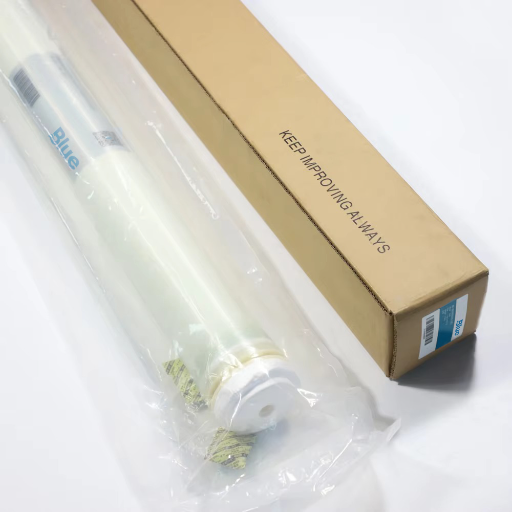
| Blue Membrane | Flow / Rejection / Area | Comparable name-brand element (published spec) |
|---|---|---|
| MB-H1-8040 | 7,500 GPD · 99.8% · 400 ft² | DuPont SW30HRLE-400 (7,500 GPD · 99.8% · 400 ft²) · Toray TM820M-400 (7,000 GPD · 99.8%) |
| MB-H2-8040 | 9,000 GPD · 99.7% · 400 ft² | Hydranautics SWC5-LD (9,000 GPD · 99.8% · 400 ft²) · Toray TM820V-400 (9,000 GPD · 99.80%) |
| MB-H1-4040 | 1,600 GPD · 99.8% · 85 ft² | DuPont SW30HRLE-4040 (1,600 GPD, 4″×40″ seawater element) |
| MB-H2-4040 | 1,900 GPD · 99.7% · 85 ft² | Higher-flow 4″×40″ seawater class |
| MB-H1-2540 | 500 GPD · 99.8% · 26.4 ft² | DuPont SW30-2540 marine class (2.5″×40″) |
| MB-H2-2540 | 600 GPD · 99.7% · 26.4 ft² | High-flow 2.5″×40″ watermaker class |
Every competitor spec below was copied from the seawater ro membrane manufacturers’ own data sheets. Check the footnote below first: test conditions across manufacturers vary widely so this chart only compares specification and dimensions. It’s not an attempt to say all these elements will perform equally in your system.
| Name-brand element | Permeate | Stable rejection | Area | Boron rej. | Source |
|---|---|---|---|---|---|
| DuPont SW30HRLE-400 | 7,500 GPD | 99.8% (min 99.65%) | 400 ft² | 92% | dupont.com PDS |
| DuPont SW30HR-380 | 6,000 GPD | 99.70% | 380 ft² | 92% | Applied Membranes |
| DuPont SW30ULE-400i | 11,000 GPD | 99.70% | 400 ft² | 87% | Applied Membranes |
| Hydranautics SWC5-LD | 9,000 GPD | 99.8% | 400 ft² | n/p | membranes.com |
| Hydranautics SWC5 MAX | 9,900 GPD | 99.8% (min 99.7%) | 440 ft² | n/p | membranes.com |
| Toray TM820V-400 | 9,000 GPD | 99.80% (min 99.5%) | 400 ft² | 92% | water.toray |
| Toray TM820M-400 | 7,000 GPD | 99.8% (min 99.5%) | 400 ft² | 95% | Toray PDS (Pure Aqua) |
Footnote: DuPont and Toray use an 8% recovery test while Hydranautics uses a 10% recovery rate. “n/p” indicates the boron rejection is not reported on the element’s data sheet. Any part number that has no available datasheet is not included in this list, and has not been estimated.
Notice
Buyer Advisory, how to trust this matrix
Since test conditions are so different among brands, at Blue Membrane we publish the exact same data sheet on which every row was based so an OEM integrator can compare with their system’s specific feed conditions. We post the percent recovery and the 800 psi test pressure where the 99.8% figure was measured, unlike the typical reseller selling a generic FilmTec seawater membrane replacement with nothing to support performance.
Seawater Membrane 5-Year TCO Model, Where the Name-Brand Premium Actually Goes
It is an open secret among purchasing agents that the identical membrane element is regularly marked up 2 to 3 times once a product is shipped with an OEM’s brand logo on it. In one documented case, a boat owner was shown a $565 branded membrane element which was available for $165 as the identical item from a distributor.
For a top-end element like a brand-name SW30HRLE-400 at the 8-inch class, list price per element runs several hundred dollars on $1,050-$1,135, while direct-from-manufacturer 8040 element pricing can range from $166 to $350 when bought at volume. Similar pricing exists at other element sizes; the same manufacturer-direct seawater ro membrane price holds at smaller sizes, where a SW30-2540 membrane price runs $253-$495 and a 4040 ro membrane price sits near $418-the same wholesale markup structure. The reality is very simple: there is an enormous and provable gap in acquisition price between OEM branded elements and those purchased directly from the element manufacturer, and this represents just one element in the total cost of ownership calculation.
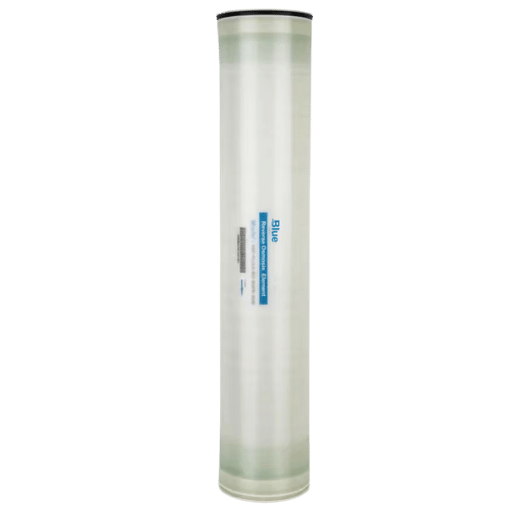
ACQUISITION GAP
$1,050–1,135 → $166–350
Per-element acquisition cost, name-brand 8040 vs manufacturer-direct 8040 — the same physics, without the channel markup.
Source: GracoRoberts / dupont.com distributor listings; Alibaba / Made-in-China manufacturer-direct quotes (2026). Energy & cleaning lines below are industry-typical, not element-specific measurements.
“We want buyers to understand and to test our new-element baselines directly because their actual financial risk is in how well those baselines hold up in production for the next few years-not in the upfront acquisition price. Judge us by what our element delivers in water, not by the brochure you receive from another vendor.”
What the TCO Model Actually Contains
Acquisition
Eliminate OEM markups through direct sourcing; these represent the largest, most easily provable cost saving in the entire element lifecycle.
Operating Cost
Overall, energy use averages 4-5 kWh per m³ for an RO system, but winning or losing here comes from matching element types (H1 vs. H2) with the system’s specific operating temperature and water salinity-not from a lower upfront element cost.
Membrane Life
The element’s life expectancy averages over three years, but failure is a performance issue rather than based on a specific operating timeline.
Lifecycle
Reverse osmosis membrane replacement is planned by lifecycle cost and total cost of ownership, and a high-performance membrane matched to your water quality requirements keeps SWRO systems and the wider membrane system at rated system performance.
The 3-Band Feedwater-to-Element Sizing Ladder
The number one reason elements fail in the field is not a bad membrane, but the right membrane for the wrong size, relative to the system’s capacity band. Sizing is a design choice and mistakenly buying based on diameter instead of feed rate is common, so we at Blue Membrane size elements by diameter to fit system capacity band, whether they’re going into small SWRO systems, large-scale seawater reverse osmosis systems, or industrial water treatment.
Where the industry is heading
Element level reverse osmosis technology is coalescing around the two trends we track: a bio-fouling-resistant surface (crosslinked PVP hydrogel, U.S. Patent 11,278,847 B2) and reduced differential pressure (81% reduction over typical two-layer feed spacers, U.S. Patent 11,484,841 B2). These are general trends in RO desalination and not proprietary product features; they inform the trajectory of our seawater desalination membrane design.
Real deployments anchor the top of the ladder across desalination plants worldwide – from a 20,000 m³/d mobile potable water supply for a municipality to an 8,000 m³/d seawater reverse osmosis permeate feed at 60% recovery from an oil refinery, sent to a second pass for boiler-quality water. This same H1/H2 membrane technology, designed for marine applications and large-scale desalination alike, scales from a 500 GPD 2540 sea-based desalinator up to the 8-inch seawater systems that run modern desalination applications.
01
Capacity Band
Marine / small
Typical Output
5–20 m³/day
Element Size
2540
Deployment: Watermakers for cruise ships & yachts, shipboard applications, land-and-sea based desalinators (TDS up to 42,000 ppm)
02
Capacity Band
Commercial / mid
Typical Output
50–600 m³/day
Element Size
4040
Deployment: Island water for resorts & hotels, land-based skids, containerized 20ft/40ft ISO units (75–240 m³/day)
03
Capacity Band
Large ind. / municipal
Typical Output
600–20,000 m³/day
Element Size
8040
Deployment: Multi-vessel arrays, coastal desalination plants, refinery process water & water supply
“Are Chinese RO Membranes Reliable?”
— Turn the Question Into a Test
“Chinese membranes don’t work as well and don’t last as long.” That’s the objection buyers say out loud. Our answer isn’t descriptive adjectives – it’s a specification certificate, standard, and a calculation you can perform yourself.
Per-Batch
Test report + warranty certificate
ISO 9001
QMS — production baseline
ASTM D4194-23
RO/NF device operating-characteristics test
ISO 25175
RO/NF membrane element performance test
NSF/ANSI/CAN 61
Drinking-water components, health effects
Table stakes ISO 9001. This quality level is now the norm across all high-quality membrane manufacturers, East or West; it proves nothing. The true differentiator is lot-level quality control tested against internationally-recognized water quality testing standards and accompanied by a certificate.
Buyer Advisory, the field test that settles it
salt rejection as (1 permeate TDS feed TDS) x 100, not a marketing claim. Check this specification against the baseline test for a new element at your typical operating temperature, and don’t replace a membrane until rejection or normalized flow can no longer be restored to 90-95% of baseline.
Fouling, not a bad membrane, is typically the source of buyer inconsistency. Our decade-long analysis of over 500 elements shows all brands degrade flux and rejection to some degree with fouling. Test the rejection spec of a Blue Membrane membrane before you install it. You’ll lose the sample coupon, not the job.
Seawater RO Element Selection & Engineering Tools
-
01VIEW_DATA ↗
Cross Reference Finder
Cross-reference and map alternative seawater RO membrane element models across major international manufacturers.
-
02SELECT_NODE ↗
H1 vs H2 Series Selector
Evaluate and select the optimal configuration between high-rejection (H1) and high-flux (H2) membrane elements.
-
03CALCULATE ↗
Element Sizing Calculator
Calculate precise structural dimensions and vessel loading capacities for industrial desalination systems.
-
04Open Tool ↗
Salt Rejection Field Test
Verify real-world membrane field performance and salt rejection rates using empirical operational data.
In a wrongly selected seawater ro membrane, the cost isn’t dollar value, but the energy cost and time out-of-service, over years.
Since Blue Membrane engineers back each quote with public benchmarks and actual batch test results, send your element size, series, and feed parameters — or the number from your old membrane — and we will send back within one business day an accepted alternative.
And unlike any other supplier or distributor, we quote you the factory-direct pricing with all of the required ISO 9001 technical documentation and provide a sample element to test against our benchmark.
Are all seawater RO membranes basically the same?
No. Differences include rejection/flow characteristics (high rejection vs. high flow), active area and test methods used to achieve reported rejection. Two elements reported to achieve “99.8% rejection” will have different on-feed behavior since the actual rejection achieved by any element is influenced by test flux -always verify your application’s rejection.
Will Blue Membrane elements drop into my existing DuPont or Hydranautics housings?
Yes for standard sizes (8040, 4040, 2540). Blue Membrane elements are made to standard sizes and maintain the typical 34-mil feed spacer thickness of our competitor’s 8×40, 10×40 and 2×40 membranes. They fit all standard pressure vessels, including 40-foot units, so use our cross-reference chart above for your current model number to identify the optimal match for flow and rejection.
Are Chinese-made RO membranes reliable?
Let performance decide, not country of origin. For the best decision, test one of our membranes in your water and report (feed TDS – product TDS) x 100, then request a batch test report for that specific lot. A 500+ element autopsy report clearly shows that any membrane, regardless of its place of origin, degrades with fouling.
Is higher salt rejection always better?
No. Even when high-rejection membranes can provide a rejection of only 0.03% greater than an ultra-high-flow element, the energy costs will be approximately 5 bars higher. In cooler or less salty feed waters, the energy-efficient H2 membrane offers more economic advantages.
What pressure is required for seawater RO?
seawater ro membranes are typically operated in the range of 55 to 75 bars to compensate for the feed osmotic pressure. Our elements have a maximum operating pressure rating of 1200 psi (8.28 MPa). On a single pass, recovered volume cannot exceed about 50% due to concentrate osmotic pressure.
What is the life expectancy of a seawater RO membrane?
Three or more years under optimal operation conditions with appropriate pretreatment can be expected, the industry standard for membrane lifespan. Replacing a reverse osmosis membrane becomes necessary only when rejection and normalized flow are unable to reach 90-95% of their clean values—not when a calendar date has been reached.
Can you customize sizes and provide OEM/private-label elements?
Yes. In addition to 8040, 4040, 4021 and 2540 elements, we also offer custom size, private-label, and OEM branded membranes throughout our full line of RO, nanofiltration, and ultrafiltration products. Any custom dimensions will be discussed when developing the quote to determine lead time.
How do I get pricing and a cross-reference for my current membrane?
Submit the current model number of your membrane or the flow, rejection, and feed characteristics of your system. We’ll provide a direct-manufacturer’s quote, complete with a cross-reference, and we can supply a sample membrane so you can confirm its performance in your own water.
Get Pricing & Cross-Reference
Trending now