Get in touch with Blue Membrane Company

July 2026 Updated | Reviewed by Blue Membrane tech team
Quick Specs
| Format | 20-ft / 40-ft ISO container or open skid frame |
| Typical capacity | 20-2,500+ m³/day per unit (industry range); Blue Membrane field platforms: 45, 65, and 200 m³/day |
| Operating pressure | 3.5-5.5 MPa (high-salinity duty) |
| Structural standard | ISO 668 (container class) + CSC safety plate |
| Time to first water | Days after delivery (factory-tested), not weeks. |
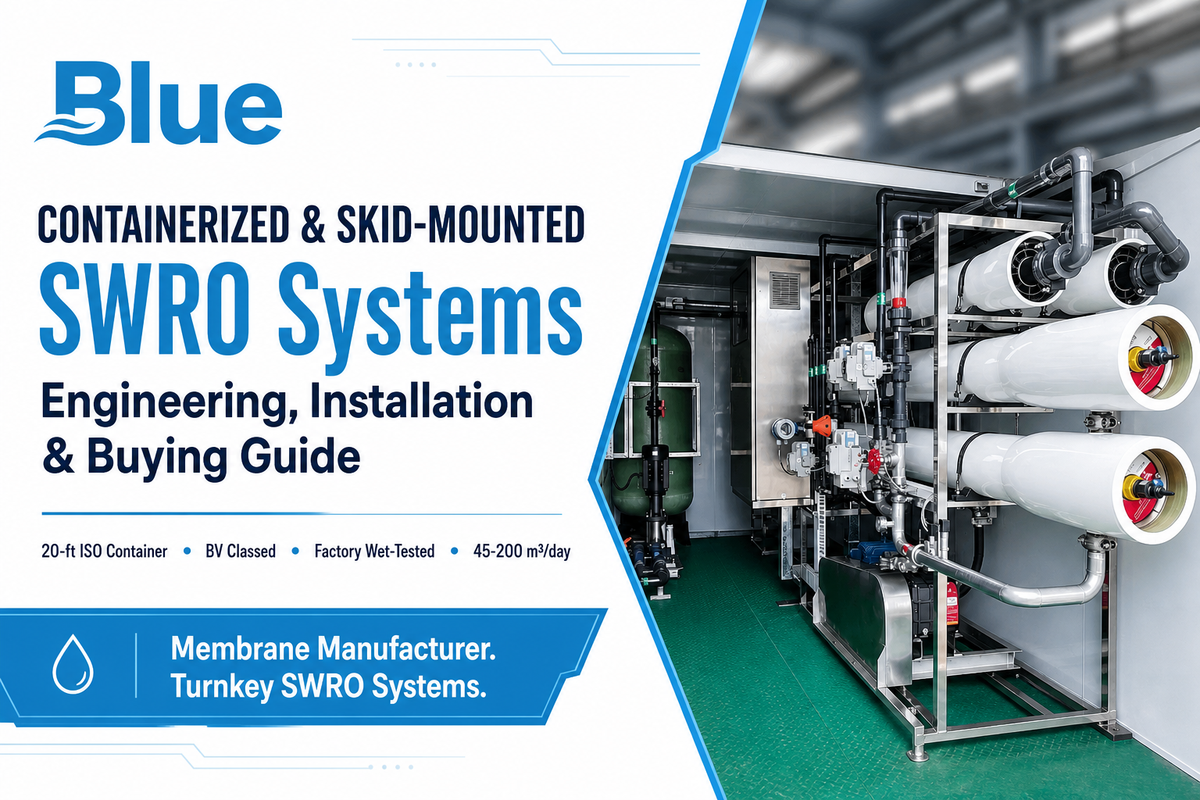
A Containerized & Skid-Mounted SWRO system is a complete, self-contained seawater reverse osmosis desalination system built and wet-tested at a factory and then shipped as a single unit within a steel ISO container or attached to an open skid frame. Such devices exist because of a simple truth: constructing a civil-works water treatment plant or seawater desalination plant on an island, offshore platform, or a disaster site takes far too long, is extremely costly and frequently physically impractical – so the plant is instead built once, correct, in a controlled environment and plugged into service on-site.
Pretreatment components (high-pressure pump, RO membranes) and controls are all built into the same standard 20-foot or 40-foot ISO shipping container. Manufacturer published capacity figures usually range from 20 to over 2,500 m³/day with full operation achieved within days of site delivery compared to the many months a poured concrete plant may require.
In This Guide
- Zero of the three best-performing competitor guides for this topic actually mention ISO 668, CSC safety plates or marine classification – this guide does, as this is exactly what is audited prior to container shipment.
- A cheaper skid setup may prove more expensive than a container when the building it require is taken into account.
- The single largest variable in the total operating cost isn’t container-versus-skid – it’s the power draw of the high-pressure pump.
- US federal intake standards (Clean Water Act 316(b)) only come into play when consumption is in excess of 2 million gallons per day-almost no individual containerized unit meets that criteria, but many grouped together will.
What Is a Containerized or Skid-Mounted Seawater RO (SWRO) Water Treatment System?
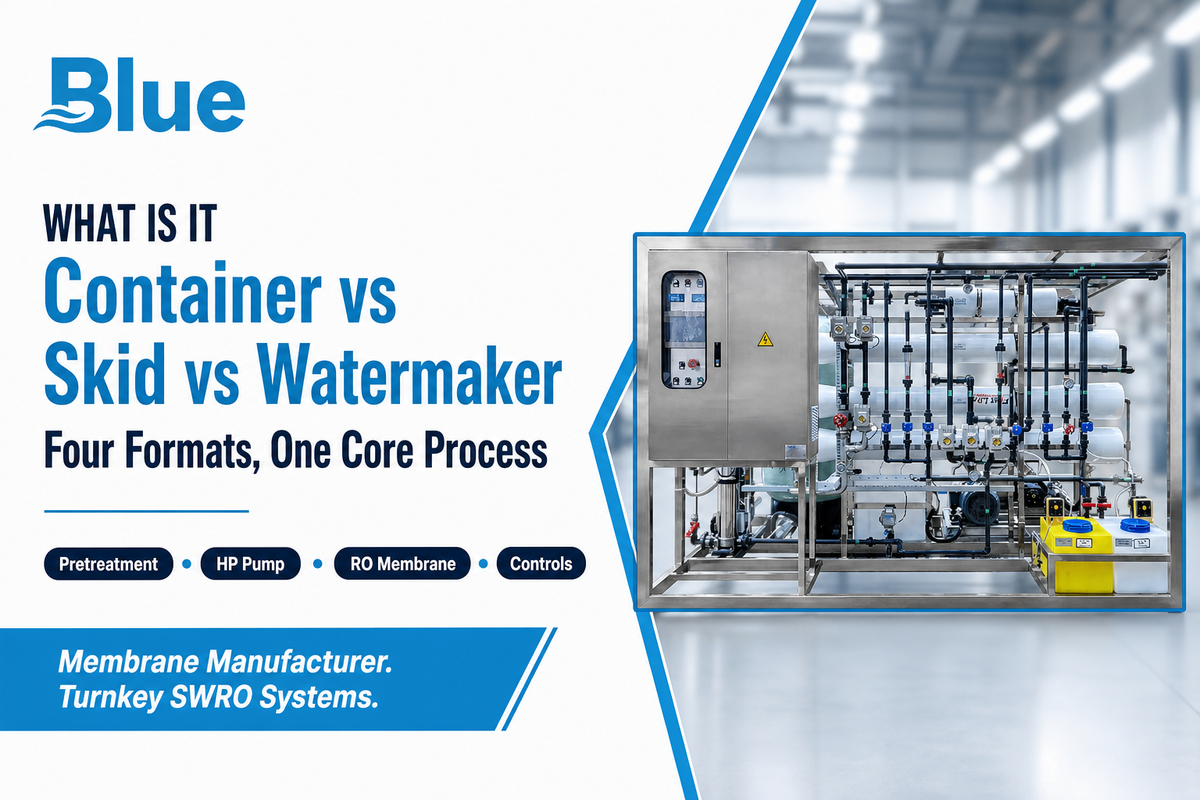
Strip away the brand name and a containerized or skid-mounted SWRO system is merely four water treatment equipment subsystems integrated together: pretreatment (including multimedia, cartridge filtration, sometimes ultrafiltration ahead of them), the high-pressure pump train, the reverse osmosis membrane vessels themselves and the control systems that operate and record the whole operation.
What varies from one “containerized”, “skid-mounted,” “marine watermaker” or “portable” water maker to the next isn’t the operation of the plant-it’s the configuration, the cycle rating and who operates the unit. Each configuration exists to treat water reliably at the salinity and flow the site actually delivers, not to change what the plant fundamentally does.
A skid unit consists of just the bare frame with everything mounted on the base plate and is designed to be installed in a building someone else has already built. A containerized unit is a skid-mounted system dropped inside a weatherproof, climate-controlled ISO shipping container that effectively becomes the plant room. Marine watermakers are a more compact, fully equipped version certified for installation on a ship or other vessel. The portable desalination unit, sometimes marketed simply as portable water treatment, sacrifices some capacity for portability.
A 2021 Chinese utility patent (Tianjin Weinabo Environmental Technology, CN216337073U, active through 2031) articulates the same four-application logic behind containerized seawater desalination plants from the equipment-design perspective: large civil-works plants are “not movable,” so “skid-mounted or container-type seawater desalination devices” are available for “water for islands, water for residents at seasides, water for offshore platforms, water for large ships and naval vessels, emergency water” – nearly verbatim to how manufacturers describe the category outside of specific vendor marketing. We discuss process (membranes, recovery rate, energy recovery, feed-water chemistry) in detail in our seawater RO systems guide, so this piece will focus on format decision.
That confusion is a real gap for first-time buyers, not just a vocabulary problem: a plant rated for the industry-standard 3.5-5.5 MPa operating pressure and shipped inside a standard 20ft or 40ft ISO-classed enclosure is still governed by two separate certification tracks, and treating them as one is the single most common mistake we see in early-stage RFQs. That tension is structural — the container’s ISO classification only proves the box is safe to lift and ship; it says nothing about the pressure vessel or the membrane performance running inside it. Blue Membrane resolves that ambiguity on its own containerized and skid platforms by publishing both certificates side by side instead of folding them into one line item on a spec sheet.
Containerized vs. Skid-Mounted vs. Marine Watermaker vs. Portable, Which Format Fits Your Site?
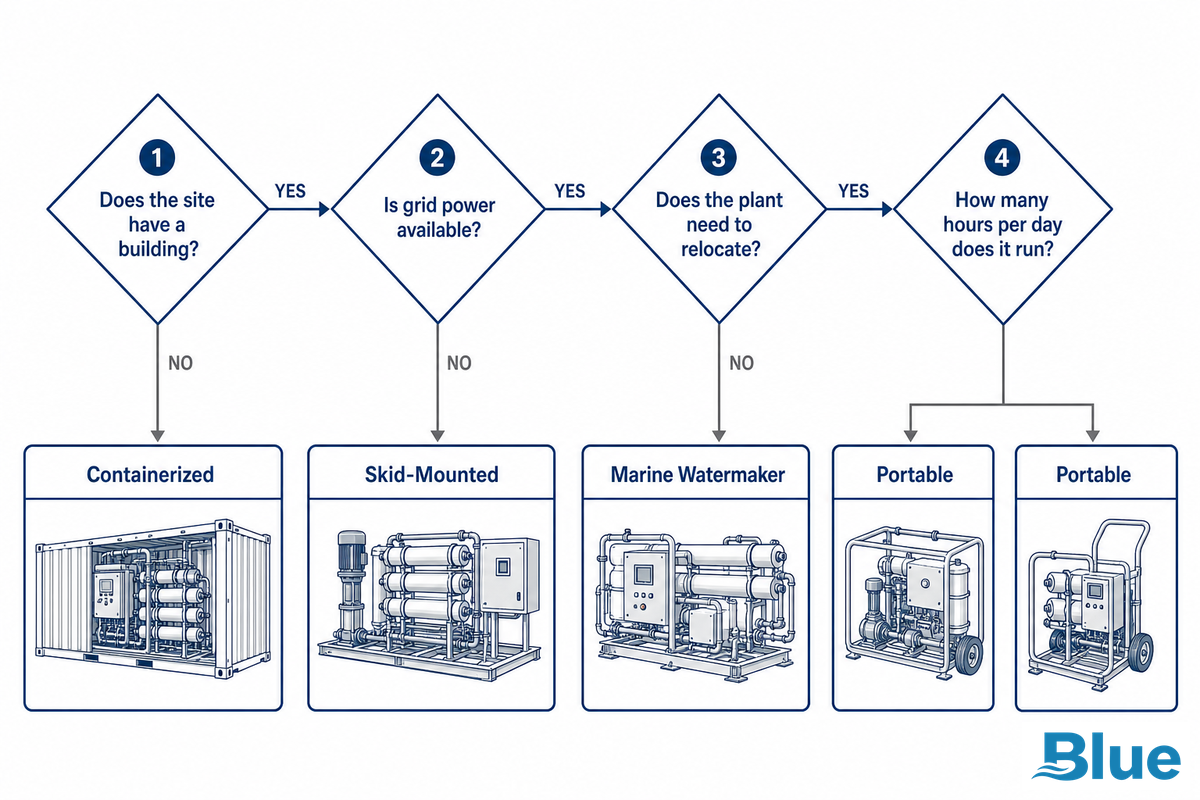
All SWRO manufacturers offer more than one format, and it’s a near-universal phenomenon that a buyer simply buys the format for which they originally searched – not the format for which their site actually calls. Four questions determine the correct format: does the site have a building, does it have grid power, does the plant need to relocate, and how many hours per day does the plant actually operate.
This same four-way logic roughly mirrors how a 2021 containerized-desalination patent separates island water, offshore-platform water, vessel water, and emergency water as distinct equipment-design cases.
| If your site is… | Power & building | Best-fit format | Why |
|---|---|---|---|
| Island, resort, or coastal facility with no plant room | 380V/50Hz land supply, no building | Containerized | Enclosure is the plant room; sits on a bare pad from day one |
| FPSO or offshore topside with existing deck/module space | 690V marine supply, deck space already weatherproofed | Skid-mounted | No need to pay for a second enclosure inside an already-enclosed topside |
| Yacht, fishing vessel, or passenger ship | DC24V or vessel AC, permanent install | Marine watermaker | Certified for continuous vessel duty at a fraction of the footprint |
| Disaster response, construction camp, or short-term event | Generator or grid, weeks-to-months duration | Portable / small containerized | Fast redeployment matters more than lowest per-unit cost |
How Do Containerized Systems Compare to Traditional (Field-Erected) Desalination Plants?
A field-erected reverse osmosis plant is designed and poured-in-place to scale beyond anything that can be fit inside a container. Useful for a municipality seeking a new large supply, this approach exposes every interface (foundation, piping runs, electrical, building envelope) to the elements, available labor, and scheduling slippage.
A factory-built containerized or skid unit dramatically minimizes this variability by assembling all the interfaces prior to shipping, though it comes with a maximum capacity per unit (additional units can be run in parallel above this ceiling). Above roughly 2,500-7,500 m³/day, depending on the design, a field-erected plant is usually more economical for continuous industrial reverse osmosis operation than a containerized one. Below this, and on sites where mobility or speed trumps pure scale, format is driven by the site conditions and available water sources, not the other way around.
Key Takeaway
When opening the RFQ discussion, don’t ask “containerized or skid.” Begin with the four key questions: power, building, mobility, and duty cycle. The format will then emerge naturally from the answers to these four.
When opening the RFQ discussion, don’t ask “containerized or skid.” Begin with the four key questions: power, building, mobility, and duty cycle. The format will then emerge naturally from the answers to these four.
Inside the Box, Container and Skid Structural Engineering
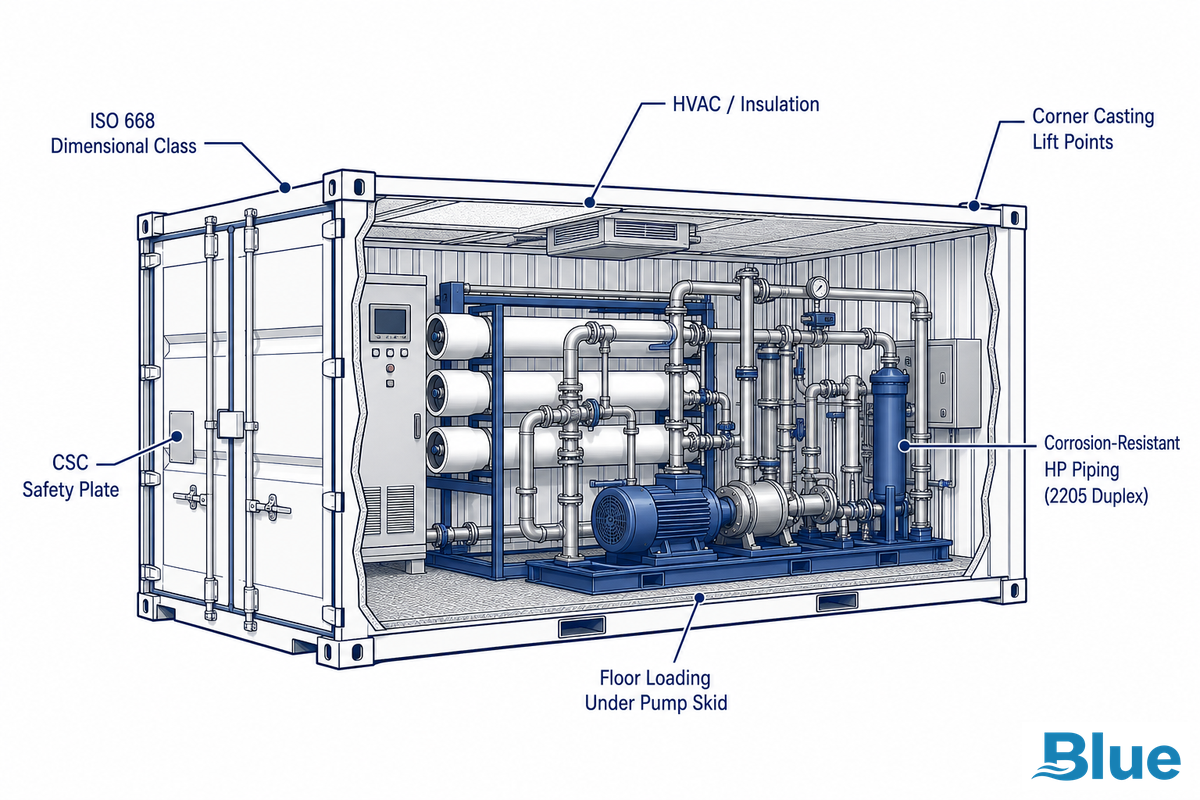
Every listing of a containerized SWRO prominently features an image of a shipping container. Almost none of these photos show the two actual specifications that are relevant to the purification plant’s container: its ISO 668 dimensional class and its CSC safety-approval plate. Neither of these should be confused with the RO equipment’s pressure vessel certification. Many buyers confuse a certified container with a certified RO system within it.
| Element type | Governing standard | What to ask for |
|---|---|---|
| Dimensional class | ISO 668:2020 | Series 1 classification (20-ft/40-ft), confirmed external dimensions to ±3 mm tolerance |
| Max gross mass | ISO 668:2020 (mass rating dates to a 2016 revision, since folded into the current consolidated edition) | 36,000 kg ceiling across all standard sizes — check the plate, not just the brochure |
| Stacking / lifting strength | ISO 1496-1 | Corner-casting rated lift points; most operators build to roughly 213,000-216,000 kg stacking strength |
| Safety approval | CSC (International Convention for Safe Containers) | A valid, dated CSC safety-approval plate riveted to the door end |
| Corrosion protection | Vendor material declaration | High-pressure loop metallurgy specified by grade — e.g. 2205 duplex + SUS316L, not “marine-grade steel” alone |
| HVAC / insulation | Vendor climate-control spec | Rated ambient operating range (commonly -10°C to +50°C) and insulation R-value, not just “insulated” |
| Electrical area classification | IEC 60079 (where applicable, e.g. FPSO topsides) | Zone rating if the container sits near a hazardous-area boundary; most onshore installs need none |
| Lifting / rigging points | ISO 3874 (corner fitting handling) | 4× ISO corner castings rated for the fully loaded unit weight, not just the empty box |
| Floor loading | Vendor structural spec | Point-load rating under the high-pressure pump skid, typically the heaviest single component |
| Noise/vibration isolation | Vendor equipment spec | Isolation mounts under the high-pressure pump; matters most for crew-occupied vessels and platforms |
Before signing any contract for containerized reverse osmosis plants, be sure to apply the following 9-Point Enclosure Framework. Jumping from the RO specification sheet to a PO without addressing these points is a quick route to discovering your container gap only after the plant has already shipped.
📑 Engineering Note
What Buyers Actually Need The corrosion-resistant loop is what Buyers Actually Need. Specified by grade, not adjective. Blue Membrane’s own containerized/skid platforms run the high-pressure circuit in 2205 duplex stainless piping with SUS316/316L pumps – a materially different corrosion allowance than painted carbon steel, and the kind of detail that should appear on a spec sheet, not a product photo.
CSC plate / ISO class The container’s own CSC plate and ISO 668 class only prove the box is safe to lift and ship. They say nothing about the pressure envelope, membrane salt rejection, or control logic inside it – those are governed separately by the equipment’s own pressure-vessel and instrumentation documentation, including the antiscalant chemical dosing skid that protects the membranes from scaling.
Ask for both certificates, not one standing in for the other.
Matching the Platform to Your Deployment
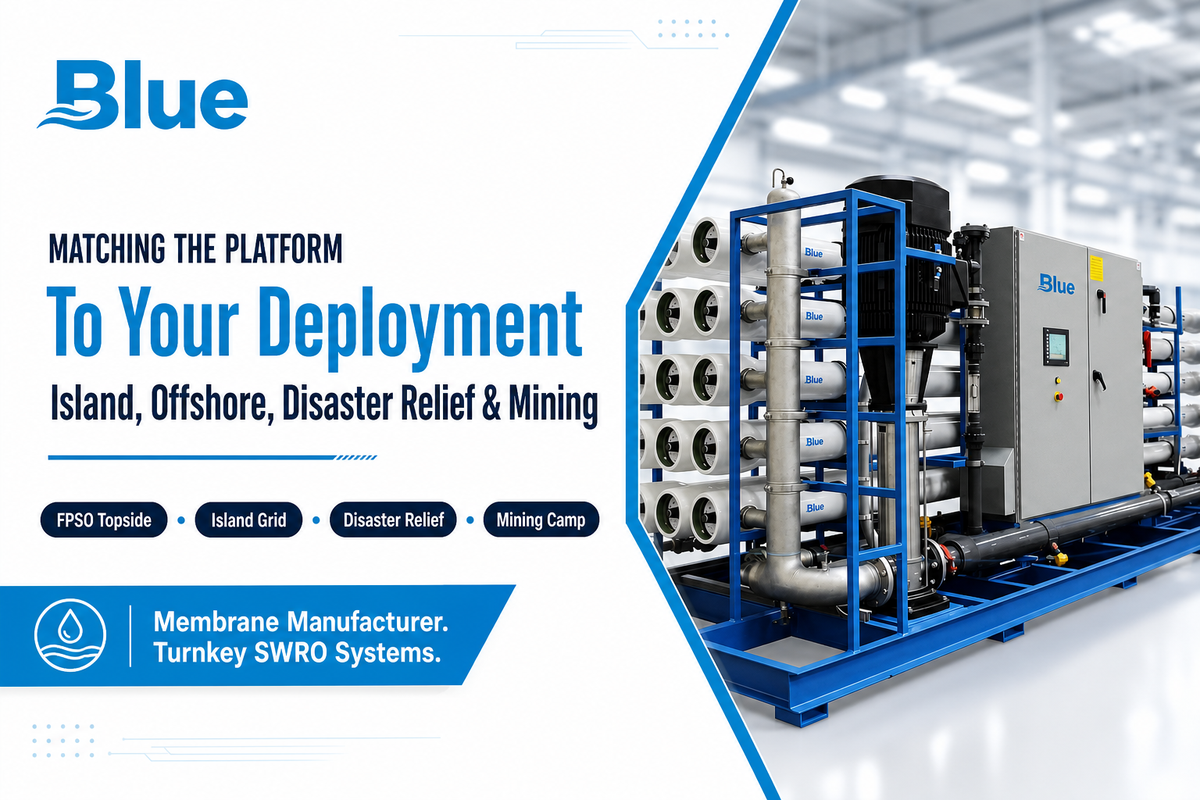
Successful Deployment In 2020, MCI Water Equipment Technologies was awarded a contract to deliver 50 containerized reverse osmosis systems for seawater desalination to power plants across the Middle East, each rated at 300,000 GPD (1,136 m³/day) and built inside air-conditioned, factory-fitted containers – a real, independently reported deployment (not a vendor’s own case study) that illustrates how quickly a containerized fleet can scale once the base design is proven.
| Scenario | Format | Question to ask |
|---|---|---|
| Island tourism / hotel | Containerized (20-ft) | Does the local grid supply match the unit’s rated voltage, or is a genset required? |
| FPSO / offshore platform | Skid, BV-classed | Does the skid’s marine classification cover the specific topside area it will sit in? |
| Disaster relief | Portable / small containerized | How fast can the unit actually be craned, trucked, and connected — not just how fast it can run once installed? |
| Mining camp (inland, brackish-adjacent) | Containerized or brackish water RO | Is the feed water actually seawater-salinity, or does a lower-pressure brackish design fit better? |
| Vessel / yacht | Marine watermaker | Is the duty cycle continuous underway use, or intermittent at anchor? |
Alternative in Ecuador A coastal engineering camp outside Manta, Ecuador needed water for roughly 200 construction workers for an 18-month build with no existing utility connection. A field-erected plant would have needed a permanent structure the client didn’t want to own after the project ended; a portable desalination unit would have undersupplied 200 people.
Instead, a single 20-ft containerized unit was specified – delivered on a flatbed, connected to a temporary genset, and sold to a second contractor when the camp closed. Resale value, not per-liter cost, is what made the format decision here.
Getting the site-to-format call wrong is not just academic: a team that specs an ISO-classed skid for standard 3.5-5.5 MPa operating pressure without confirming FPSO deck classification first risks a costly re-order once the topside area is confirmed hazardous, and in practice that kind of delay is the most expensive mistake a procurement team can make on a mobile water project. Regional buyers moving between island, offshore, and disaster-relief use cases should treat the site audit as the first step, not the last, because the risk of a mismatched format is a schedule risk long before it becomes a cost risk. Blue Membrane resolves this ambiguity by making the four-question site audit the first line of every quote, not an afterthought added once the format is already chosen.
From Factory to Foundation, Installation and Commissioning
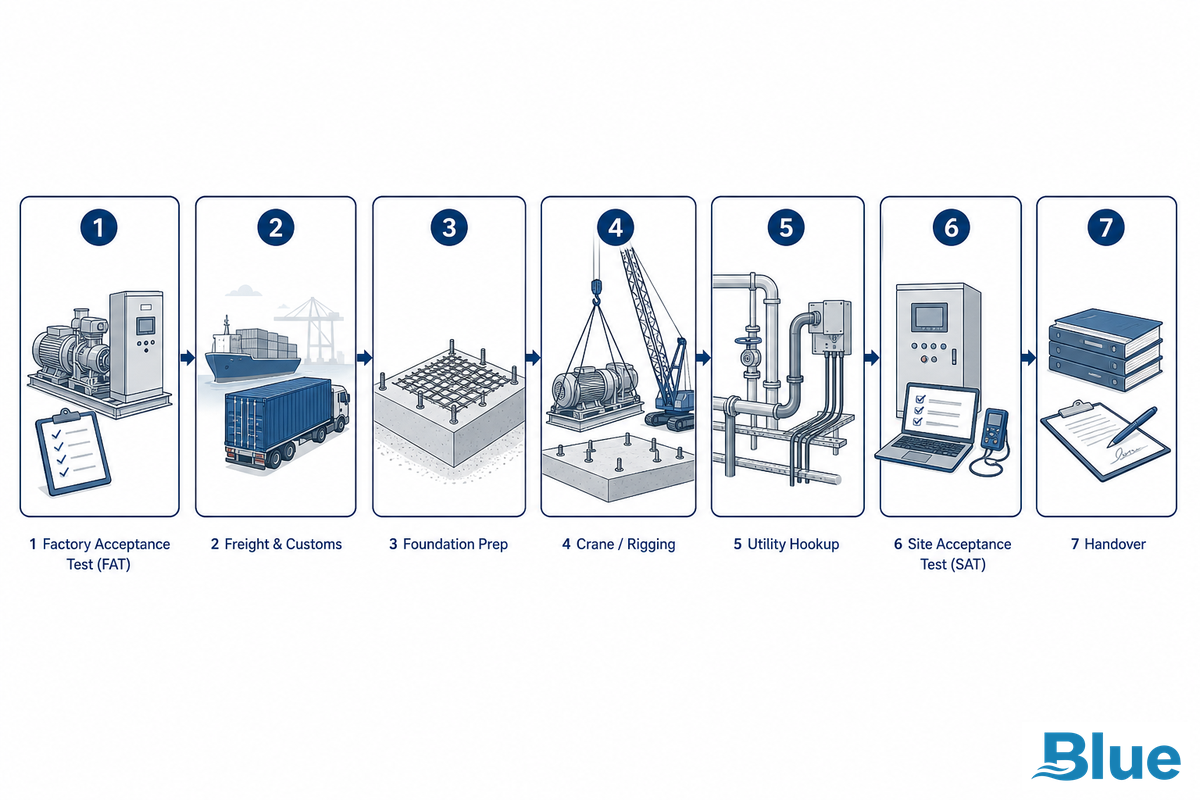
“Operational in days” is a real number, but it hides a specific sequence – and skipping a step in that sequence is where remote deployments actually lose time.
The Factory-to-Foundation Commissioning Sequence
- What’s actually required Factory Acceptance Test (FAT) The complete unit is wet-tested on feed water at the factory before it ships – this is what make a fast site turnaround possible, not a claim about the site work itself.
- Freight and customs Ocean or flatbed transport, plus import clearance at the destination port.
- Foundation prep A level concrete pad or compacted surface, sized to carry a fully loaded unit up to the ISO 668 36,000 kg gross-mass ceiling – no piling or building required for most containerized units.
- Crane/rigging Lift onto the pad using the container’s rated corner castings.
- Utility hookup Feed water intake, power connection, and concentrate discharge line – the three connections a containerized unit actually needs.
- Site Acceptance Test (SAT) A second, on-site test confirming the unit perform against the real feed water and power supply it will run on daily – not the factory’s test water.
- Handover: operator training and documentation transfer.
How Quickly Can a Containerized SWRO System Be Operational?
Connection time for the intake, discharge, and power – once the unit is on site – can take anywhere from two to five days according to the manufacturer’s estimate, due to the FAT sorting out any issues that would otherwise come up with a fresh commission.
But there’s one variable that buyers often under estimate: that’s all of step 1-2 – from the time the unit is ready to leave factory to the time it arrives in the country of destination, including transit times and clearance delays of several weeks at ports depending on document accuracy.
By far the biggest of the fallacies listed in the sequence, skipping the SAT to save a day, occurs when a unit that met its FAT on the factory’s feed water fails to perform at its expected rate in the buyer’s real-world, high-turbidity intake; the SAT is the only test point that will find that problem before the warranty kicks in.
Equipment isn’t the risk in this sequence – discipline is: skipping the Site Acceptance Test to save a day is the most expensive mistake a field team can make, because a unit that passed its Factory Acceptance Test on clean feed water can still fail against the buyer’s real intake water chemistry. Blue Membrane resolves that gap by treating the SAT as a mandatory, ISO-documented handover step rather than an optional site formality. In practice, regional teams running island, offshore, or disaster-relief deployments that skip the SAT are the ones most likely to discover a mismatch within the first 5 days of operation — well inside the factory’s own 2-5 day site-turnaround estimate.
What Drives Your Quote, RFQ, Lead Time, and Factory-to-Site Logistics
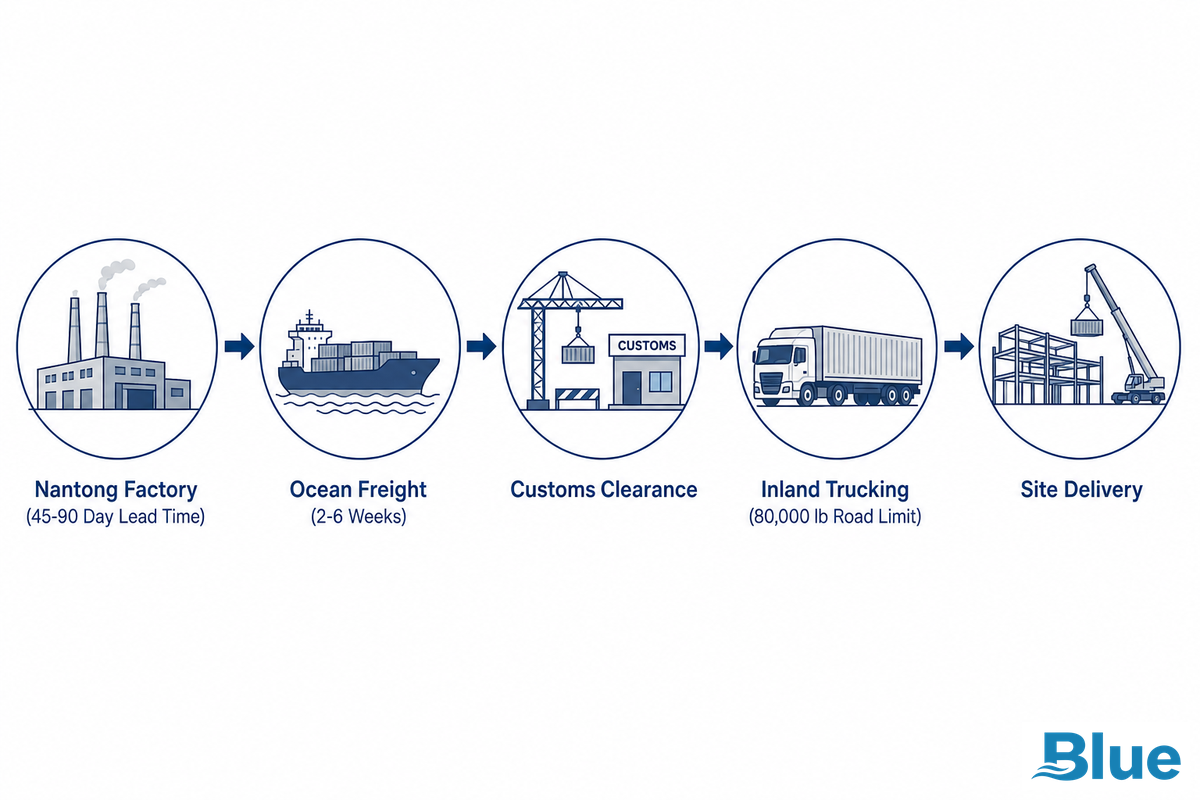
A complete RFQ for a containerized or skid-mounted SWRO system requires 5 things: feed salinity and temperature (this is a sample – a target isn’t feasible and feed water >40C will damage membranes permanently), daily demand plus desired recovery rate, and required electrical power (land-based 380V motors aren’t interchangeable with 690V motors, same applies to control).
The remaining two factors are the degree of enclosure and system features required (insulation, air conditioned, CIP, remote monitoring) and, finally, the whole life cycle picture (installation, service, reject water treatment costs – not the single unit price).
How Are Containerized SWRO Systems Shipped and Installed for Export Projects?
Because they’re already pre-packed sea freight containers, many countries have no restrictions on the crating required for factory-built units. However, these still can be oversize or overweight shipments once they depart from the port, and as per 23 CFR Part 658, the maximum road limit on U.S. interstates is 80,000 lb gross vehicle weight, provided a lower bridge formula weight doesn’t apply, including a single-axle weight limit of 20,000 lb, and 34,000 lb on tandem axles.
Loads exceeding 8 work-hours for standard disassembly for transport purposes is deemed nondivisible and follow an alternative permit route. Heavy gross vehicle weight on a fully-loaded 40-ft containerized SWRO can exceed these weight restrictions, so make sure to ascertain inland shipping permissions, rather than once it’s cleared by U.S. Customs.
Customer Lead Times- Factory lead times are generally 45-90 days after receipt of confirmed order before the material is completed and leaves the factory floor; then add 2-6 weeks for the ocean transit from the shipping port to your nearest port-again, standard ranges, not firm until verified in writing.
⚠️ Important
RFQ completion and freight costs only manage your equipment’s path. Independent project reviews of desalination plants, including the one clearly defined in Carlsbad, California, demonstrate that permitting, environmental studies and lawsuits surrounding the plant’s intake and discharge into the brine can drive the project’s schedule and financial risks – even after a format and vendor are selected. Budget permitting risk into your schedule independent of equipment delivery time – a supplier will price a shipping container but not the local regulatory authority.
Certification, Classification, and Drinking-Water Standards for Mobile SWRO
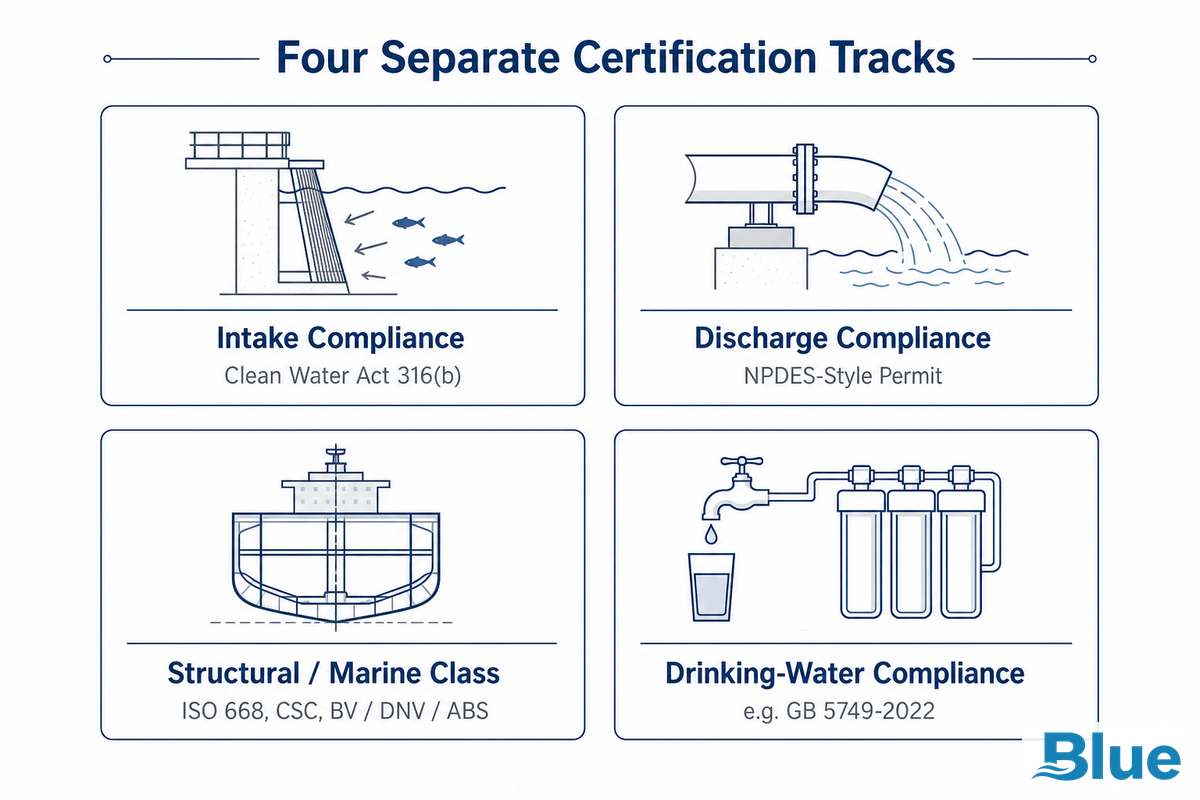
Most buyers will lump together “is this certified?” This really means: Is this certified to X standard?
Certified to Y standard?
Certified to Z standard?
Certified to A standard?
Your supplier could truthfully say yes to one of these and have absolutely no information about the other three.
1. Intake compliance
The U.S. EPA’s Clean Water Act, section 316(b), mandates requirements regarding intake locations, design, and operation to prevent damage to the fish, shellfish, and their eggs captured by cooling water intakes. This existing-facility rule (40 CFR 125.91) applies to any cumulative design intake flow exceeding 2 million gallons per day and using at least 25 percent of that withdrawal for cooling purposes, scope conceived primarily for power-plant cooling and industrial cooling, rather than for an SWRO plant’s raw-water feed intake. If your containerized or skid unit is taking in feed water and not cooling water, it will likely not fall under this specific rule, so verify with your permitting authority before assuming either way (independent state or local intake protection regulations might still apply).
2. Discharge compliance
Discharge of concentrate (brine) is a separate concern, and generally managed through an NPDES-style permit. An example is the U.S. EPA’s 2025 final permit for the Swansea Water District Desalination Facility (MA0103390), a publicly available permit for a U.S. reverse-osmosis brine discharge from a plant far smaller than a coastal municipal plant, useful for understanding what a regulator actually asks for.
3. Structural/marine classification
Is this container or skid safe to lift, ship, and mount? That question is addressed in the structural engineering section above (ISO 668, CSC) and, for offshore or marine skids, further certified by classification societies (e.g., BV, DNV, ABS). Blue Membrane’s own FPSO-topside skids carry BV marine classification for exactly this reason.
4. Drinking-water compliance
Separate from all of the above: does the permeate meet a recognized drinking-water standard? Blue Membrane’s containerized platform meets China’s GB 5749-2022 national drinking-water standard; UV sterilization and remineralization can be added so the finished RO water meets potable water applications as needed for specific projects.
“We get asked for ‘the certificate’ as if there’s one document that covers the box, the pressure system, and the water quality. There isn’t. We hand buyers four separate answers, container class, discharge permit status, marine classification where it applies, and the drinking-water standard the permeate is built to, because collapsing them into one line on a spec sheet is how a buyer ends up assuming coverage nobody actually gave them.”
Operating and Maintaining a Container/Skid SWRO Plant, Membrane Cleaning, Corrosion, and Spares in the Field
3.5 Routine RO membrane Maintenance & Field Controls: Standard reverse osmosis membrane cleaning and maintenance (chemical cleaning due to pressure increases or flow rate drops, cartridge replacement, antiscalant dosing) are all standard reverse osmosis water treatment process issues, discussed extensively in our seawater RO systems guide. For a containerized/skidded RO plant, we’re more focused on the aspects that surround this process – namely, the container itself, plus two field controls flagged by a recent study on RO plant power consumption as being commonly simplified – shutdown flushing and storage tank TDS control.
- Climate Control: In a sealed container, condensation poses the same risk to electronics as exterior corrosion; look for an actual HVAC duty cycle, not merely the presence of an AC unit.
- External Corrosion Inspection: Any steel container operating in a coastal environment sits toward the high end of the atmospheric-corrosivity categories in ISO 9223 (airborne salinity is one of the standard’s named factors), so it will require scheduled corrosion inspection rather than simply an assurance of initial coating application.
- Shutdown flushing – requires a fresh-water flush on every stop/restart to avoid feeding high concentration chloride to a resting membrane. This is one step remote and intermittent site locations are prone to omit.
- Storage-tank TDS management – the quality of containerized RO water can degrade over time in storage without a monitored treatment process, a problem specifically identified as omitted from simpler models in a 2026 systems-and-control study of RO plant flexibility.
- Spare parts logistics – for a remote or offshore site, the replacement lead time for a membrane – not the pump – is usually the longest downtime period in an idle plant.
Manufacturer-published specifications for life expectancies (structural/major-equipment: 15-20 yrs; membrane elements: 3-7 yrs, depending on feed water quality) are largely consistent across independent manufacturers and are reasonable planning guidelines. However, actual membrane lifespan varies depending on feed water quality and cleaning regime.
Format Cost Comparison, Containerized vs. Skid vs. Marine Watermaker TCO
It’s easy to simply say that containerized is more expensive than skid because it uses more steel. What that oversimplification ignores is the primary economic differentiator. A 2026 study on the electrical systems for RO plants (Hu & Konstantinou, arXiv:2601.07295) finds that RO units are one of the highest electricity users in regions where water is scarce, and the high-pressure pump – not the outer structure – is responsible for the majority of electricity usage for SWRO plants. Format is a capital decision, made at the time of purchase. Powering the pump, by contrast, is a continuing running expense for the life of the plant.
✔ Containerized: Advantages
- No building required; containerized RO units install outside directly on a pad.
- Built-in insulation, HVAC, and lighting, no separate systems needed.
- Full resale/relocation value as a complete unit
⚠ Containerized: Limitations
- Higher unit price for containerized reverse osmosis units than an equivalent bare skid
- Each unit has a fixed footprint; to expand, add units, rather than building larger structures.
- Bulkier freight; a full 40-foot container is close to the 36,000 kg weight limit, whereas a bare skid usually weighs less than half of that.
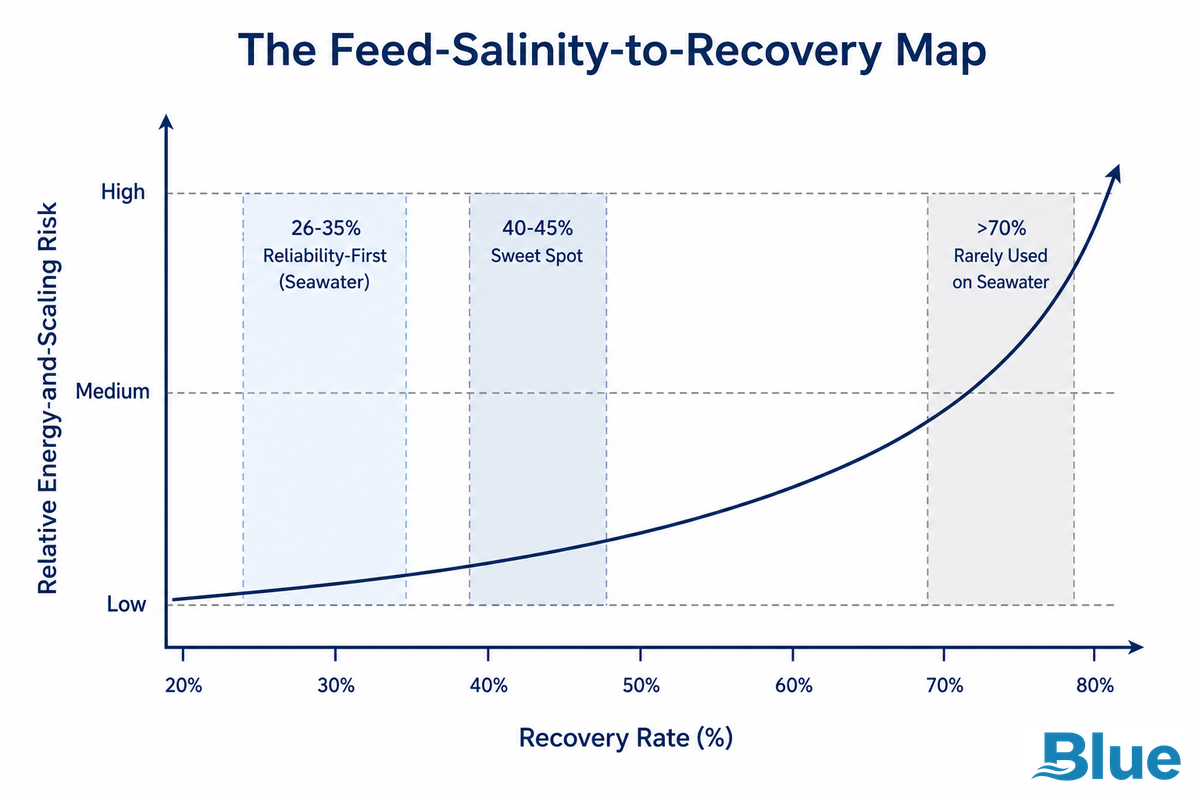
The true list of cost drivers, ordered approximately by magnitude: energy (largely the high-pressure pump plus whether advanced energy recovery is included); feed water quality and pretreatment intensity; capacity and recovery rates (a single-stage train typically runs 40-50% recovery, and pushing to a two-stage design for roughly 60% adds its own energy penalty); format and outer housing (containerized water treatment vs. skid vs. marine watermaker); and concentrate disposal. A 2024 EPA work-breakdown-structure cost model for RO/NF plants lines up with that same ordering, treating energy and process-equipment line items as the dominant capital and operating drivers rather than the enclosure itself. Format is only partway down the list, and any supplier that starts the sales conversation by comparing container vs. skid without understanding your feed water and power situation is answering the wrong question. Published unit price estimates vary widely by capacity and features; view all such estimates, online or in published comparative articles, as an educated guess and then conduct your own detailed analysis based on feed water analysis.
That gap between sticker price and real operational cost is where budget-strapped buyers get burned: choosing the cheaper bare skid because it’s less steel is a common mistake when the site still needs a purpose-built enclosure, and the delay of adding that structure later can erase one of the core benefits of containerized formats entirely. This tension is structural, not cosmetic — an ISO 668-classed skid’s operating pressure is identical to a containerized unit’s 3.5-5.5 MPa range, so the electricity bill for the high-pressure pump doesn’t change with the format, only the enclosure cost does. Blue Membrane resolves this by pricing the enclosure and the process equipment as two separate line items on every quote, in practice letting regional buyers compare true landed cost, not just factory sticker price, across island, offshore, and industrial buyer use cases.
Where Mobile & Modular SWRO Demand Is Headed
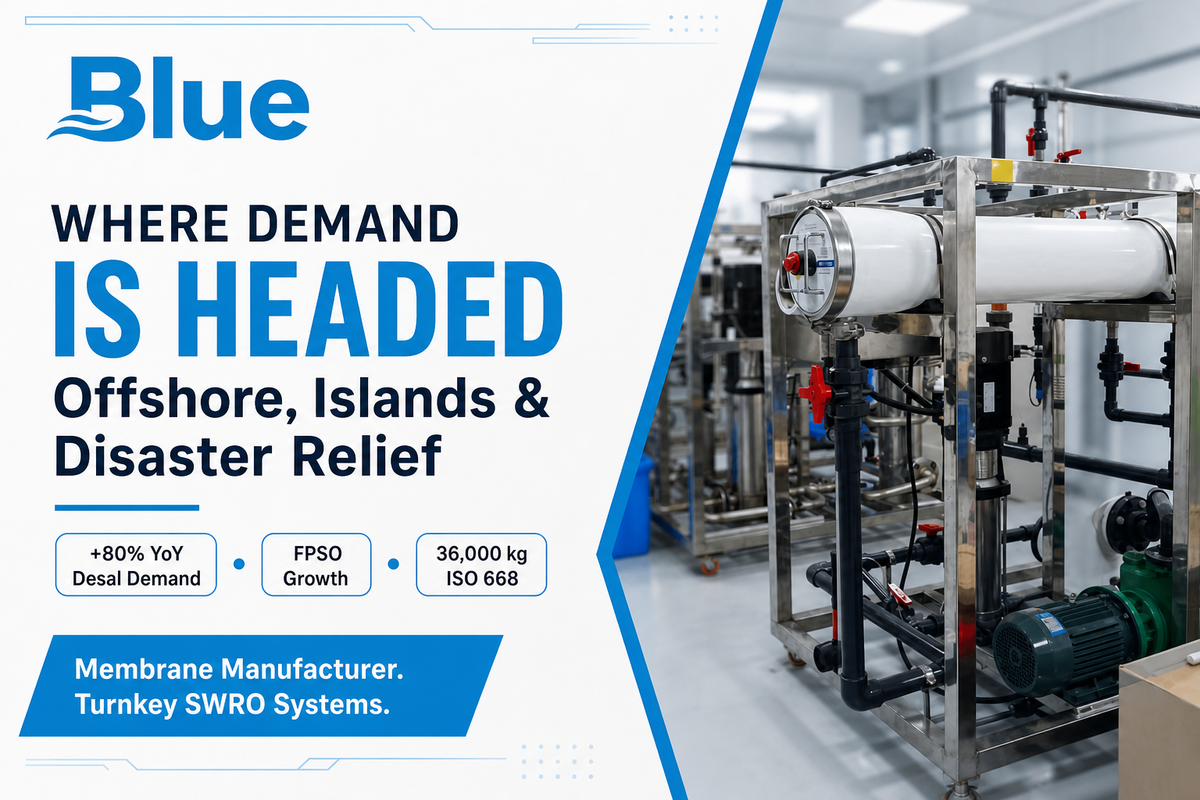
Relocatable, sustainable water supplies is the norm, not an emergency for island utilities, offshore operators and disaster-relief agencies. What’s clearest is that demand for relocatable SWRO isn’t driven simply by “water scarcity.” Instead, offshore energy operators and disaster-relief programs now routinely specify mobile water treatment in project scopes as a first thought, rather than after a facility is already up and running.
An FPSO or offshore platform commissioning team increasingly treats a classified, containerized or skid-mounted water package as a line item alongside process equipment, instead of a subsequent, delayed procurement process.
Disaster-relief and temporary camp water programs show a similar shift, increasingly requesting a containerized unit over a truck-delivered tanker contract.
Regarding standards, an amendment to ISO 668 in 2016 increased the maximum gross container mass to 36,000 kg, enabling manufacturers to incorporate heavier, higher-capacity RO trains within existing footprints without needing to create a new container classification – a subtle but significant change that Buyers looking at 2020 vs. 2026 specifications should be mindful of.
Market research analysis supports this trend for context: The containerized desalination plants Market is expected to be around $1.49 billion in 2025, growing to $3.01 billion by 2031 (approximately 12.4% CAGR), and the larger Mobile desalination Units Market is projected from around $22.29 billion in 2025 to $42.26 billion by 2031. (These are market directional figures from commercial market research, not official statistics, included as context rather than the primary justification for purchase.)
The practical takeaway if you’re planning a 2026-2027 offshore water-treatment project or a permanent, sustainable water treatment solution for disaster-response water supply capability is the procurement process: Be sure to specify the form factor (containerized/skid/marine watermaker/portable) and its applicable certification set (ISO 668/CSC and any marine classification required) in the initial RFQ alongside the RO process specification, rather than treating it as an after-thought post process-equipment selection.
The risk for buyers who wait is real: teams that treat mobile SWRO as an afterthought after the RO process is already specified routinely discover the format-decision gap too late — and by the time a 45-90 day production lead time is already committed, that’s an expensive mistake to unwind once a container is already in production. Blue Membrane resolves this by pushing the format question (containerized, skid, marine watermaker, or portable) to the front of every RFQ conversation, alongside the process specification, not after it. In practice, regional buyers evaluating offshore, island, or disaster-relief use cases are the ones most likely to face this sequencing risk, because their site constraints are the least flexible of any deployment type.
Frequently Asked Questions
Q: What permits and approvals are typically needed to install a containerized system?
View Answer
Permits and other regulatory compliance requirements vary by jurisdiction, but commonly include: a concentrate disposal permit (NPDES-style), an intake structure permit (though a facility is rarely impacted by the 316(b) 2 million gallons/day standard unless it’s an exceptionally large facility and also has a cooling water component – state level intake rules still frequently apply), a building or siting permit for the container pad, and approval from the local health department if the output is to be used as drinking water. Because a containerized unit is generally classified as equipment rather than permanent infrastructure, the permitting process is typically less complicated than for a fixed plant built on concrete foundations, but it’s rarely immediate-expect to take weeks or months and consult your local regulatory authority on the specifics prior to solidifying your timeline.
Q: What happens to the concentrated brine discharge from a containerized or skid system?
View Answer
Reject water runs roughly 1.5 to 2 times the salinity of the feed water and is usually discharged to the ocean via an outfall pipe located away from the intake, sometimes with a diffuser to speed mixing. That discharge is regulated under an NPDES-style permit (US), and a real-world example of the paperwork required for a reverse-osmosis brine discharge is the US EPA’s final permit, for the Swansea Water District Desalination Facility, issued in 2025. containerized units are built at a range of scales, with the volumes of brine produced proportional to unit capacity, so even a small containerized requires a sign-off on discharge location and monitoring plan prior to startup.
Q: How long does a containerized SWRO system last?
View Answer
Manufacturer-guaranteed useful life for the containerized equipment is commonly 15 to 20 years; RO membrane elements, which need replacement 3 to 7 years apart depending on feed water quality, upstream water quality treatment, and maintenance discipline, represent the bulk of that. That membrane life is a key number to negotiate: get it documented, tied to your actual feed water water quality analysis.
Q: What kind of insulation and climate control does a containerized RO system use?
View Answer
SWRO containers are usually well-insulated and air-conditioned/ventilated for the electronics, equipped with sufficient cooling to account for internal pump heat load, and often include maintenance lighting – all factory installed. The practical issue regarding the container and HVAC is how often it is designed to run: the real answer is what your specific climate dictates to prevent Condensation, just as outdoor elements will destroy an uninsulated machine.
Q: Can reverse osmosis actually make seawater drinkable?
View Answer
Yes, though the RO membrane itself is not the endpoint. Remineralization, pH adjustments, and disinfection are often necessary to bring the permeate up to drinking-water standards for corrosiveness, safety, and taste.
Q: What is the smallest containerized seawater RO system available?
View Answer
A typical standard containerized unit starts around 20 m³/day within a 20ft shipping container, across a number of manufacturers, and those with smaller water needs are better served by a skid or mobile unit.
Q: Why is containerized/skid-mounted SWRO considered a sustainable deployment format?
View Answer
The case for sustainability rests on more than just the reverse-osmosis process itself (which is standard across any SWRO-powered plant): containerized systems have no civil works to decommission when their use term ends, retain significant residual value for resale or redeployment, and enable users to size their plants precisely, adding units rather than over-building a fixed plant for a future spike in demand. Many of the larger units also feature energy recovery devices, which recapture pressure from the concentrate stream to save energy and reduce plant demand.
Q: What do buyers usually search for before requesting a quote?
View Answer
Most procurement teams researching a containerized seawater RO system project start by comparing a containerized seawater RO system cost against a containerized seawater RO system for sale from multiple vendors, then broaden the search to mobile reverse osmosis and small commercial reverse osmosis systems once they realize format, not just price, drives the decision. All of those searches point at the same underlying question: which platform actually fits the site.
Why We Write This
Much of the containerized SWRO marketing for water purification that appears online comes from the vendors who manufacture their boxes. We produce the spiral-wound membrane elements inside those systems in Nantong, China. Therefore, we believe it is important to distinguish what the container guarantees (ISO 668, CSC) from what the reverse osmosis technology itself guarantees (recovery, rejection, energy consumption), from what the feed water quality dictates for daily drinking water production and safe drinking water delivery (drinking-water standards).
Many vendors make the mistake, in our opinion, of combining all three into a single “certified” statement.
Reviewed by the Blue Membrane technical team.
References & Sources
- ISO 668:2020, Series 1 Freight ContainersInternational Organization for Standardization
- Cooling Water Intakes (Clean Water Act §316(b))U.S. Environmental Protection Agency
- Swansea Water District Desalination Facility, Final NPDES Permit MA0103390 (2025)U.S. Environmental Protection Agency
- Work Breakdown Structure-Based Cost Model for Reverse Osmosis/Nanofiltration (2024)U.S. Environmental Protection Agency
- 23 CFR Part 658, Truck Size and Weight, Route DesignationsU.S. Federal Highway Administration
- Stochastic Power-Water Coordination: Unlocking Flexibility in Hybrid RO Desalination Plants via Variable-Speed Pumps and Tank MixingHu & Konstantinou, arXiv:2601.07295 (2026)
- CN216337073U, Sea Water Desalination EquipmentTianjin Weinabo Environmental Technology Co., Ltd. (Google Patents)
- MCI WET Develops Containerized Seawater Reverse Osmosis Systems For Middle East Power PlantsWater Online
- Desalination coverage, including Carlsbad, California permitting and legal historyThe Associated Press
Related Articles
- Seawater RO Systems: How SWRO Works, Costs, and Specsthe process-level companion to this format-level guide
- Marine Water Maker, Vessel-Grade Seawater RO Desalination
- Portable Desalination Units
- Packaged BWRO Systems: How Brackish Water Reverse Osmosis Works, and How to Specify One