Get in touch with Blue Membrane Company

Seawater RO Systems · Navigator Watermaker Series
Marine Water Maker, Vessel-Grade Seawater RO Desalination Systems
Factory-direct marine water makers for yachts, fishing vessels, naval fleets, and offshore platforms, built around a seawater RO membrane we manufacture in-house, not source from third parties.
Request a Quote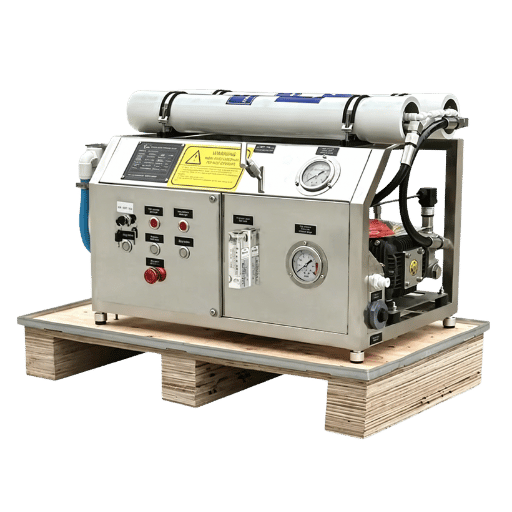
≥98%
Desalination rate
700–2,000
L/day output (4 models)
DC24V / AC220V
Solar-ready or genset
<700 ppm
Product water TDS
0.0001 μm
RO membrane pore size
In-house
RO membrane manufacturing
Hover for Specs
- Direct pricing from the factory. We eliminate all of the middleman margins to bring the most affordable high-quality marine water maker to market.
- Producing water at a ≥98% desalination rate with no chemical dosing necessary.
- The same reverse osmosis water maker technology from our largest unit down to the smallest DC-powered system. Whether you need 15 gallons a day for a small cruising sailboat powered by solar, or 2,000 liters a day for an AC-powered charter vessel, you receive the same high-quality RO membrane and desalinator design.
SYSTEM PROPOSITION
Fresh Water on Board Without the Premium Price Tag
The job of a marine water maker is to take the ocean under your hull and make it drinkable, so a long passage no longer means rationing showers to thirty seconds and stacking dirty dishes until the next marina. The vast majority of cruising sailboats have onboard water tanks holding only 75 to 200 gallons, which for two people typically runs dry in less than a week. The reason for this shortage is rarely the technology; it’s the price.
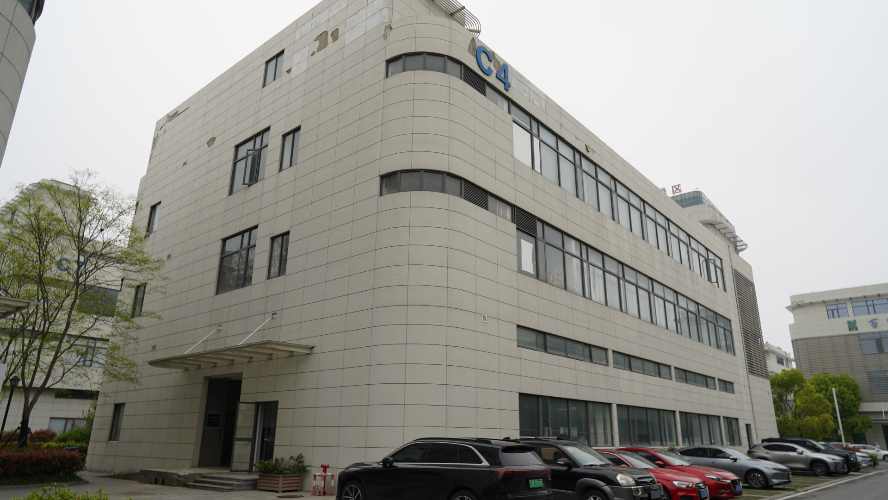
When “premium” water makers arrive on our docks from overseas suppliers, the RO membrane inside the unit has already made one round-trip visit – from Nantong to the supplier’s warehouse, to an importer’s facility, to a local assembler, and then finally on the back of a delivery truck – each leg adding profit and markup along the way, including on a third-party purchased RO membrane. Blue Membrane has no distributors, importers, or assemblers; we build the marine grade reverse osmosis membrane and assemble the finished water maker right here at our factory in Nantong.
That’s our value proposition: vertical integration of marine desalination from the RO membrane through to the fully assembled system sold direct to you from our factory. Below we present all of our options, from smallest to largest, including our system selection guide, power specifications and how to order your new Blue Membrane desalinator. Our BM-SF output consistently meets US EPA National Primary Drinking Water standards for direct onboard use.
Navigator Watermaker Series (BM-SF) — Models & Selection
Bigger isn’t always better with a marine water maker, and oversizing is a costly, common mistake because a high gallons-per-hour figure you rarely use still drains power and money up front. An oversized water maker wastes power, costs more to buy, and doesn’t help if you can’t run it against your battery or tank limits. A small marine water maker like the DC BM-SF700-1 saves power and money and still keeps pace with your daily needs.
What two people actually use per day
Below is an estimate for average daily fresh water usage per person aboard. Keep in mind to add a 30-50% cushion for visitors, dish washing machine cycles, or that last minute deck wash before you drop anchor for the night. Based on an average usage of 15 gallons/day, that means a 15 gallon/hr system will be producing water for less than 1 hour each day.
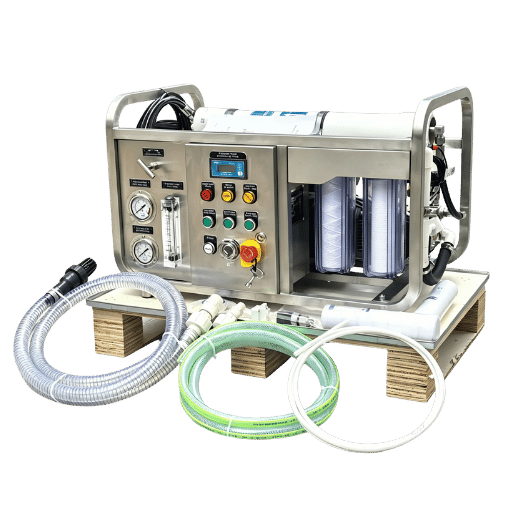
Blue Membrane Navgator BM-SF marine water maker series of four desalinator systems are manufactured from one modular design standard. All four units are designed with an all stainless steel frame, a quiet, energy-efficient high-pressure pump and a one button start up using an industrial grade PLC control, the same marine-grade reverse osmosis membrane in all of the units, but unlike a portable water maker these units are designed for fixed onboard installation.
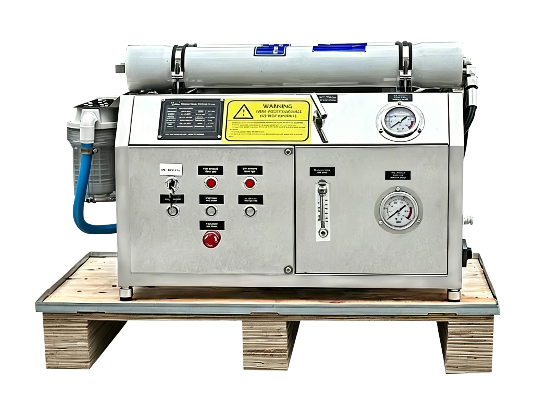
Hover for Specs
BM-SF700-1
- DC24V · 800 W
- 700 L/day (≈7.7 gph)
- 60 kg · 76×41×43 cm
- Pure DC for solar/battery
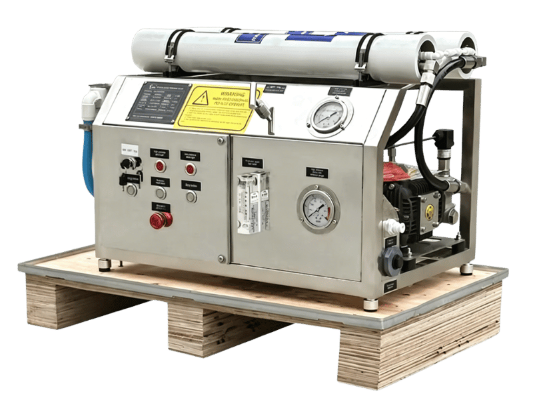
Hover for Specs
BM-SF700-2
- AC220V 50Hz · 1.6 kW
- ≈696 L/day (29 L/H)
- 84.5×47.4×43.2 cm
- Shore power / genset
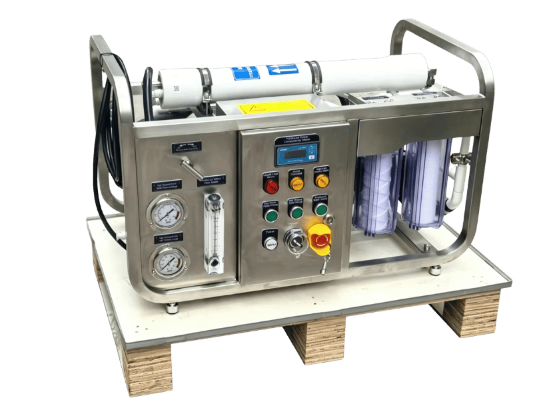
Hover for Specs
BM-SF1400-2
- AC220V 50Hz · 1.6 kW
- ≈1,392 L/day (58 L/H)
- 84.5×47.4×43.2 cm
- Mid-size cruisers
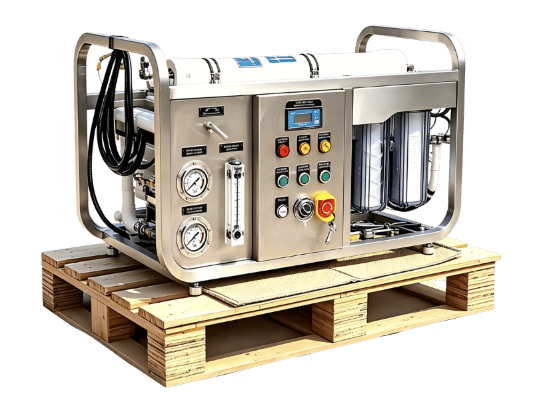
Hover for Specs
BM-SF2000-2
- AC220V 50Hz · 1.6 kW
- ≈1,992 L/day (83 L/H)
- 84.5×47.4×43.2 cm
- Larger vessels / crew
Vessel-to-Output Sizing Matrix
Whether you own a sailboat or are looking for an offshore platform or navy vessel system, select the model below that fits your vessel,crew and power generation. Figures given below are under normal seawater test conditions (i.e. 35,000 ppm and 77 deg F), actual production may vary by up to 10%.
| Vessel & use | Crew | Daily need | Recommended model | Output | Power source |
|---|---|---|---|---|---|
| 30–40 ft sailboat, off-grid | 2 | 10–18 gal | BM-SF700-1 | 700 L/day | DC24V solar/battery |
| 30–40 ft, shore/genset | 2 | 10–18 gal | BM-SF700-2 | 696 L/day | AC220V |
| Fishing vessel, day runs | 2–3 | 15–25 gal | BM-SF700-2 | 696 L/day | AC220V genset |
| 40–50 ft cruiser | 2–4 | 20–35 gal | BM-SF1400-2 | 1,392 L/day | AC220V |
| Charter yacht, guests | 4–6 | 35–55 gal | BM-SF1400-2 | 1,392 L/day | AC220V genset |
| 50 ft+ motor yacht | 4–6 | 40–60 gal | BM-SF2000-2 | 1,992 L/day | AC220V |
| Naval fleet / patrol | 6+ | 50–90 gal | BM-SF2000-2 | 1,992 L/day | AC220V ship power |
| Offshore platform | crew | continuous | BM-SF2000-2 ×n | 1,992 L/day each | AC220V |
| Solar-only expedition | 1–2 | 8–15 gal | BM-SF700-1 | 700 L/day | DC24V panels |
This is the same sizing logic as that which can be seen in some independent membrane-element patents such as US Patent US7632410B2 on multi-stage water purification – that capacity should track demand rather than spec sheet maximum.
BM-SF vs Typical Marine Watermakers, Spec by Spec
Hard to buy in to “reliable & affordable” or “energy efficient.” Numbers, yes. So here’s the BM-SF700-2 vs the spec sheet band typical in this size class of compact marine watermaker.
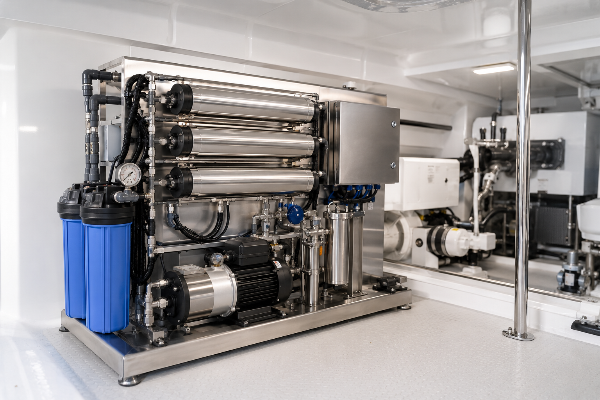
SYSTEM INSIGHTS
The line that changes the math is membrane source, because a replacement RO membrane is a commodity, not brand magic. The same membrane can be had for $265, or around $700 elsewhere, the same physical part, and the hidden cost is the assembler markup between them. Unlike an assembler that marks up a bought-in element, Blue Membrane delivers the membrane itself, so the recurring spend that dominates a reverse osmosis system’s lifetime cost stays low. The US Department of Energy’s desalination program documents that membrane and energy recovery drive most of that 3–7 year cost cycle.
Another honest efficiency statement – no, we don’t promise 100%. The basic nature of reverse osmosis allows a small amount of bypass, this is the honest reason our spec sheet states 98%, not a marketing-driven round number. While ultra-low-draw pumps exist, their clever design comes at the cost of fussiness, which isn’t suited for a water maker operating at remote locations. The BM-SF compromises by employing a proven high-pressure pump you can understand, with minimal power per gallon.
| Specification | BM-SF700-2 | Typical class unit | Why it matters |
|---|---|---|---|
| Desalination rate | ≥98% | 98–99%+ | Direct drinkable water |
| Product water TDS | <700 ppm | <500–1,000 ppm | Taste + tank safety |
| Inlet TDS handled | <35,000 ppm | ~35,000 ppm | Full open-ocean seawater |
| Output | 29 L/H (7.7 gph) | 6–15 gph | Match to daily need |
| Rated power | 1.6 kW AC | 0.3–1 kW | Size genset/inverter |
| Membrane source | Made in-house | Third-party (DuPont/Toray) | Spare supply + cost |
| High-pressure pump | ~800 PSI | 800–1,000 PSI | Overcomes osmotic pressure |
| Frame | Marine-grade stainless | 316 SS / marine plastic | Corrosion resistance |
Built Around Our Own RO Membranes, The Manufacturer Advantage
Most marine watermaker brands are assemblers, and that is a hidden risk. They buy the reverse osmosis membrane, wrap a pump and a casing around it, and add their margin — so when something breaks, a spare part can be expensive or scarce in a remote region. Parts availability is the one factor long-distance cruisers rank above raw output. Unlike those assemblers, whereas a reseller waits on the same third-party supplier, Blue Membrane delivers the membrane in-house, because the part you replace every 3–7 years should come from the manufacturer that engineered it.
“The membrane is the heart of the system and the part you replace most. We make ours in-house, spiral-wound from our own RO sheet, so a customer sourcing a BM-SF is buying from the company that also supplies the spare, not from a reseller waiting on the same third party everyone else uses.”
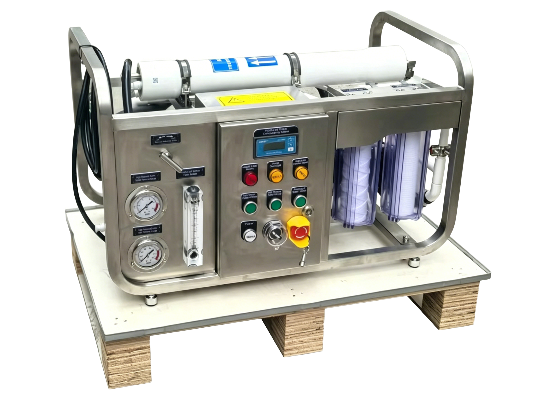
Integration Specs
From sheet cutting to Y-ring installation and final packaging – eight steps of controlled production occur under our quality system within our facility: RO membrane sheet cutting, feed-spacer and permeate-carrier cutting, rolling, high-temperature curing, Y-ring seal installation, and packaging.
- Our RO Seawater Membrane Series is engineered to be the direct performance equivalents of a number of widely utilized and referenced membrane models.
- One-stop shopping: membrane element and complete water maker from a single source manufacturer.
- In use in desalination, marine and industrial water treatment applications across over 20 countries worldwide.
Data Module
Vertical integration, by the numbers
Eight controlled production steps under one quality system, 20+ countries of deployment, and a seawater membrane rated for 3–7 years of service. Unlike an assembler, Blue Membrane pairs a factory-made RO element with the complete water maker — from a 700 L/day DC unit to a 2,000 L/day AC system for yachts, fishing vessels, and offshore platforms.
Research in Reverse osmosis module, such as patent JPWO2024214605A5 (2024), regarding Energy-Recovery Membrane Architecture suggests what this category will look like, and what lets a manufacturer be a leader is controlling the membrane rather than relying on others to develop the right one.
Want the membrane spec sheet and element datasheets?
Talk to a marine water engineer for a detailed spec →Power Your Way, DC24V Solar/Battery & AC Shore/Genset
Energy is the most valuable resource on a boat, so power decides the model before anything else. Our BM-SF line splits cleanly into a pure-DC unit for off-grid vessels and AC units for boats with a generator or shore connection.
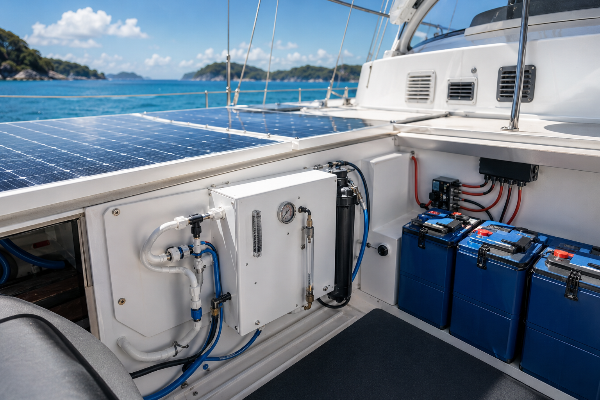
SYSTEM / SPECIFICATIONS
DC24V — BM-SF700-1
- 800 W · connects direct to solar panels or battery bank
- no generator required
- 700 L/day off-grid
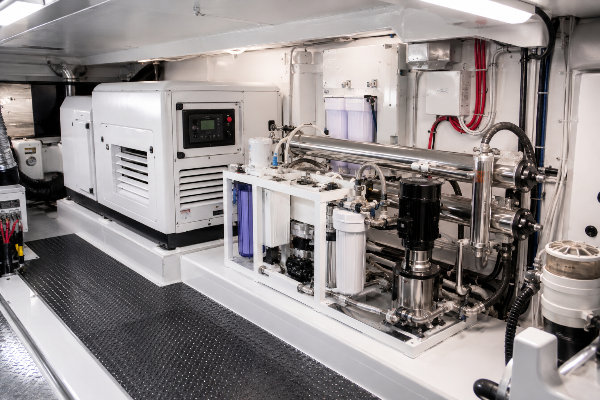
SYSTEM / SPECIFICATIONS
AC220V — SF700-2 / 1400 / 2000
- 1.6 kW · ship generator or shore power / large inverter
- higher output, shorter runtime
- up to 1,992 L/day
The DC path is what real cruisers reach for on smaller boats, because an AC-only system forces a generator you may not want to run, and wasted power is an expensive mistake off-grid. The DC24V BM-SF700-1 works as a sailboat water maker on solar or batteries, a sailor running a 7–8 gph 12-volt system straight off solar called it cost-effective with no reliability issues. Unlike bulky AC-preferred units, whereas those demand a genset, Blue Membrane delivers the pure-DC BM-SF700-1 for the 12 volt marine water makers segment, where a DC-native design avoids the 10–15% loss of an extra AC conversion.
Power draw, in context
Pumps run with Ultra efficient at 85-155 Watts; the other standard DC machines consume between 240-480 Watts and AC machines consume from 330-880 Watts. Using it for a few hours with an AC machine will consume the equivalent of running your genset and this for 100-250 Ah of battery storage will run 15 Gallons, you’ll just have to select a solar array to match what you chose in terms of voltage and amperage.
Given that according to work performed on renewable energy in the USA by NREL, any unnecessary AC conversion wastes efficiency and power, having the equipment that operate in DC will mean better efficiencies on the solar power side, thus eliminating any losses of a separate converter, especially for a solar-powered boat where any unused AC will only end up going back to the batteries, if the system was to do such a conversion. This makes the DC24V unit suitable for the job as it can directly draw from solar or your onboard batteries, the same ones your DC power equipment is running off already, thus saving space as well as resources.
Not sure whether DC or AC fits your battery bank?
Get a free sizing estimate →
Certifications, Safety & Marine-Grade Construction
Given that buying a desalinator from an unknown company can lead to significant risks, a good way to judge it and avoid paying extra for things that aren’t going to matter much is to inspect its quality standards, its construction, certifications and, after having evaluated these factors, make sure the cost is appropriate for the value received, as on a cruise any equipment failure offshore could prove to be extremely costly. Hence, Blue Membrane incorporated multiple protections in all its BM-SF models, as a marine failure could have expensive repercussions offshore.
ISO 9001
Quality management system
NSF 58
RO membrane element grade
Marine-grade SS
All-stainless frame
Drinkable output
Meets national standards
20+ countries
Deployed globally
Every BM-SF is encased in a stainless steel frame that ensures excellent corrosion resistance even in an aggressive salty environment, whether installed in an engine compartment or exposed to the elements in the deck space. Additionally, safety measures have been integrated into the electrical and hydraulic components.
- High/low-pressure protection guards the membrane and high-pressure pump
- Built-in protection for motor overcurrents along with pressure gages and flow meter for monitoring in real time.
- Dual PLC + relay control circuit that ensures stable performance under adverse sea conditions.
Procurement Guide, Pricing Context, Lead Time & Support
You will own this system for a decade or more, so the number that matters is total cost of ownership, not the sticker. And what drives that ten-year number? It is the membrane, the very part we manufacture in-house.
$265–$700
the market cost of a replacement RO membrane — the recurring spend that shapes 10-year ownership, and the component Blue Membrane produces in-house
Source: trade-forum market data (trawlerforum.com); membrane life 3–7 years by condition
What actually drives your price
Blue Membrane quotes to your specific application, instead of throwing out a number, because these variables impact your specific figure differently for every boat.
| Factor | Effect on price |
|---|---|
| Model & output (700–2,000 L/day) | Higher output → higher unit cost |
| Power configuration (DC24V vs AC220V) | DC solar-ready vs AC genset differ |
| OEM / ODM & private-label branding | Custom spec and label add tooling |
| Order volume & spare-parts package | Volume and spares lower per-unit cost |
| Destination & shipping terms | Freight and duties by market |
Click to flip & read specs
Buyer note: protect the membrane, protect the budget
A $15 pre-filter protects an $800 membrane, a deferred pre-filter change is the most frequent cause of early membrane death. Budget pre-filters every 3–6 months and a membrane clean at 6–12 months, and factor a spare-parts kit, pre-filters, membrane, and through-hull fittings, into the first order if your vessel will run remotely.
Sourcing directly from the factory shortens the spare-parts chain that strands assembler-brand owners in distant ports. Worldwide salinity varies widely, so the USGS water science reference on saline water is a useful check when you map your cruising ground to inlet TDS before specifying a system.
Engineering Hub
Marine Water Maker Planning Tools
Access our suite of precision calculators and estimators designed to help you dimension the right marine water maker, forecast power budgets, and project 10-year total cost of ownership. Select a tool below to begin your configuration.
How much does a marine water maker cost?
Premium imported marine water makers range from about $3,200 to $16,000+ before installation, with professional install adding $500–$5,000. A factory-direct manufacturer cut out the dealer markup, and Blue Membrane can quote directly for your model, power option, and order volume. Request a quote today.
Can you drink water from a watermaker?
Yes! The Blue Membrane Reverse Osmosis system removes 98% of the salt and provides product that falls under 700 ppm TDS, meeting National Drinking Water standards, and does so without the need for any chemical treatment. An on-board flow meter and pressure gauge will enable you to verify the water quality before it goes into your tank.
How long do watermaker membranes last?
Marine RO membranes are generally rated at 3-7 years of service – 5-7 with disciplined maintenance and a cleaner environment, but potentially as short as 2-3 in more turbulent or poorly maintained conditions. A $15 pre-filter and freshwater flushing after each use is very inexpensive insurance for an $800 membrane, and you’ll always have a replacement available through us.
Do I need a generator to power a marine water maker?
Not for the DC model. The BM-SF700-1 is designed to run directly from DC24V solar or a battery bank, which is why off-grid sailors favor it. The AC220V systems (SF700-2, SF1400-2, and SF2000-2) operate from shore power, a generator, or a large inverter, offering greater output and faster fill times.
How do I choose the best marine water maker for my boat?
A watermaker should be sized for your daily consumption not maximum output, as oversizing it only wastes power and battery capacity. In fact, the best marine water maker for most people isn’t the biggest one on the market. A cruising couple uses 10-18 gallons per day, so a DC BM-SF700-1 covers a small off-grid sailboat while a BM-SF1400-2 or BM-SF2000-2 suits a larger crew. Use the Vessel-to-Output Sizing Matrix above to map your vessel, crew, and power source to a BM-SF model, or simply tell us what you’re looking for.
Trending now