Get in touch with Blue Membrane Company

![Compatibility & Cross-Reference Chart Guide [2026]](https://bluemembrane.com/wp-content/uploads/2026/07/ro-membrane-cross-reference-guide-featured-1.png)
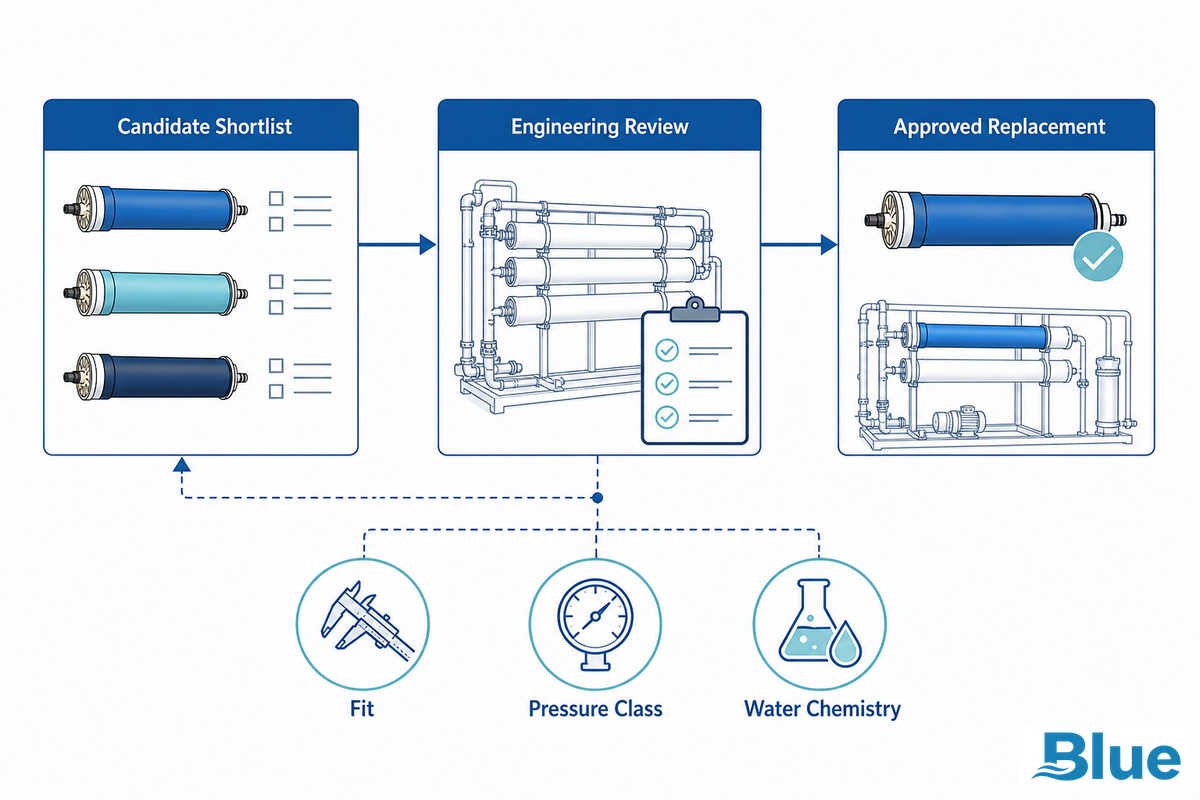
A Compatibility & Cross-Reference Chart is a shortlist document for comparing possible RO membrane replacement candidates against an original model. When the original element name, manufacturer, or product line changes, a Compatibility & Cross-Reference chart helps a buyer find possible RO membrane replacement models. Think of it as a shortlist tool, not final approval. Even a safe match still needs size, pressure class, feed water, rejection target, chemistry, vessel fit, and normalized performance data.
To look up models, start with Blue Membrane’s Compatibility & Cross-Reference chart. Use the checks below before a purchase order, RFQ, or plant change request leaves your desk.
What a Compatibility & Cross-Reference Chart Can Decide
Used well, a membrane cross reference can answer the first buyer question: “Which replacement membranes should be reviewed for this existing model?” Most charts compare model families, element format, application class, and expected performance band. That first screen saves time across RO, NF, brackish water, seawater, low pressure, and fouling-resistant products.
No chart can decide every operating risk. Nor does a chart match prove the same water quality result, the same cleaning response, the same certification scope, or the same energy profile in a working system. AWWA describes membrane processes as part of water treatment system design, including microfiltration, ultrafiltration, nanofiltration, reverse osmosis, and electrodialysis; that process-level framing is broader than a one-line model equivalent. AWWA membrane process reference. FDA’s reverse osmosis guide also treats RO as an operating process, not a chart-only replacement decision.
Right use is simple: use the chart to narrow the field, then use plant data to confirm whether the element can work in the real system condition. Good membrane selection starts with that boundary.
Blue Membrane engineers treat a 4040 or 8040 cross-reference result as a risk screen, not final sign-off, because vessel fit, certified scope, and water chemistry can split two similar models. For an industrial buyer or OEM team, the precision review should include 24 hours of startup data and a 30 days trend.
The 6-Field No-Blind-Swap Safety Check
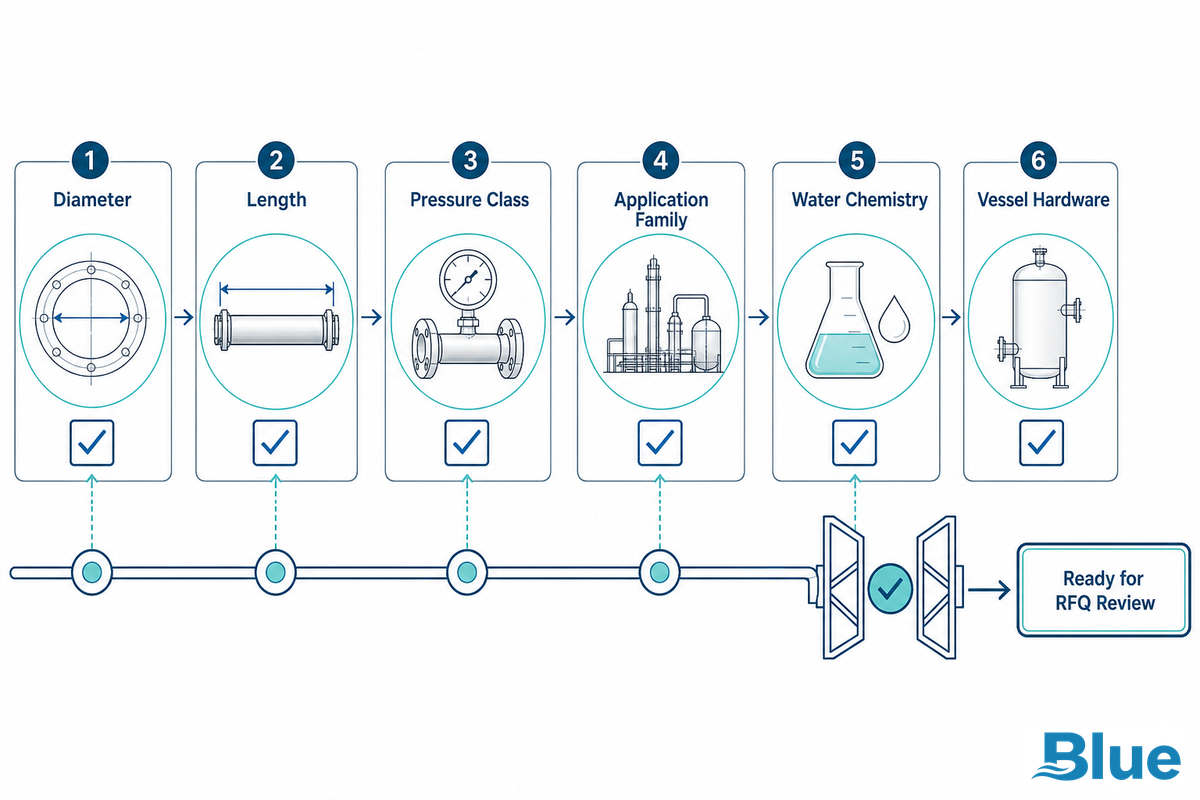
Safe replacement review turns a cross reference chart into six evidence fields. If any field is missing, treat the match as a candidate, not an approval. Choose the candidate only after the missing field has been checked against the actual system.
| Field | What to verify | Why it matters | When to ask engineering |
|---|---|---|---|
| 1. Element size | 4-inch, 8-inch, 40-inch length, diameter, end configuration | 4040 and 8040 names start the review but do not prove vessel fit | Adapters, brine seals, or vessel age are uncertain |
| 2. Pressure class | ULP, BWRO, SWRO, high recovery, or NF duty | Operating pressure changes flux, salt passage, recovery, and energy load | Feed pressure or recovery is close to a design limit |
| 3. Application family | Industrial process water, municipal, desalination, wastewater reuse, food and beverage, or commercial purification | Identical model format can face very different fouling and cleaning stress | New application differs from the old membrane duty |
| 4. Feed water chemistry | TDS, SDI, TOC/COD, oxidizer exposure, pH, temperature, and scaling risk | ASTM D4195 covers water analysis for RO and NF application, including projections tied to salt rejection, permeate flow, recovery, and pretreatment needs. ASTM D4195-23 summary | Feed water changed since the original element was selected |
| 5. Rejection and flow target | Required permeate quality, salt rejection, permeate flow, recovery, and normalized trend | Raw readings can shift with pressure, temperature, conversion, and feed concentration; ASTM D4516 addresses RO performance standardization. ASTM D4516 reference | Catalog conditions differ from plant readings |
| 6. Certification and hardware scope | NSF/ANSI 58 or NSF/ANSI/CAN 61 needs, product water tube, seals, adapters, feed spacer, active area | Certification and hardware details are model-specific, not brand-family proof. NSF listings are one way to check potable-water component scope. NSF official listing example | Project has potable water, OEM, or distributor certification requirements |
This table is the No-Blind-Swap Check: a cross reference chart supplies the candidate model, while the six fields decide whether the candidate deserves engineering approval.
Why 4040 and 8040 Size Matches Are Not Enough for the Right Membrane
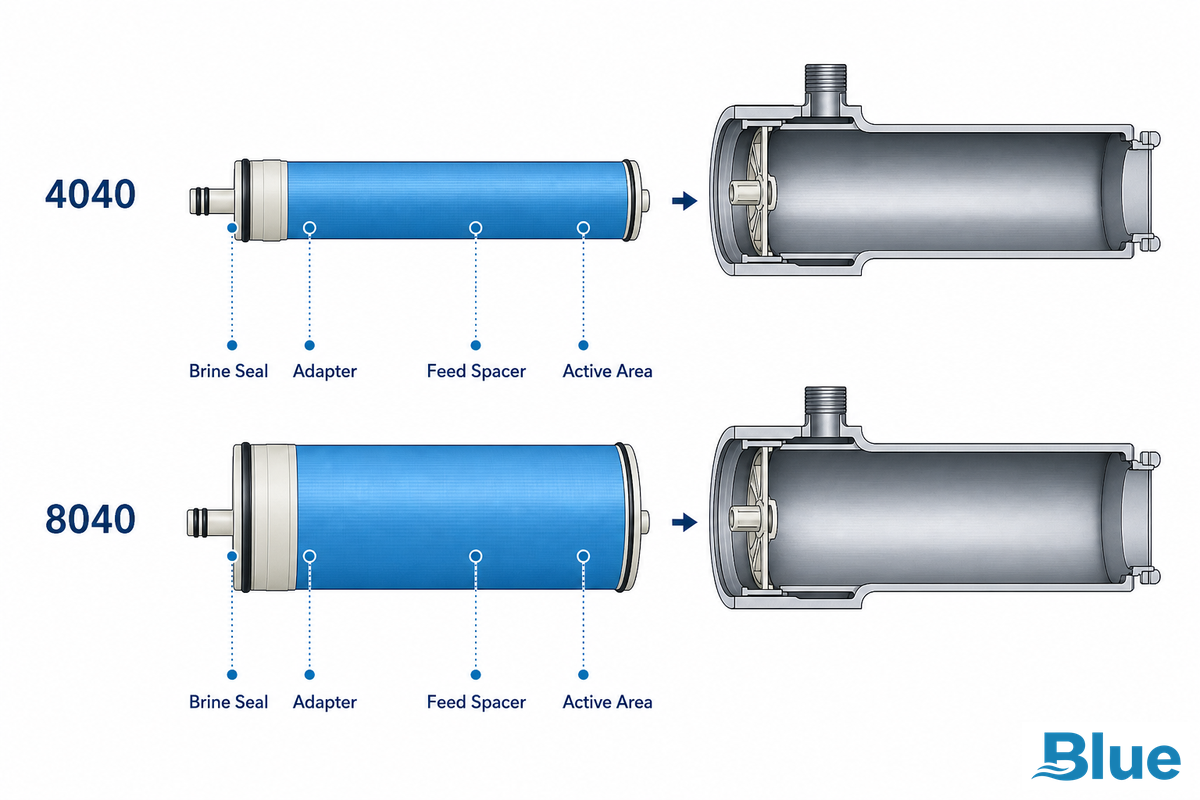
4040 and 8040 are helpful shorthand because they point to common 4-inch and 8-inch diameter element formats with 40-inch nominal length. Trouble starts when buyers stop there. Even with the same size, an element can still differ in feed spacer design, membrane area, brine seal detail, pressure drop behavior, and certified use scope.
Before approving a low-risk replacement, ask whether the new element fits the same pressure vessel, adapter set, interconnector layout, brine seal direction, and array position. Next, ask whether the membrane sheet chemistry and spacer geometry fit the water. Even if a membrane element looks right in the vessel, it can still create a different flow split, pressure drop, or fouling pattern.
Point-of-use drinking water standards add another boundary. NSF/ANSI 58 covers residential or point-of-use RO drinking water treatment systems and related claims such as material safety, structural integrity, TDS reduction, efficiency, recovery, and contaminant reduction. That is useful context, but it is not an industrial 8040 equivalence rule. NSF/ANSI 58 overview.
Blue Membrane engineers treat this as a precision fit risk because a 40 in label cannot show seal direction, adapter wear, or certified scope. For an industrial buyer or OEM team, the application review should include 24 hours of startup behavior and a 30 days trend before accepting the size match.
Pressure-Class Fault Lines: ULP, BWRO, SWRO, ZLD, and NF
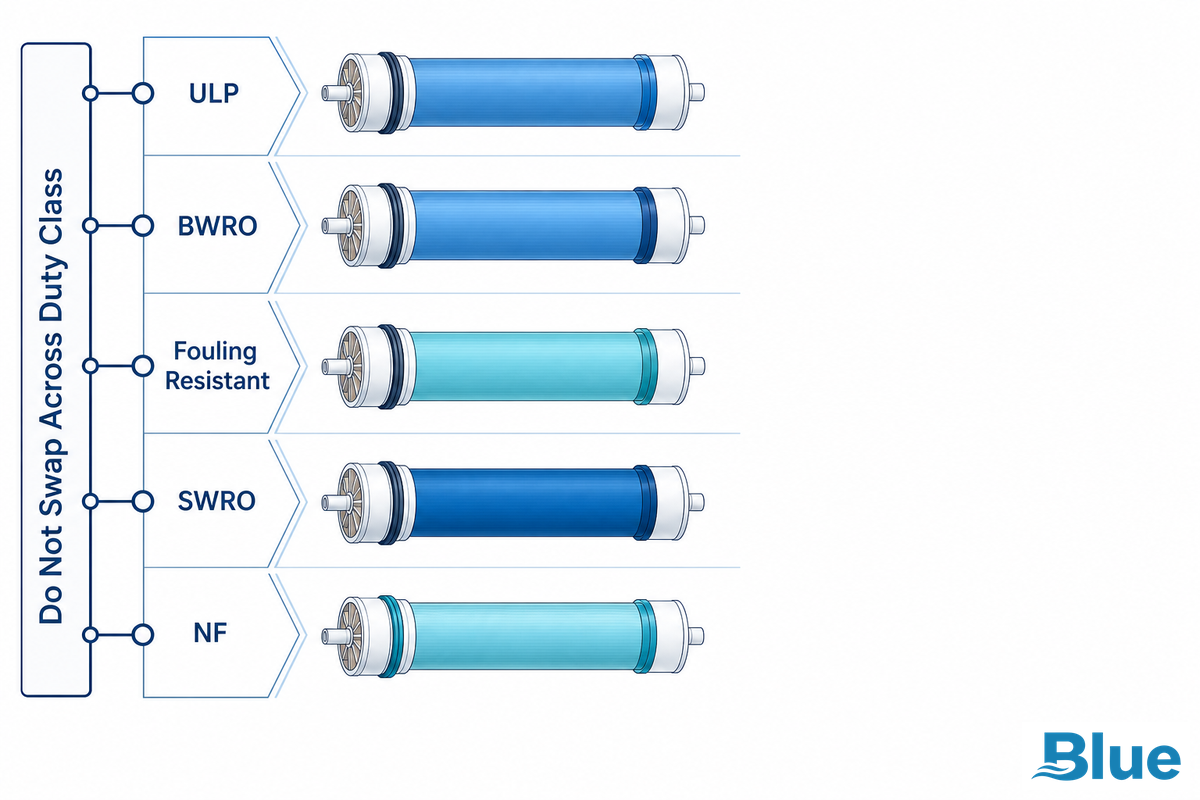
A common mistake is to assume that all high rejection RO membrane elements are the same type of product. The pressure class and application family matter for how the element will perform with feed salinity, recovery, fouling load, and cleaning history.
| Type family | Chart clue | Do not assume | Extra check before replacement |
|---|---|---|---|
| 1. ULP RO membrane | Low pressure or ultra-low pressure label | Lower energy use means the same fouling tolerance | Confirm feed pressure, recovery, and cleaning history |
| 2. Standard BWRO | Brackish water RO family | Any BWRO model fits every brackish water source | Confirm TDS, scaling risk, SDI, and salt rejection target |
| 3. High rejection BWRO | High rejection or premium rejection label | Higher rejection always lowers total operating cost | Review pressure, recovery, and permeate quality need |
| 4. Fouling-resistant BWRO | FR, fouling resistant, low fouling, wastewater reuse clue | Standard BWRO can be replaced without chemistry review | Check TOC/COD, surfactants, cleaning record, and pretreatment |
| 5. SWRO | Seawater RO family | Size match makes it a drop-in for brackish water | Check pressure vessel rating, recovery, and energy profile |
| 6. Low-energy SWRO | Seawater plus low-energy language | Lower pressure keeps the same margin in every intake | Check seasonal salinity, temperature, and pretreatment stability |
| 7. ZLD or high-recovery RO | High recovery, concentrate, or zero-liquid-discharge duty | Standard replacement membranes can handle concentration stress | Review scaling index, concentrate chemistry, and cleaning interval |
| 8. NF membrane | Nanofiltration, NF, selective divalent ion removal | NF is simply “weaker RO” | Check target ions, color, organics, hardness, and rejection profile |
| 9. Certified potable component | NSF/ANSI/CAN 61 or NSF/ANSI 58 context | Certification transfers by family name | Check exact model listing, use condition, and project requirement |
If the target for replacement is low-pressure duty, begin with the Blue Membrane low-pressure ULP elements. Brackish water projects should consider the brackish water RO membrane family. Seawater projects should check the seawater RO membrane page.
Difficult organic or reuse duty is for fouling-resistant RO elements. Selective separation should explore nanofiltration membrane options.
Model Families: FilmTec, Hydranautics, Toray, AXEON, and Blue Membrane
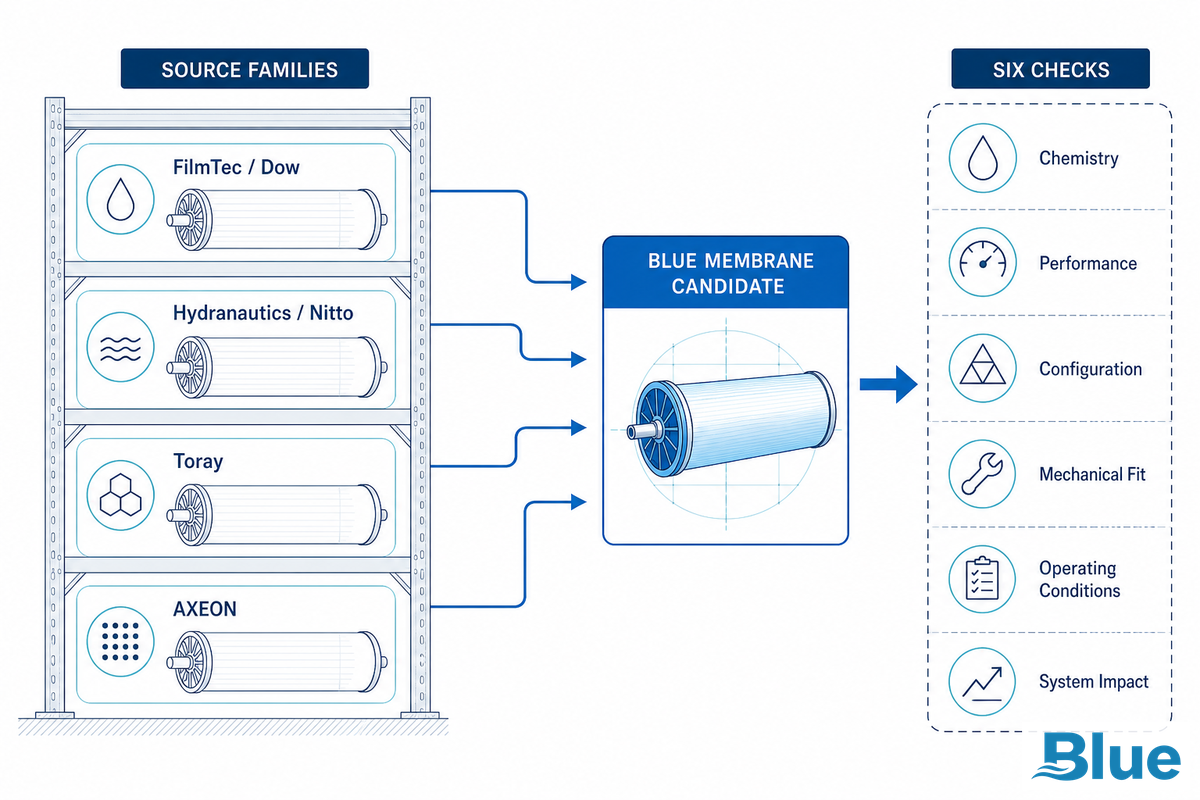
Model-family names guide a user to the correct shelf of a chart. FilmTec, Dow, Hydranautics, Nitto, Toray, AXEON, and Blue Membrane are good search and cross reference entities, not the final match.
Individual manufacturers may present membrane models under various test conditions, product types, certification listings, and application information. Chart data can link a Blue Membrane element to a familiar model family, but the buyer will still need to evaluate the six factors described earlier. This is especially critical when the project includes potable-water certification requirements, OEM documentation, or the need for a clean RFQ packet for a distributor.
Blue Membrane designs and manufactures membrane sheet and spiral wound elements for desalination, ultrapure water, industrial process water, wastewater reuse, food and beverage processing, and commercial purification. The safest path for comparing model families is to correlate a chart to system data, then obtain documented match from the manufacturer, rather than just the family name.
Use the RO membrane elements hub when transitioning from a chart candidate to a product family.
Feedwater, Fouling, and Water Quality Checks Before Replacement
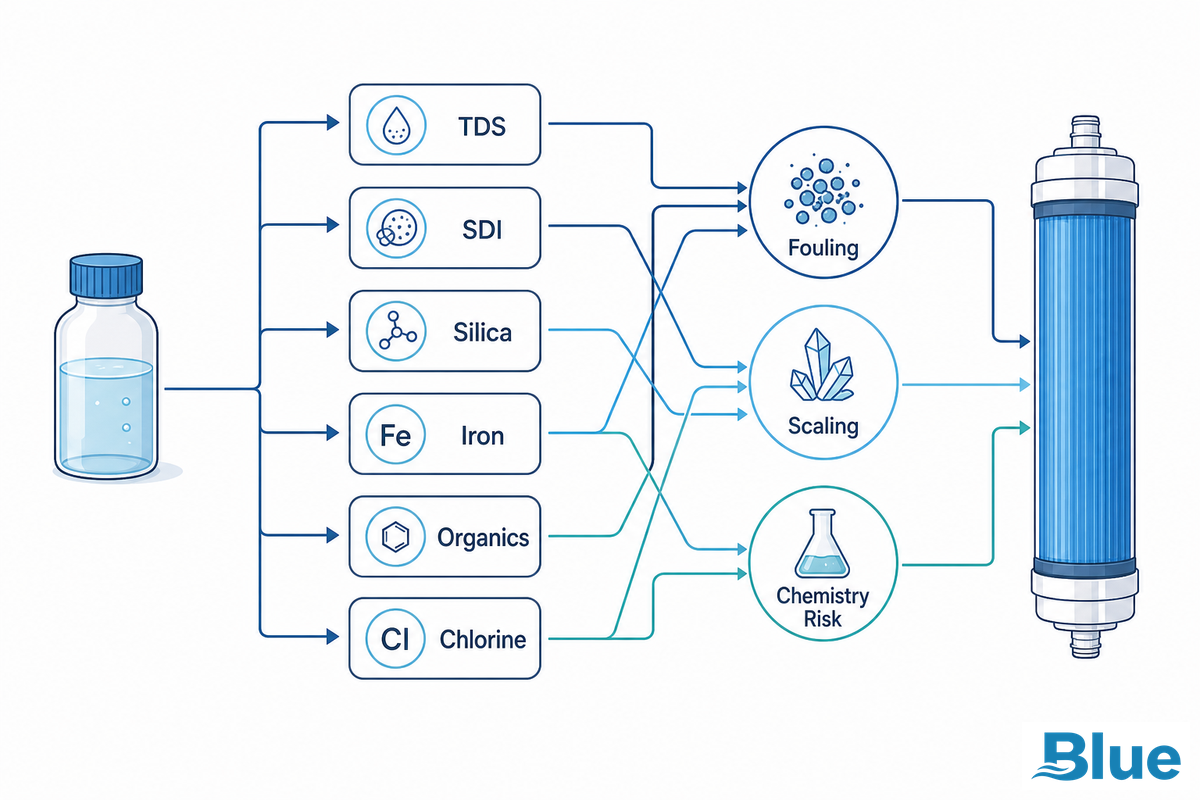
Feed water is where many seemingly innocent chart matches fail.
One feedwater profile won’t predict behavior when raw water composition changes, a pretreatment change is made, a new cleaning chemical is used, or the temperature swings through a filtration system in different seasons.
As a minimum, gather TDS, SDI, TOC or COD if organic matter is a concern, pH range, temperature, oxidizer exposure, antiscalant application, recovery and cleaning history.
While ASTM D4195 can support water analysis during RO/NF application evaluation, do not cite the standard as proof of model equivalence; use feedwater evidence instead during the replacement review.
The practical evidence comes from fouling sources.
A 2023 Heliyon study shows fouling can affect membrane life span, permeability, operating pressure, and the need for frequent cleaning. That study examines monitoring, characterization, mitigation, and the future of fouling control. See the fouling review on PubMed Central.
An RO/NF fouling study from 2024 identified the cause as low molecular weight organic compounds and discussed the role of germicides, surfactants, and phenolic compounds in flux reduction for thin-film composite membranes. See this article for RO/NF organic fouling review.
When conducting replacement work, treat “same size” and “similar rejection” as incomplete when chemistry has changed.
Blue Membrane engineers use feedwater evidence as a production risk check because a fouling problem can fail in 24 hours or appear after 30 days. For industrial buyer and OEM application notes, the certified precision review helps separate membrane selection from pretreatment correction.
The 12-Point Replacement Evidence Sheet
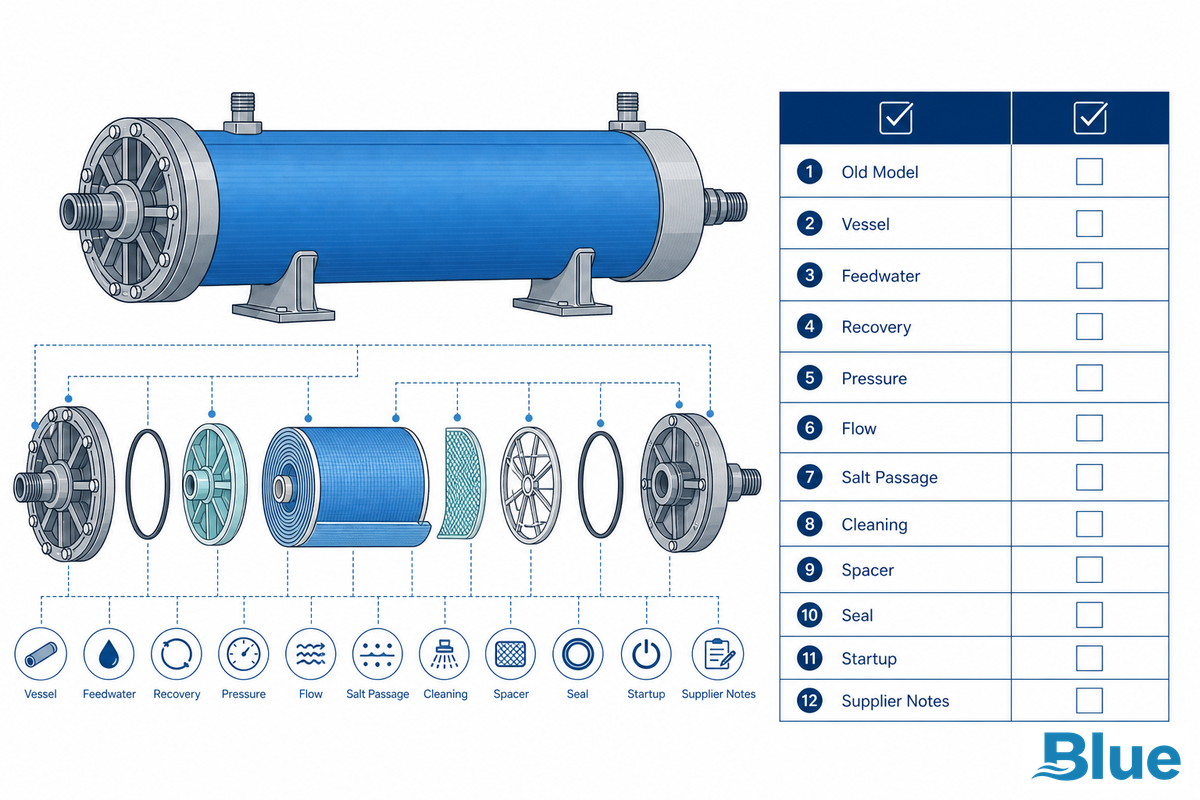
This 12-Point Replacement Evidence Sheet turns a membrane cross reference into an RFQ-ready packet. Better inputs lead to less back-and-forth between the plant, distributor, OEM, and manufacturer.
Blue Membrane provides the evidence sheet as an RFQ guide because missing data creates delay and wrong model risk. For an industrial buyer or OEM team, attaching 24 hours of pressure data and a 30 days conductivity trend makes the certified engineering review specific.
| # | Evidence field | Send this data | Why it protects the match |
|---|---|---|---|
| 1 | Current membrane model | Full model name, brand, and any suffix | Prevents wrong family selection |
| 2 | Element size | 4040, 8040, or other format plus vessel details | Separates nominal size from hardware fit |
| 3 | Array layout | Vessel count, elements per vessel, stage layout | Shows recovery and pressure distribution |
| 4 | Feed pressure | Normal range and recent changes, in psi or bar | Identifies pressure-class mismatch |
| 5 | Recovery | Design and actual recovery percentage | Flags scaling and concentrate stress |
| 6 | Feed TDS | Recent lab or online readings | Supports salt rejection and pressure review |
| 7 | SDI or turbidity | Pretreatment performance trend | Shows particulate fouling risk |
| 8 | Temperature | Average and high/low operating window | Needed for normalized flow comparison |
| 9 | pH and oxidants | Operating pH, cleaning pH, chlorine or oxidizer exposure | Protects membrane chemistry |
| 10 | Cleaning history | Frequency, chemicals, last clean, reason for cleaning | Shows whether replacement is solving the real cause |
| 11 | Required permeate quality | Conductivity, TDS, silica, hardness, boron, or application-specific target | Clarifies the true rejection requirement |
| 12 | Normalized performance baseline | Permeate flow, salt passage, pressure drop, and recovery after standardization | Connects startup data to ASTM D4516-style performance review |
When the 12 fields are ready, use Blue Membrane’s membrane replacement RFQ readiness check. If you’re still narrowing model families, use the ro membrane cross-reference selector before sending a request.
Post-Replacement Startup Data and Operating Conditions Checks
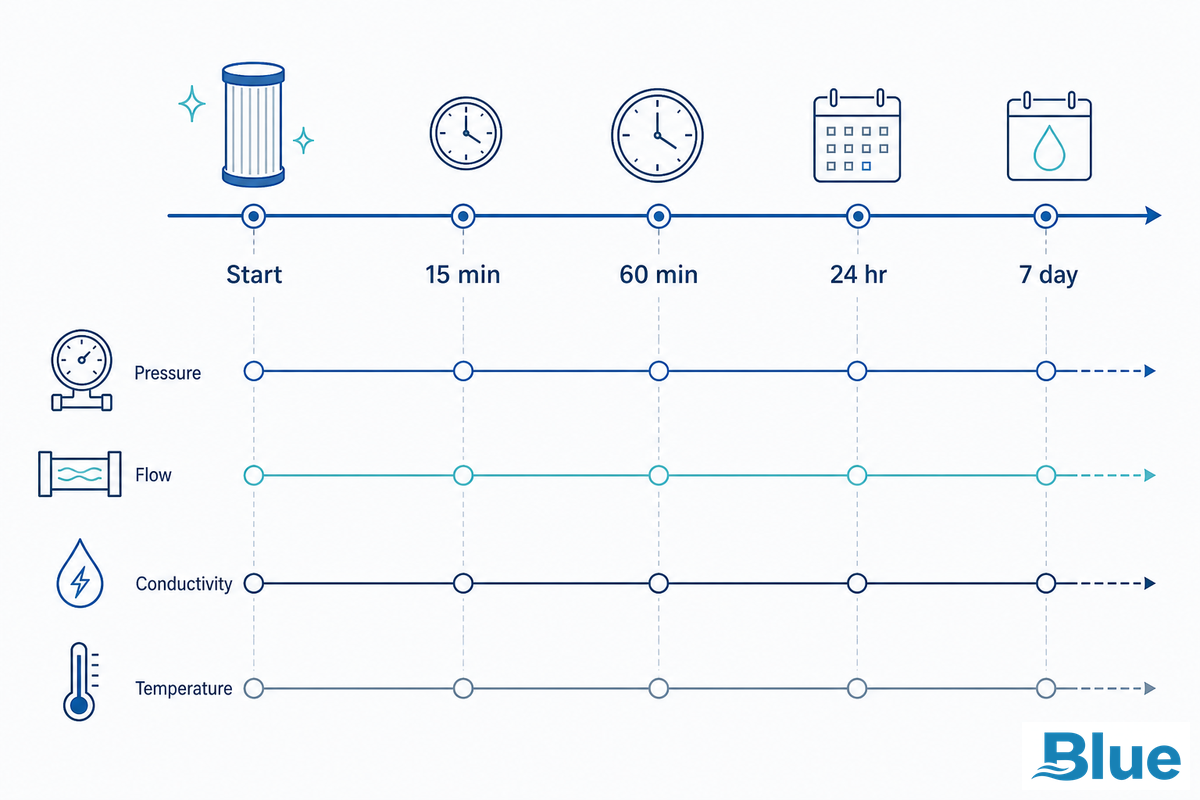
Procurement isn’t the finish line. After installation, compare startup data with the old baseline and the expected condition for the new element under actual operating conditions. Watch permeate flow, salt rejection, pressure drop, differential pressure, product conductivity, recovery, and normalized performance trend.
Do not judge the new membrane by raw flow alone. Pressure, feed concentration, temperature, and conversion can move the numbers. ASTM D4516 exists because RO performance data needs standardization before it is compared. A replacement that looks strong on day 1 can still be wrong if normalized salt passage, pressure drop, or recovery behaves differently after a stable run period. In quality-sensitive process settings, FDA’s reverse osmosis guide is a useful reminder that RO performance belongs in operating records, not only product selection files.
Field teams can use a simple 3-reading habit: record startup, record after the system stabilizes, and record again after the first cleaning or first water-source change. If one value move sharply, review installation first, then feedwater, then product selection.
A commissioning log can use columns such as 0 hours, 15 min, 60 min, 24 hours, 48 hours, 7 days, 14 days, 30 days, and 90 days; record membrane age such as 2 years and cleaning interval such as 3 months, 6 months, 12 months, 18 months, or 24 months only when those values are known. Buyers sometimes convert 4040 and 8040 nominal formats to about 101.6 mm or 203.2 mm diameter and about 1,016 mm length, but those dimensions still don’t replace vessel confirmation. Local alarm bands should be labeled as investigation triggers, not automatic rejection rules.
What Is Changing in RO Membrane Replacement in 2026
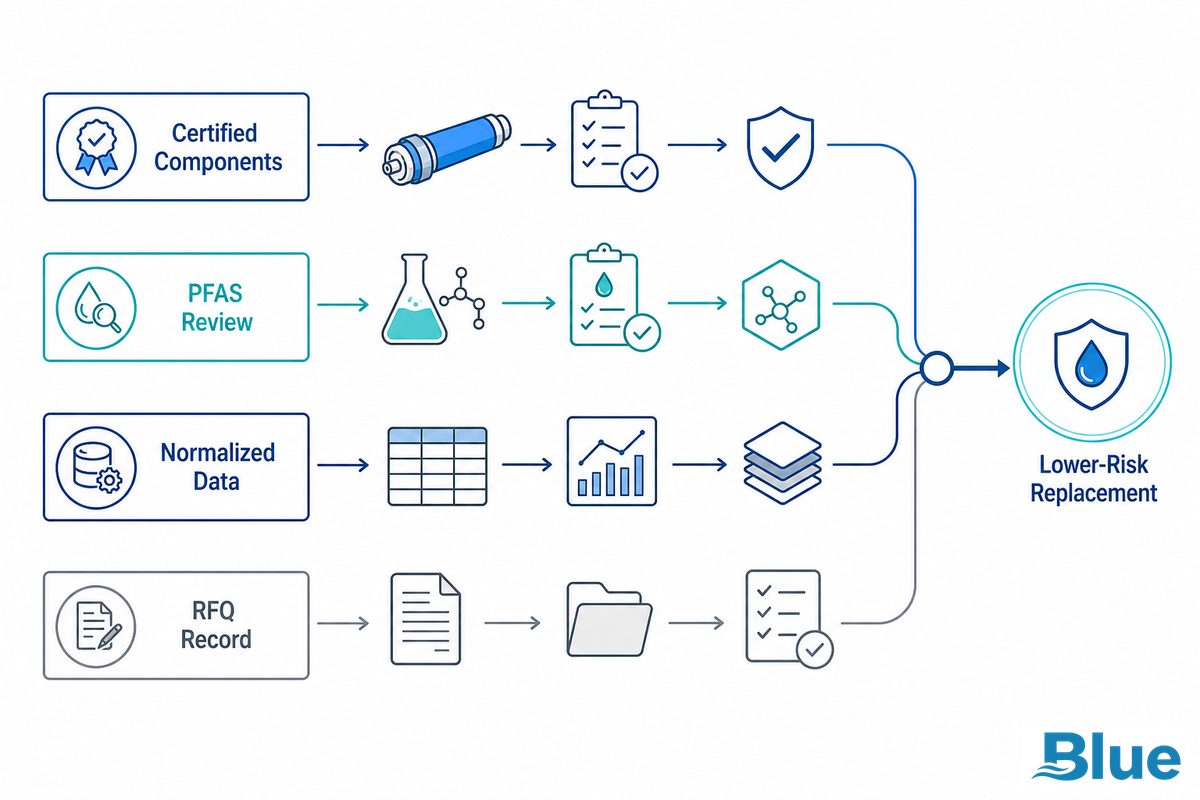
Buyers don’t need more charts as much as they need better documented replacement decisions. Low-volume exact searches such as membrane cross reference chart often carry high commercial intent, while broader replacement searches show that users also need education before model lookup.
Regulatory and standards discussions add a second reason for caution, especially in drinking-water contexts. EPA PFAS materials discuss certified filters and manufacturer replacement instructions. EPA PFAS filter guidance. This doesn’t mean every RO system needs an immediate membrane swap. Documentation, certification scope, and replacement instructions deserve more attention, and teams should verify current rules before treating a regulation as a replacement trigger.
Blue Membrane provides this 2026 section as a documentation risk guide because a regulatory note can fail when buyers treat it as a direct replacement order. For industrial buyer and OEM teams, the review should compare certified scope, 24 hours of operating notes, and a 30 days record before changing the membrane family.
Across industrial projects, the practical change is the same: a cross reference chart should feed a documented review, not replace it. To sort 8040 applications, Blue Membrane’s 8040 application and pressure path selector can help route the next step.
FAQ
Is a cross-reference chart enough to approve an RO membrane replacement?
No. One cross-reference chart should get you on a shortlist, but the approval process requires the system data behind both the new and old element. Size, pressure class, application family, feed water chemistry, rejection and flow target, vessel fit, certification scope if any, and normalized startup performance must be assessed before classifying a match as approved. Even with a well-known replacement model, in a system where feed water is changing, keep the unit on candidate status until the operating data and manufacturer review match.
Can I replace a FilmTec or Hydranautics membrane with a Blue Membrane model?
Usually, but model number is just the first step. Use Blue Membrane’s cross-reference page to find candidate replacement membranes, then send the 12-point evidence sheet for review. The stronger match is the one that fits the vessel, pressure class, feed water, rejection target, certification need, and operating history, not only the brand family shown in the chart.
Why does the same 8040 size not guarantee compatibility?
8040 tells you it’s generally 8-inches by 40-inches but not that it has the same membrane area, feed spacer behavior, end config, brine seal fit, pressure-drop profile or application duty. Two 8040 elements might fit your vessel but will perform differently under fouling, temperature, recovery, or feed chemistry stress. Review the hardware first and compare normalized flow, salt passage, pressure drop and product conductivity after startup.
Which feedwater data should I send before asking for a replacement match?
Submit current TDS, SDI, temperature, pH, recovery, feed pressure, permeate quality target, any known exposure to oxidizers or organics, and a brief cleaning history. If the system process any feed, waste water recycle, food and beverage, or seawater, be sure to share any pertinent application information and note pretreatment so the manufacturer can assess chemical risk. Old lab data are valuable if dated and the current pretreatment is noted.
When should I use NF instead of an RO replacement?
Select NF if you’re seeking removal of select ions, such as hardness, color, larger organic species, or certain multivalent species instead of full desalination. NF isn’t a weakened RO. It has its own rejection, pressure window, and application logic, so a review of the chart will involve comparing the desired contaminant removal and water quality against the application’s properties. When salt rejection is the primary concern, RO is a more suitable family, and when soft or demineralized water is desired, a separate NF review is appropriate. This question should be answered before model matching starts. Ask what must pass, what may remain, and what the downstream process can tolerate. A cross-reference chart can then point to RO or NF candidates without forcing the buyer into the wrong membrane family.
References
- AWWA – Membrane Processes
- ASTM D4195-23 – Water Analysis for RO/NF Application
- ASTM D4516 – Standardizing RO Performance Data
- NSF/ANSI 58 – RO Drinking Water Treatment Systems
- NSF Official Listings – RO Elements Example
- Fouling in Reverse Osmosis Membranes – PubMed Central
- RO/NF Fouling by Low Molecular Weight Organic Compounds – PubMed Central
- EPA – Identifying Drinking Water Filters Certified to Reduce PFAS