Get in touch with Blue Membrane Company

Blue Membrane · Seawater RO Systems
Containerized & Skid-Mounted Seawater RO (SWRO) Systems
Factory-direct desalination systems, built by the company that make the membrane inside them.
Blue Membrane designs and fabricates containerized and skid-mounted SWRO plants for islands, offshore facilities, and coastal industrial facilities where salty and corrosive water, combined with no available infrastructure, is the single biggest hurdle. Our RO membrane sheets are fabricated internally, then our spiral-wound membranes and a whole plant system (pretreatment, high-pressure pumps, membranes, and controls) are fitted inside an industry standard 20-foot shipping container or on a prewired skid. Each plant is built, tested and shipped from the factory ready to connect to the feed and electricity.
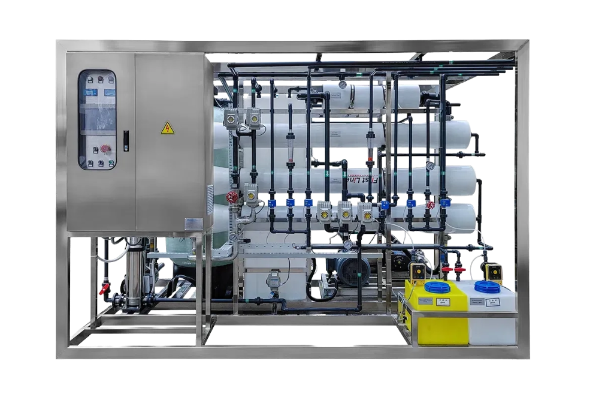
Seawater Is Corrosive, Remote, and Unforgiving, and Standard RO Skids Aren’t Built for It
How the Desalination Process Works
Inside every containerized water treatment plant, the reverse osmosis process starts with pre-treatment: raw water and feed seawater pass through a microfiltration system that removes suspended and dissolved solids before the membranes. High pressure then drives the pre-treated water across the membrane, which rejects the salts from seawater to purify the stream into potable water and safe drinking water.
Seawater desalination converts saline water — ocean water and salt water at full strength — into desalinated water and pure water. Where thermal desalination boils it, this seawater reverse osmosis system uses reverse osmosis desalination instead, the lower-energy route for sea water reverse osmosis, sea water desalination, and everyday seawater treatment. The permeate is purified water clean enough for drinking-water quality, or polished to demineralized purity.
Why 2.0 MPa+ Matters
Seawater desalination only works once feed pressure exceeds the osmotic pressure of the brine. This compact system incorporates a 3.5-5.5 MPa high pressure circuit with over-pressure release above 6.2 MPa and a low pressure shutdown system that closes the system at less than 0.05 MPa; the two systems required for a membrane protecting unmanned island installation.
Unlike a repurposed commercial skid, this loop is engineered to hold pressure, because chloride at 35,000 ppm will seize an undersized pump and destroy the 99% salt rejection the membranes deliver. On our side, Blue Membrane engineers each build to the duty, request a spec sheet to confirm it against your feed analysis.
Blue Membrane Containerized & Skid-Mounted SWRO, Models & Configurations
We construct three field tested systems, each having been successfully delivered and operationalised. The capacities are scaled to meet the salinities and your day rate; example shipping specifications follow – we have rounded them a bit.
Containerized · Island / Coastal
65 TPD Container SWRO Plant
- Permeate2,700 L/h
- Product TDS<500 mg/L
- Recovery35%
- Pressure3.5–5.5 MPa
- Power17.2 kW
- Supply380V/50Hz/3ph
- Enclosure20-ft, IP54
- Membrane8040 × 4
Skid · FPSO Topside
200 m³/day Skid SWRO
- Fresh water200 m³/day
- Product<300 ppm
- Recovery≈33%
- Raw flow25 m³/h
- Power≈74 kW
- Supply690VAC 50Hz
- ControlPLC, IP44
- ClassBV
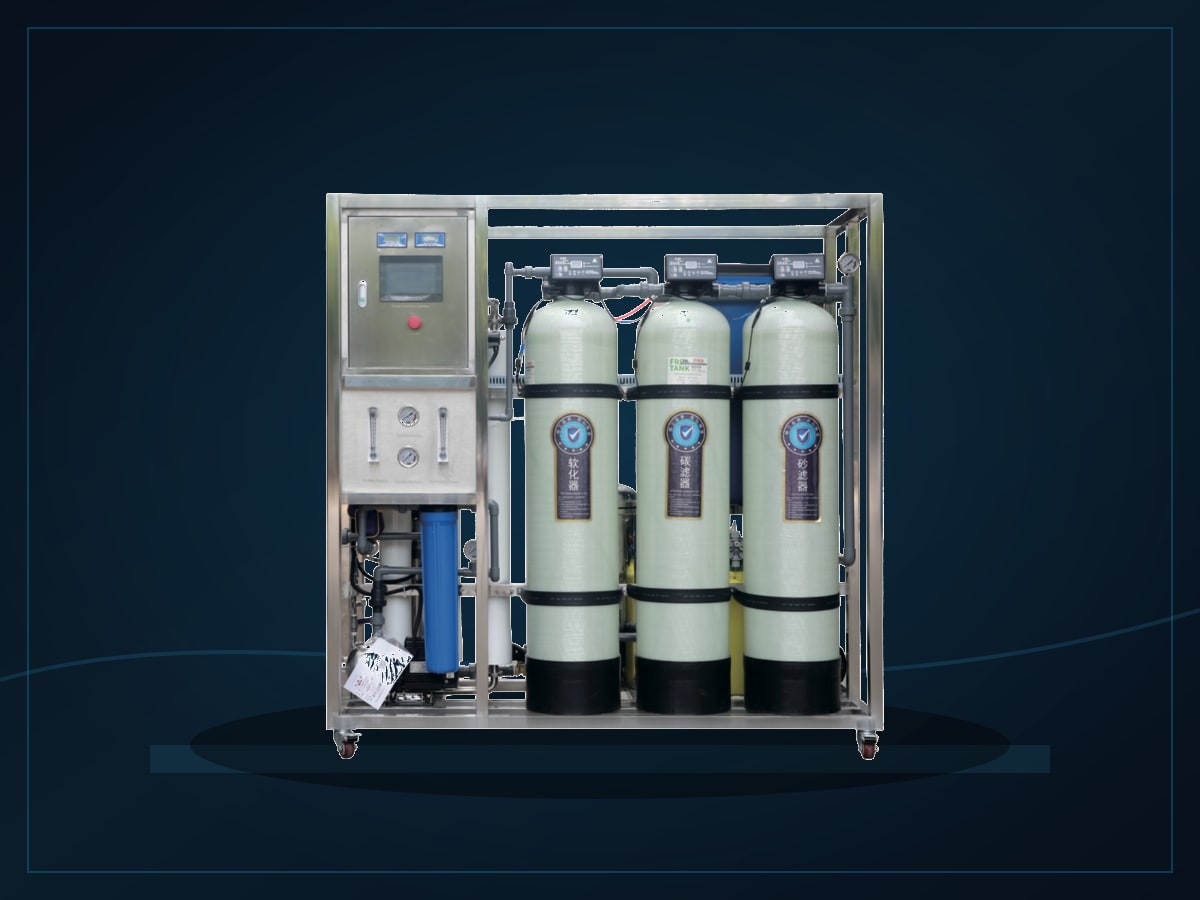
Skid · Two-Stage Demin
45 m³/day Skid SWRO + Demin
- Stage 1 fresh45 m³/day
- Stage 1 TDS≤300 ppm
- Stage 2 demin5 m³/day
- Stage 2 TDS≤5 ppm
- Recovery≈26%
- Power24–25.5 kW
- Supply690VAC 50Hz
- ClassBV
Inside a Blue Membrane Containerized RO System
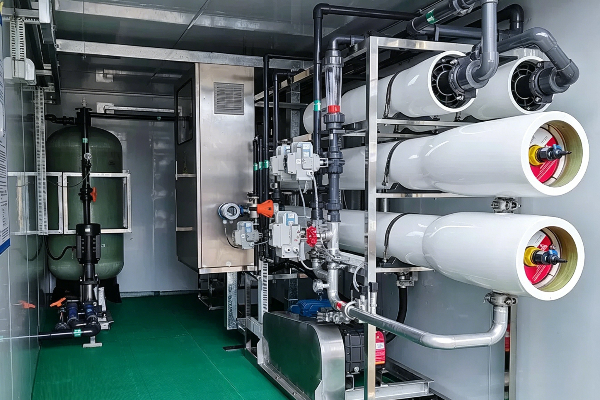
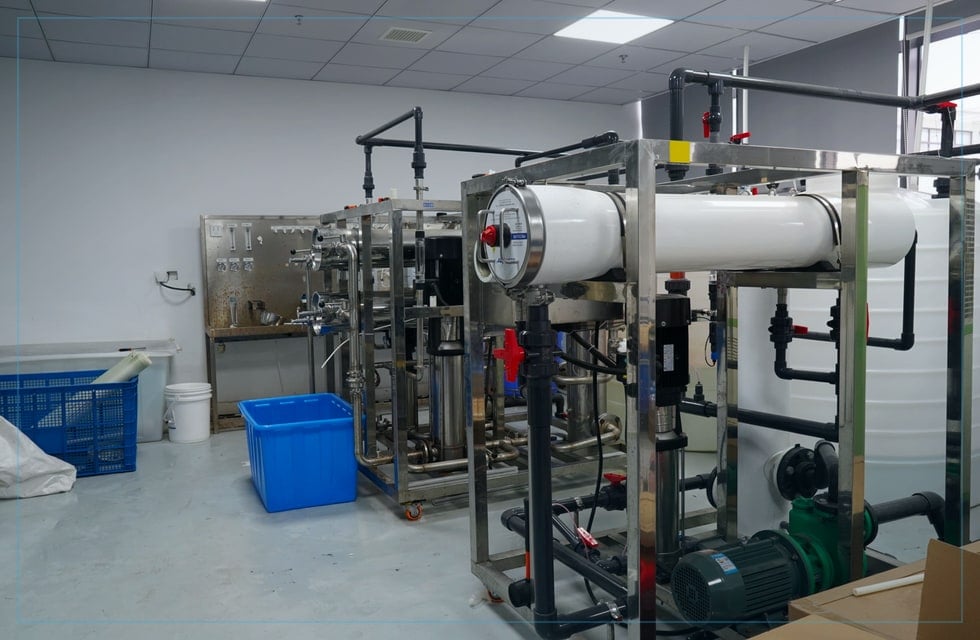
Every Containerized Reverse Osmosis System Ships the Whole Deal in One Skid. A Containerized RO System – also referred to as a Mobile Reverse Osmosis System or a Containerized RO Unit – will ship pre-plumbed and pre-wired on a containerized frame the feed pump, multimedia and precision filters, high-pressure pump, membrane pressure vessels, control valves and a CIP circuit. What you receive is a finished Containerized RO plant, Wet Tested at the factory prior to leaving Nantong.
A hidden risk here is a system spec’d to a brochure capacity that then fails within 500 hours on a real 35,000 ppm feed. Unlike vendors who assemble around bought-in membranes, Blue Membrane engineers each membrane train to the salinity you send us.
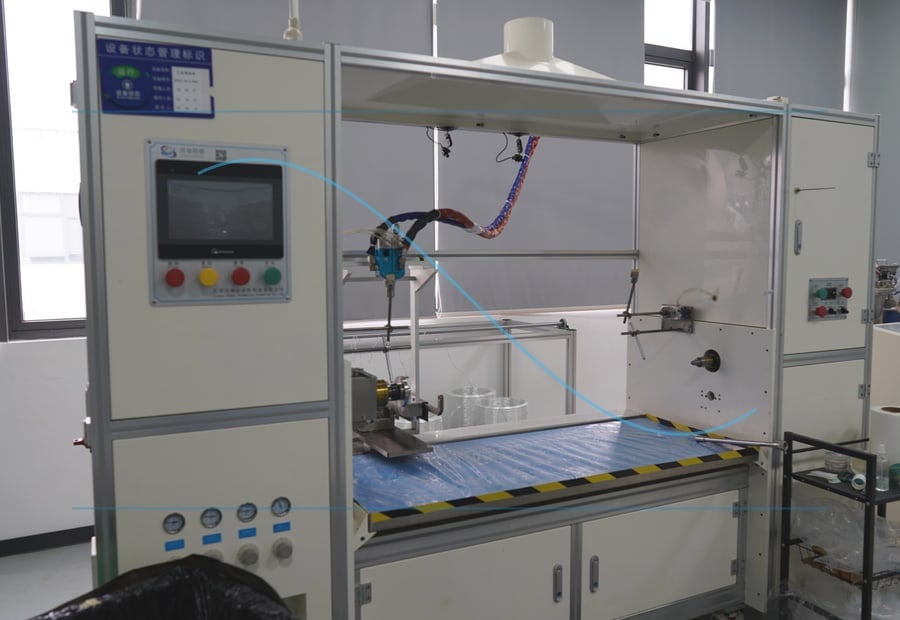
Hover to inspect system data
SYSTEM ARCHITECTURE
System Build, Dosing & Controls
Each containerized system ships pre-assembled — a reverse osmosis water treatment unit whose membrane filtration, chemical dosing, and discharge systems are wired as one. Control systems automate the dosing systems, track water pressure and flow rates, and log system performance so RO membrane fouling is caught before it cuts system efficiency.
This membrane technology packages industrial RO and containerized RO water systems into reverse osmosis units that scale from a single RO unit to multi-train RO plants. Each containerized water treatment build is a self-contained water treatment plant — a turnkey system, a water solution, and a reverse osmosis plant delivering steady water production and reliable RO water.
The Membrane-Maker Spec Disclosure Table
Vendors will show a picture and a capacity. But since we manufacture both membranes and integrate plants, you see the full duty envelope-all the specs an engineer need to size a job.
| Parameter | 65 TPD Container | 200 m³/day Skid | 45 m³/day Skid (2-stage) |
|---|---|---|---|
| Product water | 2,700 L/h | 200 m³/day | 45 + 5 m³/day |
| Product TDS | <500 mg/L | <300 ppm | ≤300 / ≤5 ppm |
| Feed salinity | Seawater | 30,580–35,690 ppm | 30,580–35,690 ppm |
| Recovery rate | 35% | ≈33% | ≈26% |
| Power draw | 17.2 kW | ≈74 kW | 24–25.5 kW |
| Power supply | 380V/50Hz/3ph | 690VAC 50Hz | 690VAC 50Hz |
| HP metallurgy | 2205 duplex + SUS316L | Marine-grade | Marine-grade |
| Membrane element | 8040 × 4 | Spiral-wound SWRO | Spiral-wound SWRO |
| Enclosure / class | 20-ft, IP54 | Skid, BV, IP44 | Skid, BV, IP44 |
Since our 8040, 4040, 4021, and 2540 membrane elements are built in house, any element, and any future replacement, comes from one place. (ISO/TC 282 water)
Decision Matrix, Which Platform Fits Your Site
| If your site is… | Daily need | Best-fit platform | Why |
|---|---|---|---|
| Island resort / coastal factory | ~65 TPD potable | 65 TPD Container | GB5749-2022 drinking water, self-contained plant room |
| FPSO / offshore process water | 200 m³/day | 200 m³/day Skid | 690V marine power, BV class, one-stage RO |
| Offshore needing demin water | 45 + 5 m³/day | 45 m³/day Two-Stage | Second RO pass delivers ≤5 ppm demin |
Need a capacity between these points?
Get a custom capacity quote
Containerized vs Skid-Mounted vs Field-Erected, A Data-Driven Comparison
Format choice is a trade-off in cost, schedule, and how easily the plant move. Field-erected plants win on very large municipal scale; for the 45–200 m³/day range, containerized and skid formats deploy faster and relocate.
Why Format Beats Footprint
A costly mistake is choosing a format on footprint alone, then watching a field-erected plant slip weeks and double its 30-day schedule. That happens for a structural reason: on-site assembly exposes every interface to delay, whereas a factory wet-tested unit is engineered to arrive commissioned. In practice, Blue Membrane delivers both containerized and skid formats, wet-tested to ISO-grade procedure before shipment.
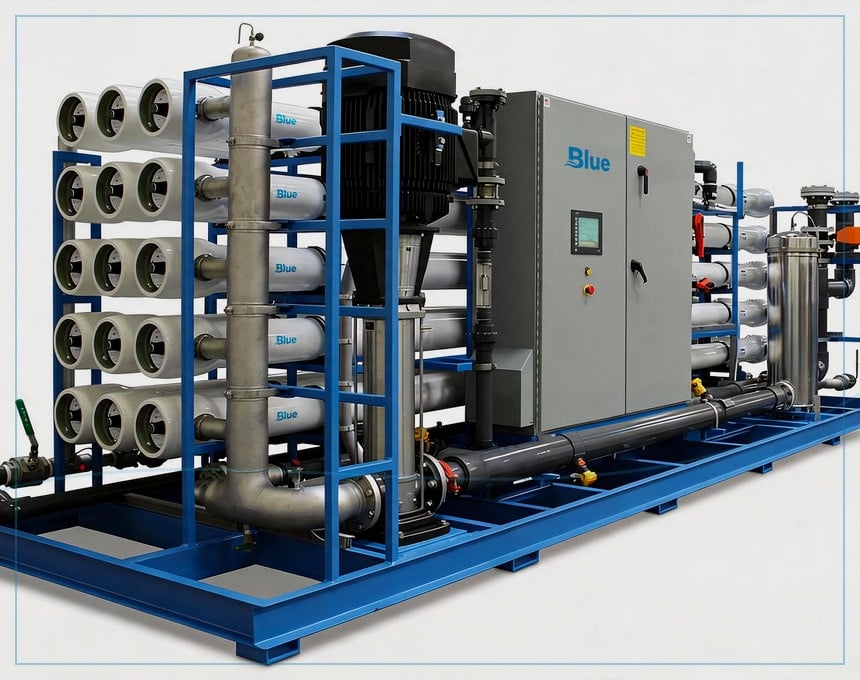
The SWRO Deployment-Format Selector
| Factor | Containerized | Skid-Mounted | Field-Erected |
|---|---|---|---|
| Time to water on site | Days (connect & power) | Days (install on deck) | Weeks–months |
| Factory pre-test | Full wet test | Full wet test | Commissioned on site |
| Footprint | 20-ft ISO block | Open skid frame | Dedicated building |
| Relocatable | Yes — lift & ship | Yes — craned | No |
| Weather protection | Insulated + AC built in | Needs enclosure/shelter | Building |
| Best duty | Islands, remote coast | Offshore decks, integration | Large municipal |
| Typical capacity | Up to ~65 TPD/unit | 45–200 m³/day/unit | 1,000s m³/day |
Both skid and containerized plants commission in days (U.S. DOE) due to pre-assembly on either a skid or in a standard shipping container. Pretreatment, high-pressure pumps, membranes, and controls are integrated before leaving the factory, whether they are dropped onto a skid, for easy installation on a topside or mounted within a shipping container ready to be placed on a foundation and started.
SYSTEM ENGINEERING NOTE
Buyer Advisory, Don’t Undersize the Pretreatment
Each unit is built with Multimedia Filtration (MMF) and two levels of precision filtration, 20m plus 5m before the membrane and include an onboard CIP chemical cleaning system. When you’re dealing with high-turbidity water, specify your pretreatment appropriately-fouled membranes are a far more common cause of stranded assets than undersized pumps.
Field Results, Recovery Economics & What SWRO Actually Costs to Run
Our systems run on real projects: a 65 TPD container producing GB5749-2022 drinking water for island hotels and factories, and 200 m³/day plus 45 m³/day skids supplying process and demineralized water to FPSO topsides. Each ships as complete seawater desalination equipment, factory wet-tested before shipment against its rated salinity envelope.
The Feed-Salinity-to-Recovery Map
Recovery rate is where most SWRO buyers make an expensive mistake: chasing a higher number past the 40–45% sweet spot raises both energy cost and scaling risk, because brine osmotic pressure climbs with every point of recovery. In practice, Blue Membrane engineers our platforms at 26–35% recovery and quantifies the trade-off honestly, unlike vendors who quote a headline recovery they cannot hold on 35,000 ppm feed.
| Recovery band | Energy & cost effect | When it fits |
|---|---|---|
| 26–35% (our platforms) | Lower feed pressure, gentler on membranes | High-salinity seawater, reliability-first, remote sites |
| 40–45% (industry sweet spot) | Best cost-per-m³ balance | Large plants with energy recovery devices |
| >70% | Rising energy, scaling, ultra-high pressure | Rarely on seawater — brackish or special duty |
Industry consensus validates the 40-45% range as the inflection point for increased energy and operating cost due to osmotic pressure rise, and 70%+ requires ultra-high-pressure RO. Our 26-35% recovery for high salinity seawater is not a weakness but an intentional choice made to improve membrane life and reliability for unattended sites.
Where These Systems Deploy
These systems answer water scarcity where a fixed plant cannot go. A containerized or mobile desalination unit supports rapid deployment for disaster relief, island municipal water, offshore industrial water, and mobile water production at a remote water source.
One water desalination platform handles a seawater desalination system, a brackish reverse osmosis plant, or a compact desalination plant, so this RO technology gives one water purification solution across mixed water sources. That flexibility makes a containerized water purification plant the practical answer to desalinate seawater for industrial water and municipal water alike.
“We size seawater trains for the salinity we’ll actually see offshore, not the brochure number. Running a lower recovery on a 35,000 ppm feed keeps the tail-element flux sane, that’s what makes a membrane last on a platform no one visits weekly.”— Blue Membrane Engineering Team, Nantong, China
Hover to read engineering note
Seawater RO’s real operating cost is dominated by the high-pressure pump, which draws 60–70% of total energy (USPTO US7550088B2); industry water-cost figures land around $0.50–1.00 per m³ depending on scale and energy price. Blue Membrane cannot audit your local power tariff, so we give you the real kW draw instead of a headline payback.
17.2–74 kW
Measured power draw across our 65 TPD, 45 m³/day, and 200 m³/day platforms — the honest input for your own $/m³ model.
Source: Blue Membrane factory data sheets. Industry SWRO specific energy 2.5–4.0 kWh/m³; small units run higher.
Certifications, Metallurgy & the Membrane-Maker Advantage
The real risk in a desalination purchase is never about where the plant is made, it is whether it is certified and pressure-tested for the duty. We answer that with documents and metallurgy, not adjectives.
The Real Risk Is Certification, Not Country
Low-cost vessels that have not been pressure tested are the market risk, not the country of origin, because an uncertified housing is what fails at 83-bar duty and drops below 99% rejection. By contrast, Blue Membrane certifies to BV and GB 5749-2022 and will not claim what the documents don’t show, whereas assemblers rarely quantify their metallurgy at all.
Our 65 TPD container produces water compliant with China’s GB 5749-2022 national drinking water standard; the FPSO skids carry BV classification with maker certificate, asbestos-free declaration, supplier’s declaration of conformity, and full material declaration. Seawater pressure vessels operate in the 31–83 bar range that ASME Section X governs (ASME BPVC Section X) with a six-times design safety factor.
Why the Membrane Maker Building Your System Changes Everything
We’re different from most: We don’t buy membranes; we make the spiral wound elements, from cutting the sheet to the final Y-ring seal.
- Spare-part security: your 8040 elements and every replacement come from the same maker, no orphaned membranes when a third-party brand is discontinued.
- Metallurgy you can verify: feed pump in SUS316, high-pressure pump in SUS316L, high-pressure piping in 2205 super duplex.
- One accountable supplier: membrane, system, and after-sales sit under one roof, so performance is not split across vendors.
Procurement Guide, Sizing, Lead Time, Materials & After-Sales
If you buy a containerized SWRO plant, it’s a specification project, not a catalog order. These are the items that influence your configuration and price quote.
What Drives Your Quote
- Feed salinity & temperature: A SWRO feed water temperature above 40 °C, even briefly, can permanently degrade membranes, send us a water analysis, not just a flow target.
- Daily demand & recovery: your target m³/day plus site recovery sets membrane area and pump size.
- Power available: 380V land supply versus 690V marine changes motor and control specification.
- Enclosure & options: insulation, air conditioning, CIP, remote monitoring, and conductivity/flow instrumentation (WIKA, KHRONE) are selected to duty.
- Total cost, not unit price: Watch for hidden costs such as installation, maintenance, and reject-water disposal that a headline unit price hides.
PROCUREMENT ADVISORY
Buyer Advisory, Ask About Membrane Replacement Lead Time First
A costly procurement mistake is comparing unit price before lead time, then waiting 60+ days for membrane replacements while a remote plant sit idle. When evaluating Chinese manufacturers, request documented membrane replacement lead times, because spare-part delay, not the pump, is what strands a remote plant. Because we make the elements ourselves, Blue Membrane engineers spare-part security in, since we make the 8040, 4040, 4021, and 2540 elements ourselves, and will not claim a lead time we can’t hold in writing.
Pricing on a custom seawater system varies with capacity, metallurgy, power supply, plus optional upgrades (above), so we quote to suit the specific requirements rather than give a meaningless price. Please forward your water analysis and daily capacity to Blue Membrane for a formal quotation and an indication of the lead time.
Post-treatment options include UV sterilization and a product-water storage tank, and on high-hardness or high-suspended-solid intakes we size pretreatment to protect the membranes. Export buyers who specify in GPD convert directly, the 65 TPD container is roughly 17,000 GPD. Whether you need an industrial reverse osmosis system, a high volume RO system, or a compact RO skid design, capacity scales to your daily demand.
SYSTEM ENGINEERING
Buyer Advisory — Match the Platform to Your Feed Water Quality
Send a full feed water quality profile and we size the reverse osmosis plant to it: seawater at high TDS, brackish raw water, or a mixed water source each set a different membrane system and pretreatment. We confirm the salts-from-seawater load, water pressure, and target water production before quoting.
You get a water purification solution matched to your duty — an industrial water or municipal water system that produces safe drinking water (US EPA) and, where the process needs it, ultrapure demineralized water.
SYSTEM ENGINEERING UTILITIES
Engineering Tools & Resources
SWRO Platform Selector
Select the optimal skid or containerized platform based on your daily capacity and site requirements.
Open Tool
SWRO Energy & Water-Cost Estimator
Calculate projected power draw and operating costs per cubic meter using real-world pressure metrics.
Open Tool
SWRO Recovery-Rate Advisor
Determine the safest recovery limits for your specific feed salinity to prevent scaling and membrane damage.
Open Tool
Frequently Asked Questions
SYSTEM ENGINEERING & SPECIFICATIONSSince the plant is built and water tested at the factory within the container, all work required on-site is simply hooking up water and power feed and brine disposal. With a typical containerized plant, within a matter of days after setting in place, it’s producing water compared to several weeks for a field constructed plant.
Our open-ocean feed platforms handle 30,580–35,690 ppm TDS. Membrane count, vessel size, and the high-pressure loop are all sized to your specific water analysis, so a sample result is required with enquiries.
Our 65 TPD container stays under 500 mg/L TDS and satisfies the GB 5749-2022 drinking water standard. A two-stage 45 m³/day skid adds a second RO pass to provide ≤5 ppm demineralized water where the process dictates.
Measured draw is 17.2 kW on the 65 TPD container, 24–25.5 kW on the 45 m³/day skid, and about 74 kW on the 200 m³/day skid. Industry seawater RO specific energy runs 2.5–4.0 kWh/m³, with smaller units higher because they benefit less from energy recovery.
Yes. We design our systems inside standard 20-ft ISO containers or on craneable skids for export and configure capacity, voltage, enclosure, and instrumentation for your site. We work through system integrators, OEM partners and distributors.
FPSO skids are supplied with BV classification, including maker’s certificate, supplier’s declaration of conformity, asbestos-free declaration, and material declaration. Container drinking-water systems meet GB 5749-2022 standards. Full documentation is available upon request.
We quote elements based on your duty and not a general value because the life of any element depends upon the feed water quality, the recovery rate, and the diligence with which you follow the cleaning schedule. Since we produce the 8040 and all other elements at our factory, any replacement parts come from a single accountable source. We publish the replacement interval against your feed and cleaning regime, not a generic number that ages badly on a real intake.
Running 26-35% recovery on high-salinity seawater maintains acceptable flux and brine pressure on the tail element, protecting the element from damage at remote and unattended locations. Pushing recovery higher on seawater systems increases both energy consumption and scale potential beyond the 40–45% sweet spot generally accepted in the industry.
Trending now