Get in touch with Blue Membrane Company

Updated July 2026 | Reviewed by Blue Membrane technical team.
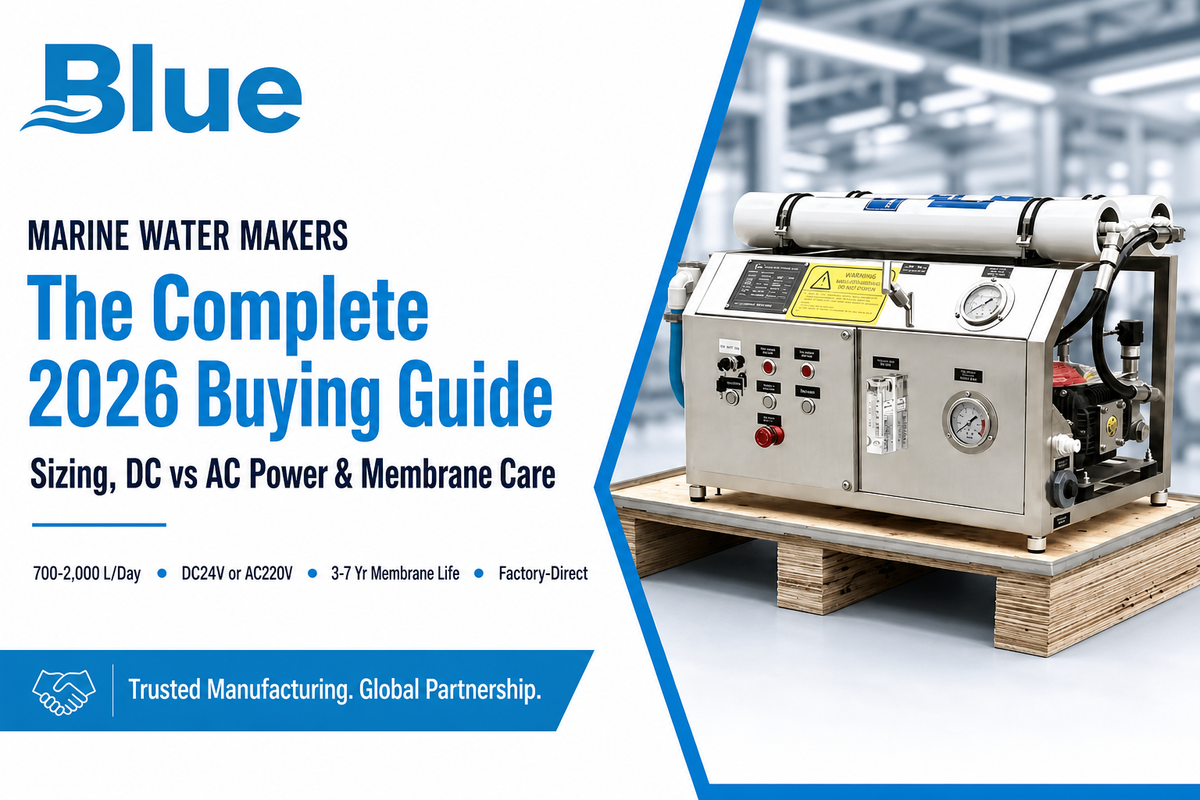
marine water makers are the gear that give a boat its own water source, converting a cruising sailboat, fishing boat, or oil rig from an object that has to keep running back to port for fresh water on board into one that doesn’t. Run out of fresh water 400 miles from the nearest marina and the issue isn’t luxury – it’s the trip. This document on marine watermakers for boats explains how these systems do what they do, what the ideal size for one is without excess power and cost, what causes a membrane to die young, and what you should watch for when comparing similar models, whether you’re shopping for a sailboat water maker or a larger AC system for a motor yacht.
Reverse osmosis is the fundamental operation behind all marine water makers: seawater is forced through a semi-permeable membrane at high pressure, separating fresh drinking water from salt brine. Appropriately sized, a DC or AC system can deliver around 700 to over 2,000 liters of fresh water per day, taken directly from the ocean below your hull.
Key Takeaways
- Larger is not always better – four different independent cruiser sources listed below all caution that oversizing chews energy and hard currency without increasing reliability.
- An emergency/survival Lernal and a daily-use marine water maker are different pieces of equipment; don’t size one as if it were the other.
- The membrane within the housing has a bigger impact on the probability of death young than the brand of frame does – the very same physical membrane component gets reused and resold a 2-3x mark-up.
- Choosing a cheap pre-filter replacement will save a membrane component worth dozens of times more; neglecting filter replacements is the single most common reason for premature membrane death.
- DC and AC are just two options – there are engine-driven models too, but most buying recommendations avoid them entirely.
Quick Specs
| Process | Reverse osmosis (RO) — high-pressure seawater forced through a semi-permeable membrane |
| Typical desalination rate | ≥98% |
| Typical product water TDS | Under 500-1,000 ppm (WHO’s optimal-taste range is 50-300 ppm; the EPA’s secondary (aesthetic) guideline ceiling is 500 ppm) |
| Power options | DC 12V/24V, AC 110V/220V, or engine-driven |
| Typical output range | 700 L/day (small DC unit) to 2,000+ L/day (larger AC unit) |
| Membrane service life | 3-7 years depending on maintenance discipline |
What Is a Marine Water Maker? How It Turns Seawater Into Fresh Water
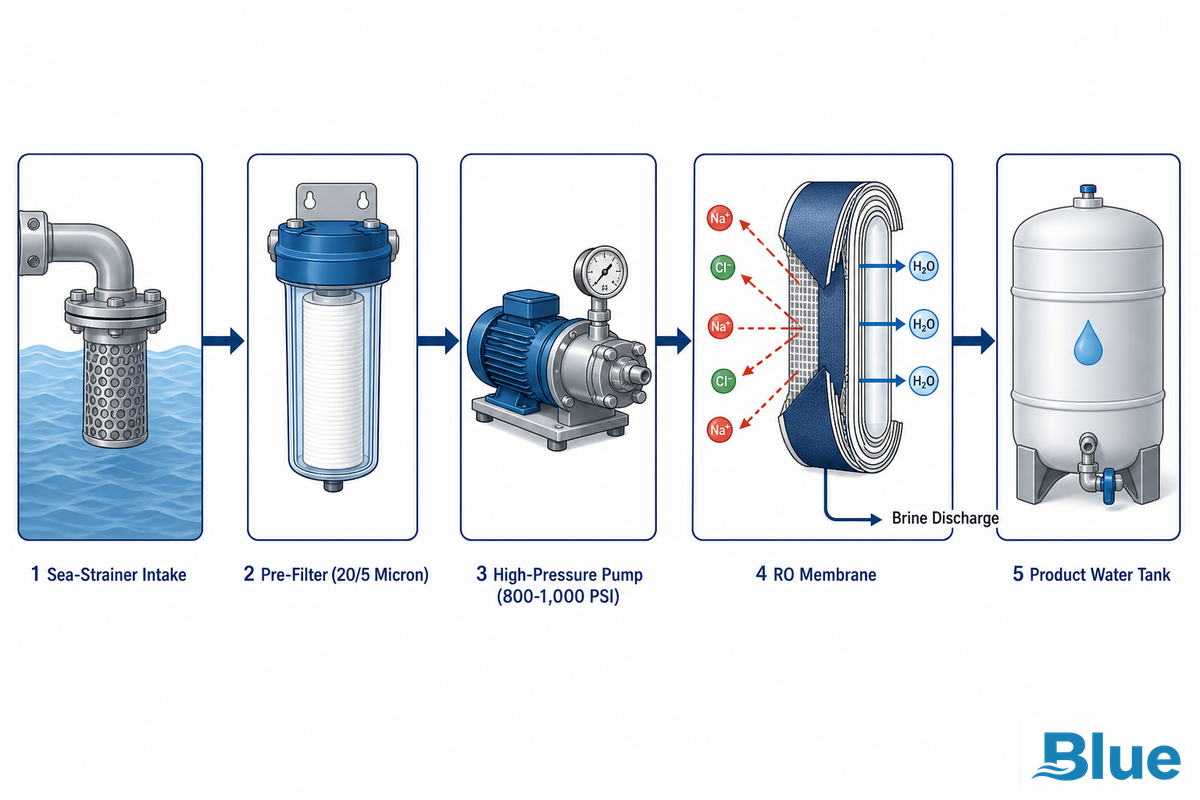
A marine water maker is a shipboard appliance that removes salt and other dissolved solids from seawater by means of reverse osmosis, producing water ready for drinking, cooking, and showering. It replaces the trip back to a marina for fresh water with a self-contained onboard supply.
The process is executed in five phases: an intake takes fresh seawater in beneath the water line, typically via a sea-strainer (commonly a 20 mesh basket or finer); a pre-filter filtration stage (routinely a coarse 20 μm / 20-micron cartridge followed by a finer 5 μm / 5-micron polishing stage) removes sediment and organic particle matter before entering the membrane; a high-pressure pump then presses that filtered seawater – at 800 psi to 1,000 psi (55 bar to 69 bar) for a seawater unit, at a commonly cited 8% to 15% single-pass recovery rate – through a spiral-wound RO membrane; the membrane itself is the working part, its pores narrow enough to exclude salt ions and bacteria yet broad enough to permit water molecules; and the last tasting phase is scrutinizing the product’s total dissolved solids (TDS) before it proceeds into a tank, sometimes with a mineralization or UV step added for flavor and safety.
Most first-time buyers aren’t prepared for the necessary pressure. Seawater contains around 35,000 parts per million dissolved salt; overcoming the osmotic pressure of that solution to purify it and push the fresh water back out the other side of the membrane requires serious water pressure from the pump — it’s why a reverse osmosis marine system needs dedicated pump and membrane housing, rather than just an enlarged household under-sink filter. The NSF/ANSI 58 standard that applies to point-of-use RO units — although not to marine systems specifically — includes standards for material construction and performance against which many credible marine RO membrane builders still design.
Is the water produced by a marine water maker safe to drink?
In most cases, yes, as far as salt content goes, provided the total dissolved solids (TDS) reading is acceptable. TDS measures how well the membrane rejects salt; it is not a complete water-potability test, so a clean TDS reading alone doesn’t guarantee the water is free of other contaminants.
For optimal taste, the World Health Organization recommends water be between 50 and 300 ppm TDS; in the United States, the EPA’s Secondary Drinking Water Standards put the maximum acceptable limit for taste at 500 ppm TDS. (Note that this EPA guideline isn’t one of the agency’s mandatory primary health-based standards for potable water, and even under that limit, properly functioning marine RO systems generally require no chemical additions in the salt removal stage themselves-the membrane removes the salt, most bacteria and most dissolved minerals.) What a TDS measurement can’t tell you, if the source water is contaminated (e.g. by fuel spills or biotoxins), is whether there are dissolved chemical or biological toxins in the source water that would cause contamination in the output water — those are feed-water issues, not membrane performance issues. See below under marine-Specific RO Stressors. In a municipal SWRO, a series of post-treatment steps (disinfection, remineralization, pH stabilization, etc.) is typically applied after the RO membrane before the water is considered drinkable. Onboard RO systems often skip these stages, and it’s the combination of a reliable onboard TDS meter, care to keep your intake water clean, and closed, covered storage of your product water that actually ensure its potability.
💡 Pro Tip
Your membrane’s Rated Desalination Rate (e.g., 98%) is an estimate of what it can achieve under ideal conditions. The best indicator of actual performance on any given day is your onboard TDS meter. Trust the meter over the specs.
If you’re looking for RO system design, specifications, and information about applying RO technology in the industrial, municipal, or OEM sectors (rather than a single, compact unit), see our engineer’s guide to seawater RO systems, which covers pre-treatment, energy recovery, and other specifications important at the request-for-quotation level.
Types of Marine Watermaker Systems, Portable, Modular, and Fixed
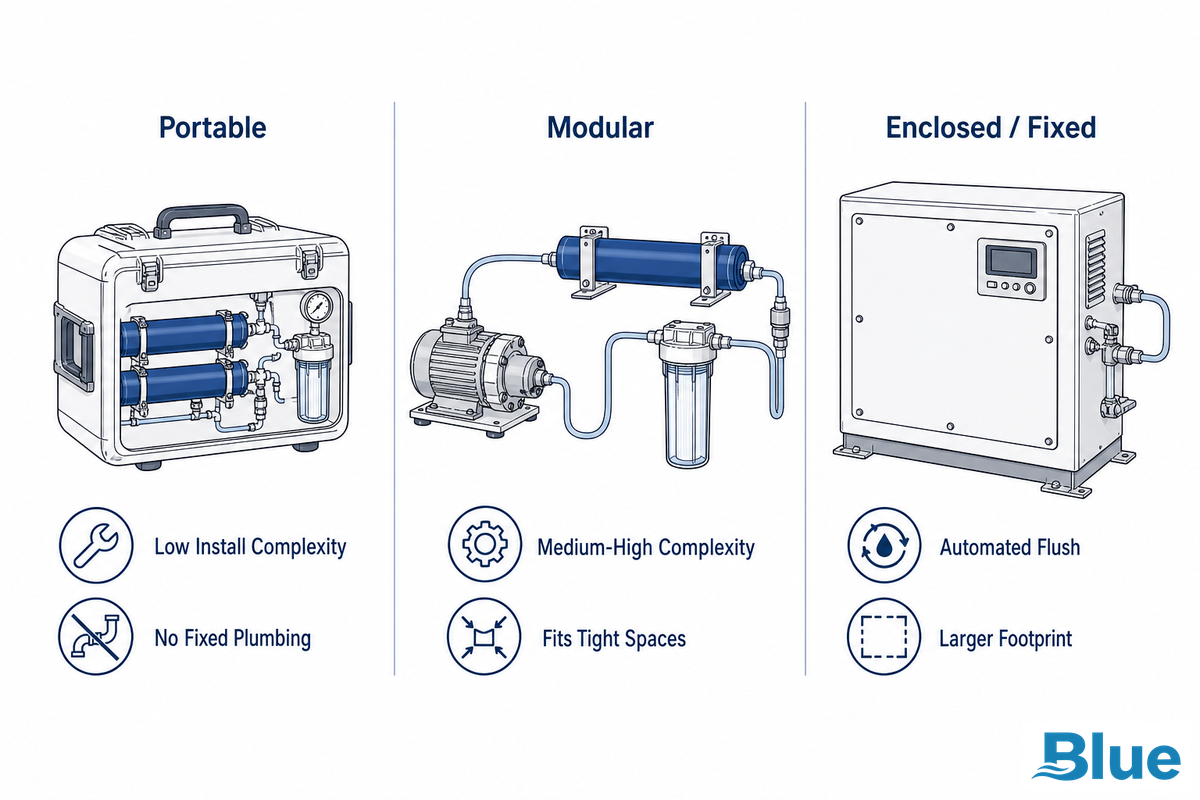
Before you can even start comparing product numbers, you need to determine your requirements for ease of use and available space. Watermaker installation follows one of three basic modular design formats, each making a different compromise between convenience and space/flexibility requirements. Small marine water makers and other portable water maker setups suit occasional users who don’t want fixed plumbing; enclosed units trade that flexibility for hands-off automation.
| Type | Install complexity | Typical fit |
|---|---|---|
| Portable | Low — no fixed plumbing | Occasional use, small sailboats, temporary/loaner setups |
| Modular (component-by-component) | Medium-high — you fit feed pumps, membrane housing, filters into available space | Tight or irregular engine rooms; hands-on owners comfortable with valves operated manually and reading a TDS meter |
| Enclosed / fixed | Medium — one footprint, but a large one | Vessels with dedicated equipment space; owners who want automatic flush and inline testing rather than manual valve operation |
A self-contained enclosed system’s allure, automated freshwater flush, quiet operation, remote control startup, comes with a price in space. These are often significantly larger in overall size than the sum of their parts and components would seem to imply, which is the reason most smaller sailboats are better suited to more compact, modular, or even portable configurations, despite their greater hands-on operational requirements.
⚠️ Important — Emergency Units Are a Different Category
Hand-pump or emergency desalination units (the kind stashed in a life raft’s ditch bag) are designed to be emergency survival equipment for limited, intermittent water use. Do not oversize or over budget for one in anticipation that it’ll replace a daily use unit, and don’t plan on using your daily use system as life raft equipment.
Planning to install a watermaker but your engine room has insufficient space for a modular installation? Then our portable desalination systems page discusses compact models that are available in a size specifically designed for this limitation.
DC/12V vs AC, Matching Power to Your Battery Bank or Generator
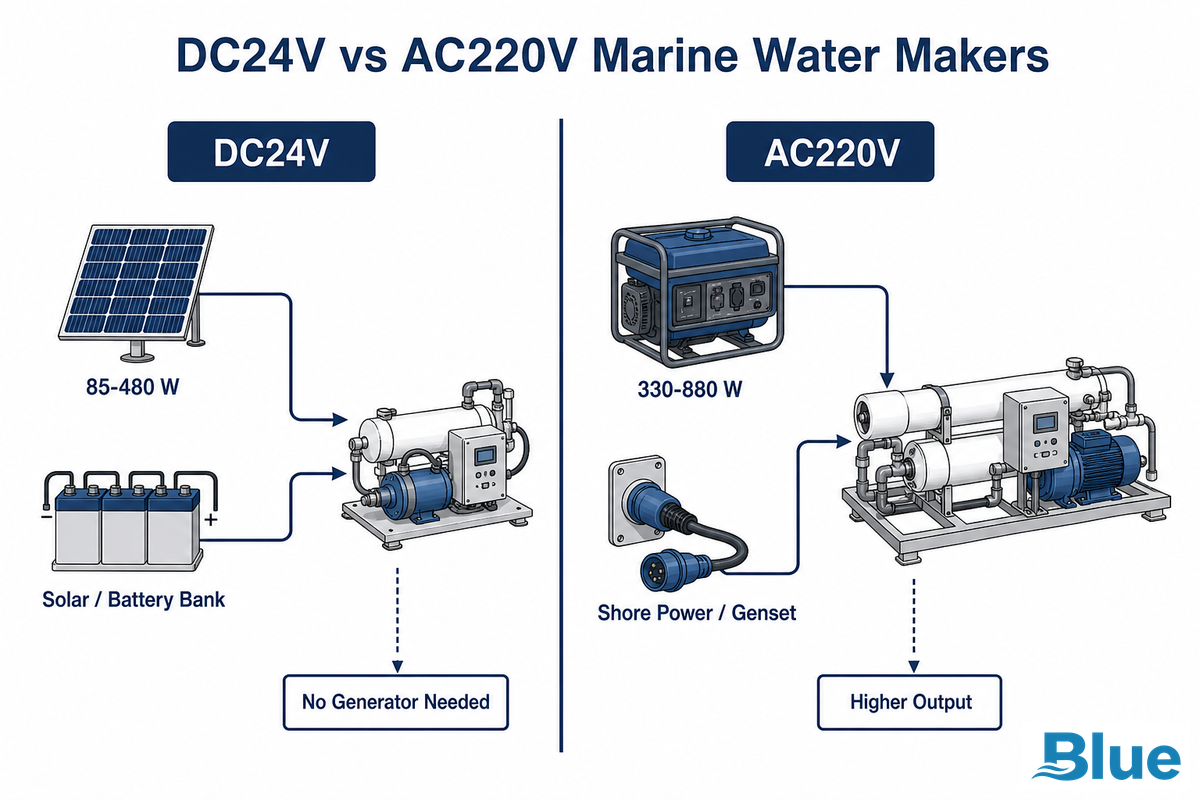
No single decision determines more what system is right for your boat than the power source and its energy efficiency. Get it wrong, and even a properly-sized, energy-efficient watermaker will drain your battery power quicker than your solar panels can recharge it, or it will go unused, since you won’t run your generator every single day. Whichever you pick, the installation itself should follow the American Boat & Yacht Council (ABYC) E-11 standard for AC and DC electrical systems on boats — the reference most reputable marine electricians and surveyors already wire to.
What is the difference between AC and DC powered models?
DC (12 volt or 24V) marine water makers run directly off your battery bank and suit boats that rely mainly on solar or wind charging, trading slower output for lower power draw. AC (110V/220V) units need shore power, a generator, or a large inverter, but produce water much faster.
A 12 volt marine water maker (or its 24V sibling) is a “no generator” solution with lower power consumption and fewer watts per gallon produced, requiring less amp-draw for a tight house bank. It just gives up output; it’ll typically produce less water per hour than AC-powered systems, but you just run it for a bit longer to make up for it on a daily basis. AC (110V/220V) systems output much more water per hour if your daily requirement is high or your running time is short.
The third type – engine-driven watermakers – is mostly omitted from purchase guides; they get their power off the main engine while it’s running. They’re great if your boat is running its engine already but are mechanically complex and generally require a mechanic.
| Power class | Typical draw | Best fits |
|---|---|---|
| Low-draw DC (e.g. positive-displacement pump designs) | Roughly 85-155 W | Solar/wind-only vessels with a limited house bank |
| Standard DC | Roughly 240-480 W | Vessels with a moderate battery bank and daily charging |
| AC | Roughly 330-880 W | Boats running shore power or a generator regularly anyway |
Note regarding the figures in this table: the draw ranges (roughly 85 to 880 watts across classes, a watt-for-watt comparison worth doing before you buy) are cited widely across marine watermaker marketing pages, including manufacturers’ own sites, but there’s no single identifiable primary source behind them. Treat them as commonly cited industry figures for budgeting purposes, not a guaranteed spec for any specific model, ask any manufacturer for their unit’s actual rated amp draw before sizing a battery bank around it.
Sizing a Watermaker, Crew, Vessel Type, and Daily Gallons
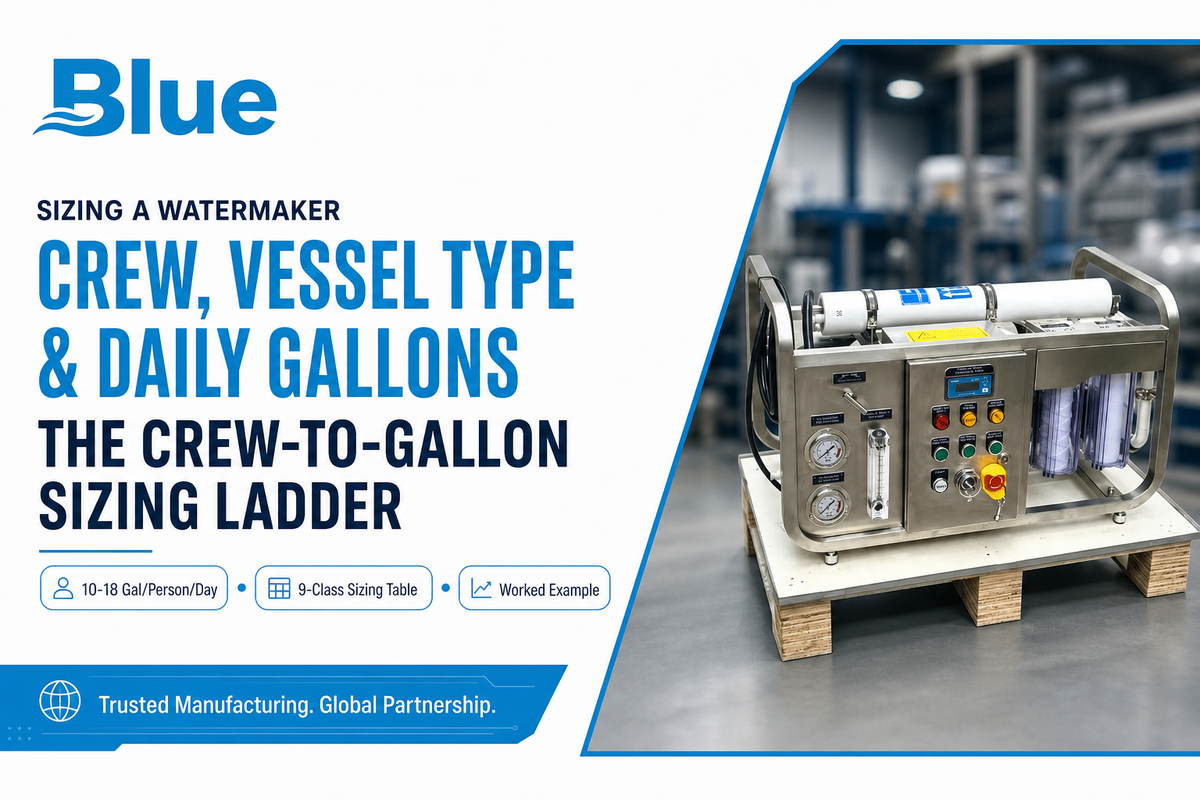
One piece of advice comes up over and over on this topic, regardless of brand: don’t oversize. “More output isn’t always better,” says one boat-electronics resource bluntly, a bigger system means more current draw, more heat, more mechanical load, and less flexibility if your battery bank can’t keep up, and similar sources from both independent trawler and cruising-sailor camps make the same point. A watermaker sized for your actual daily usage, instead of the biggest number on the spec sheet, is both cheaper to run and easier to keep fed with power.
How do I know what’s the right size watermaker for my boat?
Start with your daily per-person water needs, not vessel length. A conservative estimate for drinking, cooking, dishes, and a shower is 10 to 18 gallons per person per day; multiply by crew count, then add a 30-50 percent buffer for guests and extra dishwashing.
That buffer also covers an eleventh-hour spray down before you drop the hook. Manufacturers usually specify daily output in gallons or liters assuming a continuous 24-hour run, convert that figure to an hourly rating to help assess how long we’ll have to actually run a particular machine to meet our daily need. (A unit rated at 15 gallons per hour meeting our modest 15-gpd demand only needs to run an hour.)
| Vessel class & use | Crew | Daily need (with cushion) | Reasonable output class |
|---|---|---|---|
| Solo sailing, coastal, off-grid | 1 | 7-14 gal | ~700 L/day, DC |
| 30-40 ft sailboat, off-grid weekender | 2 | 13-27 gal | ~700 L/day, DC |
| 30-40 ft sailboat, offshore passage | 2 | 13-27 gal, higher duty cycle | ~700 L/day, DC, run longer per session |
| 40-50 ft cruiser, shore power access | 2-4 | 26-72 gal | ~1,400 L/day, AC or high-output DC |
| 40-50 ft cruiser, off-grid liveaboard | 2-4 | 26-72 gal | ~1,400 L/day, high-output DC preferred |
| Fishing vessel, day runs | 2-3 | 18-30 gal | ~700-1,400 L/day, AC genset |
| Charter yacht, paying guests | 4-6 | 52-108 gal | ~1,400-2,000 L/day, AC |
| 50 ft+ high-capacity motor yacht or power boats, regular guests | 4-6 | 52-108 gal | ~2,000 L/day, AC |
| Naval or offshore-platform fleet use | 6+ | 78+ gal, continuous | ~2,000 L/day per unit, multiple units in parallel |
A worked example: two people cruising on a 40-foot boat that usually docks each night under shore power will need around 15 gpd according to the above conservative estimate (2 × ~7.5 gal). If we add a 30 percent buffer for visitors and the inevitable rounds of dish washing that come with having more than one cook on board, we’re looking at 20 gallons of need. But that assumes constant use, so round it to 40 gallons (150 L) of capacity for occasional days when you run low on wash water or fill a small tank with some potable after a particularly dusty day’s sail. At this capacity, you’ll comfortably fit within a 700 L/day DC water maker operating just under two hours a day, well within a range that makes purchasing an 1,400 L/day AC machine a non-issue. In fact, opting for the bigger, more expensive machine in this case wouldn’t offer greater reliability; it would only represent an upfront added cost, use more energy per gallon at partial loads, and consume engine-room space better spent elsewhere.
The Navigator BM-SF marine water maker lineup is a real four-model example of how output classes map to DC and AC configurations from 700 to nearly 2,000 L/day, and its sizing calculator will let you crunch the numbers for your own crew and boat.
How the RO Process Handles Marine Conditions
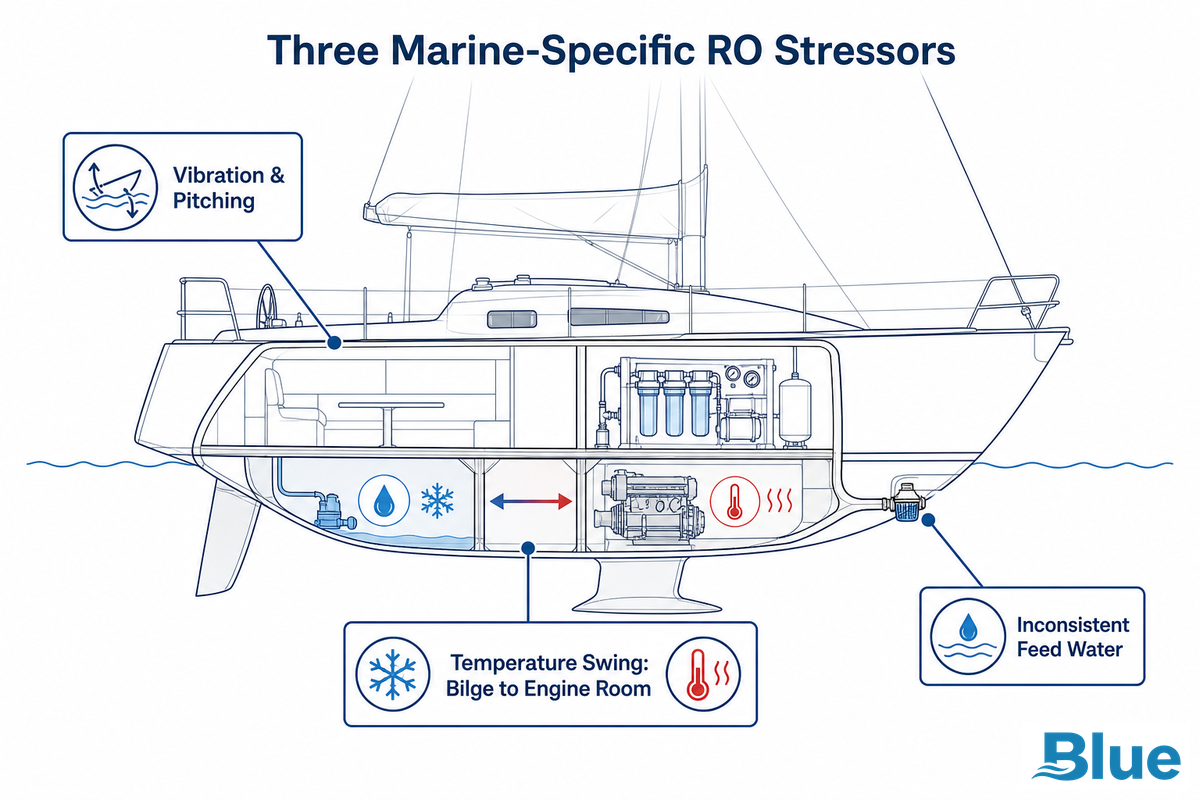
Household under-sink RO filters use the same basic separation principle (gph output aside) as a marine water maker, but a marine environment is far harsher than a kitchen sink cabinet: pitching motion, swinging temperatures, start-stop duty cycles, and inconsistent feed-water quality all stress the system in ways a stationary home unit never faces.
A stationary shore-based RO system can run in a controlled-temperature environment at constant pressure using feed water that’s already gone through a municipal or well pretreatment process; by contrast, your boat’s system will be pitching, swinging in temperature from the cool bilge up to the hot engine room, operating in start-stop mode instead of on a continuous duty cycle, and drawing from water quality that can shift dramatically from clear open ocean water to murky harbor water with biological matter.
Three marine-specific stressors the average buying guide glosses over: Vibration and the perpetual rocking of the sea can stress components and membrane housings to the breaking point – that’s why marine-rated units get all-stainless frames and flexible, vibration-resistant plumbing, not rigid PVC pipe common in household installations. Intermittent operation (run for an hour or two, then sit idle, not run 24/7) means the membrane spends more time at rest; that’s where the need for a freshwater flush every use comes in – a membrane left wet and full of concentrated brine between uses will scale and foul much faster than one that get rinsed clean. And inconsistent feed-water supply is a marine-specific hazard a stationary intake system with a controlled source avoid. Running a watermaker in a marina or harbor (where fuel sheen, silt, and biofouling are concentrated) is the fastest way to destroy a membrane that would otherwise last for years in the open sea. Output is also feed-temperature sensitive: manufacturer literature commonly cites an optimal range around 68°F to 85°F (20°C to 29°C), with production tapering off in colder water and the membrane facing added stress above that band, one more reason engine-room heat and cool bilge water both matter to where you plumb the intake.
Contaminated feed-water is as much a safety as a fouling concern, so it’s worth getting clear about what, exactly, an RO membrane rejects. Salt ions are rejected consistently, and at high rates – it’s the membrane’s primary job. It’s a little different for organic contaminants: organic rejection is specific to the chemical structure of the individual contaminant, and academic testing on RO membrane solute rejection shows that, in general, rejection is less effective on organic molecules than it’s on salt ions. So hydrocarbon sheens, solvents, or toxins from an algal bloom can come through the filter at rates less than they do for salt; it’s one reason intake water selection discipline is just as important as membrane specs, and “stay away from marinas, harbors, and obviously murky water” is a safety rule as much as it’s a maintenance tip.
📐 Engineering Note
NSF/ANSI 58 (currently 2024/2025) defines the material and performance requirements for point-of-use ROs but is scoped for home point-of-use systems, not vessel desalination. It therefore offers a useful credibility check for the membrane element itself, but not for the entire marine installation, the intake configuration, or your water storage habits. A membrane element designed to that standard, when installed within a marine-style stainless frame and plumbed with appropriate, vibration-resistant fittings, is a distinctly better product than a standard RO cartridge merely installed in a boat; nevertheless, the standard itself is limited to the membrane element.
Maintenance, Flushing, Pickling, and What Actually Kills a Membrane
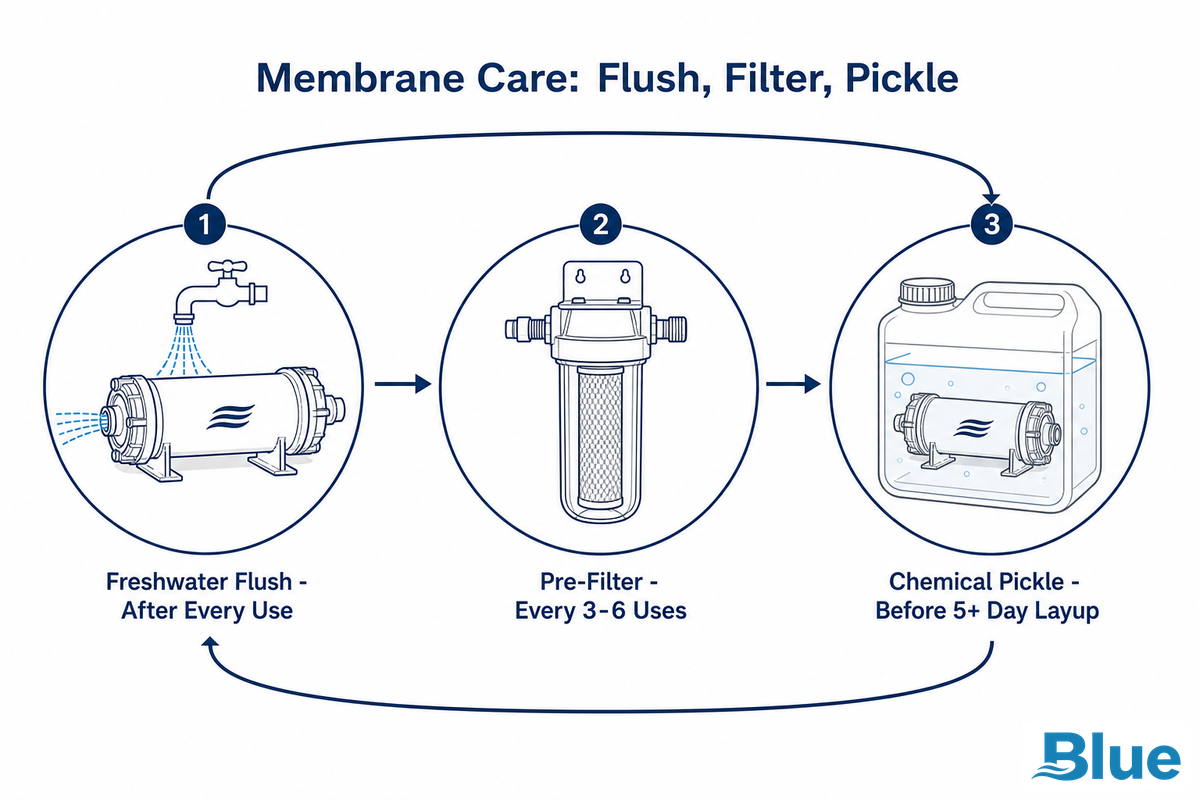
More than any spec on the box, two habits dictate a membrane’s life: a freshwater flush after each use and good habits regarding the pre-filter. Running fresh (non-chlorinated) water through the system for a few minutes after each session displaces the concentrated brine solution, which would otherwise rest against the membrane element and promote scaling or bio-fouling — membrane fouling research consistently identifies stagnant, nutrient-rich water sitting against the membrane surface as the main driver of biofilm growth, which is exactly what a post-use flush interrupts. The more expensive error to skip is replacing the pre-filter. A $10-20 disposable pre-filter cartridge will extend the life of a $300+ membrane element, and it’s cited almost universally by manufacturer, retailer, and third-party testers as the number one reason membranes fail early. (Note that these price figures appear to be estimates cited by the trade, as no primary source could be identified).
“The membrane is the heart of the system and the part you replace most. We make ours in-house, spiral-wound from our own RO sheet, so a customer sourcing a system is buying from the company that also supplies the spare, not from a reseller waiting on the same third party everyone else uses.”
Blue Membrane Engineering Team
| Signal | Check first | Likely fix |
|---|---|---|
| Product water TDS creeping up slowly | Feed-water temperature and recovery rate changes | Normalize before assuming membrane damage; may just be seasonal feed variation |
| Output volume dropping, pressure rising | Pre-filter condition, scaling | Replace pre-filter, run a membrane clean cycle |
| Sudden TDS spike | O-rings, housing seal, membrane breach | Inspect physically — don’t assume calendar age alone explains it |
| Unusual pump noise or cycling | Air in system, low inlet flow, strainer blockage | Bleed system, check intake strainer before assuming pump wear |
How rigorously must the post-session flush rule be followed in practice? Reports from real-world users vary far more than the manufacturer’s specifications. While most manufacturer and retailer recommendations specify a post-session flush, a daily rinse when in use, and a brine pickle for anything more than 4-5 days of downtime, some cruisers with a part-time liveaboard lifestyle have run systems successfully with up to a month of downtime between uses (especially in cool weather and less biologically active water). Ultimately, the safe approach is to err on the side of the more conservative recommendation, while noting that actual performance depend to some extent on water quality, climate, and how many days pass before a flush is administered.
How long do RO membranes last?
Across manufacturer, retailer, and third-party sources, a consensus range of 3 to 7 years exists for a membrane element’s service life. The main factor separating the 7-year elements from the 3-year ones is pre-filter maintenance discipline and feed-water quality, not brand.
Well-maintained elements using relatively clean open-ocean water and stored with proper pickles will likely last on the upper end of the spectrum, whereas those fed poor quality water with deferred filter changes can degrade within 2-3 years. Keep a TDS meter and a product flow meter handy, and compare the gauge and product flow readings before and after the membrane; when TDS and differential pressure climb well past normal (even if the unit is still on schedule) and the pre-filter consumable need constant replacement, it’s time for a membrane replacement.
What Actually Predicts Reliability (Buying Criteria, Not Brand Rankings)
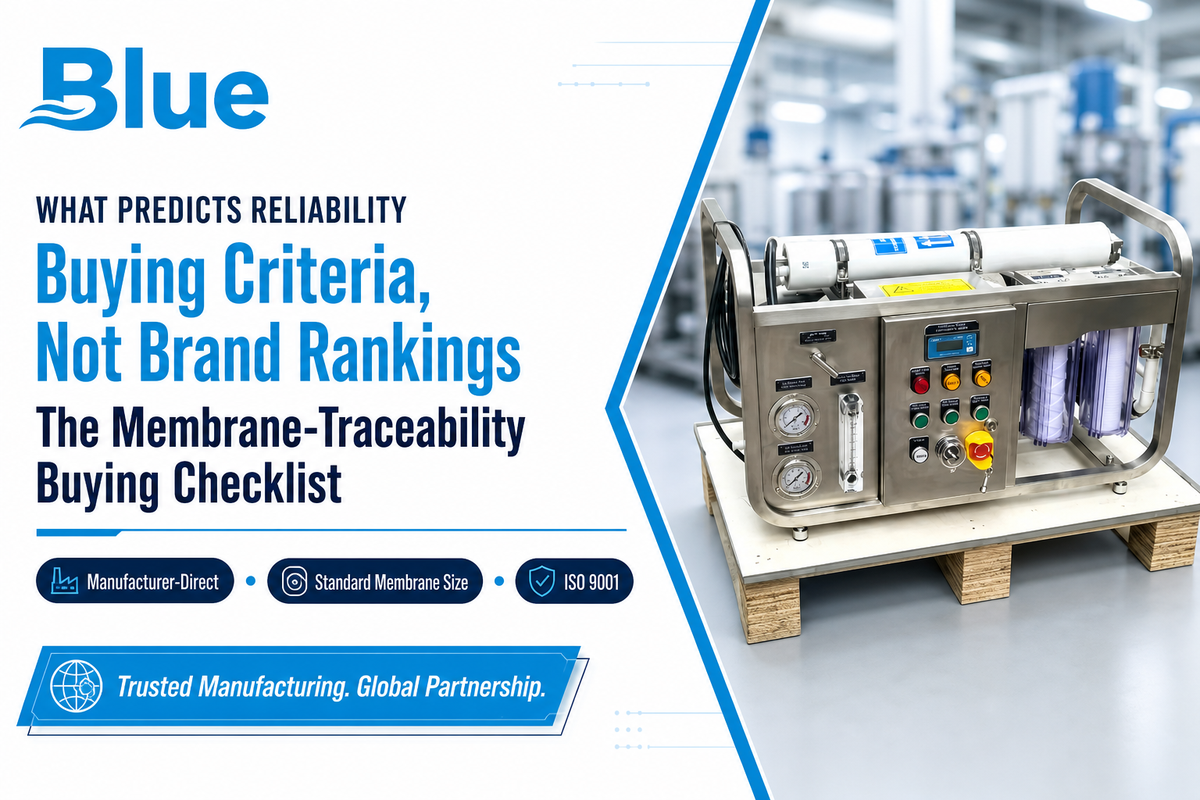
Much online advice regarding “best marine watermaker” is brand-specific (and often a given manufacturer placing their own brand at the top), which can mislead a prospective buyer looking for comparative insights. Instead of simply recommending one brand over another, look at which specific attributes correlate most closely with a high-quality, efficient watermaker’s longevity and reliable performance, a cost-effective, easy-to-use watermaker isn’t necessarily the one with the biggest marketing budget.
✔ What manufacturer-direct buying gets you
- A membrane sourced from the same company that stocks the replacement, a shorter spare-parts chain
- Traceability: what’s the membrane actually composed of, how do we test it.
- Often cheaper margin on the membrane itself as there’s no reselling party involved
⚠ What you give up
- A narrower brand/model selection than a multi-brand assembler or retailer offers
- Potentially less local dealer/installer network depending on region
- Less third-party comparative review coverage than well-established assembler brands
The Membrane-Traceability Buying Checklistfour things you can ask for, no matter who your supplier is:
- ✔Who’s actually manufacturing the membrane inside the housing, the seller, or someone the seller get it from?
- ✔Is the replacement membrane a commonly carried standard size, 2.5-inch x 40-inch on most DC units, 4-inch x 40-inch on larger AC units, or a specific size only available from the original seller?
- ✔What’s the material of the frame and the pressure rating of the device, and is it suitable for your vessel’s specific requirements and duty cycle?
- ✔How is the unit certified, ISO 9001 quality system, NSF-grade membrane element, or neither?
Take the proprietary-membrane-size question seriously. If you invest in a watermaker designed to use an idiosyncratic, vendor-specific membrane component, you’re exposed to over paying for the only part that can fit it or waiting weeks for one to be delivered to some remote sailing ground, a price that’s not included on the list but appears in year three or four when the original membrane is ready to be retired. Buying a system based on an off-the-shelf part you know you can spec and buy on your own eliminates this dependency.
That’s what the Blue Membrane is all about: the RO membrane sheets and spiral-wound elements that go into our own marine water maker line are actually produced by us (not out sourced and relabeled) and we make that very same seawater membrane seawater technology available for use on our full lines of seawater RO membrane elements if an industrial or commercial buyer wants to spec membrane without a full packaged system.
Cost, Upfront Price and the 10-Year Ownership Number
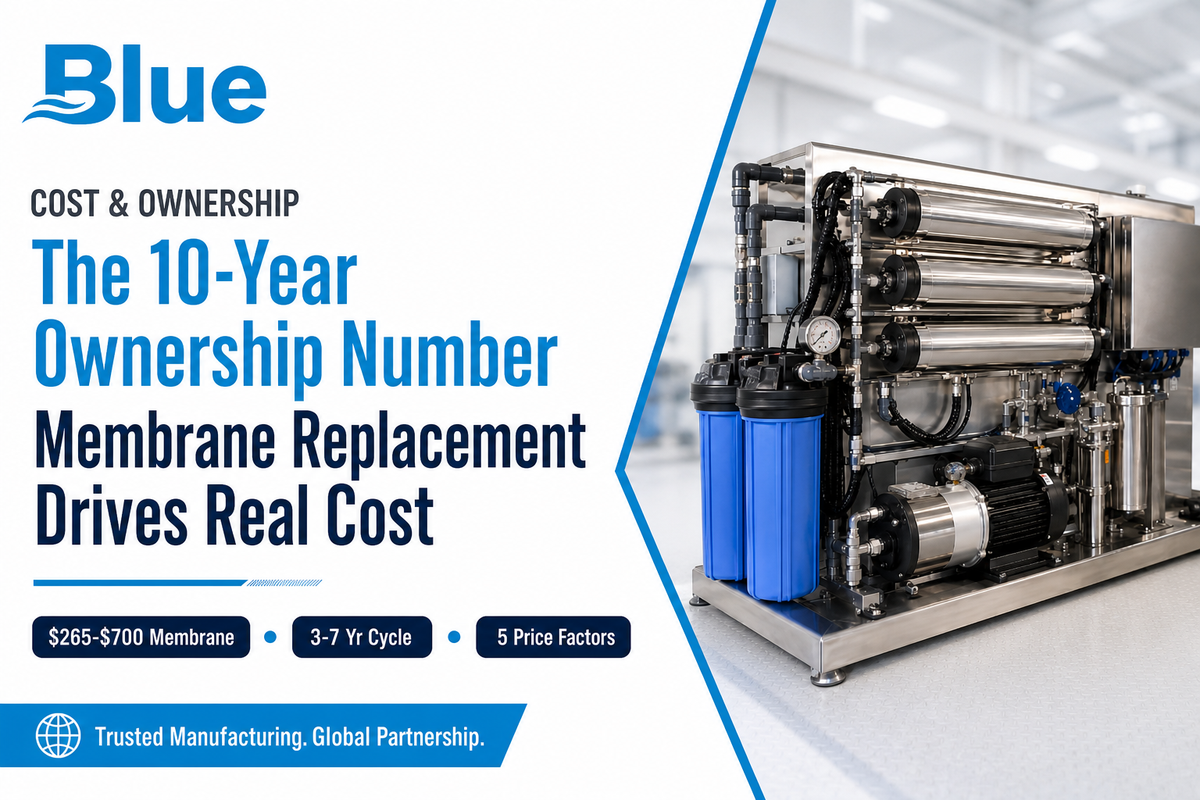
Sticker price is a really bad indication of what a marine water maker will actually cost you in the time you’ll own it – the ongoing expense-the membrane that you’ll be replacing every few years- is a line item almost nobody ever accounts for.
$265-$700
Typical replacement membrane cost
3-7 yrs
Membrane replacement cycle
$200-$4,000
Installation, DIY vs professional
Membrane replacement figure sourced from marine trade-forum market data (trawlerforum.com); treat it as a directional range, not a quote, actual cost varies by component size and whether the seller stocks a standard or proprietary part.
| Factor | Effect on price |
|---|---|
| Model & output (700-2,000+ L/day) | Higher output → higher unit cost |
| Power configuration (DC vs AC vs engine-driven) | DC solar-ready units and AC genset-fed units price differently by component mix |
| OEM/ODM or private-label branding | Custom spec and tooling add cost |
| Order volume & spare-parts package | Volume and bundled spares lower per-unit cost |
| Destination & shipping terms | Freight and import duties vary by market |
Factory-direct pricing eliminates just one layer in that cost structure: the assembler markup on a membrane the seller didn’t manufacture. See Blue Membrane’s procurement guide and pricing context to understand how the factors above apply to a specific quote.
Outlook, Boat-Show Season, Anchorage Rules, and What’s Changing
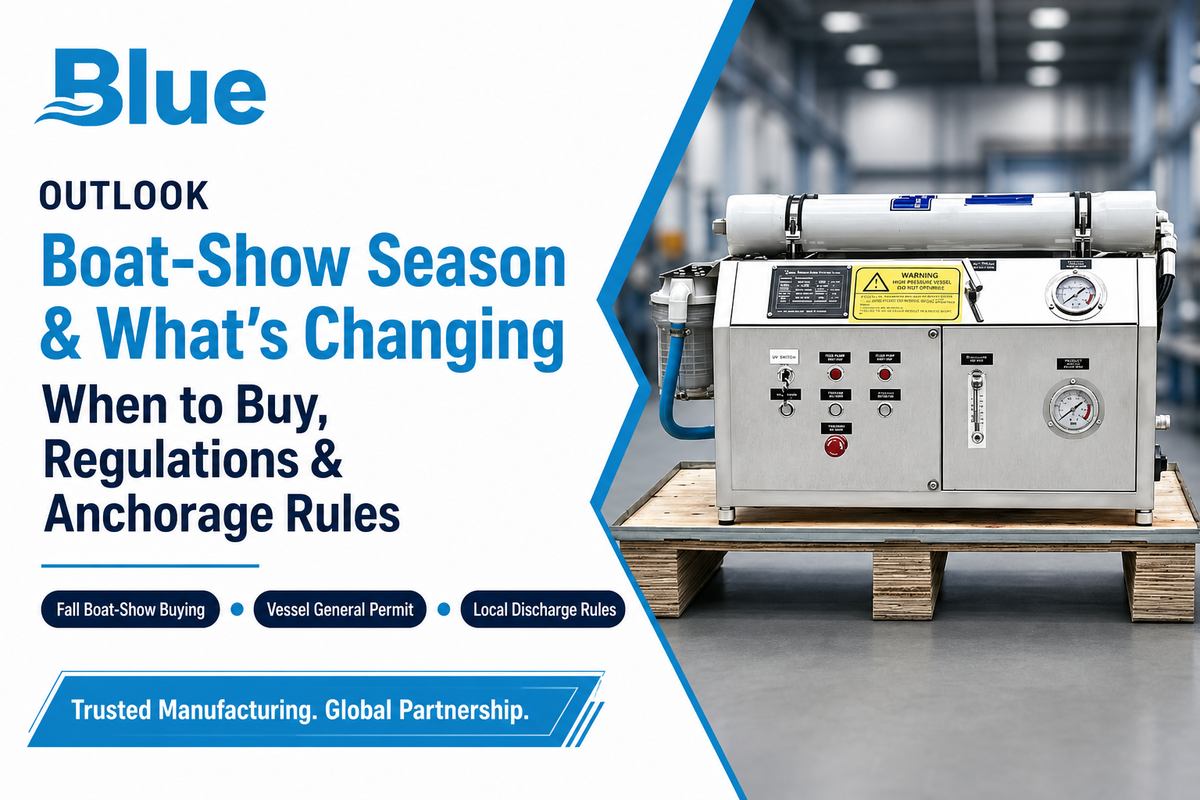
(Updated July 2026) Purchase interest in the marine watermakers is tied more to the cruising schedule than to underlying technology developments: the volume of searches for the boat-mounted watermakers is typically higher each autumn, reflecting a rise in buyer interest coinciding with the U.S. boat show circuit-the mid-October Annapolis Sailboat Show and the late-October/early-November Fort Lauderdale International Boat Show being the two largest. Buyers research equipment for upcoming refits or spring voyages in the fall. If you intend to sail in spring, buying in the fall allow more time for a custom-built or factory-direct order.
Ignoring that lead time costs you a weather window, not just money. A crew that orders a factory-direct DC unit in February for a March Bahamas crossing routinely runs into the same problem: build queues stretch to 6-8 weeks during the pre-season rush, the membrane housing arrives after the boat’s ideal crossing window has closed, and the trip either slips a month or goes out with jerry cans and a prayer instead of a working water maker. Ordering in the fall, right after boat-show season, avoids that queue entirely and still leaves room for a sizing consult if your crew count or itinerary changes over the winter.
Regulations for watermaker operation differ by vessel class, and it’s worth not conflating them. EPA’s federal Vessel General Permit covers commercial and large non-recreational boats (and the vast majority of recreational boats don’t need such a permit). Most recreational boating is governed by local rules: most marina managers and no-discharge zone markers forbid all overboard discharge, even watermaker brine-despite the small amounts that single boat systems produce when compared to a land-based plant. Although volumes differ, the environmental concerns are similar at all scales, the brine discharge management principles applied by municipalities inform local marina and anchorage policy, while commercial vessels (and boats over roughly 79 ft) fall under the federal permit and recreational boats are subject to state and local regulation instead. Always check local marina and anchorage rules before running a watermaker while at the dock and review the permit status for your vessel if it’s operating commercially.
Multiple market-research firms publish desalination-equipment market size and growth-rate figures in the low-to-mid-teens CAGR range; treat those numbers as directional, order-of-magnitude industry context rather than a decision-grade input for an individual buyer, we haven’t found a source specific enough to the marine-watermaker segment to cite a precise figure with confidence.
Marine Water Maker FAQ
Q: Can I run my watermaker in a marina or harbor?
View Answer
Operating a marine water maker in a harbor or marina is generally not a good idea and can quickly foul the membrane — these environments concentrate silt, fuel sheen, and biological matter that even a good pre-filter can struggle to keep up with. Save watermaker use for open water, and check local marina rules before discharging overboard at a dock.
Q: What’s the difference between a “watermaker” and a “desalinator”?
View Answer
In marine jargon, the two terms describe the same type of RO equipment, and there is little distinction between “watermaker” and “desalinator” from the perspective of the average manufacturer, retailer, or cruisers. “Desalinator” is the broader engineering term for any technology that desalinates (also including rarely used on boats today distillation), while “watermaker” has come to specifically refer to RO-only systems in the recreational boating market. So if you see either on a boat equipment listing, chances are they’re referring to an RO unit.
Q: Do I need a generator to power a marine water maker?
View Answer
Not if you select a DC unit. The DC/12 or 24-volt watermakers system is designed to run directly from your house battery bank (which can be charged via solar, wind or your engine’s alternator), which is precisely why off-grid and solar-dependent cruisers prefer them. AC (110 or 220-volt) units must run from a generator, shore power or an enormous inverter, but deliver output at a faster rate. If your generator doesn’t run much for other systems on the boat, a DC unit takes that off your plate; if you do run your generator often for other things, the AC unit can tap into that, adding to the demand.
Q: How long do watermaker membranes actually last in daily use?
View Answer
Three to seven years. For all the different manufacturers and technologies available, the spread in typical component lifespan is mostly determined by maintenance, not the manufacturer, based on reports from various sources. Skipping the pre-filter change-a job that costs a few bucks for a paper element and saves hundreds on the life of the much more expensive membrane sheet or spiral-wound element-is consistently reported as the single most common cause of early element failure. (The specific dollars for this trade-off, by the way, are consistently reported and the figure seems unlikely to have come from an independent study).
Q: What regular maintenance will my watermaker need?
View Answer
Flush after each use, check the pre-filter every 3-6 uses and replace when dirty, inspect or clean the membrane element every 6-12 months depending on feed-water quality and usage, and chemical-pickle with a manufacturer-recommended preservative solution before any layup longer than about five days, to keep saltwater residue from scaling the membrane.
Q: Why buy a dedicated watermaker instead of just carrying more water tankage?
View Answer
There is a hard ceiling to how much water you can carry: cruising sailboats typically hold 75-200 gallons, a volume easily consumed by two people in less than a week, and extra tankage adds weight and interior space to an already tight living environment. A watermaker breaks that ceiling — and is arguably a more eco-friendly choice than trucking bottled water to a marina — by allowing you to produce your own fresh water from sea water under your hull, so rather than calculating passage length based on water available, you simply make what you need and can carry an infinite supply, so long as you have the capacity to power the equipment itself.
Why We Write This
Blue Membrane makes the RO membrane sheets and spiral-wound elements used in many marine water makers, including our own BM-SF Navigator Series. This guide isn’t a marine-products-only comparison; it’s meant to help any boat owner evaluate watermakers industry-wide. Two power-draw and pre-filter figures we found repeated word-for-word in a competitor’s marketing are flagged in the text rather than presented as ours. Reviewed by the Blue Membrane technical team.
References & Sources
- NSF/ANSI 58: Reverse Osmosis Drinking Water Treatment SystemsNSF International
- Secondary Drinking Water Standards: Guidance for Nuisance ChemicalsU.S. Environmental Protection Agency
- WaterSense Point-of-Use Reverse Osmosis Systems SpecificationU.S. EPA
- Management of Brine Discharges to Coastal WatersCalifornia State Water Resources Control Board
- Zero Discharge Seawater DesalinationU.S. Bureau of Reclamation
- Roles of Sulfites in Reverse Osmosis (RO) PlantsNational Institutes of Health / PMC
- Vessel General Permit for Discharges Incidental to the Normal Operation of VesselsU.S. Environmental Protection Agency
- Solute rejection in reverse osmosis membranesarXiv preprint
- E-11: AC & DC Electrical Systems on BoatsAmerican Boat & Yacht Council
- Fouling in Reverse Osmosis Membranes: Monitoring, CharacterizationNational Institutes of Health / PMC
Related Articles
- Seawater RO Systems: How SWRO Works, Costs, and Specsthe engineer/OEM-focused companion guide to this one
- Nanofiltration Membrane (NF) Guide for Water Treatment and Water Purification
- The Complete Guide to Low-Pressure & Ultra-Low-Pressure (ULP) RO Membrane Elements
- Packaged BWRO Systems: How Brackish Water Reverse Osmosis Works