Get in touch with Blue Membrane Company

Revised July 2026 | Reviewed by Blue Membrane technical team
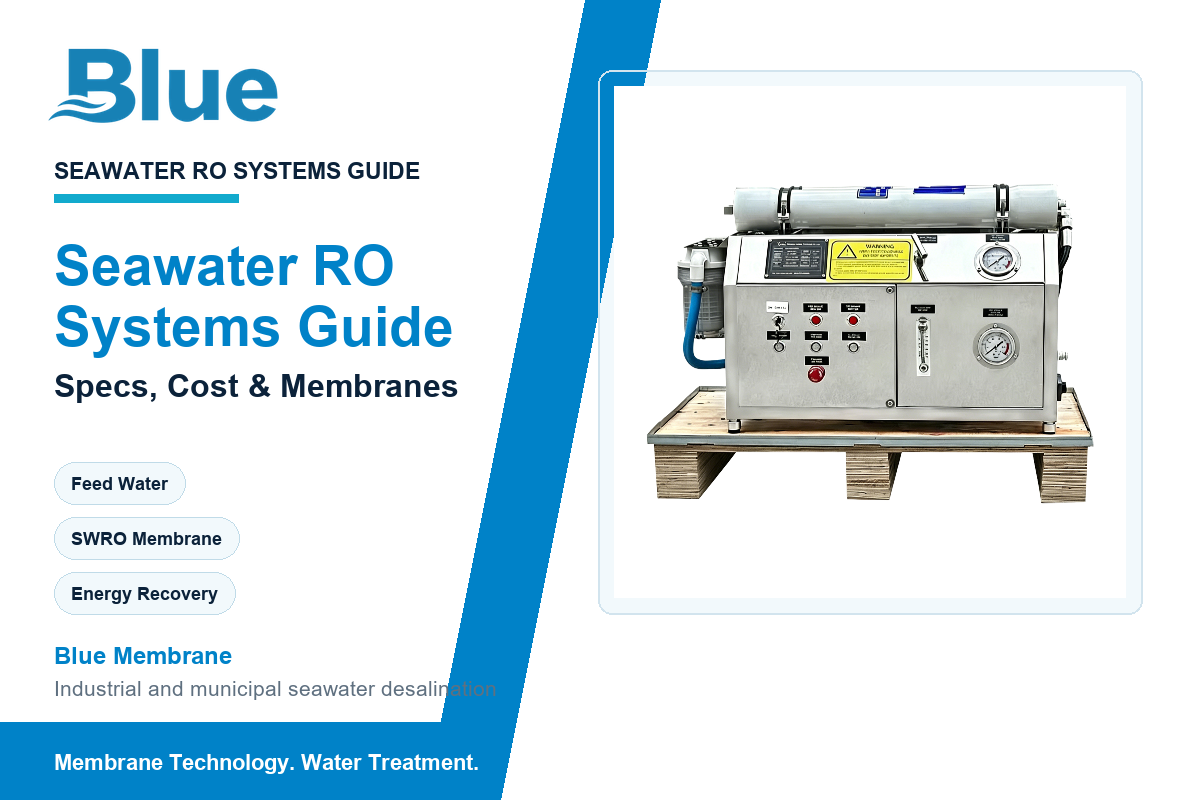
Seawater RO systems turn salt water into usable fresh water by pushing high-salinity feed through a seawater-rated reverse osmosis membrane. This seawater RO systems guide is written for engineers, system integrators, OEM buyers, and procurement teams that need to judge a reverse osmosis desalination system before asking for a quote.
This isn’t a second sales page for Blue Membrane’s existing seawater RO system options. Blue Membrane’s solution page explains product lines. Here, the goal is to explain the technical decisions behind a good RFQ: feed water, pretreatment, membrane data, energy recovery, post-treatment, and operating risk.
Quick Specs Card
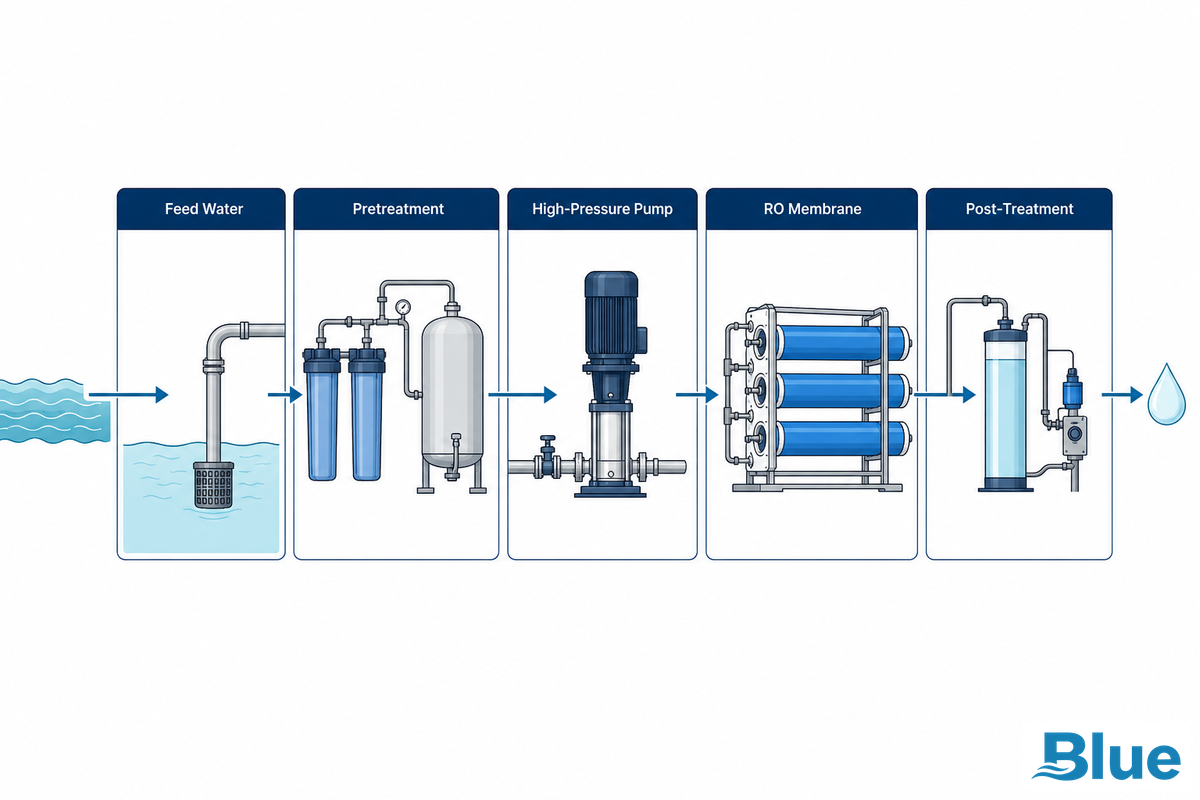
| Input to confirm | Why it matters | Evidence basis |
|---|---|---|
| Feed salinity | Sets osmotic pressure, membrane class, pump pressure, and recovery target. | Ocean water is about 35,000 ppm salt. |
| SDI, turbidity, biology | Tells whether sand, cartridge, UF, dosing, or intake changes are needed before the membrane. | Pretreatment is tested by turbidity and SDI impact. |
| Membrane datasheet | Confirms rejection, flow, test basis, pressure, pH range, spacer, and replacement certainty. | Use published element data, not only skid photos. |
| Drinking-water use | Triggers remineralization, pH correction, disinfection, blending, and local review. | WHO and public-system guidance treat this as risk management. |
Specification risk starts when 35,000 ppm salinity, an 800 psi test assumption, or post-treatment scope is missing, because OEM and production applications fail in different ways. Blue Membrane engineers use this card as a precision RFQ checklist, not as a substitute for site data.
What Is a Seawater Reverse Osmosis System?
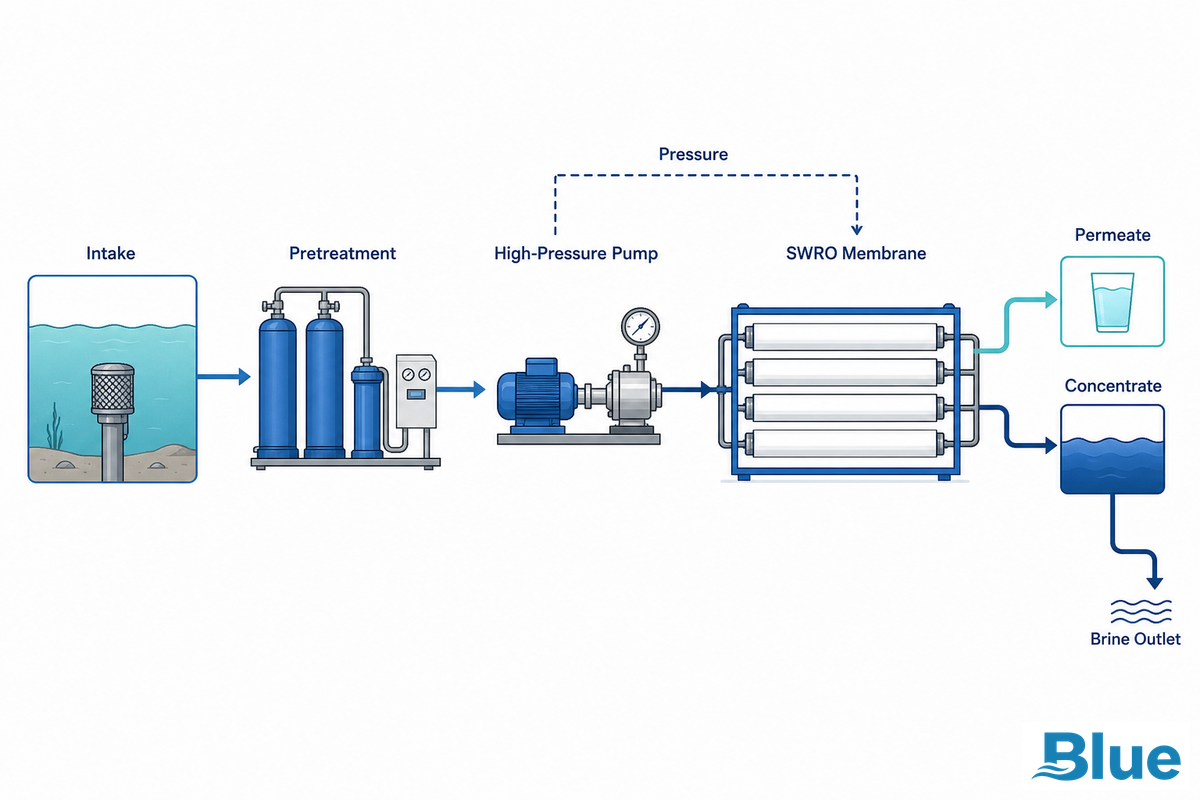
In practice, a seawater RO system is a high-pressure water treatment package that uses seawater reverse osmosis to separate fresh permeate from dissolved salt. Ocean water contains about 35,000 ppm salt according to the U.S. Geological Survey, which is why a household RO unit or brackish water RO skid isn’t enough for true sea water.
A seawater reverse osmosis system is a water desalination technology built to remove dissolved salts; compact watermaker systems use the same separation idea, but they don’t carry the same duty cycle as commercial seawater RO desalination packages.
Typical flow path: intake, coarse screening, pretreatment filter, dosing where needed, high-pressure pump, pressure vessel, RO membrane, concentrate discharge, permeate polishing, and storage. Each block exists to protect the membrane or finish the product water. Filtering seawater isn’t enough; the system has to overcome osmotic pressure and manage the reject stream.
The 5-Gate SWRO Specification Map
| Gate | Question to ask | Risk if skipped |
|---|---|---|
| Feed water | What are salinity, SDI, turbidity, temperature, organics, and biology? | Wrong pretreatment and early fouling. |
| Pretreatment | What protects the membrane during seasonal intake swings? | Scaling, biofouling, and pressure rise. |
| Membrane | What datasheet test basis proves rejection and flow? | Unverified permeate quality. |
| Energy | What kWh/m3, recovery, pump efficiency, and ERD basis is quoted? | Low capex, high operating cost. |
| Product water | Is the permeate for process water, potable water, or demineralized polishing? | Unsafe or out-of-spec final use. |
Feed Water Salinity in the Desalination Process: SDI, Turbidity, and Pretreatment
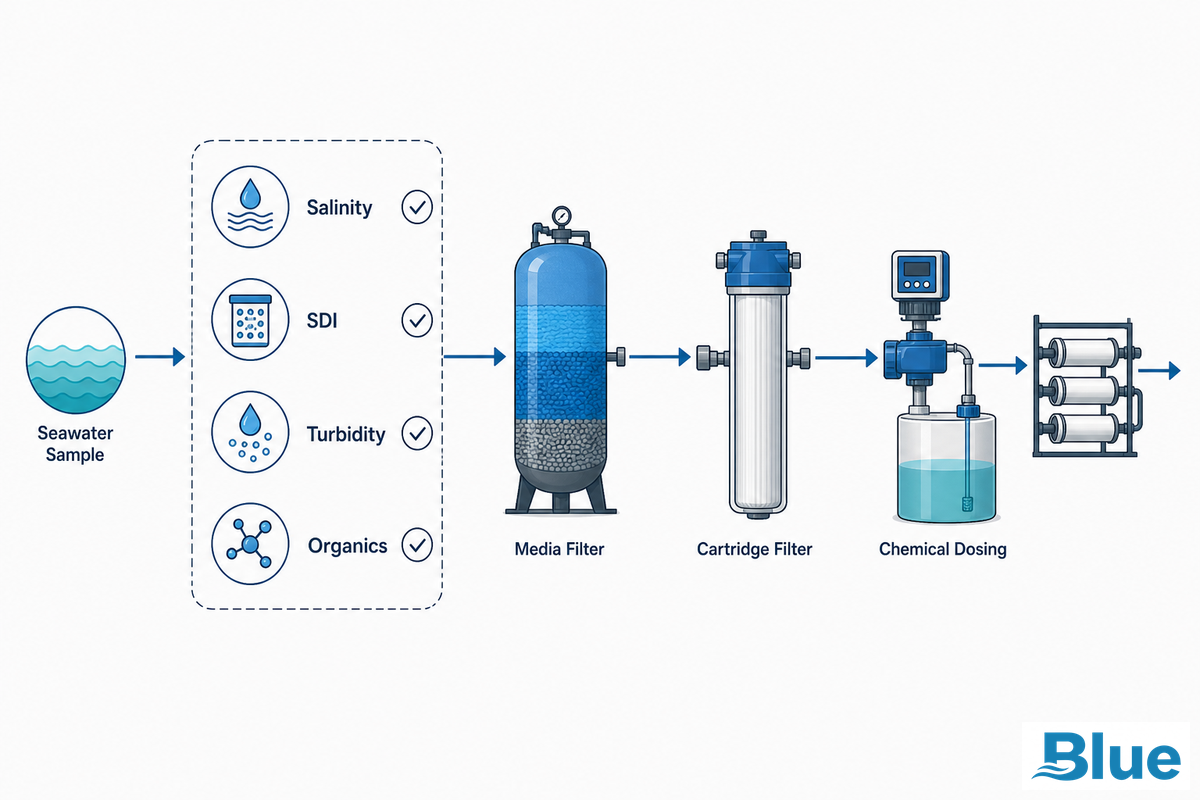
Feed-water data comes before the quote. TCEQ notes that public systems using desalination must review water sources, treatment type, and by-product handling, while USBR pretreatment work shows why turbidity and silt density index matter before SWRO membranes are loaded. TCEQ desalination guidance is a useful public-system reference for this review discipline.
A weak or untraceable RO membrane can make a strong stainless frame fail commercially, but the membrane also needs clean feed. Beach wells, open seawater intakes, offshore platforms, and emergency portable units can all be called salt water treatment. They don’t present the same fouling risk.
In OEM production or municipal applications, Blue Membrane engineers compare 24-hour intake variation, 5.5 MPa pressure class, and precision membrane data before sizing pretreatment because the wrong front-end choice can fail before the RO elements reach stable operation.
| Symptom | Likely source | Buyer question |
|---|---|---|
| Fast cartridge plugging | Turbidity, algae, intake debris | Was SDI tested in worst-season feed? |
| Permeate TDS drift | Fouling, oxidation damage, membrane defect | Can the supplier show normalized data, not only raw TDS? |
| Rising differential pressure | Scaling or biological growth | What antiscalant and cleaning triggers are specified? |
| Frequent cleaning | Pretreatment mismatch | Does the design change with seasonal intake quality? |
The RO Membrane-First SWRO Buyer Matrix
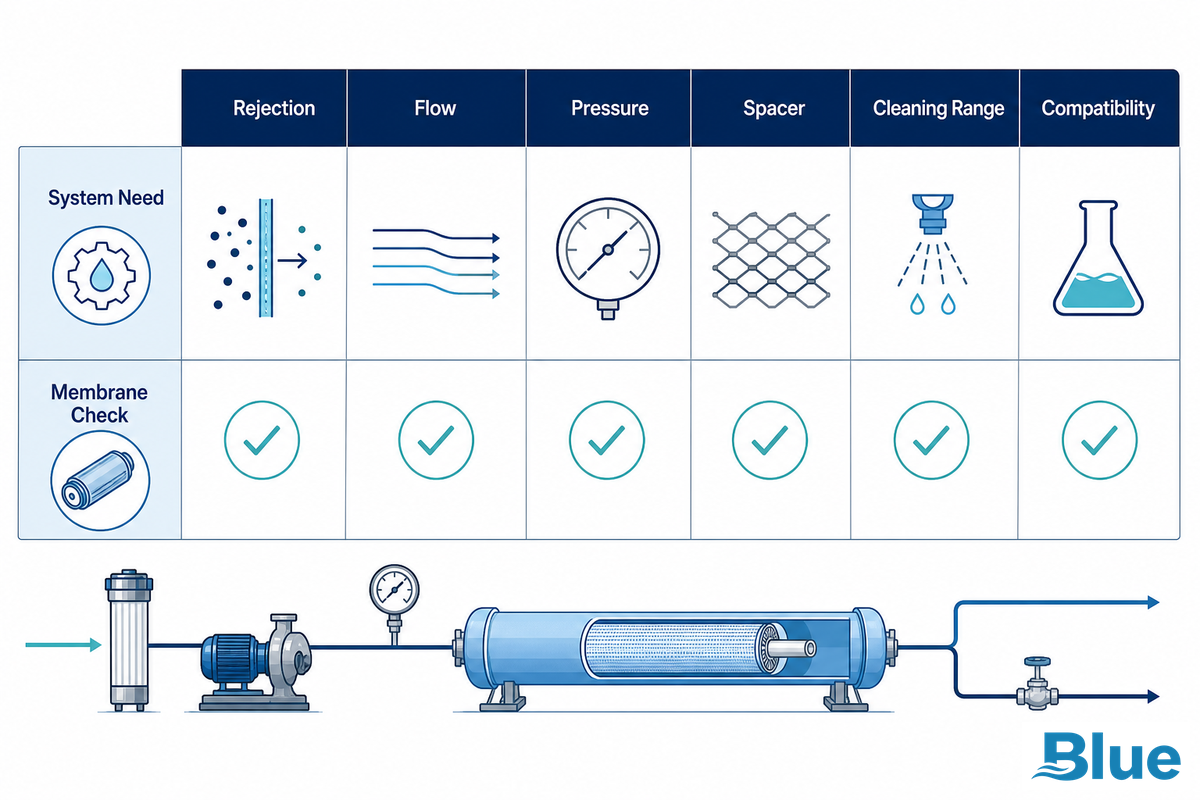
One common assumption is that the frame, pump brand, or container size defines the seawater desalination system. Counter-intuitively, the RO membrane defines the final separation result. Buyers can change controls later; a poor membrane choice can force years of high salt passage, higher pressure, or short cleaning intervals.
When the goal is to desalinate seawater at commercial scale, seawater desalination membranes and RO membrane fouling risk should be reviewed before pumps, frames, or control screens.
Blue Membrane’s public solution page is the right place to review H1 and H2 seawater RO membrane product specifications. This guide uses that page as the downstream configuration reference, so the article stays focused on RFQ decisions rather than republishing product data. Current patent activity also shows that membrane materials remain an active innovation area, including desalination membrane work filed in 2025, such as WO2025238551A1.
Don’t rely on first-party membrane claims alone. Cross-check the same fields against independent membrane manuals such as DuPont’s FilmTec RO/NF technical manual, then ask whether the quoted element has a named model, test pressure, salt rejection method, cleaning limits, and replacement path.
| Field | Why it belongs in the RFQ | Acceptable evidence |
|---|---|---|
| Salt rejection | Defines permeate TDS and second-pass need. | Test basis with ppm, pressure, temperature, recovery. |
| Permeate flow | Affects membrane count and vessel layout. | Datasheet flow under stated test conditions. |
| Pressure range | Controls pump, piping, and pressure-vessel class. | Rated max pressure and normal operating window. |
| pH and cleaning tolerance | Controls cleaning procedure and chemical risk. | Published pH range and cleaning guide. |
| Feed spacer | Changes fouling tendency and pressure drop. | Spacer thickness and channel design note. |
| Traceability | Protects spare supply and warranty decisions. | Model number, factory source, replacement plan. |
“A seawater RO quote should let an engineer compare membrane test conditions line by line. If the membrane inside the pressure vessel cannot be named, the system cannot be audited.” – Blue Membrane technical team
Energy Recovery and the High-Pressure Energy Cost Trap
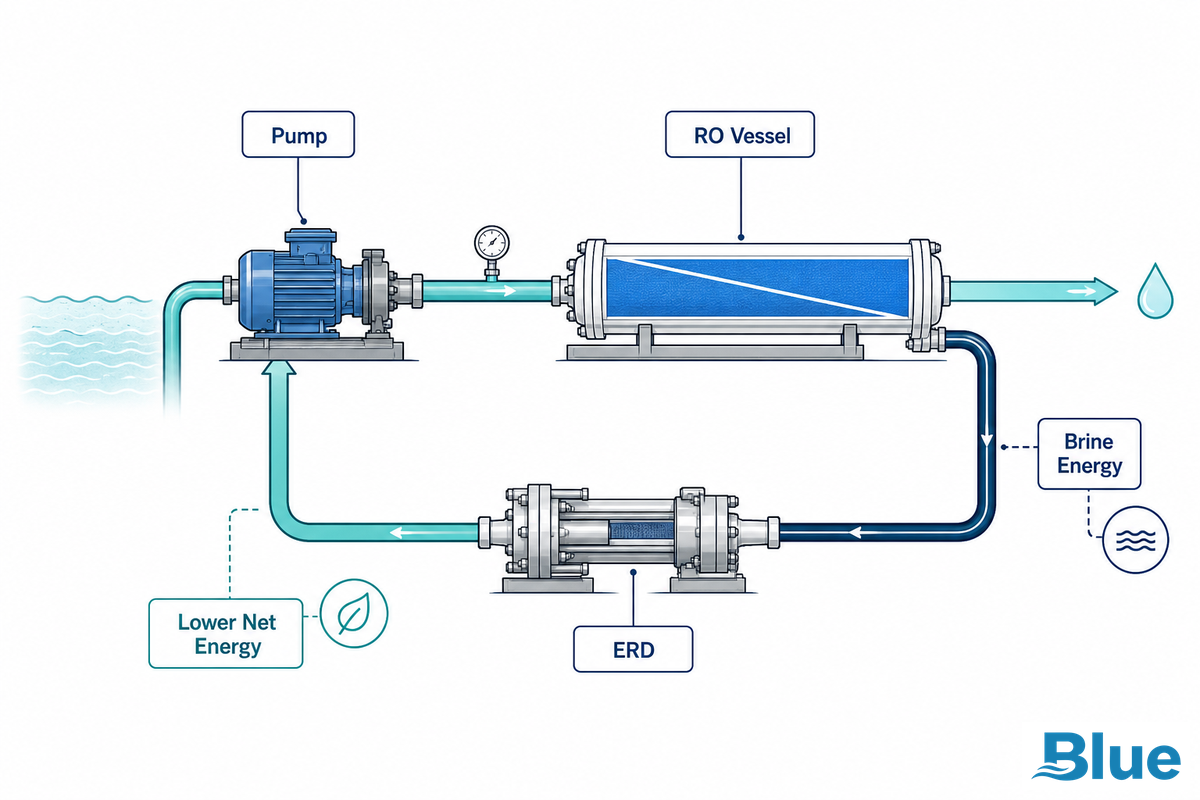
Seawater reverse osmosis is pressure-driven, so energy is never a side note. Academic work from the University of South Florida frames energy recovery devices as a way to cut power consumption in SWRO plants.
In OEM production applications, Blue Membrane engineers compare 24-hour duty, kWh/m3, and 800 psi pressure class because power-cost risk can fail the project before membrane price matters.
That energy cost risk is why RO desalination quotes should state the whole package basis, not only the membrane element or the nominal pump rating.
A quote based only on daily output hides energy, recovery, metallurgy, controls, and concentrate-discharge risk. Low equipment price may become high water cost if the supplier excludes the energy-recovery device, overstates recovery, or quotes membrane-only energy rather than packaged plant power.
Capacity isn’t the only breakpoint. Some smaller low-energy packages can still use energy-recovery hardware, while some intermittent emergency systems may accept higher kWh/m3 to keep controls simple. Ask for the ERD basis, not only the plant size.
| Project condition | ERD question | Finance risk |
|---|---|---|
| Low-duty portable or emergency system | Will simple design beat added equipment? | Overbuying hardware for rare use. |
| Resort, island, or coastal facility | What kWh/m3 is guaranteed at real recovery? | Power cost overwhelms membrane savings. |
| Municipal or industrial continuous duty | Is pressure exchanger or turbine recovery in the base quote? | Lifecycle cost is under-modeled. |
| Retrofit plant | Can existing pumps, controls, and pressure vessels support ERD changes? | Downtime and integration cost. |
Energy Recovery reported May 21, 2025 contracts over $7 million for SWRO projects in Spain, tied to estimated energy savings and retrofit use. Treat vendor numbers as a live-market signal, not a neutral benchmark. Use government, academic, or project-specific engineering documents for final cost and energy assumptions.
Emerging approaches can change the energy picture, but they shouldn’t be treated as the default quote basis. A 2021 arXiv paper on direct-drive ocean wave-powered batch reverse osmosis modeled energy use as low as 2.30 kWh/m3 under specific sea states; that’s a technology watch item, not a guarantee for a containerized plant or marine skid.
Blue Membrane engineers treat kWh/m3, 800 psi pressure class, and recovery as one application-specific risk because a low-price quote can fail when production power costs dominate.
Marine, Skid, Containerized, Portable, or Municipal: Match the Site, Not the Label
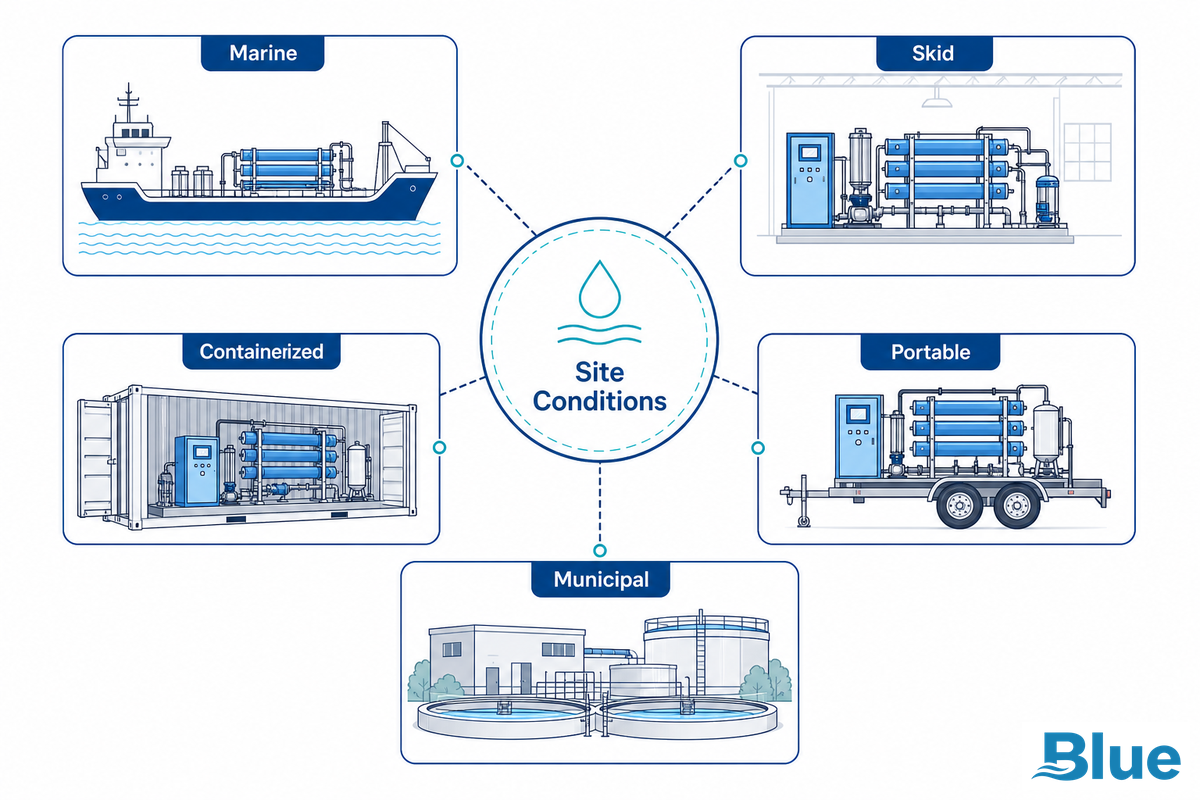
System labels are useful, but they aren’t the specification. Marine watermakers, containerized plants, skid-mounted offshore packages, portable emergency units, and public-water SWRO plants can all use the same desalination process while needing different materials, intake protection, power, certification, controls, and service access. TCEQ’s public-system review page is a reminder that final use and jurisdiction change the design conversation.
Deployment choice also has an environmental boundary. AP’s 2026 desalination explainer reports that modern RO plants still face brine discharge and intake-system concerns, including harm to seafloor habitats and trapped larvae or plankton. A buyer comparing a beach-well resort plant with an open-intake municipal plant should treat intake and outfall design as a specification item, not a permitting footnote.
With a large coastal withdrawal, the intake risk may be a first-order feasibility gate. The EPA indicates that the intake structures can withdraw fish, shellfish, and eggs from the environment and draw them into a facility’s cooling-water system; the environmental impacts may be substantial and facilities withdrawing more than 2 million gal/d may be subject to intake requirements under NPDES. Before a desalination intake is treated as a separate project, a purchaser should inquire about who will manage intake screening, entrainment evaluation, brine treatment and mixing, and outfall monitoring.
There can also be rules specific to desalination plants. For example, the seawater desalination provisions addressed by California Water Boards have planning, permitting, operation, siting, design, technology, discharge and mitigation elements required for ocean protection and water quality protection. “Containerized” or “municipal” isn’t simply an packaging specification: it has implications for CEQA review, intake technology, brine management, and what’s required to get a bankable quote.
| System type category | Likely system direction | Quote field to verify |
|---|---|---|
| Vessel or yacht | Compact marine SWRO | 12 V, 24 V, or AC power; pressure rating in psi; service access. |
| Passenger or crew vessel | Medium marine package | Daily duty hours, spare membrane count, and cleaning interval in months. |
| Island hotel or resort | Containerized or skid SWRO | 17.2 kW reference load, 35% recovery target, and concentrate route. |
| Coastal industrial user | Skid-mounted process-water SWRO | Pretreatment pressure drop, 800 psi test basis, and chemical storage days. |
| Offshore platform | Marine-grade skid package | 690 V power, IP55 class, 74 kW reference load, and BV paperwork. |
| Remote camp or emergency site | Portable desalination unit | 24 hours autonomy, generator size in kW, and cartridge stock for 30 days. |
| Public water supply | Engineered SWRO with review package | 1,200 psi component ceiling, disinfection, and acceptance testing plan. |
| High-salinity or hot-season feed | Lower recovery with stronger pretreatment | 5.5 MPa pressure-class check, 26% to 35% recovery range, and scaling margin. |
| Low-energy replacement project | Membrane-first retrofit review | Compare 20% lower-energy claim, kWh basis, and 3 years spare availability. |
Now that feed-water testing is complete, use this matrix to match your feed-water data to an SWRO configuration before narrowing equipment options.
Seawater Desalination Cost and Capacity: What Actually Moves the Quote
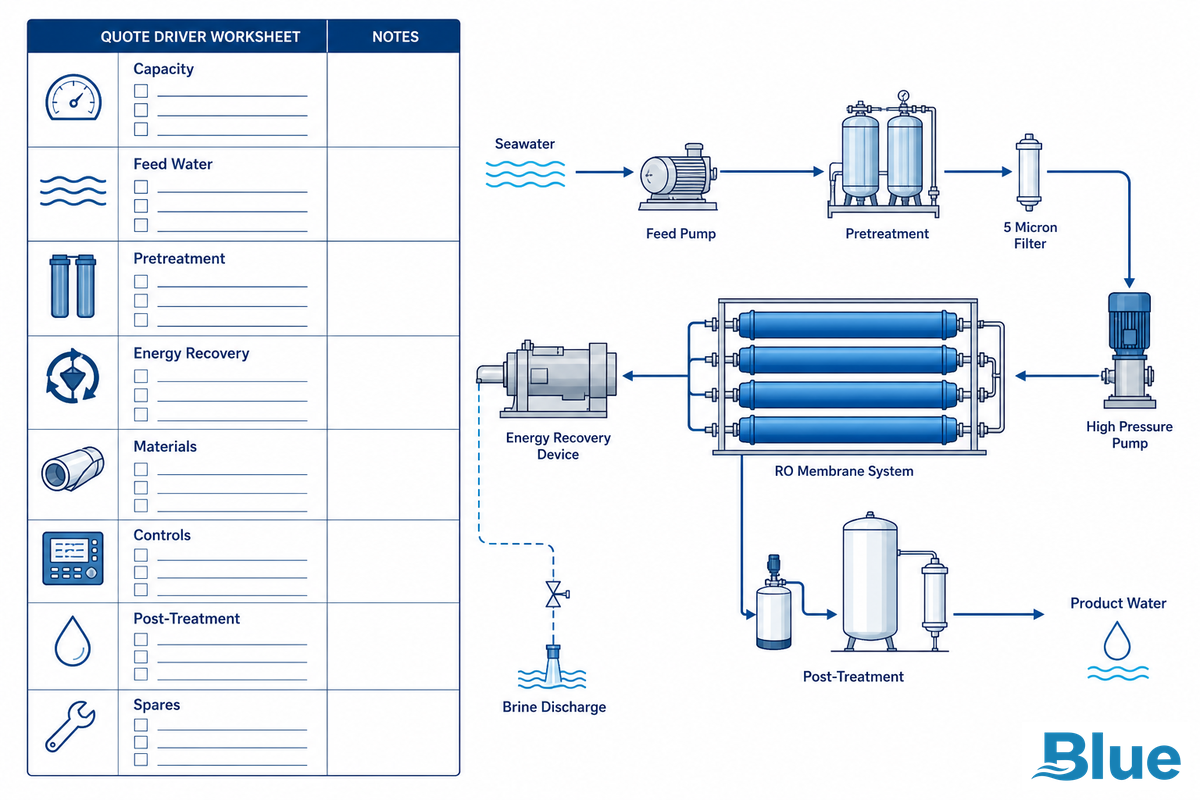
How much to desalt 1 gallon of ocean water?
It’s asked a lot but often answered with misleading numbers. Cost is determined by source-water salinity, source withdrawal method, pretreatment, membrane count, pump efficiency, energy recovery, construction materials, controls, post-treatment, concentrate disposal, power price, and facility utilization hours. Use public cost estimates as ranges, then ask the vendor to explain the assumptions.
Municipal and public-system purchasers also need to consider a pre-RFQ question: Should this site use seawater desalination at all, or should conservation, leakage, water reuse, imported water or a brackish source be examined prior?
A seawater RO facility might be the correct solution, but the feasibility study shouldn’t jump over the portfolio step of water source selection.
When the quote is for drinking water, disposal and public-system review also affect cost; see TCEQ’s desalination guidance for treatment-waste and review context.
In OEM, municipal, and industrial production use cases, a 1,000 m3 worksheet is useful because a quote can fail when recovery, kWh/m3, or concentrate disposal is hidden. Blue Membrane engineers check the spec basis before a request for quote.
| Input field | Supplier must state | Why it changes cost |
|---|---|---|
| Feed TDS and temperature | Design basis and correction factors | Changes pressure and permeate flow. |
| Recovery rate | Operating recovery, not only max recovery | Changes concentrate volume and scaling risk. |
| Specific energy | kWh/m3 for whole plant | Converts directly into operating expense. |
| Membrane replacement | Element count, price, life assumption | Hidden cost if element source is unclear. |
| Post-treatment | Mineral dosing, pH correction, disinfection | Often excluded from equipment-only quotes. |
| Commissioning and tests | Acceptance test scope | Prevents disputes after startup. |
Project pricing should start with the worksheet, then request a project quote for a seawater RO system with feed-water data included.
Drinking-Water Safety, Post-Treatment, and Public-System Review
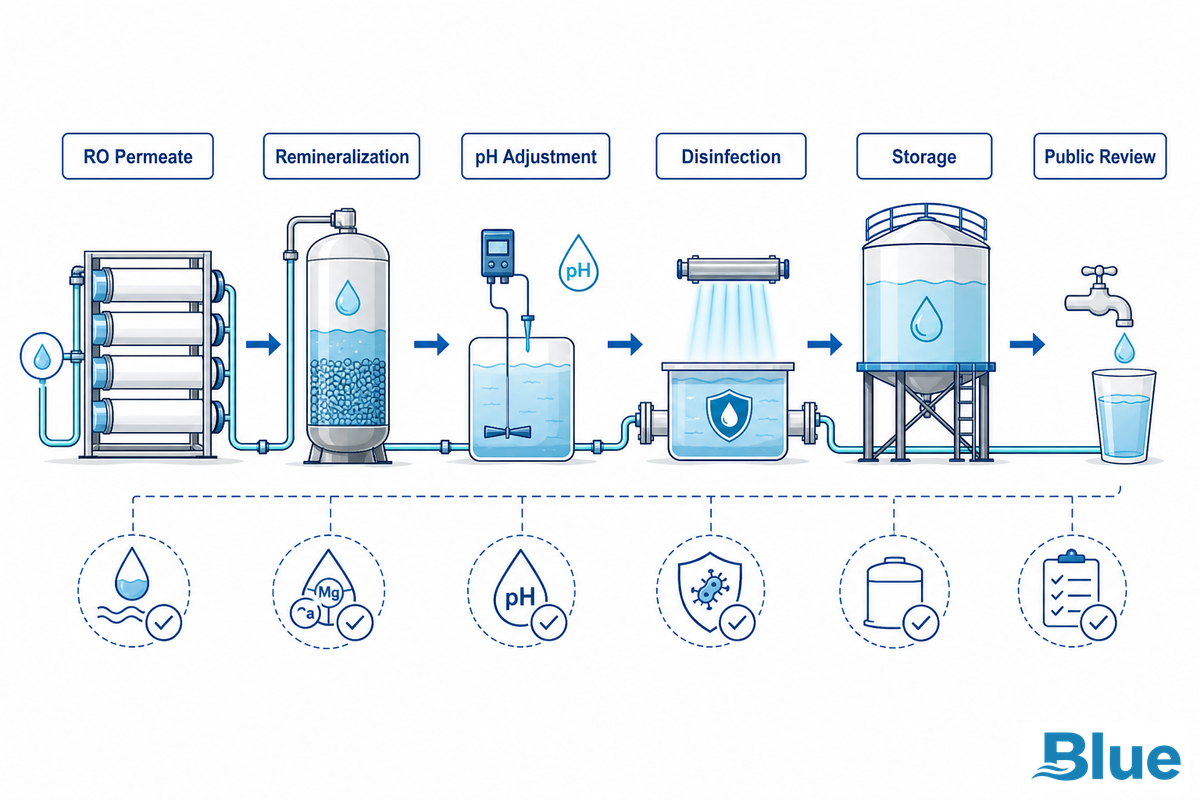
Is reverse osmosis okay for drinking water sea water?
Yes, but the permeate isn’t the end result in potable water on its own. WHO guidance on desalinated drinking water centers on chemicals and microbes of concern, and public-system guidance pages such as TCEQ’s desalination guidance don’t stop at the membrane.
Typical follow-up stages involve remineralization, pH correction, disinfection, blending, storage protection, and monitoring. AP refers to desalinated fresh water that has been re-treated to comply with drinking water regulations, often with mineral addition, which validates including remineralization in the finishing steps rather than treating it as an add-on. Boron, bromide, corrosion control, and discharge at the local point are also relevant issues. Low conductivity isn’t proof of safe drinking water.
Don’t overlook: NaCl rejection and TDS aren’t the only parameters relevant to a potable-water supply. Factors such as boron, bromide chemistry, iodine removal, corrosion control and requirements for a second RO pass can demand a different assessment. Check with your supplier on constituents being modeled other than bulk passage through the salt process.
In public-water or resort applications, the risk is not only salt passage: a 24-hour storage design can fail if pH correction, disinfection, and monitoring are outside the scope. Blue Membrane engineers separate membrane rejection from finished-water compliance because the specification must cover post-treatment.
- Check final water usage: drinking water, process water, boiler feed, irrigation or emergency supply.
- Ask whether remineralization and corrosion control are included.
- Confirm disinfection and storage design – not only RO permeate quality.
- Check whether local public-water review applies before operation.
- Ask who owns concentrate discharge permits and monitoring.
Operation and Maintenance: Cleaning, TDS Drift, and Membrane Life
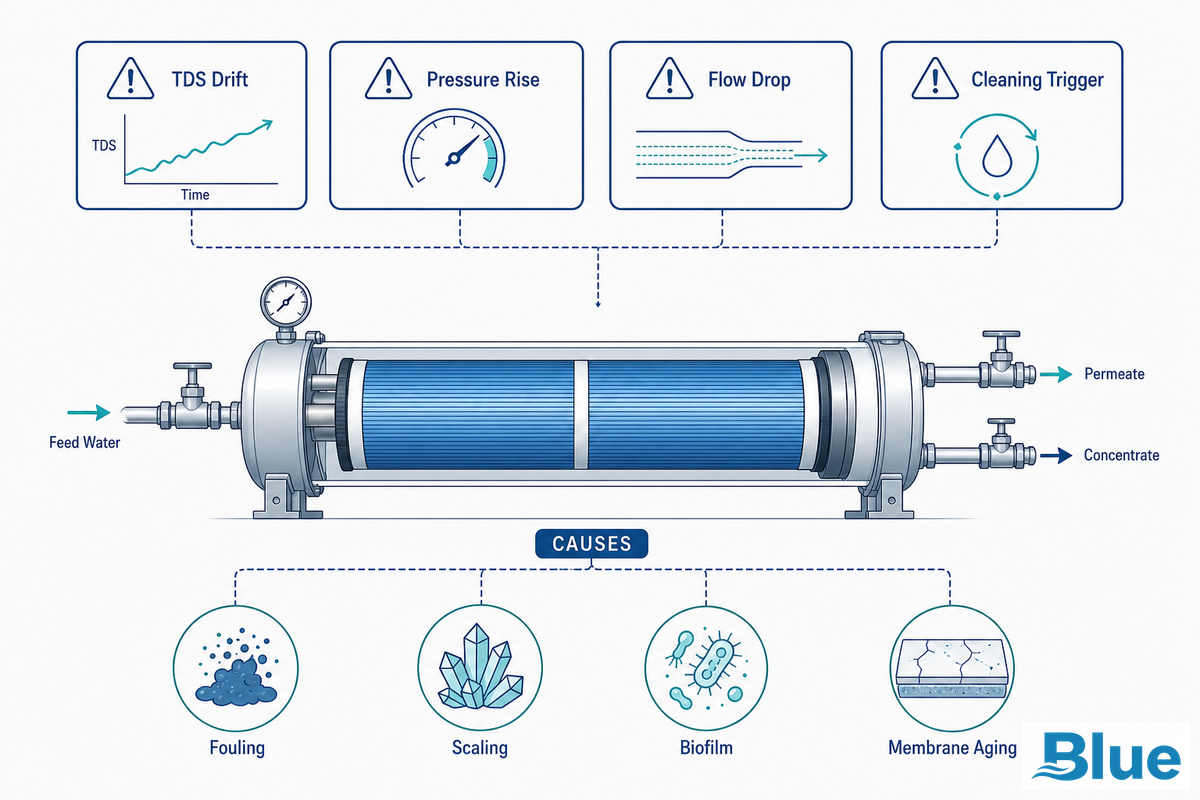
Membrane failing after 3 months isn’t usually solved by buying the same membrane again.
It requires a water report, pretreatment review, chemical exposure check and normalized data. DuPont’s FilmTec technical manual details fouling and scaling in staged membrane systems, and public guidelines like TCEQ’s desalination webpage remind us that feed and byproduct are reviewed prior to operation.
In production or marine applications, the problem is often a hidden cleaning trigger, because 3 months of drift can come from feed change rather than membrane age. Blue Membrane engineers ask for normalized data, oxidant history, and precision replacement matching before recommending elements.
| Signal | Check first | Decision |
|---|---|---|
| Permeate TDS rises slowly | Normalize for temperature and recovery. | Trend before replacing elements. |
| Differential pressure rises | Check scaling, biological growth, and prefilter performance. | Review pretreatment and cleaning trigger. |
| Flow drops after cleaning | Check irreversible fouling or chemical damage. | Inspect membrane handling and oxidant exposure. |
| Sudden TDS jump | Check O-rings, vessel loading, probe calibration, and membrane breach. | Stop guessing from calendar age alone. |
Which RO is best for salt water?
True seawater needs an SWRO membrane and system rated for high salinity, high pressure and the duty cycle needed. Lower-salinity brackish water may require only BWRO and may use lower pressures. Selection is based on feed salinity and water quality, not a general filter designation.
Outlook: Why SWRO Specifications Are Moving Toward Energy Recovery and Traceable Membranes
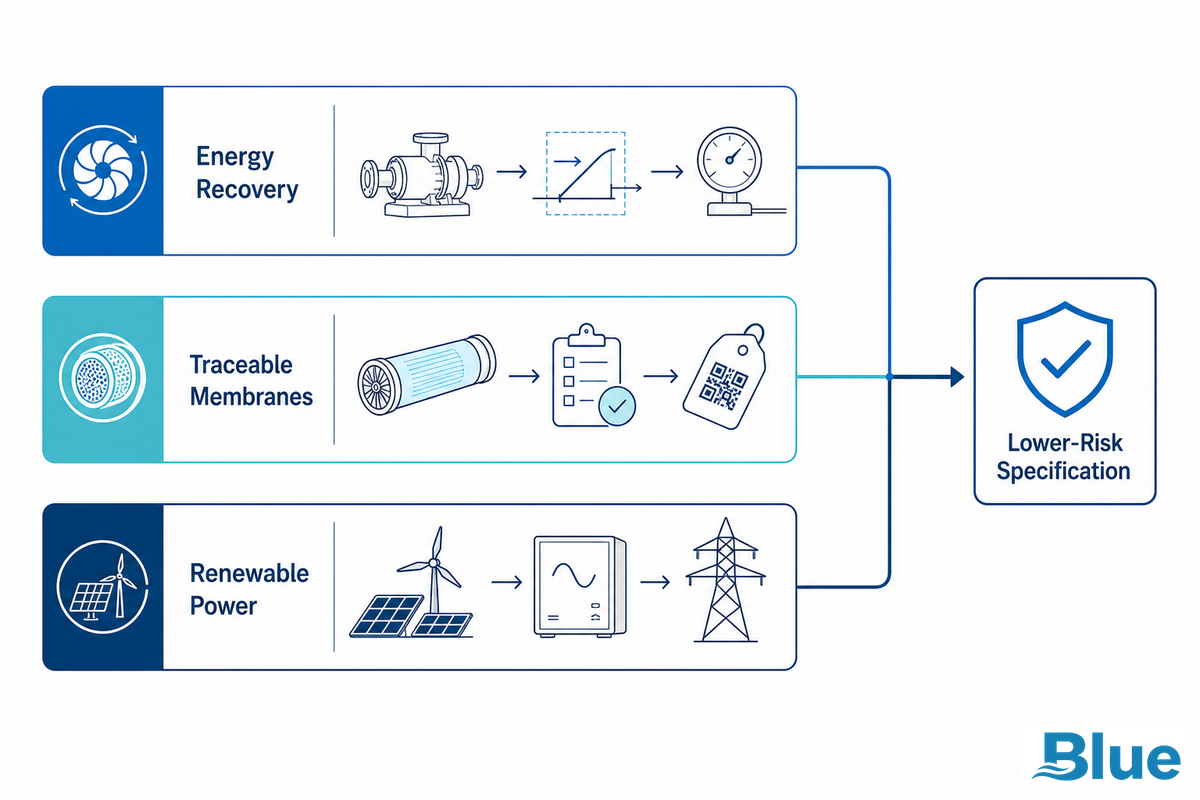
Buyer behavior has transitioned from general market growth talk to increased scrutiny, questioning whether the plant has: traceable membrane performance; realistic recovery; economic energy recovery; and water-safety review. IDRA’s Desalination & Reuse Handbook 2025-2026 underscores desalination and reuse remain on the front lines of water security, while patent literature like WO2025238551A1 confirms that research into membrane materials continues.
A common assumption to dispute is that more recovery always yields a lower cost for water.
While more recovery may reduce intake volume and the volume of the byproduct stream, it also tends to increase the likelihood of scaling, require higher doses, necessitate more frequent cleanings, and stress the membrane. Another faulty assumption occurs when buyers compare system capacity without verifying the membrane. Two 65 TPD systems may possess widely different data sheets, energy requirements and spare-part risk profiles.
Is there a device that can make ocean water drinkable?
Yes, but it is not a single filter. It is an SWRO membrane system package with an integrated intake system, pretreatment module, high-pressure pump, energy recovery systems, a byproduct management strategy, and post-treatment processes.
This highlights why careful specification is more critical than the label on the skid.
The next risk is over-specified recovery: a 65 TPD package can fail in the field because energy, cleaning, and spare supply aren’t linked to the membrane data. Blue Membrane engineers connect traceable membrane selection, production duty, and precision test basis before treating a trend as a purchase spec.
FAQ
Can you use reverse osmosis on sea water?
Yes, but only with a seawater-rated reverse osmosis system, not just a household RO unit. Concentrated ocean water can reach about 35,000 ppm salt.
Consequently, the system must be equipped with a seawater RO membrane, high-pressure pump, pretreatment capabilities, corrosion-resistant materials, a concentrate handling system, and post-treatment steps for drinking purposes. Proper quotations begin with the feed-water’s chemistry and the required daily production, not just a generic gallons-per-day quantity.
Which RO is best for salt water?
Genuine seawater calls for an SWRO membrane and system bundle rated for high salinity, high pressure, and the desired operating cycle.
Lower-salinity brackish water may be served by a BWRO system and lower pressures. Selection hinges on feed salinity, desired recovery rate, fouling tendency, water quality specifications, and operating hours. Buyers should scrutinize membrane datasheets instead of only comparing pumps or skid appearance.
How much does it cost to desalinate 1 gallon of ocean water?
There’s no single cost per gallon applicable to all seawater RO projects. Costs will vary depending on capacity, salinity, intake design, pretreatment, membrane count, energy recovery, pump efficiency, materials of construction, post-treatment, discharge method, electricity cost, spare parts, commissioning scope and duty cycle assumed in the bid. The economics of small marine units, resort containerized plants, and municipal public water supply are very different. Ask suppliers to declare their assumptions for kWh/m3, recovery rate, spare parts, membrane life, cleaning chemicals, control instrumentation, site acceptance tests, and whether post-treatment is included in their package.
How long do SWRO membranes last?
Membrane life depends on feed quality, pretreatment, cleaning habits, oxidant exposure, and scaling prevention. Monitor salt passage and differential pressure in addition to calendar age.
What is the difference between brackish RO and seawater RO?
Brackish RO generally treats lower salinity water and runs at lower pressures. Seawater RO, however, typically addresses higher salinity, more aggressive corrosion issues, and less consistent intake variability, which changes the design criteria for membrane, pump, pretreatment, and post-treatment.
Should I buy a complete SWRO system or specify the membrane first?
A full packaged system may be appropriate for small, standard-duty applications. In industrial, municipal, offshore, resort, or OEM type projects, work back from the membrane and target feed water quality, as the membrane dictates rejection, flow, pressure, cleaning capability, and certainty of replacement. The quality of the frame and piping are less important than having an authentic membrane with traceable performance.
Once your feed water analysis, daily target throughput, and end use have been established, compare Blue Membrane’s seawater RO system options, and request configuration details specifying membrane series, basis of test, pressure, recovery, energy basis, and post-treatment.