Get in touch with Blue Membrane Company

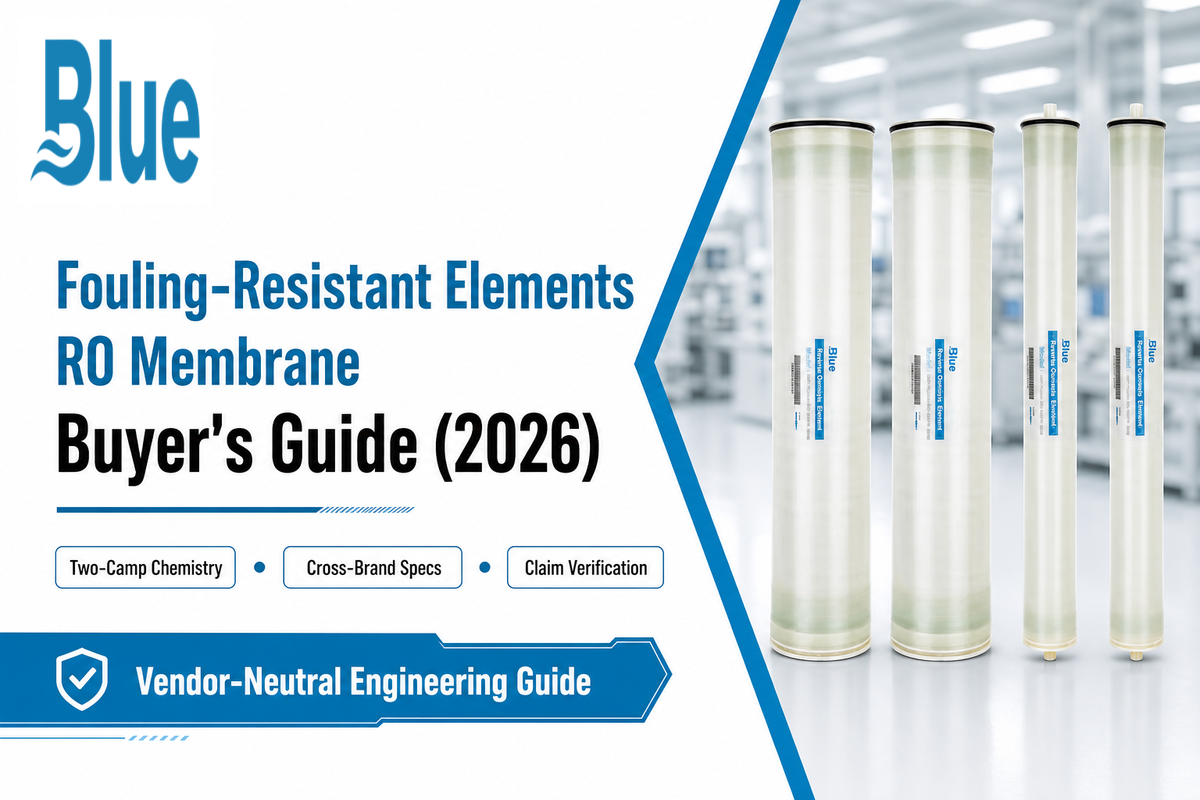
Fouling-resistant elements are spiral-wound RO or NF membrane components designed to retard the adsorption of organics, biofilms, colloids, or scaling onto the membrane surface. This means fewer cleanings, without a need to reconfigure any of your system components (pressure vessel, plumbing, target recovery, etc.). The real question a buyer faces is more focused than “do FR chemistry work,” it’s whether an FR element or a pretreatment update can more cost-effectively address your fouling problem, and how to discern a true FR claim from marketing puffery prior to investing cash.
In short: Fouling-resistant elements reduce cleaning frequency and slow flux decline on organic, biological, and colloidal foulants, but they don’t fix scaling on their own — and industry data shows early membrane replacement, not cleaning chemicals, is the largest cost driver fouling actually causes.
- The biggest fouling cost is generally not the chemicals themselves; a 2021 peer-reviewed study of 7 full-scale Dutch RO and NF plants found fouling adds roughly 24% to RO operating cost, and the predominant cost factor was early membrane replacement, not cleaning cycles.
- FR elements come in at least two distinct chemistry camps, hydrophilic surface-modified polyamide and zwitterionic, and they’re not interchangeable in how they behave on different feedwaters.
- The term “fouling-resistant” doesn’t necessarily mean stable salt rejection. In one 2019 field trial with rival FR element products, one claimed-FR element had 80% more salt passage than the comparison element under similar biofouling conditions.
- Specifications are tested under different conditions between brands (e.g. 2,000 ppm NaCl at 225 psi for one, vs. 1,500 ppm at 150 psi for another) so a comparison of rejection percentages without matching test conditions is misleading.
Quick Specs
| Typical stabilized rejection | 99.5% – 99.8% (brand and test-condition dependent) |
| Feed spacer thickness | 28 mil (standard) vs. 34 mil (FR-designated), most brands |
| Max feed SDI15 | 5 (most brands) – 6 (Blue Membrane Z2) |
| Max feed TDS | ~10,000 ppm (brackish-class FR elements) |
| Standard housing sizes | 8040, 4040, 4021, 2540 (industry-wide de facto sizing) |
| Fouling’s real cost share | ~24% of RO operating cost (Jafari et al. 2021) |
What Is a Fouling-Resistant RO Membrane Element, and Why Is It Its Own Category?
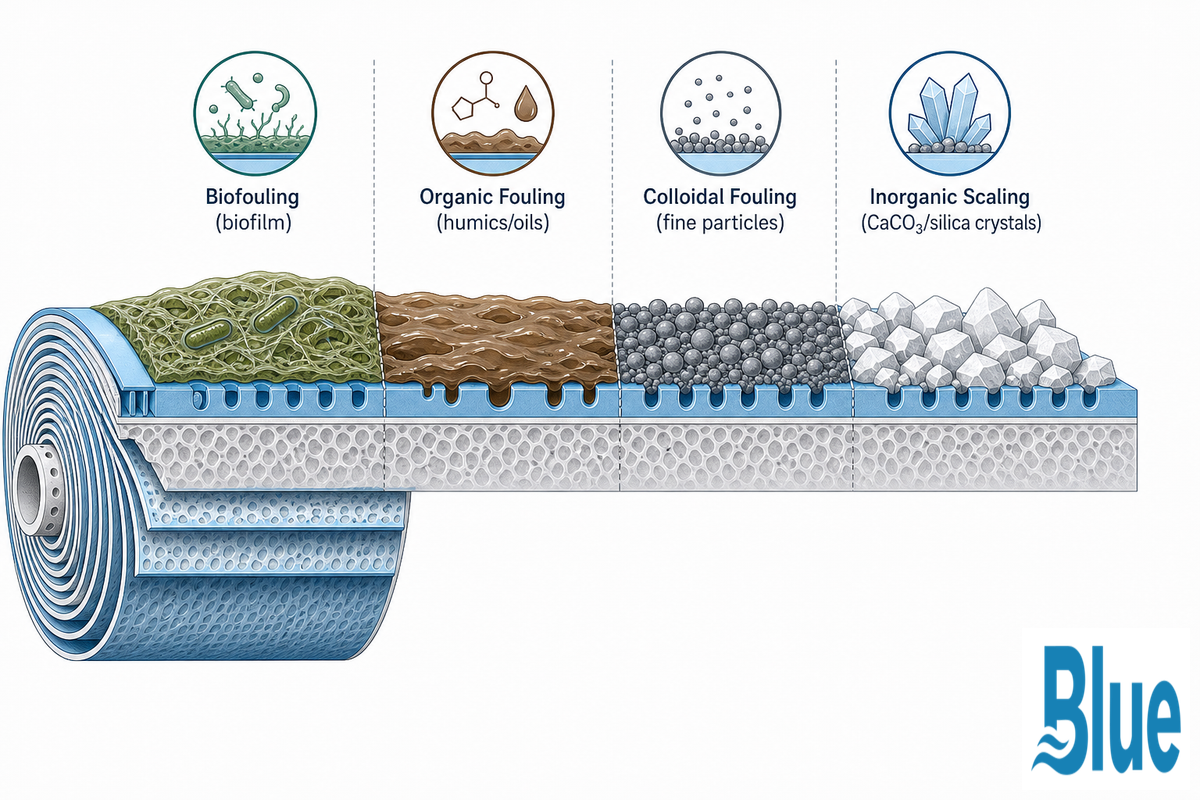
Every RO and NF membrane eventually fouls. An FR element’s job is to answer which of four main mechanisms is primarily driving that damage, and whether its surface chemistry can inhibit it. Research published in Heliyon in 2023 organized the main types of membrane fouling into four categories that have shown up repeatedly in both research and vendor documentation.
- Biofouling (microorganisms that grow as a biofilm on the membrane surface).
- Organic fouling (humic substances, oil, and proteins adsorb to the membrane surface).
- Colloidal/particulate fouling (very fine suspended solids that penetrate pretreatment and plug into the membrane’s surface pores).
- Inorganic scaling (calcium carbonate, silica, sulfates precipitate out of concentrated feed waters).
FR elements work by retarding biofouling, organics, and colloids-through modification of membrane surface chemistry or feed channel geometry-that present less of a sticky surface. Scaling is an inherent feed water chemistry problem the membrane surface can’t completely solve and should still be managed with appropriate pretreatment (antiscalant dosing, softening, etc. or by operating at conservative recovery rates). Blue Membrane’s own Z2 FR elements are a typical example of hydrophilic modification technology.
📐 Engineering Note: why this matters financially: a widely-cited industry estimate, repeated across the fouling-research literature for over a decade, puts the annual global cost of biofouling prevention in desalination at approximately $15 billion. Separately, chemical cleaning alone can run 5-20% of a typical RO unit’s total operating cost, before any premature-replacement cost is counted. Ahmed et al., 2023, Heliyon.
Cleaning triggers are uniform across all sources: a flux dip to about 10%, a differential-pressure increase to about 15%, or a salt-passage increase of about 10% from baseline are the parameters operators normalize against, not a set calendar interval. That one piece of framing information is critical because later, in the CIP frequency section, the entire replacement timing decision is built around trend data, not a fixed service-life figure. It’s also the practical answer to how to prevent membrane fouling from becoming a replacement decision by surprise: normalize against these three thresholds before a cleaning cycle is even due.
How Fouling-Resistant Membranes Actually Work: The Two-Camp Fouling-Resistance Split
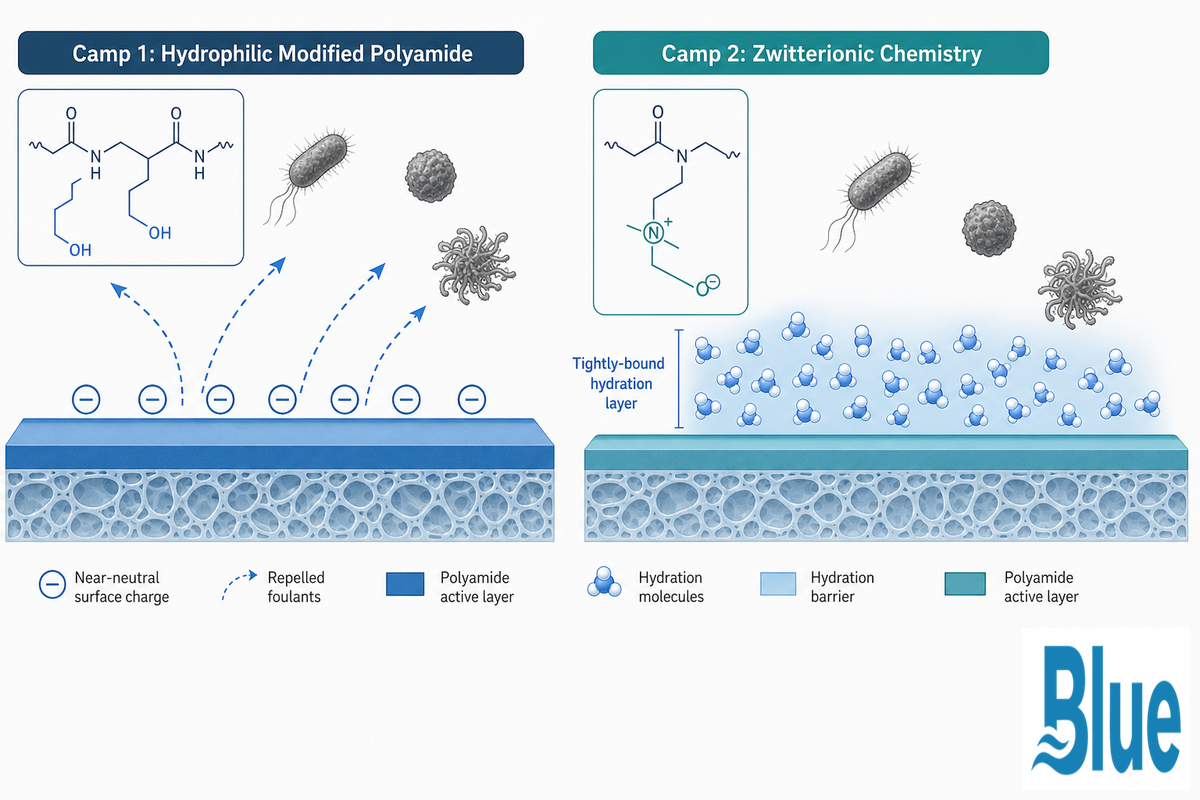
Fouling-resistant membranes work by altering the membrane’s outer surface chemistry or feed-channel geometry so organics, biofilm precursors, and colloids have less to physically adhere to. Every commercially available fouling-resistant element on the market can be placed in one of two engineering camps based on that design principle; this isn’t simply cosmetic, as the camps actually resist different types of foulants.
Both camps start from the same manufacturing baseline. A standard reverse-osmosis element is a polyamide thin-film composite (TFC) — a layer formed by interfacial polymerization directly on a polyethersulfone support layer, itself cast onto a polyester backing. FR modification happens to that base membrane material after formation, not instead of it. Elimelech et al.’s widely cited 1997 study in the Journal of Membrane Science found the higher fouling rate of standard thin-film composite membranes traces to surface roughness inherent in interfacially polymerized aromatic polyamide membranes, not membrane pore size alone; the field of membrane science has built directly on that finding ever since. Camp 1 is, in short, a hydrophilic membrane strategy: it functionalizes exposed carboxyl groups on the base polyamide membranes’ surface to reduce that roughness and slow foulant deposition on the polyamide membrane surface. Camp 2 grafts on zwitterionic side chains instead. That same core TFC chemistry, with different post-formation surface treatments, also underlies the thin-film composite nanofiltration membrane products used in softer-duty water treatment applications. Either way, the goal is the same: give the membrane material improved fouling resistance against natural organic matter and biological foulants, forming a thinner fouling layer, without changing the underlying separation performance.
Camp 1: Hydrophilic, Near-Neutral-Charge Surface Modification
This is the more mature camp; it dates back at least as far as a 2011 patent (US9598598B2, zwitterionic anti-biofouling coatings) and includes more recent work up through 2022 (US11278847B2 for hydrogel-coated RO membrane). Even a recent 2024 Chinese patent continuation filing (CN119499894A) confirms that the camp is far from moribund. Both DuPont’s Fortilife and BW30FR element lines and Blue Membrane’s Z2 elements use this design: a hydrophilic modified-polyamide skin in conjunction with an almost neutral surface charge decrease the electrostatic and hydrophobic attraction that causes organics, oils, and biofilm precursors to stick to the membrane surface.
Camp 2: Zwitterionic Chemistry
The alternative approach is zwitterionic membranes, which incorporate positive and negative charged groups on the same surface layer to create a strongly attached hydration layer that physically repels foulants, before they can adhere. The most commonly found commercial product in this category is ZwitterCo, and the technology has received some very credible independent government support; a feasibility study from the US Department of Energy regarding ZwitterCo’s technology is accessible from New Mexico Environment Department, rather than the company. In practice, an industrial buyer specifying a replacement element for a food-and-beverage or produced-water application is the case where picking the wrong camp is the most expensive mistake, since a hydrophilic-modified element on a heavy-organics feed can foul within weeks of installation.
“Not always” is the honest caveat here: a 2013 peer-reviewed study of zwitterion-containing polymer additives found the modification does not always result in improved membrane performancethe outcome depends on how the zwitterionic groups interact with the specific foulants present in a given feed stream, not a blanket guarantee.
Key takeaway: ask which approach a vendor’s “fouling-resistant” element takes and why, hydrophilic-modified polyamide has the longer field track record. Zwitterionic technology is newer to commercialize but offers a different mechanical approach and may perform better on organics-heavy feedstreams such as dairy process water and produced water, where hydrophilic modification can sometimes struggle. Blue Membrane’s Z2 Element Selector tool walks through this camp question against your own feedwater parameters.
Fouling-Resistant Membrane vs. Pretreatment Upgrade: The FR-vs-Pretreatment Breakeven Point
The “FR elements will reduce your cleaning costs.” That has been the most frequent narrative heard from buyers, but the reality is exactly the opposite based on available data, and understanding the real framing change the decision.
⚠️ Important: peer-reviewed research covering 7 full-scale Dutch RO and NF plants found the cost of fouling averaged 24% of total operating cost for RO plants and 11% for NF plantsand identified the early membrane replacement cost as the major factor, with additional energy consumption second and cleaning-chemical cost only a minor contributor. Jafari et al., 2021, Desalination.
That reframes the buying decision. If your feedwater is fouling badly enough to force early element replacement, spending more on RO membrane cleaning chemicals doesn’t touch the biggest cost driver, but neither does an FR element automatically fix a pretreatment gap that’s letting too much foulant load reach the membrane in the first place. Where your money is actually leaking is what should drive the decision.
Decision Framework: FR Element, Pretreatment Upgrade, or Both
- If cleaning frequency has crept up but your replacement interval hasn’t shortened – a pretreatment upgrade (antiscalant dosing, cartridge filtration, UF ahead of RO) is usually the cheaper fix, because you’re paying for chemicals, not new elements.
- If elements are being replaced before their expected 3-5 year service life despite a reasonable cleaning schedule – that’s the signal an FR element addresses directly, since it’s aimed at the cost driver the Dutch study identified as dominant.
- If your dominant foulant is scaling (see H2-7 below) – neither fixes it alone; pretreatment is required regardless of membrane choice, and an FR element without matching pretreatment just delays the same failure mode.
A worked comparison: a plant treating a 5,000 ppm TDS organics-heavy wastewater-reuse feed, running quarterly cleanings and a 4-year average element life, isn’t in crisis – a straight pretreatment tune-up likely buys another year of service before an FR swap pays for itself. A plant with the same feed forcing monthly cleanings and 2-year element turnover is exactly the case where the Dutch study’s cost structure applies, and the FR element’s higher unit price is offset by avoided early replacement, not by cleaning-chemical savings.
Blue membrane’s fouling TCO estimator runs this comparison against your own cleaning-frequency and replacement-interval numbers. In practice, an industrial buyer running this application-specific math is a five-minute exercise against numbers already sitting in the plant’s own maintenance log.
Cross-Brand Fouling-Resistant Element Comparison: The Cross-Brand FR Spec Audit
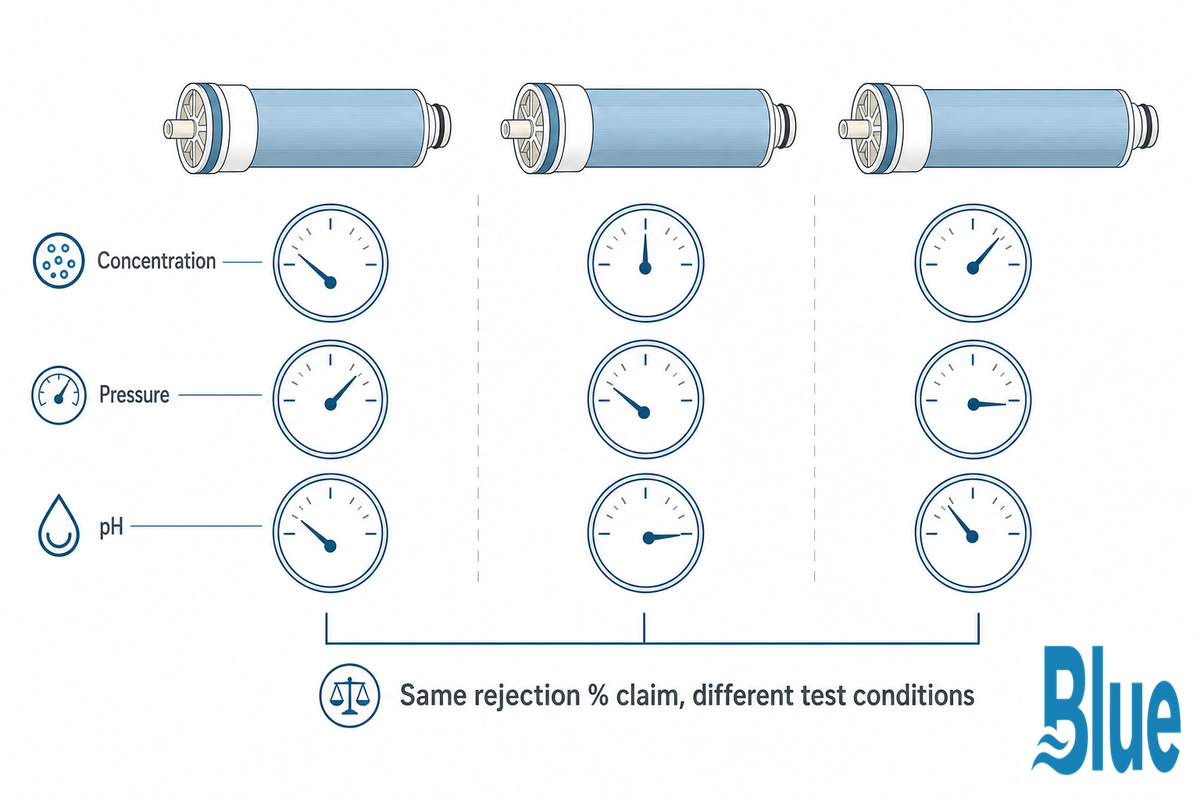
Spec sheets across brands look comparable at a glance, but they aren’t tested under identical conditions – and that difference matter more than the headline rejection number.
| Element | Feed spacer | Stabilized rejection | Test conditions | Max feed SDI |
|---|---|---|---|---|
| DuPont FilmTec Fortilife CR100 | 34 mil | 99.8% | 2,000 ppm NaCl / 225 psi / pH 8 | 5 |
| DuPont FilmTec BW30FR-400/34 | 34 mil | 99.5% | 2,000 ppm NaCl / 225 psi / pH 8 | 5 |
| Hydranautics ESPA2-LD | 34 mil | 99.6% | 1,500 ppm NaCl / 150 psi / pH 6.5-7.0 | not published |
| Hongtek FR-8040 | 34 mil (typ.) | 99.5% | 2,000 ppm NaCl / 225 psi / pH 7.5 | 5 |
| Blue Membrane Z2-8040 | 34 mil | 99.7% | 2,000 ppm NaCl / 225 psi / pH 7-8 | 6 |
Two things the table surfaces that a single spec sheet won’t: first, Hydranautics’ ESPA2-LD is tested at a meaningfully lower concentration and pressure than the other four (1,500 ppm/150 psi, against 2,000 ppm/225 psi for the rest) – a rejection number from that test condition isn’t directly comparable to the others without adjustment. Second, four of the five elements converge on the same 34-mil feed spacer, confirming the wider channel is the real industry-standard lever for fouling resistance across brands, not a single manufacturer’s proprietary feature.
Blue membrane’s BW30FR cross-reference tool lines up a specific replacement element against your existing DuPont-based system on these same axes. The mistake most buyers make is treating rejection percentage as a single comparable number across every spec sheet, which creates a hidden gap between the lab-reported figure and what the element actually does on a real application, because the vendor’s own test pressure and concentration were never checked against the buyer’s real feedwater.
How to Verify a “Fouling-Resistant” Marketing Claim Before You Buy: The FR Claim Verification Protocol
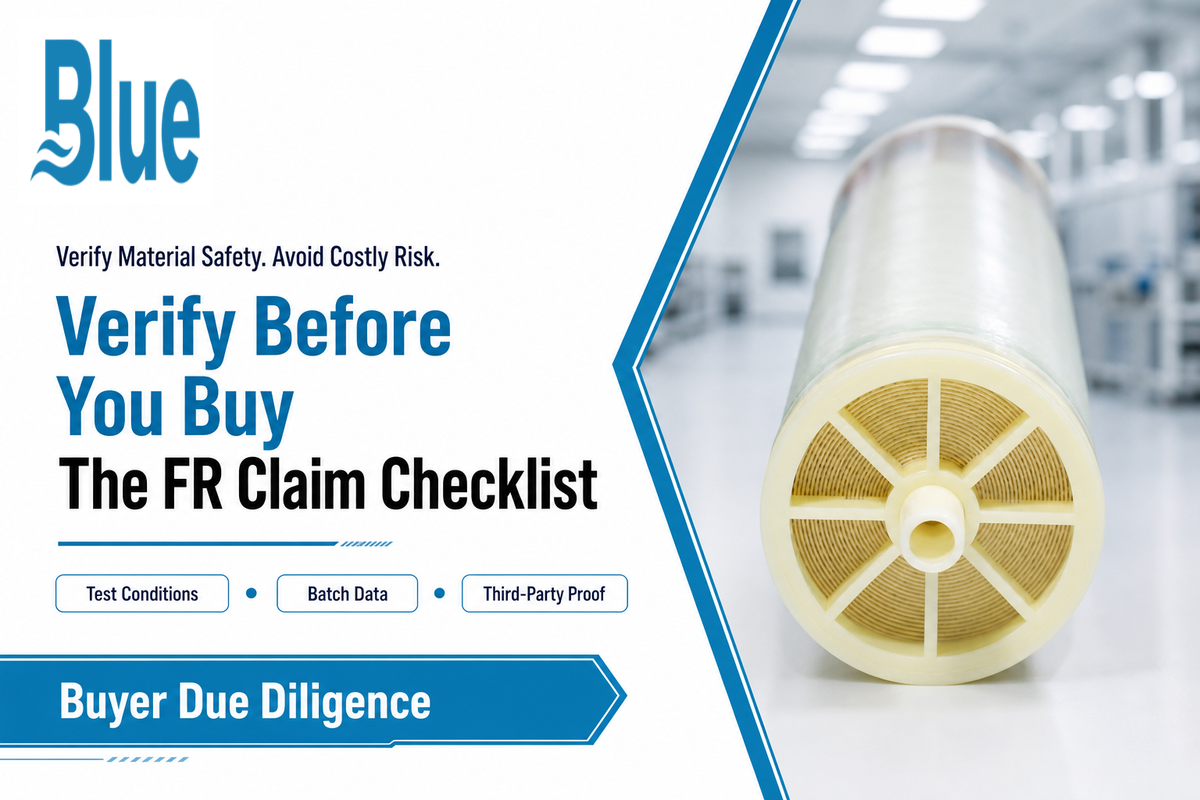
A “fouling-resistant” label isn’t independently regulated or certified – any manufacturer can put it on a spec sheet.
Ironically, the most useful evidence that the label can fail comes from a competing vendor’s own field-trial claim.
⚠️ Important: in an October 2019 field trial in the Middle East using Red Sea feedwater, DuPont reported that a rival element marketed as fouling-resistant experienced an 80% increase in salt passage across repeated cleaning cycles, while DuPont’s own comparison element held stable permeate quality under the same biofouling conditions. Reported via Water Online, 2019.
Treat that case honestly: It’s a vendor’s assertion about an unnamed competitor, verified only by re-publication in trade press-not an independent, third-party laboratory study. Not reasons to discount-in fact, this case perfectly illustrate why this protocol exists-as the only public data available that FR labels can fail come from a vendor that has a product to sell as an alternative.
What to Demand From Any FR Vendor Before You Buy
- The exact test conditions-such as concentration of feed, temperature, pressure, pH, and recovery rate-under which the claimed rejection number was obtained. Don’t just ask for the number itself.
- Data that proves consistent performance over a number of units, from the same batch, and that’s taken under the vendor’s stated conditions. It’s not just one, best-case unit.
- Proof that performance data from the field exists, ideally in the form of third-party verification or independent third-party testing. Don’t just rely on the vendor’s case studies.
- Test procedures that match the specific operating conditions and constraints of your site. That includes using your site’s SDI value and your facility’s recovery rate target, along with your facility’s specific energy consumption-not the vendor’s laboratory settings.
Blue Membrane’s own membrane replacement RFQ readiness check is built around this same demand-the-data logic before a purchase order go out.
Sizing and Housing Compatibility: The Drop-In Compatibility Gap
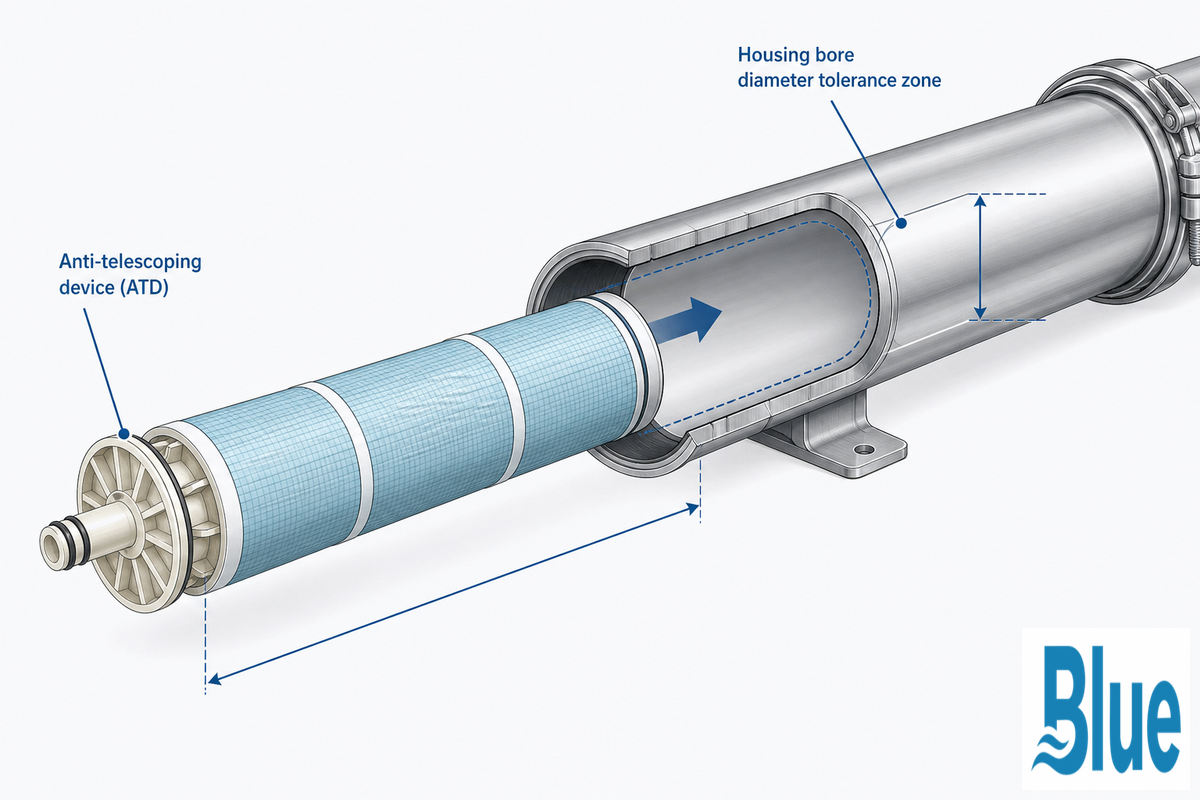
The various 8040, 4040, 4021, and 2540 designations (diameter × length, in inches) that describe RO membrane housing aren’t unique to any single manufacturer. According to a patent filing by Hydranautics concerning their proprietary internal anti-telescoping device (ATD)-which sits at each end of an RO element-the standard size of the ATD is about 7.874 inches (200 mm) in diameter, a size described as the industry de facto standard. This measurement doesn’t, however, take into account differences in the vessels themselves: The same patent filing mentions a study that showed the inner diameter of pressure vessels among major manufacturers varied from 7.945 to 7.968 inches, a 0.023-inch spread that ATD and element design has to engineer around. The mistake many facilities make, in practice, is treating housing fit as the whole story for an industrial application, because a dimensionally-correct element with the wrong feed spacer can still leave a hidden performance gap once it’s actually installed and running at your operating pressure.
“ATD diameters were historically around 7.874 inches (200 mm), which has been an industry de facto standard… [while] a survey taken of major vessel manufacturers revealed an inner diameter range of 7.945 inches to 7.968 inches” — two related but distinct tolerances: the component’s own sizing, and the housing bore it has to fit inside.
While that housing uniformity is handy, because an FR element from one brand will likely fit a vessel manufactured by another, it’s not an indication of a functionally equivalent element. ATD size and vessel bore don’t account for variation in feed spacer design, membrane area, and operating pressure that different brands may incorporate into identical-size elements, as the comparative chart of different FR element manufacturers illustrates.
✔ What Housing Fit Confirms
- Diameter and length match the pressure vessel
- Element physically installs without vessel modification
⚠ What It Doesn’t Confirm
- Feed spacer thickness matches (28 mil vs. 34 mil)
- Pressure rating and active area match the original design
Facility operators who substitute a replacement element based solely on fit often wind up running at a different pressure than the system was designed for. A useful guiding principle here: housing compatibility should count as the initial filtering step, not the only criteria, in a selection decision. Blue Membrane’s RO membrane cross-reference selector does exactly that: it checks feed spacer, area, and pressure rating together rather than dimensions alone.
Which Foulant Types Does Fouling-Resistant Chemistry Actually Help With? The 9-Type Foulant Coverage Matrix
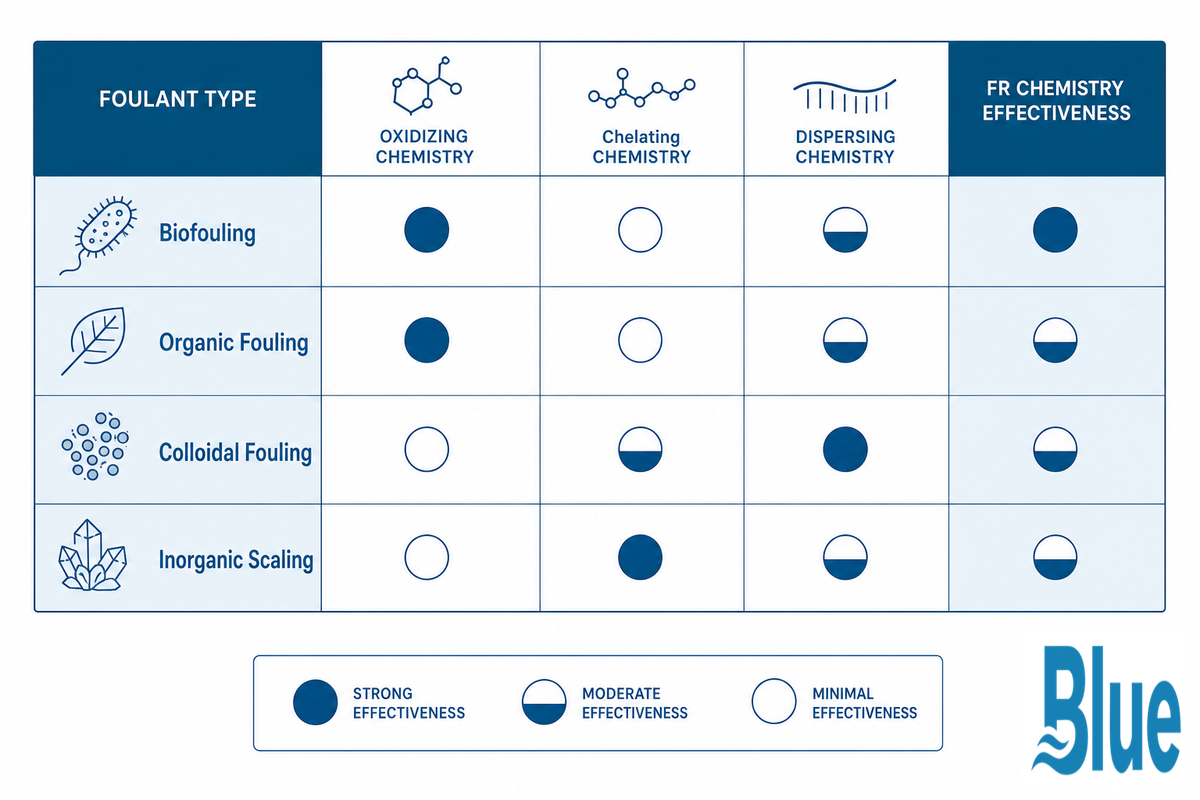
FR chemistry isn’t a magic bullet, and the honest version of that’s far more helpful to the buyer than the marketing one, especially once you understand the actual reverse osmosis membrane fouling causes behind your own feedwater. These four broad categories break down into nine specific foulant subtypes an industrial buyer is likely to actually see on a feed-water report, each with a different verdict against the same FR chemistry mechanism.
| Foulant type | FR chemistry helps? | What still needs pretreatment |
|---|---|---|
| Biofouling — bacteria/biofilm | Strong — hydrophilic/zwitterionic surfaces directly reduce adhesion | Chlorine/biocide dosing before the FR element if free chlorine present |
| Organic fouling — humic substances/humic acids | Strong — near-neutral surface charge repels most organic adsorption | Coagulation/UF ahead of RO for high-organic feeds |
| Organic fouling — oils, greases, surfactants | Strong — same near-neutral surface charge limits oil-film adsorption | Oil/water separation or DAF pretreatment for oily feeds |
| Organic fouling — proteins (dairy/food processing streams) | Strong — same mechanism, but protein layers rebuild faster under heat | UF pretreatment for high-protein feeds |
| Colloidal fouling — clay/silt particles | Moderate — wider feed spacer reduces cake-layer buildup rate | Multimedia/cartridge filtration still required (SDI target unchanged) |
| Colloidal fouling — iron/manganese oxide colloids | Moderate — same feed-spacer effect, doesn’t remove the metal itself | Iron/manganese removal (aeration + filtration) ahead of RO |
| Inorganic scaling — calcium carbonate (CaCO₃) | Minimal — surface chemistry doesn’t stop precipitation from concentrated feed | Antiscalant dosing and/or recovery-rate limits |
| Inorganic scaling — calcium/barium sulfate (CaSO₄/BaSO₄) | Minimal — same precipitation chemistry, unrelated to membrane surface | Antiscalant dosing matched to sulfate chemistry |
| Inorganic scaling — silica (SiO₂) | Minimal — precipitation-driven, independent of membrane choice | Silica-specific antiscalant and/or recovery-rate limits regardless of element |
Practical implications: if your primary operating mechanism is scaling, an FR element swap in the absence of an effective antiscalant program targets the wrong process variable. If biological and organic fouling-resistance is the dominant mechanism-which a 2023 peer-reviewed literature review flags as being the primary driver of the overall cost of preventative maintenance-then FR element installation targets exactly the right mechanism for that operating scenario. Operators of brackish feeds approaching the top of the TDS range should also consult the brackish water RO membrane elements guide for the scaling-specific pretreatment thresholds that apply regardless of which element camp is installed. In practice, an industrial buyer should run their own feed water analysis against this table before requesting quotes for any specific application, rather than assuming an FR label covers every foulant they’re seeing on the bench.
When to Switch to Fouling-Resistant Elements: The CIP-Frequency Trendline Read
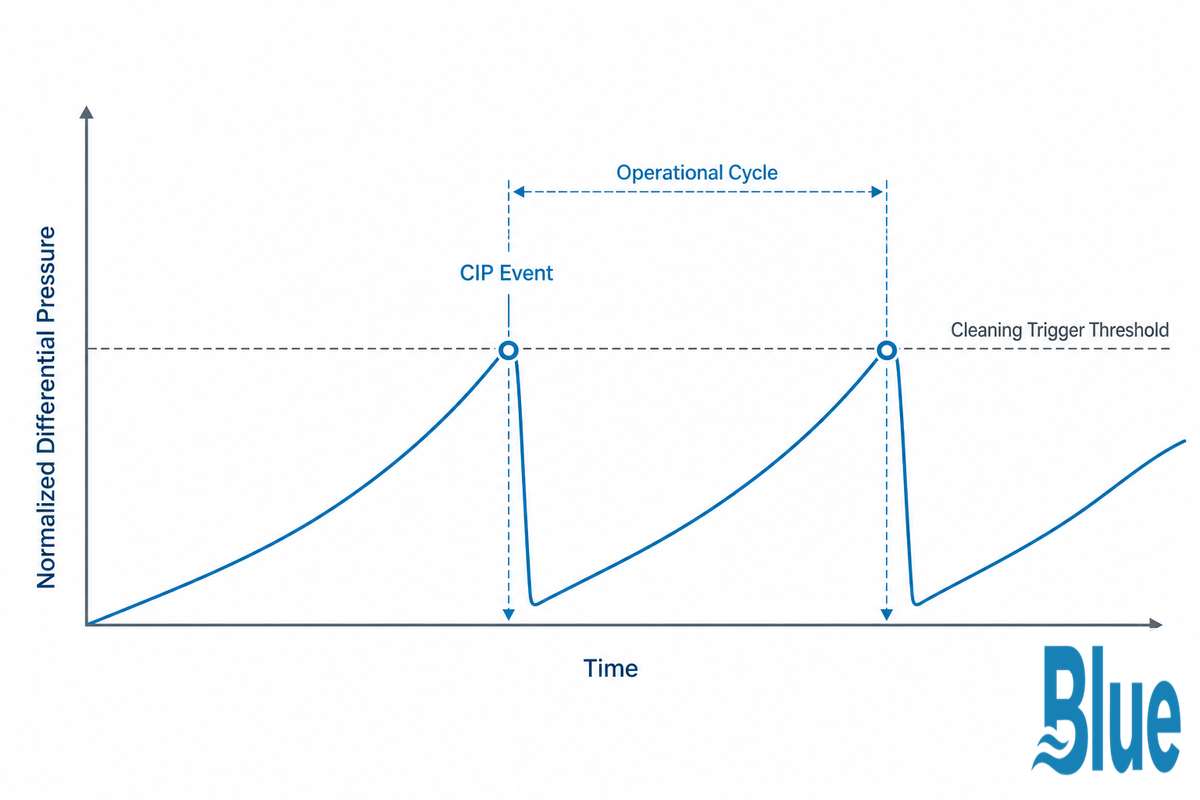
The most logical trigger for an element replacement decision is a trend within your own operating data, not a static calendar number from manufacturer spec sheets. Process engineers discussing real-world plants converge on a simple rule of thumb: a roughly 10% shift from baseline normalized flowrate or salt rejection is the cleaning threshold.
A brackish-water operator, for instance, managing a 27-year-old plant with a 70 mg/L silica feed and 50% conversion, cited a normal operating condition for their plant as cleaning every 1 to 2 months and a normal operating life span for membrane of 5 years — a reminder that “normal” cleaning frequency is unique to any given feedwater.
Reading Your Own Trendline
- Normalize flux, differential pressure, and salt passage against a clean baseline, raw numbers drift with temperature and feed pressure, normalized numbers don’t.
- A cleaning frequency that’s stable but frequent (say, monthly) suggests a pretreatment gap, an FR swap alone won’t lengthen the interval if the root cause is untreated feedwater.
- A cleaning frequency that’s climbing month over month, especially alongside a slowly rising differential pressure that cleaning no longer fully resets, is the signal that the element itself, not just the feed, has reached the point an FR swap is worth evaluating against the breakeven logic above.
In practice, an operations team tracking this trendline from existing SCADA data, feed pressure in psi and normalized flow, can flag the replacement decision for a specific application weeks before a routine cleaning cycle would have masked the real trend.
That trendline reflects real hydraulic behavior, not just an abstract score. As the accumulation of particles builds a layer on the membrane surface, permeate flux and flow rate both drop for the same applied pressure, forcing the system to work harder to hit the same water yield. Osmotic resistance is the physical driver: fouling raises the effective resistance the applied pressure has to overcome, so filtration performance degrades incrementally rather than failing outright — exactly why a single spec-sheet number can’t substitute for trend data. In a properly designed membrane module, the tangential flow shear against that accumulating layer is what a low energy design tries to maximize; the true economic impact of fouling only shows up when normalized data is tracked over months, not read off any single day’s dashboard. A single anomalous reading, due to membrane fouling’s inherently gradual onset, rarely justifies an emergency swap on its own. UCLA researchers’ 2022 review in npj Clean Water lists proactive, trend-based monitoring as one of only three real levers against biofouling operating cost, alongside site-specific pretreatment design — the same monitor-the-trend logic this section builds on, not a one-off recommendation. Hoek et al., 2022, npj Clean Water.
Industry Outlook: Where Fouling-Resistant Membrane Technology Is Headed

As you might expect, these two approaches were recognized and categorized by engineers some years back. Today, the most interesting advances are likely not in stronger fouling-resistance chemistry, but on a front that could remove a pretreatment step entirely.
Two Tracks Worth Watching
- A chlorine-resistant membrane element developed by NSF Small Business Innovation Research grantee NALA Systems purportedly can cut operating costs by as much as 20-30%. That figure comes from a 2021 NSF-prepared feature in AIChE’s Chemical Engineering Progress — an NSF promotional piece about its own funding recipient, not a third-party evaluation, and now several years old with no independently confirmed commercial-scale update found. (If this technology, or something like it, makes it to a commercial FR element, it would eliminate the dechlorination step every current polyamide-based FR element requires. The claim should be considered a talking point to probe rather than an established benefit at this point).
- Science magazine published in 2024 a study that details a chlorine-resistant polyester-based membrane chemistry, with a chemical architecture substantially different from what’s used today for polyamide-based FR elements — the material isn’t yet commercially available.
If you’re a buyer contemplating a system design with a 10-year or longer capital horizon, chlorine-resistant chemistry is something you can start watching by name in conversations with your vendors, even if it’s not an immediately purchaseable commodity. Broader market sizing for the RO membrane market does exist, per multiple research reports, but those reports are a high-level backdrop; the concrete factor you’d want to actionize is the technology and funding detailed above, not market-growth percentage. Readers evaluating a wider technology switch entirely may also want the nanofiltration membrane guide (nano filtration membrane, or NF membrane, technology), which covers a lower-pressure alternative for selective organics/hardness removal. In practice, the risk for an industrial buyer locking in a system design today is a hidden opportunity cost: a plant built around a 10 year capital horizon without revisiting dechlorination could be stuck with a pretreatment step a competitor’s newer application no longer needs.
Zooming out, fouling resistance isn’t unique to seawater RO. That same underlying mechanism — slowing how quickly a foulant layer builds on the ro membrane surface — matters across the broader water purification landscape: brackish and municipal desalination membranes, industrial wastewater treatment membranes for water reuse, and even lower-pressure uf membranes and forward osmosis systems used ahead of RO in some treatment systems all face a version of the same problem. Purification economics work the same way in each case: a plant chasing water quality targets for clean water production, or preparing feed for water desalination downstream, benefits from the same core FR logic regardless of which membrane family sits in that specific train position — only the pressure, chemistry, and cost of the swap change.
Frequently Asked Questions
Q: What is a fouling-resistant RO membrane element?
View Answer
A fouling-resistant RO membrane element is a spiral-wound reverse osmosis construction incorporating surface chemistry changes — more hydrophilic with a near-neutral, or zwitterionic, charge, often coupled with a larger feed spacer — aimed at slowing the rate of adhesion by organic matter, biofilms and particulates (foulants), and in turn increasing the duration between cleaning events.
Q: What’s the real difference between an anti-fouling and a standard RO membrane?
View Answer
The common element between both designs is the same thin-film composite polyamide chemistry. For standard elements, a conventional approach utilizes a 28-mil feed spacer along with a conventional polyamide surface. Anti-fouling (FR) elements involve modifying the polyamide surface — the addition of a more hydrophilic coating with a near-neutral, or zwitterionic, charge — as well as a larger, typically 34-mil feed spacer, which improves crossflow and reduces the available surface area for foulants to bridge and attach. These features may increase unit cost and sometimes may result in a slight difference in flux at equal pressures compared to conventional elements.
Q: Do fouling-resistant membranes eliminate the need for cleaning?
View Answer
No. While FR elements extend cleaning intervals and mitigate flux decay, they do not eliminate cleaning altogether. Marketers’ claims that this technology offers maintenance-free operation should be understood as exaggerations of the capabilities; a more accurate statement is longer intervals between cleanings rather than no cleanings at all. Scaling in particular still needs antiscalant dosing or recovery-rate limits regardless of which FR element is installed, since surface chemistry alone doesn’t stop mineral precipitation from a concentrated feed.
Q: Are fouling-resistant elements from different brands actually interchangeable?
View Answer
Theoretically yes, at least from a dimensional standpoint. Common 8040/4040/4021/2540 housing sizes represent an industry-wide de facto standard, not proprietary technology unique to a single manufacturer, so another brand of element should technically fit an existing pressure vessel. However, from a performance standpoint, it’s not guaranteed: there may be variations in feed spacer thickness, active membrane area and rated pressure between elements of different brands that fit the same housing. Ensure those three specifications are consistent before treating a cross-brand element swap as a like-for-like substitution.
Q: How long do fouling-resistant elements typically last?
View Answer
For most industrial elements, regardless of whether they are standard or FR construction, an operational lifespan of 3 to 5 years is achievable with good pretreatment practices and routine cleaning procedures. FR chemistry is designed to help a facility operate closer to the outer end of that range with a more challenging feedwater, rather than offering indefinite longevity. Ultimately, feedwater quality and the effectiveness of pretreatment methods will determine the ultimate boundary.
Q: Is a wider feed spacer alone enough to call a membrane “fouling-resistant”?
View Answer
No, and this is one of the most common buyer miscommunications. Wider feed spacer (34mil vs 28mil) is helpful because of the increased cross-flow and resulting reduced differential pressure — one factor of fouling resistance, half of the engineering story, but only half. Surface chemistry (hydrophilic modification or zwitterionic groups) determines how the foulants interact with the membrane surface itself. An element with wider spacer, but no modified surface chemistry, will foul organics and biofilm nearly as fast as standard elements, just slightly slower because cross-flow has improved. Always ask about surface chemistry changes, not just spacer width, if considering a “wide-spacer” element for fouling resistance. The simplest check: ask the vendor which of the two chemistry camps (hydrophilic-modified polyamide or zwitterionic) their element actually uses — a supplier that can only describe the spacer geometry, with no answer on surface chemistry, likely hasn’t modified the surface at all.
Why We Write This
Blue Membrane designs and manufactures reverse osmosis and separation membrane elements (including our Z2 fouling-resistant elements), as well as advising water treatment clients on fouling-resistant solutions throughout the industry. We developed this guide to help purchasers independently evaluate fouling resistance across major product categories, critically compare supplier claims, and assess the merits of an element replacement vs. pretreatment approach – not to advocate for a single, panacea solution to fouling. Reviewed by the Blue Membrane technical team.
References & Sources
- Ahmed, M.A. et al., “Fouling in reverse osmosis membranes: monitoring, characterization, mitigation strategies and future directions,” Heliyon 9(4):e14908 (2023)PubMed Central (NIH)
- Jafari, M. et al., “Cost of fouling in full-scale reverse osmosis and nanofiltration installations in the Netherlands,” Desalination 500:114865 (2021)Elsevier, open access
- Sandia National Laboratories, “Anti-Fouling Membranes” research program (SAND2008-1597W)U.S. Department of Energy national laboratory
- National Science Foundation SBIR/STTR, “Chlorine-Resistant Membranes Promise a New Era for Reverse Osmosis”
- Yao, Y. et al., “More resilient polyester membranes for high-performance…” Science (2024)American Association for the Advancement of Science
- ASTM D4189-23, “Standard Test Method for Silt Density Index (SDI) of Water”ASTM International
- Liu, Y. et al., “Zwitterion-containing polymer additives for fouling resistant ultrafiltration membranes,” ScienceDirect (2013)
- Elimelech, M. et al., “Role of membrane surface morphology in colloidal fouling of cellulose acetate and composite aromatic polyamide reverse osmosis membranes,” Journal of Membrane Science 127(1):101-109 (1997) — Elsevier
- Hoek, E.M.V. et al., “Reverse osmosis membrane biofouling: causes, consequences and countermeasures,” npj Clean Water 5:45 (2022) — UCLA, eScholarship (University of California)
- “DuPont Water Solutions To Showcase New Fouling-Resistant Seawater Reverse Osmosis Element,” Water Online (2019)
- Hydranautics, “Anti-telescoping device and handle for spiral wound membrane element,” WO2014151695A2USPTO/Google Patents
Related Articles
- Brackish Water RO Membrane Elements: Complete Guidefeed classification, sizing, and fouling control for brackish-water elements
- Brackish water RO membrane elementsproduct line for 1,000-10,000 ppm feedwater
- RO membrane compatibility cross-reference chartmatch elements across brands on real performance parameters