Get in touch with Blue Membrane Company

Residential RO Elements (NSF58)
Residential RO Membrane Elements, Custom & OEM Spiral-Wound Elements
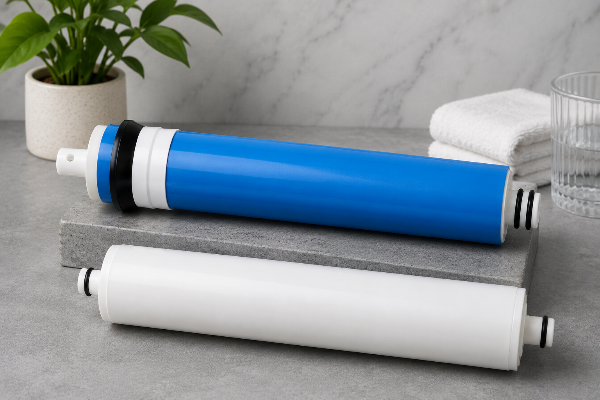
The heart of any household RO system – that thin film composite spiral wound thing doing all the work inside is the Residential RO Membrane Element. We make those ourselves. At Blue Membrane we cast our membrane and wind our elements here at our facility in GPD ranges from 50-1600 GPD and full customization of size as well as OEM/ODM Private Label.
SPECIFICATIONS MATRIX
- 50–1600 GPD
- 35–90 mm diameter
- Fits 1812 / 2012 / 2512 / 3012
- Spiral-wound polyamide TFC
- OEM / ODM & private label
What’s a residential RO membrane element?
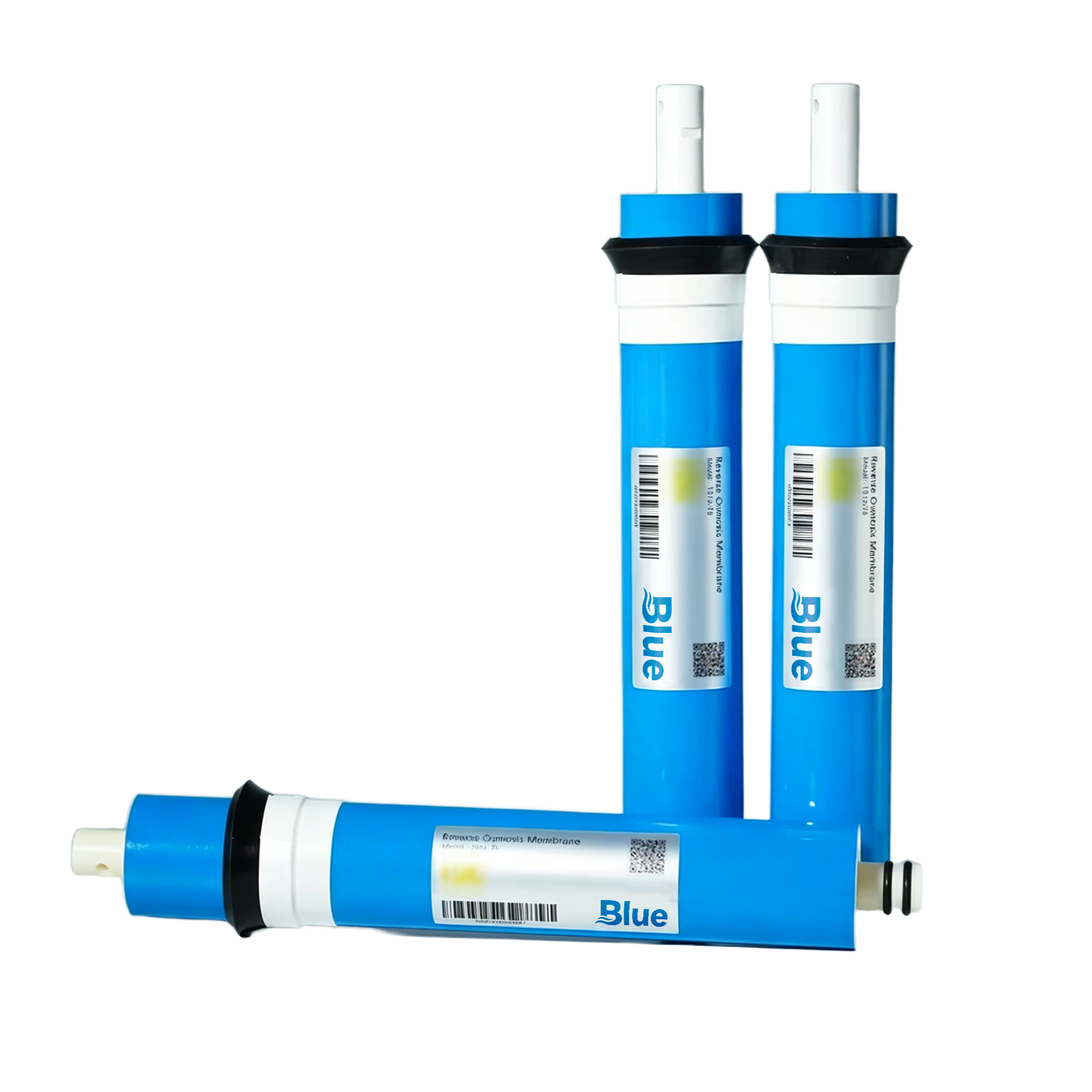
The replaceable spiral-wound cartridge in your point-of-use RO is the heart of your water purifier; its job is to extract contaminants and dissolved salts from your feed water. These elements are manufactured by winding a polyamide TFC (thin-film composite) membrane onto a core permeate tube, and they’re usually rated according to the GPD (gallons per day) output they produce. In your typical home system, typically 50-100 GPD, that one piece alone decides rejection rate, water flavor and how frequently you should replace filters.
Two outcomes that separate us from rebranders
-
Manufacturer-direct
We make the membrane sheet and wind the element in-house, so batch consistency, dimensions and private-label are all under one roof.
-
NSF/ANSI 58-ready material set
Built from wetted materials engineered to meet NSF/ANSI 58 performance and NSF/ANSI 372 lead-content requirements.
NSF/ANSI 58
50–1600 GPD
- Flux range
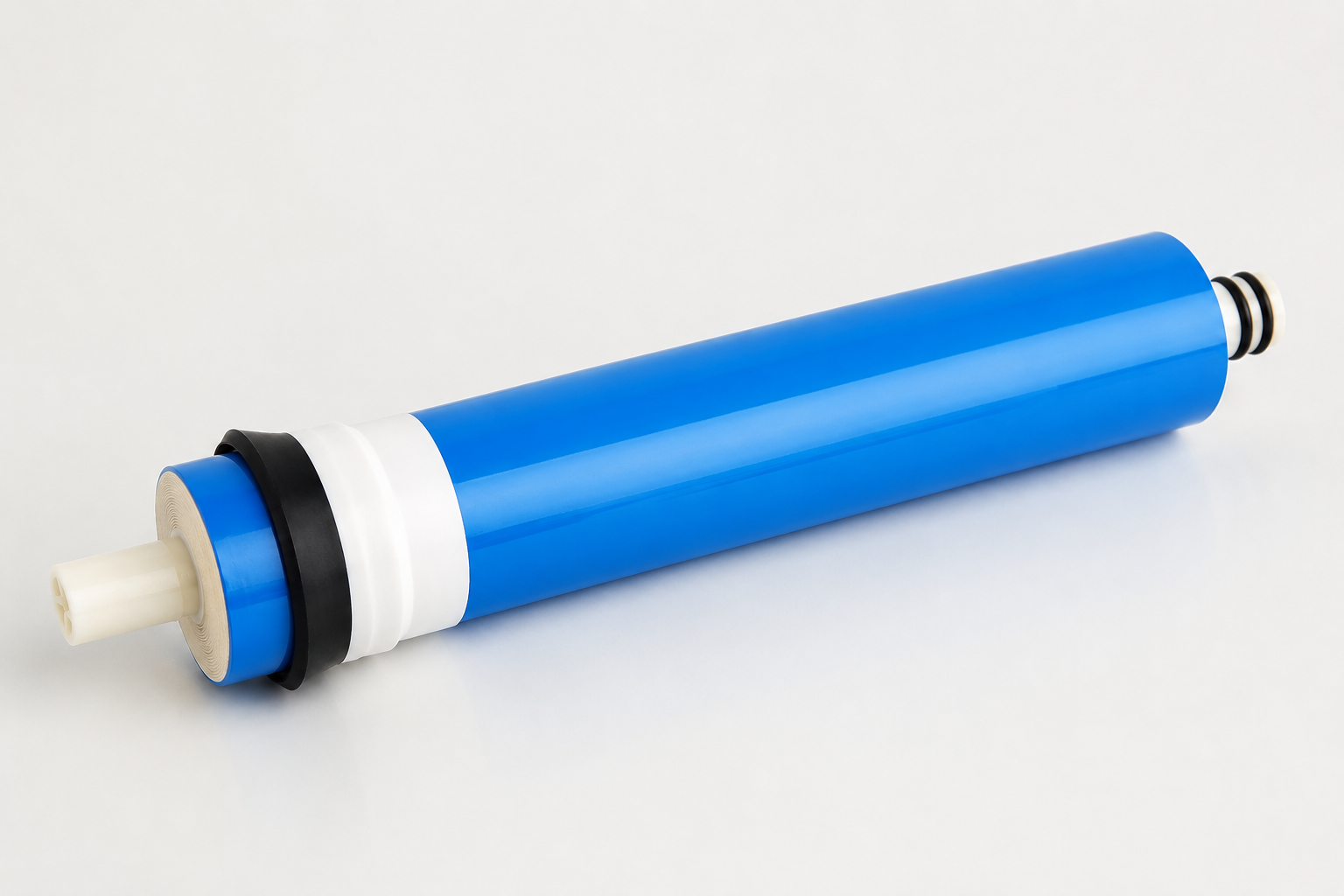
- 50–1600 GPD
- Diameter
- 35–90 mm
- Length
- 180–333 mm
- Dimensional tolerance
- ≤ ±0.5 mm
- Membrane
- Polyamide TFC, spiral-wound
- Stabilized NaCl rejection
- up to 99.5–99.6%*
*Stabilized rejection measured at stated test conditions — see “Rated vs Real-World” below.
Why Most “RO Membrane Suppliers” Don’t Make Their Own Elements
Most of the firms selling “RO membrane elements” have no capability to produce their own element. They purchased the flat-sheet membrane, then put it into their own housings, and print a label. So, batch consistencies, element size, lead time couldn’t be ensured.
That’s what leads to fake “Filmtec” membranes in circulation and to a scan-to-verify app sent out by Dow, or customers opening a new, allegedly real element only to discover a 30-50 TDS reading. Without the factory backing the label, you just get what shows up in the container.
Experienced buyers learn to ask the seller for their certificate and verify the hologram before trusting a marketplace membrane, friction you avoid entirely when you buy direct from the maker.
Factory Note
“Everybody can put a label on. I can take you out to the sheet cutting station and the winder, the vacuum-integrity test benches all components pass prior to boxing. That is the very nature of direct purchasing.”
Manufacturer-Direct vs Rebrander — what actually differs
| Capability | Rebrander / distributor | Blue Membrane (manufacturer-direct) |
|---|---|---|
| Membrane sheet casting | Bought in | In-house |
| Element winding & curing | Outsourced / re-spooled | In-house, 8-step line |
| Custom diameter / length | Catalog SKUs only | 35–90 mm / 180–333 mm |
| Private-label OEM/ODM | Sometimes | Standard (logo, packaging, seals) |
| Batch traceability | Container-dependent | Per-batch vacuum-integrity QC |
| Counterfeit risk | High on open marketplaces | None — direct from the maker |
Blue Membrane is on the manufacturing side of that line. The same in-house sequence runs in every unit, meaning that the batch that you ordered for month nine is the exact same thing as the sample that you signed off for in month one.
STEP 01
Membrane Sheet Cutting
RO membrane sheet cut
STEP 02
Rolling Machine
Element winding
STEP 03
High-Temp Curing
High-temperature curing
STEP 04
Y-Ring + Packaging
Y-ring seal & pack
The reason is structural: an unknown, inconsistent supply chain is a risk you inherit, whereas buying from the maker gives you one accountable source. Blue Membrane delivers every element from the same line, engineered to the same spec.
Where the element sits in residential filtration systems
This reverse osmosis membrane element constitutes the final high-rejection stage in the multi-step filtration train. Downstream from sediment and carbon filters it fits inside the membrane housing, from where it supplies the storage tank with the treated and pressurised water.
- The pre treatment stage – sediment and carbon block – do the dirty job, remove chlorine prior to reaching the RO membrane.
- The RO membrane element in RO stage provides fine filtration and high rejection for dissolved salts that are out of reach for UF/NF.
- The water exits after the membrane housing, in post treatment, this could be remineralisation, or a polishing filter.
Getting this order right protects membrane life: in any water treatment train, a reverse osmosis system is only as good as the pretreatment feeding the element, so we advise on the entire filtration system, not just the cartridge.
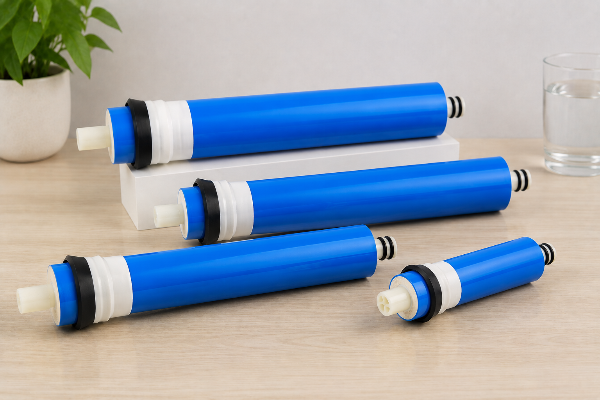
BLUE MEMBRANE RESIDENTIAL RO MEMBRANE ELEMENT RANGE, MODELS, GPD & DIMENSIONS
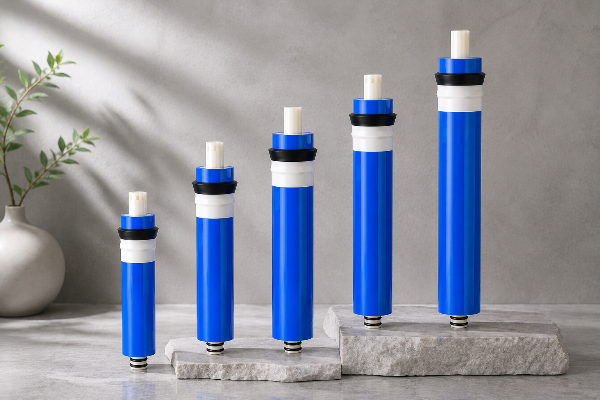
Our residential line offers nine standard sizes as well as full custom. Elements are named per industry convention for element form-factors: first two digits are the inch diameter of the membrane element; the second two digits are the inch length of the element - so a 1812 is 1.8 inches diameter and 12 inches long.
Get the reverse osmosis membrane element size wrong and it either won't seat in the housing or underperforms - an expensive return for an integrator. Rebranders keep only a handful of catalog SKUs; because we wind every diameter in-house to a tight ±0.5 mm tolerance, the size you need is a line-setup change, not a special order.
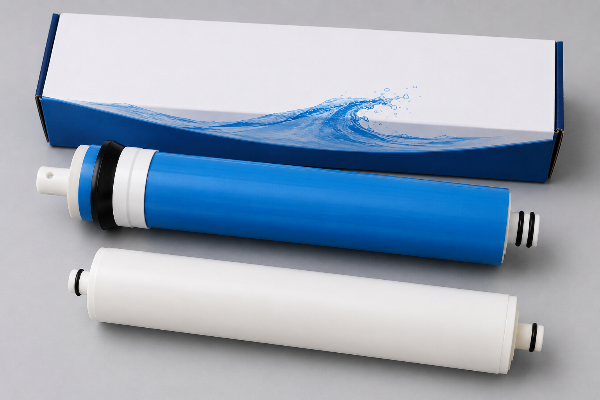
RESIDENTIAL RO ELEMENTS
±0.5mm TOLERANCE
Residential RO membrane element range (standard models)
| MODEL | NOMINAL SIZE | RATED GPD | TYPICAL FIT / APPLICATION |
|---|---|---|---|
| RE-1812-75 | 1.8″ × 12″ | 75 | Under-sink home RO (most common) |
| RE-1812-100 | 1.8″ × 12″ | 100 | Higher-flow under-sink |
| RE-2012-100 | 2.0″ × 12″ | 100 | Under-sink / small point-of-use |
| RE-2012-150 | 2.0″ × 12″ | 150 | Whole-home booster / light commercial |
| RE-2512-200/300 | 2.5″ × 12″ | 200–300 | Light commercial, cafes, labs |
| RE-2812-400 | 2.8″ × 12″ | 400 | Light commercial / kiosks |
| RE-3012-500 | 3.0″ × 12″ | 500 | Small commercial systems |
| RE-3013-600/800 | 3.0″ × 13″ | 600–800 | Commercial point-of-entry |
| RE-3313-1000/1200 | 3.3″ × 13″ | 1000–1200 | Small-system / OEM integration |
Residential RO Element Selection Matrix
Select a starting model based on its intended application and estimated throughput, then check if its size fits your current housing.
Selection Matrix — match demand and application to a model
| DAILY DEMAND | BEST-FIT HOUSEHOLD / USE | RECOMMENDED GPD | MODEL |
|---|---|---|---|
| Low (1–3 people) | Under-sink drinking water | 50–75 | RE-1812-75 |
| Medium (3–5 people) | Under-sink, higher draw | 75–100 | RE-1812-100 / RE-2012-100 |
| High (large family) | Whole-home booster | 150 | RE-2012-150 |
| Light commercial | Cafe / office / lab | 200–400 | RE-2512-300 / RE-2812-400 |
| Commercial POE | Small system builder | 500–800 | RE-3012-500 / RE-3013-800 |
| OEM integration | System manufacturer | 1000–1600 | RE-3313-1200 / custom |
Custom manufacturing for specialized systems
In addition to our stocked line of SKUs, we custom manufacture 50 to 1600 GPD membranes with 35 to 90mm diameter and 180 to 333mm length - all with our tight 0.5mm tolerances - with choice of endcaps and seals (stock or custom).
Rated vs Real-World GPD, Reading an RO Membrane Element Spec Sheet Honestly
Honesty problem #2: the GPD figure. A "75 GPD" element rating was done at 77°F, 60 psig pressure, low-concentration water, and a recovery rate of 15%. Conditions which no kitchen ever replicates.
This same 75 GPD element will produce only about 16 GPD at 55°F and 30 psig effective pressure - a value that's approximately 21% of its nameplate rating. Actual output can range from a low of about 20% to as high as 40% of label value depending on line pressure and temperature.
Counter-intuitive, but true
The bigger the GPD, the better the water - this is untrue. Based on real world tests, rejecting 99% at 75GPD reduces to 97% at 50GPD and 98% at 100GPD. Larger GPD elements typically waste more water because of lower recovery percentages.
Why the label and your tap disagree (rated-vs-field derating)
| Factor | Lab rating condition | Typical home condition | Effect on output |
|---|---|---|---|
| Temperature | 77°F (25°C) | ~55°F (13°C) | × ~0.6 |
| Feed pressure | ~60 psi | ~40–50 psi (minus tank back-pressure) | × ~0.5–0.7 |
| Feed TDS / osmotic load | 250 ppm NaCl | Often higher | Lowers net driving pressure |
| Recovery | 15% | 15–25% (1:3–1:4 to drain) | Sets drain-flow match |
What an honest spec sheet publishes
Blue Membrane includes its test conditions with every rejection or flow specification, because a rejection rate without context is marketing hype, not engineering.
Test-condition-backed rejection (Blue Membrane RO series)
| Series | Stabilized NaCl rejection | Stated test conditions |
|---|---|---|
| Pure-water (C1/C2) | 99.5–99.6% | NaCl 1500–2000 ppm, 150–225 psi, 25°C, pH 7–8 |
| Brackish (Z1/Z2) | 99.6–99.7% | - |
| Seawater (H1/H2) | 99.8% | - |
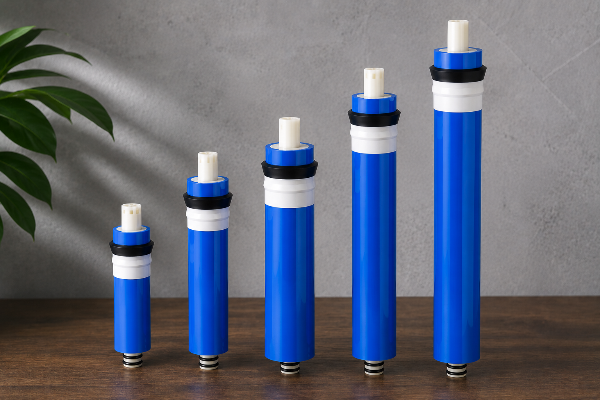
What a Residential RO Membrane Element Removes, Contaminant Rejection
It’s not a single rejection figure, but one that varies by contaminant. Below are standard residential TFC ranges; we aren’t trying to mislead you by calling them all 99.99%.
There's a reason integrators pursue that last percentage point of rejection: as reef-keepers put it, for every 2% you increase the membrane's efficiency you roughly double the life of the downstream DI resin, so rejection is a running-cost lever, not a vanity metric.
Typical residential TFC rejection by contaminant class
| Contaminant | Typical rejection | Source basis |
|---|---|---|
| Total dissolved solids / salt (NaCl) | 96–99% | Manufacturer spec (250 ppm test) |
| Lead | ~99% (directional) | Vendor field data |
| Arsenic (V) | ~95% | Vendor field data |
| Nitrate | ~85% | University extension |
| Fluoride / nitrate / arsenic(III) | 44–94% | EPA field study |
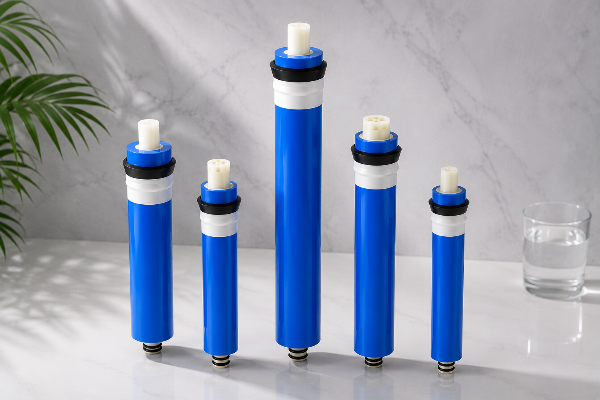
The honest engineering limit: chlorine
The polyamide TFC membrane is attacked by free chlorine. Performance fails after about 1,000 ppm-hours total exposure; its continuous free-chlorine limit is just under 0.1 ppm.
The membrane can't remove chlorine itself; an activated-carbon prefilter must catch it before it hits the element - up to 95% is removed here. The remaining chlorine oxidizes the polyamide membrane's skin, rejection gradually drops, and the permeate TDS climbs.
Why the three-layer build matters
The rejection is performed by a 0.1- to 0.3-micron polyamide skin, supported by a 40- to 50-micron polysulfone layer, which is backed by a 120- to 150-micron polyester fabric supporting the applied pressure. Feed spacer geometry, a unique patentable design area, determines concentration polarization and fouling-it’s why membrane element engineering is anything but a commodity.
Your source water is every bit as important as the membrane element. For brackish water where the feed water TDS is high, a higher pressure membrane series provides a greater degree of rejection, so we match the membrane to your feed water not sell you one model fits all.
This is also where reverse osmosis technology departs from coarser filtration technologies like UF/MF: where those remove particles and some organics, only a reverse osmosis membrane is capable of rejecting dissolved salts like sodium, nitrates and fluoride to this degree. Among the types of reverse osmosis membranes used residentially, this polyamide composite design - its three-layer ro membrane element structure and reverse osmosis membrane material - is what sets the rejection ceiling.
Custom & OEM/ODM Residential RO Elements, From Drawing to Mass Production
Engineering Integrity
A system designer doesn’t need a catalog item. They need an element that fits a particular housing, pump, and brand. We run custom and private label programs as standard practice, not as an accommodation.
Whether you're an OEM system builder matching a 100 GPD element to your own housing or a distributor launching a private-label line, the spec that matters is the one drawn to your feed water, not a catalog average. A trap many buyers fall into is contracting with a “custom” supplier who then outsources the winding, losing control over tolerances and lead times. Because we cast and wind ourselves, we hold a tight ±0.5 mm tolerance and control every step - not like a rebrander simply re-packaging an existing item.
±0.5 mm
Tolerance Control
- Drawing & requirement confirmation.
- Sample build.
- Performance testing.
- Mass production.
What we customise
We work in a diameter and length envelope between 35-90mm and 180-333mm respectively and provide standard or custom endcaps, standard or custom seals, along with complete private label and packaging.
Because our membrane casting and winding is done under one roof, creating a custom geometry means reconfiguring our own line instead of sourcing from elsewhere.
NSF/ANSI 58 & Material Compliance
for Residential RO Elements
It's often in the certification language that a supplier either slips up or gets a little creative with the truth. This section explains what the standard addresses and what we claim.
The most significant risk for a buyer lies with a supplier who can present a certificate they haven't earned - just such a claim prompted a December 2024 public notice by NSF. Instead of making claims backed by nothing we can support in an audit, we detail material and performance compliances we can substantiate.
NSF/ANSI 58 vs 61 vs 372 — which standard covers what
| Standard | Certifies | Applies to |
|---|---|---|
| NSF/ANSI 58 | Contaminant reduction, structural integrity, efficiency, material safety | The complete point-of-use RO system |
| NSF/ANSI 61 | That wetted materials don’t leach harmful contaminants | Components (incl. a membrane element) |
| NSF/ANSI 372 | “Lead-free” — ≤0.25% weighted-average lead | Wetted components; folded into 58 |
Certification scope: NSF/ANSI 58 covers reverse-osmosis drinking-water treatment systems and components. Certification must be verified for the exact model being offered.
What Blue Membrane claims, and won’t
Blue Membrane does not present these residential elements as NSF-certified unless a current, model-specific certificate and public listing are supplied for verification.
That’s a choice. NSF announced in December 2024 that a supplier has made and presented a false NSF certification - the quickest route to alienating an OEM buyer.
Housing Compatibility & Cross-Reference, Fits Standard Residential RO Housings
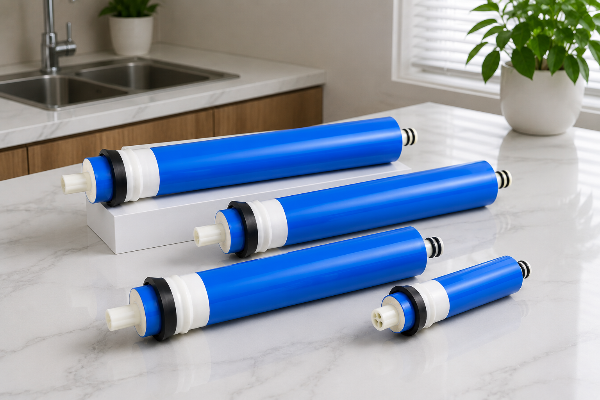
The element doesn’t perform unless it seats properly in your pressure housing. Blue Membrane elements adhere to the exact same form factors as the existing housing.
An element that seats improperly bypasses flow or seals and may result in leakage, the most common failure reported by integrators. We maintain 0.5mm tolerance and cross-reference against your model number - where another may just hope the ‘standard’ size fits.
Housing & Form-Factor Compatibility
| Form factor | Nominal size | Fits housing ID | Equivalent sizing |
|---|---|---|---|
| 1812 | 1.8″ × 12″ | ~2.0–2.05″ ID | Under-sink (FilmTec/GE) |
| 2012 | 2.0″ × 12″ | 2.0″ class | Under-sink / small POU |
| 2512 | 2.5″ × 12″ | 2.5″ class | Light commercial |
| 3012 / 3013 | 3.0″ × 12–13″ | 3.0″ class | Commercial POE |
- Includes a standard Y-ring/brine seal or a custom seal if requested, ensuring an accurate fit with no leakage.
- 0.5mm tolerance to ensure proper fit without forcing.
- Cross-referencing your existing element with your existing model number.
Residential RO Elements (NSF58) Engineering Tools
-
GPD Sizing Selector
Determine the optimal Gallons Per Day (GPD) rating for residential systems based on specific feed water conditions.
Launch Tool -
Rated vs Real GPD Calculator
Calculate the actual permeate flow rate by compensating for real-world operating pressure and temperature variables.
Launch Tool -
Housing Cross Reference
Identify compatible membrane housings and verify physical dimension fitment across standard NSF58 elements.
Launch Tool -
Flow Restrictor Matcher
Accurately pair RO membranes with the correct capillary flow restrictors to maintain specified recovery ratios.
Launch Tool
Custom built residential RO elements made by the membrane specialists.
Submit your GPD target, house size or a drawing and we'll get back with the appropriate model or a custom feasibility analysis, realistic test conditions and lead-time estimate to produce your volumes.
Residential RO Membrane Element FAQ
01
Which GPD residential RO membrane element do I need — 50, 75, or 100 GPD?
For most under-sink homes, 75 GPD is the sweet spot, and the RE-1812-75 is our most-ordered residential element for exactly that reason. Counter-intuitively, jumping to 100 GPD can slightly lower rejection and waste more water, so bigger isn't automatically better. Match GPD to your daily demand using the Selection Matrix above, then confirm the physical fit against your existing housing before you order.
02
Is a 100 GPD membrane better than a 75 GPD one?
Not necessarily. Field data shows rejection often peaks around 75 GPD (~99%) and dips at 100 GPD (~98%), and higher-GPD elements can run lower recovery, more water to drain. Choose GPD for your demand, not for the biggest number on the box.
03
How do I know a low-cost membrane isn’t a counterfeit or a nanofilter mislabeled as RO?
On open marketplaces you often can’t, counterfeit “Filmtec” elements and mislabeled nanofilters are a known problem. Buying manufacturer-direct removes that risk: you get the maker’s test conditions, per-batch QC records, and a traceable element instead of a re-boxed unknown.
04
Can you manufacture custom sizes, end caps, or private-label (OEM/ODM) elements?
Yes — 50–1600 GPD, 35–90 mm diameter, custom end caps, seals and full private-label packaging.
05
Will your residential RO element fit my existing RO housing (1812 / 2012)?
Standard 1812, 2012, 2512 and 3012/3013 elements fit the matching standard housings, held to ≤ ±0.5 mm so they seat without forcing. Send us your current model number and we confirm the cross-reference before you order.
06
Are Blue Membrane residential RO elements NSF/ANSI 58 compliant?
They are manufactured with materials engineered to meet NSF/ANSI 58 performance and NSF/ANSI 372 lead-content requirements. Here is the nuance most suppliers skip: NSF/ANSI 58 certifies a complete RO system, not a standalone replacement element, which instead earns its safety credentials through NSF/ANSI 61 and 372 at the component level. So we describe material and performance compliance honestly, rather than displaying a certification mark we do not hold for the bare element.
07
Why is my real-world output lower than the rated GPD?
Ratings are measured at 77°F and ~60 psi, but a real kitchen is colder and lower-pressure, so actual output is commonly around 25% of the label.
08
What is your MOQ and lead time, and how long does an element last?
Samples are available for validation, and standard elements move faster than custom developments, request a quote for an estimate on your volume. A residential element typically lasts 2–3 years, but replacement is condition-driven: monitor TDS-rejection decline rather than the calendar, and good pretreatment extends life.
Trending now