Get in touch with Blue Membrane Company

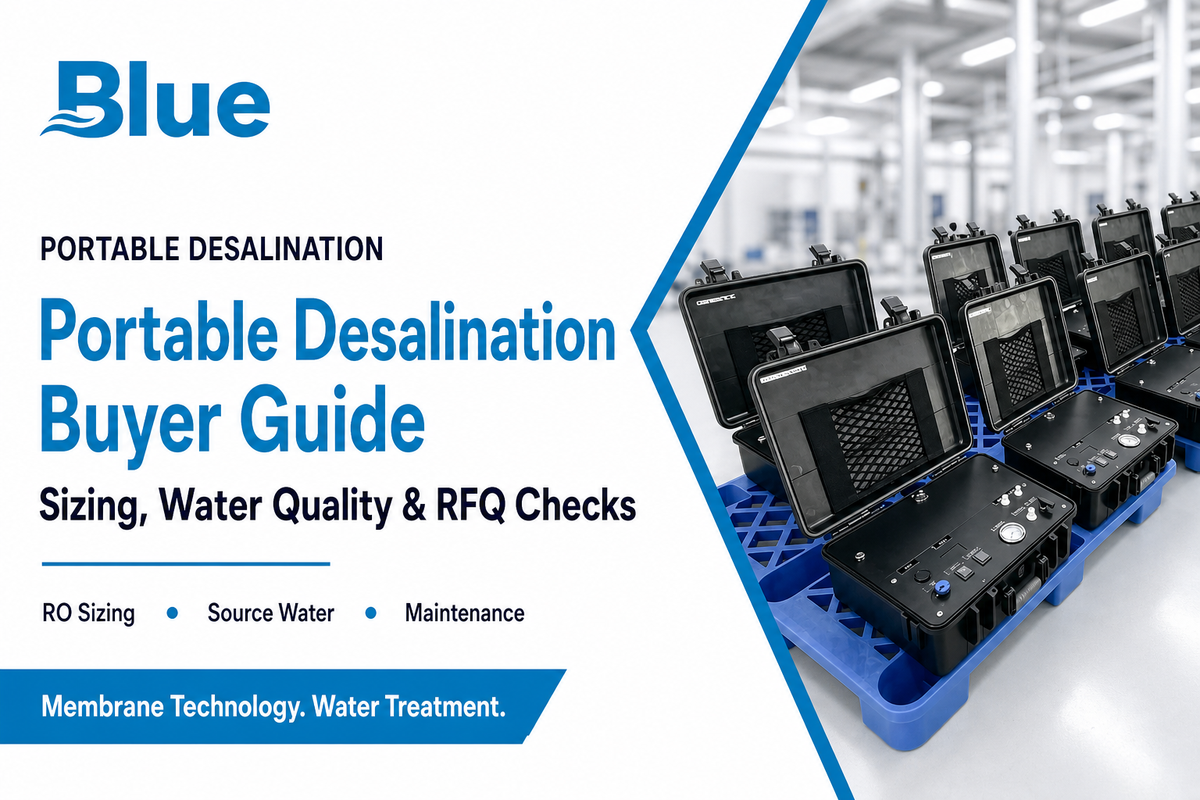
Portable Desalination Units are compact systems that extract salt from seawater or brackish water, usually with reverse osmosis, so remote teams can produce drinking water or treat water near the source rather than hauling in fresh water.
Many buyers may group every portable desalination device as the same class of equipment. But consider a hand-pump desalinator for life rafts, a marine watermaker, a skid-mounted RO unit, a desalination kit for off-grid work, and a trailer-based desalination system. All these are portable, but none have the same output, power, source-water limits, maintenance or finished-water responsibility.
Quick Specs Card
- High-output portable systems most often use reverse osmosis, with smaller units relying on thermal or solar distillation.
- Feed water typically includes seawater or brackish water following screening and prefiltration.
- Buyers need to evaluate salinity, suspended solids, oil or organic contaminants, power supply, recovery rate, brine route and output target.
- Useful output units are L/h, L/day, GPD, recovery, permeate TDS and duty cycle.
- Equipment labels aren’t substitutes for raw water testing, finished-water compliance assessment, storage management, disinfection planning or proper maintenance.
What Portable Desalination Units Are – and What They Are Not
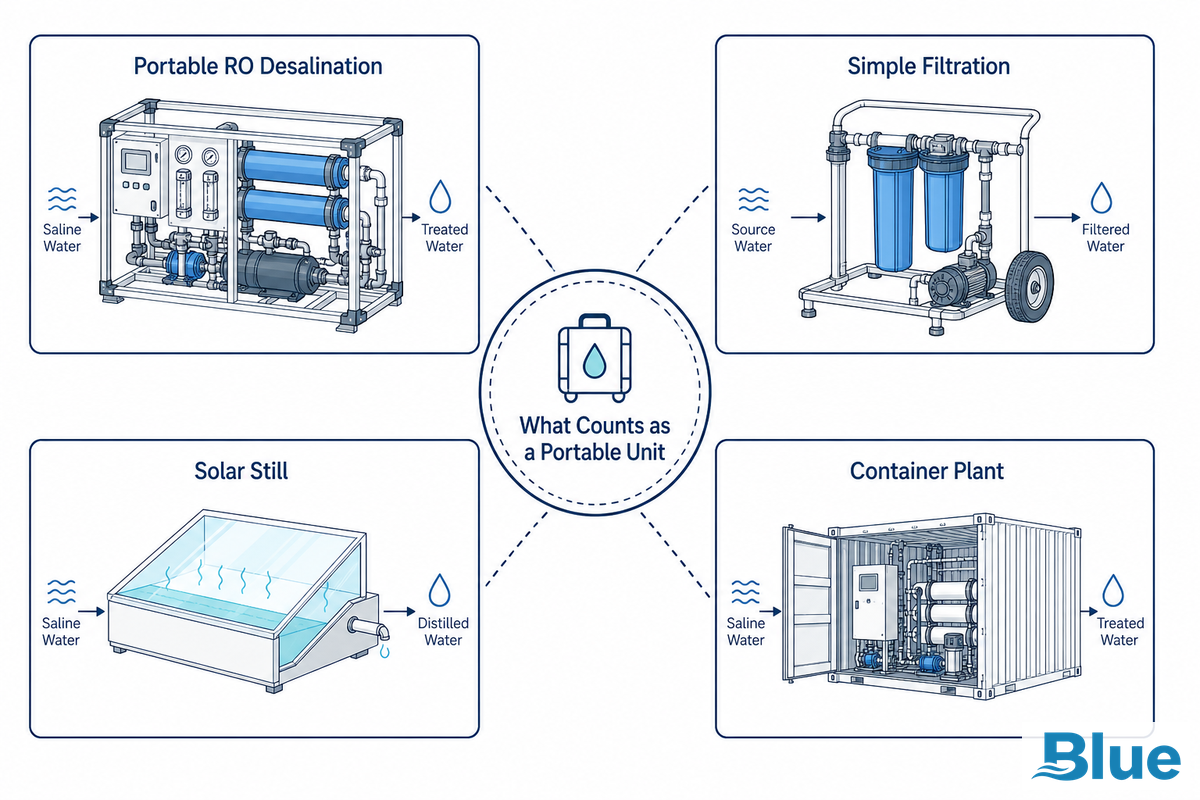
A portable desalination unit lowers dissolved salt in saline water. This process differs from standard filtration. Filters capture sediment; activated-carbon cartridges can reduce tastes, odors and organics, but dissolved salt requires a desalination process like reverse osmosis, electrodialysis or distillation. USGS’s desalination explainer distinguishes saline-water desalination from filtration, noting that ocean water contains about 35,000 ppm dissolved salts.
In many portable seawater desalination projects, reverse osmosis serves as the system’s centerpiece. Inside the RO unit, a high pressure pump pushes feed water against an RO membrane, allowing water molecules to permeate while salt and most rejected material leave as brine or concentrate. FDA’s reverse osmosis guide is geared toward controlled water systems, but the discussion of feed water, pretreatment, fouling, flushing, TDS, recovery, and microbial monitoring is relevant for portable RO buyer comparison.
Blue Membrane focuses on the membrane element of that chain: spiral wound elements and membrane sheets for desalination applications, industrial water, municipal water treatment, wastewater reuse, ultrapure water, and commercial water purification systems. This experience matters because membrane is not a generic keyword. It is the layer responsible for salt rejection, and it is also exposed to chemical stress, foulants, inadequate flushing, and improper storage.
The 10-Scenario Portable Desalination Map
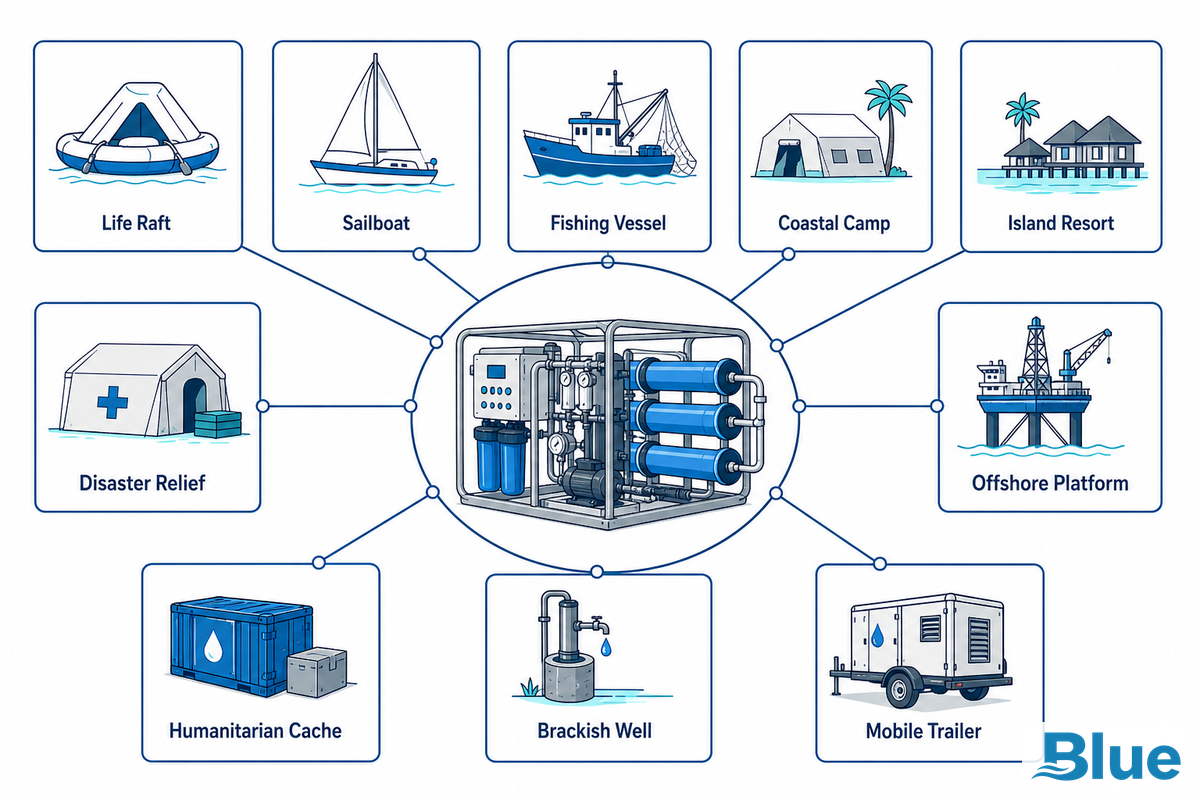
Begin by considering the intended deployment rather than focusing on the cheapest price. Ask the core question: “What problem are we truly attempting to address?” Below, the 10-Scenario Portable Desalination Map helps avoid model-specific marketing jargon and gives engineers, distributors, and project buyers a shared framework before they solicit bids.
Evidence note: The scenario split below is anchored to USGS desalination background and CDC emergency water supply guidance, then translated into buyer planning language.
| Scenario | Likely unit class | Capacity signal | Main power risk | Water-quality risk | When to step up |
|---|---|---|---|---|---|
| Life rafts | Manual survival desalinator | Very low L/day | Human labor | Seawater plus emergency handling | When rescue time is unknown or crew size is high |
| Small sailboat | Compact marine watermaker | Daily crew demand | Battery and charging hours | Biofouling, oil sheen, storage | When the boat needs routine freshwater, not only backup |
| Fishing vessel | Powered portable watermaker | Tank refill cycle | Generator uptime | Fuel, oils, suspended solids | When crew use and washdown demand rise |
| Coastal camp | Portable seawater RO unit | L/day plus storage | Solar panel area or fuel supply | Seasonal algae and turbidity | When camp population is fixed for weeks |
| Island resort backup | Skid-mounted desalination unit | Guest and staff peak demand | Generator redundancy | Finished-water compliance, storage hygiene | When potable supply becomes a guest-safety issue |
| Disaster relief point | Mobile RO unit with tanks | People served per day | Fuel logistics | Unknown contaminant mix | When public agencies need testing and traceability |
| Offshore platform | Marine-grade RO unit | Crew duty cycle | Power integration | Spare parts, corrosion, safety rules | When service region and spares define uptime |
| Humanitarian cache | Containerized or trailer RO | GPD and operators per shift | Fuel, solar, and battery planning | Testing, storage, public-use rules | When the site serves many people for many days |
| Brackish inland well | Brackish-water RO unit | Recovery and pretreatment | Pump sizing | Hardness, iron, organics, microplastics | When scaling or fouling risk is high |
| Mobile contractor trailer | Packaged portable RO system | Shift demand and refills | Generator hours | Source variability | When multiple sites share one unit |
In practice, this use case map reduces the mistake risk because the source data and buyer search evidence point to different applications: life rafts, a camper, marine crews, relief points, and industrial buyer projects do not share one water budget. Blue Membrane’s membrane manufacturing context helps OEM teams ask for the right membrane and testing data before the RFQ stage.
This map also helps prevent the existing Blue Membrane solution page from experiencing keyword cannibalization. This article’s goal is to provide a conceptual framework, while the product solution page should detail the specific commercial aspects.
How Portable RO Units Turn Seawater Into Drinking Water
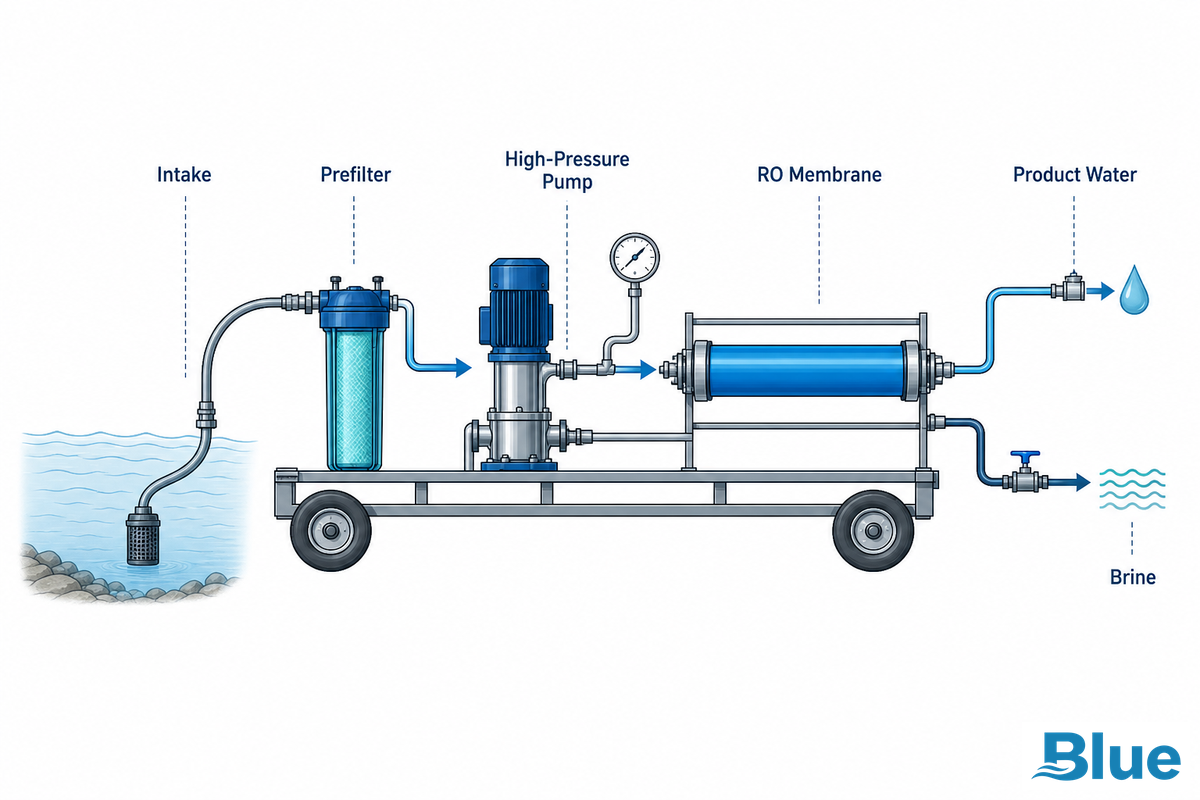
A typical treatment train on a portable RO unit would include: Intake screening, Prefilters, sometimes carbon or specialty filter, high pressure pump, ro membrane, flow control, product-water storage, and reject water disposal. Prefilters serve to protect the membrane; they aren’t the primary salt barrier. Your pump and membrane choices determine if seawater desalination is even feasible at your operating salinity and flow rate.
RO isn’t magic. It needs adequate pressure, sufficiently clean feed water, compatible chemistry and a way to dispose of concentrated brine. If your feed water is highly turbid, contains oil, biofilm, surfactant or entrained disinfectant, the membrane may quickly lose efficiency or even fail entirely. If you stored your RO unit wet under poor conditions, bio-growth can occur. If you store the unit dry and your particular type of membrane doesn’t tolerate this, you may see reduced performance over time. These are not trivial maintenance details; they often dictate whether your portable desalination system continues to work past month three.
The technical risk exists because FDA reverse osmosis guidance and USGS desalination evidence connect salt removal to pump pressure, membrane condition, feed water, recovery, and testing. In the field, an OEM or industrial buyer should ask Blue Membrane or the system integrator how the membrane sheet, spiral wound element, and pressure package work together at the stated salinity.
Can you drink ocean water if you desalinate it?
Treated seawater is potable only when the unit is designed for seawater, operated inside feed-water limits, maintained, and periodically tested against the drinking-water rules for that use. RO can remove much dissolved salt, but it does not by itself settle bio-growth, storage hygiene, disinfection compatibility, or user training.
Capacity, Power, and Recovery: The Sizing Math Buyers Should Check
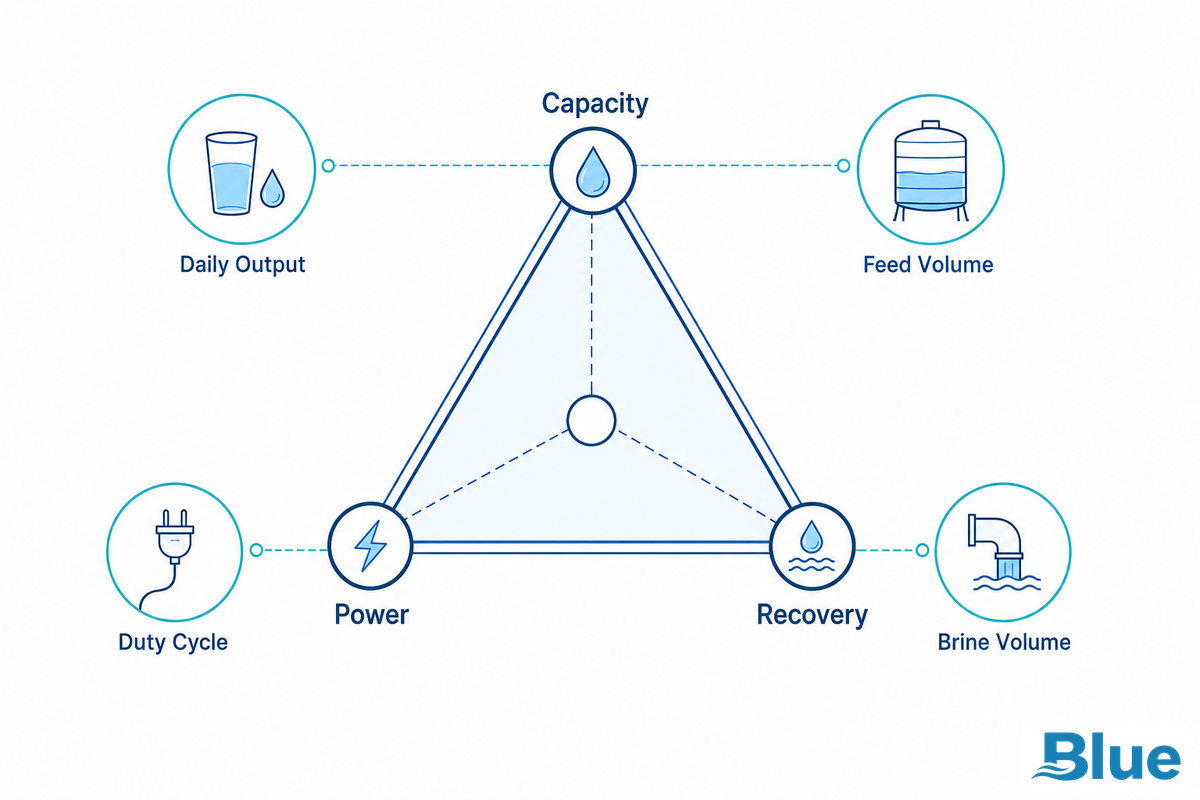
Use the Capacity-Power-Recovery Triangle to make useful comparisons between different portable desalination units without getting distracted by a single output number.
| Triangle point | Buyer question | Why it changes the quote |
|---|---|---|
| Capacity | How many L/h, L/day, or GPD are needed after storage and duty cycle? | A unit that looks large at one hour may be small over a day if power is limited. |
| Power | Is the power source shore power, generator, battery, solar panel, or manual pump? | The same membrane train can need a different pump, controller, and operating plan. |
| Recovery | What share of feed becomes permeate, and where does the brine go? | Recovery affects feed volume, concentrate volume, membrane stress, and disposal planning. |
These numbers are not official Blue Membrane product specifications. Instead, they are source-supported values or standard values used in RFQ comparisons.
| Unit to normalize | Example value to request or cite | Evidence status |
|---|---|---|
| Package weight | 9.25 kg | Source-backed prototype figure from PV magazine |
| Package footprint | 42 cm x 33.5 cm x 19 cm | Source-backed prototype figure from PV magazine |
| Power draw field | 20 W, 500 W, or 1 kW | 20 W is source-backed prototype context; larger values are RFQ fields, not claims |
| Battery or generator field | 1 kWh or 2 kWh per operating window | Qualified planning field for vendor proposals |
| Electrical package | 12 V, 24 V, or 48 V | Qualified RFQ field for portable and marine packages |
| Pressure field | Vendor-rated pressure condition | Qualified RFQ field; vendor must provide rated condition |
| Run-time field | 6 hours per day | Qualified planning example for daily output math |
| Recovery field | about 12% (planning only) | Qualified planning example for feed and brine math |
| Emergency storage context | 3 days | Source-backed CDC emergency-water planning context |
| Public-water threshold context | 60 days per year | Source-backed EPA public-water-system context |
| Membrane storage interval | 6 months or 12 months | Qualified RFQ field; vendor should state preservation limits |
For the purposes of rough calculation, let’s assume you’re operating a small powered unit that produces 12 L of product water per hour, running 6 hours per day. This is 72 L/day of product water. If your unit’s recovery rate is 12%, then your daily feed-water demand would be about 72 / 0.12 = 600 L/day, with 528 L/day of brine discharge. This isn’t a product claim for the Blue membrane unit. It’s the sort of calculation a buyer should expect to receive when asking vendors for a quote.
A sizing mistake becomes expensive because a 6 hours per day worksheet can hide pump pressure, brine handling, and storage risk. In practice, an OEM or industrial buyer should ask Blue Membrane and the system integrator to show the source data, pressure rating, membrane area, recovery assumption, and testing plan on the same spec sheet before accepting a capacity claim.
Prototype output rates show why research systems cannot be used as proxies for commercial capacity. For instance, MIT reported a portable research device that produced about 0.3 liters per hour at 20 watt-hours per liter and noted potential for powering via solar panel. These are interesting science developments, but a headline touting solar desalination power levels would need to be translated into L/day, hours of sunlight, battery capacity and water storage volume.
How much fresh water can a portable desalination unit produce?
Actual product output is determined by feed water salinity and temperature, membrane area, pump pressure, the targeted recovery rate, available operating hours, and pretreatment measures. On a boat, the meaningful metric for a portable watermaker might be daily crew demand and tank refill time. At a mobile relief site, output may be measured as people served per day and the testable quantity of treated water produced. Ask for both summer and winter conditions if source temperature changes by season.
The 6-Sample Source-Water Gate
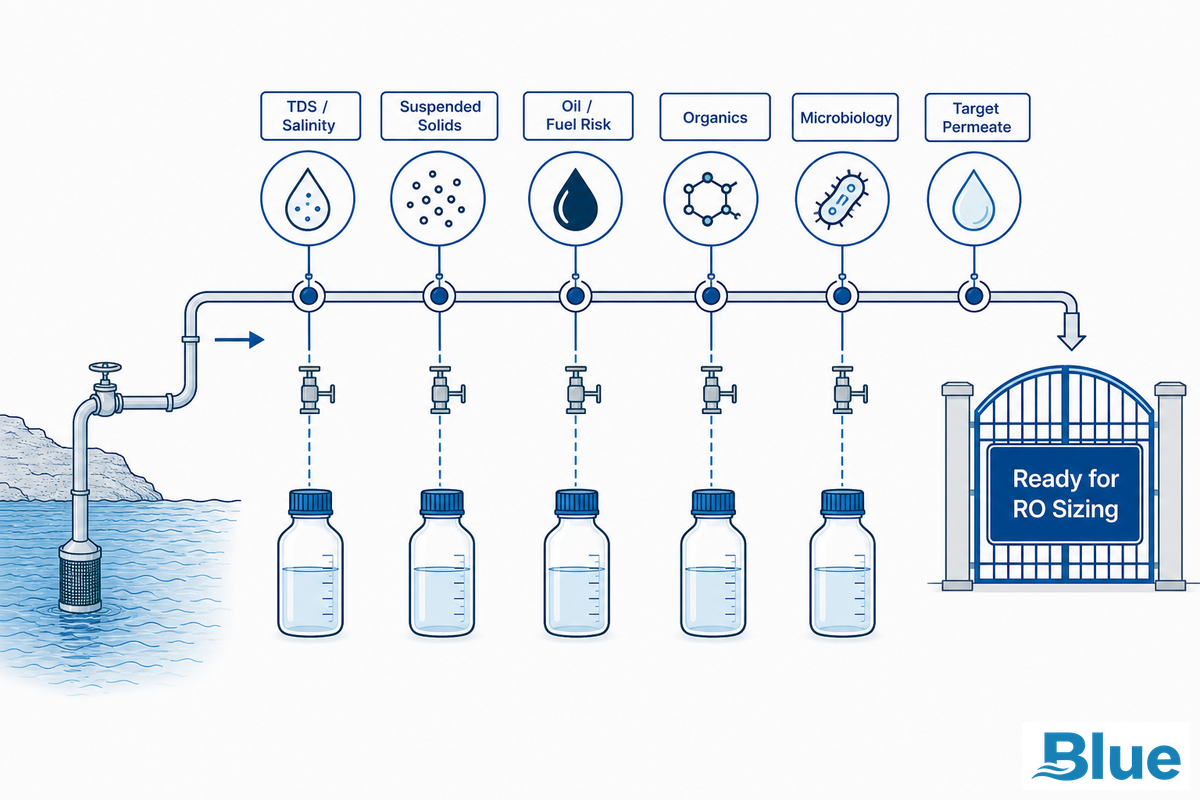
The 6-Sample Source-Water Gate turns the fuzzy question “can it make clean water?” into a question one can answer. This same gate stops an unsafe shortcut: salt reduction is not the whole drinking-water assurance process. For drinking water, the U.S. Environmental Protection Agency’s National Primary Drinking Water Regulations cover public water supplies and contaminant groups beyond dissolved solids, including microbial and chemical categories.
| Sample input | Why the RO supplier needs it | Buyer decision |
|---|---|---|
| TDS or salinity | Sets pressure, membrane selection, and salt rejection expectations | Seawater RO, brackish RO, or another treatment path |
| Turbidity or suspended solids | Signals filter loading and fouling risk | Prefilter type and cleaning plan |
| Oil, grease, or fuel risk | Can damage membranes and defeat simple filtration | Reject the source or add pretreatment and testing |
| Organics, odor, or color | May need carbon or specialty treatment before or after RO | Define the cartridge and monitoring plan |
| Microbiology and disinfection need | RO is not a substitute for a full microbial safety plan | Add disinfection, storage control, and verification |
| Target permeate TDS and final use | Drinking water, process water, and boiler feed have different endpoints | Set acceptance tests before installation |
This gate is useful because the problem often starts before installation: one source water sample may hide seasonal risk, pollution, oil, organics, or contaminated water after storms. In practice, a plant manager or OEM partner should send the sample data with the RFQ so Blue Membrane can help frame membrane selection, pretreatment, and finished-water testing questions.
WHO’s drinking-water guidelines frame drinking-water quality as a risk-management and standards issue. For certification questions, the NSF/ANSI 58 overview is also useful for RO drinking-water systems. Do not turn either source into an implied product certification unless the supplier provides matching test documents.
Maintenance and Consumables: Membranes, Prefilters, Flushing, and Storage
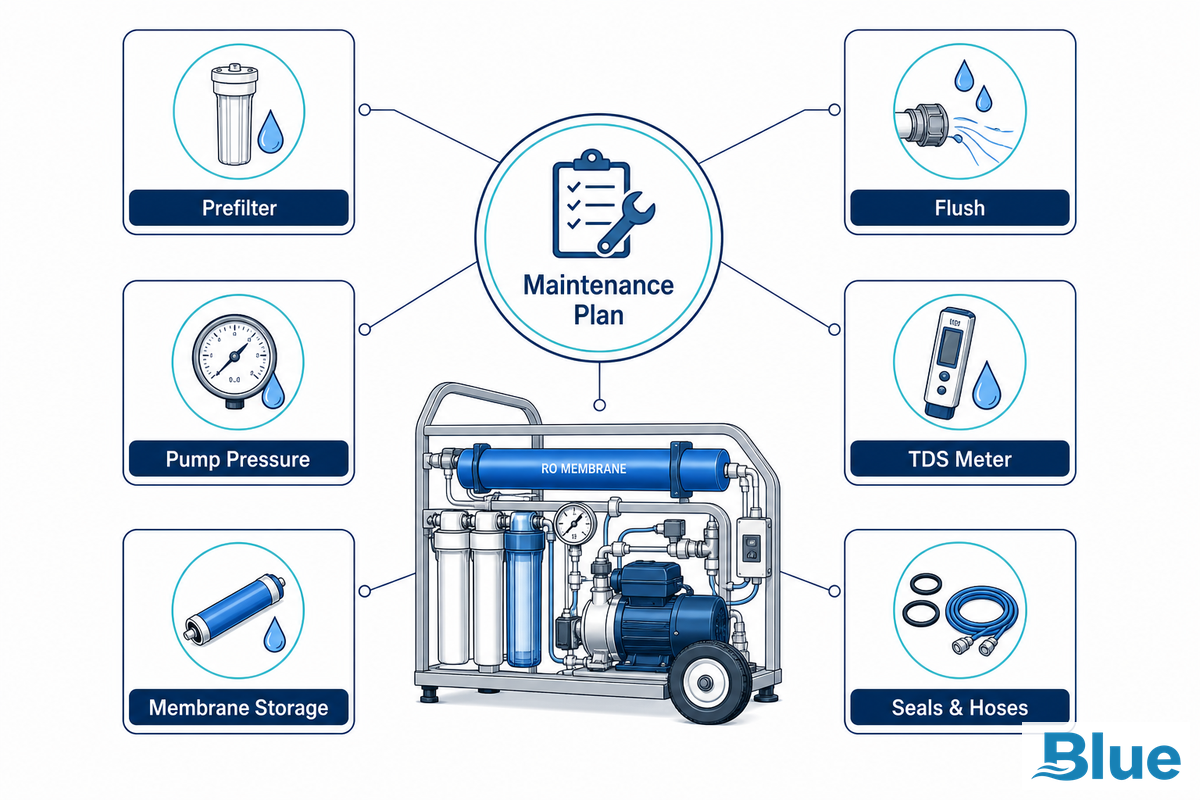
portable doesn’t necessarily imply maintenance-free. Some small devices tend to be unforgiving, because there’s an element of variation in the user, spares-carrying case, and incoming water for every installation. membrane lifetime is reduced by deposits (fouling), incomplete flushing, contact with water in the mains (chlorine, etc), and growth of microorganisms, or storage failures – not age itself.
Evidence note: The operating factors in FDA reverse osmosis guidance include pretreatment, fouling, flushing, TDS, recovery, and microbial monitoring, which is why maintenance belongs in the RFQ rather than only in the manual.
The maintenance problem is a field application issue because a 24 V or 48 V package, a 500 W pump, a 1 kWh battery window, a vendor-rated pressure field, and a 6 months or 12 months storage interval can all change service planning. Blue Membrane buyers should confirm the membrane model, replacement filters, preservation procedure, and test sample schedule before the unit leaves the workshop.
| Task | Trigger | Why it matters | Buyer question |
|---|---|---|---|
| Replace prefilter or cartridge | Pressure drop, visible loading, or scheduled interval | Protects the RO membrane from solids and fouling | Which replacement filters ship with the unit? |
| Freshwater flush | After seawater operation or storage prep | Reduces salt, biofilm, and stagnant brine in the system | Is flush water built into the installation plan? |
| Check pump pressure and flow | Output drop, high TDS, or abnormal noise | Confirms the pump can still meet membrane conditions | Can operators read pressure and flow without special tools? |
| Monitor permeate TDS | Every operating day for drinking water service | Flags salt passage, membrane damage, or poor setup | What meter and acceptance range are supplied? |
| Preserve or store the membrane | Long idle period | Prevents biological growth or dry-out damage | What is the storage procedure and shelf life? |
| Inspect seals, hoses, and brine lines | Before field deployment | Leaks waste power and can contaminate product water | Are spares standard sizes available locally? |
Blue Membrane purchasers can experience membrane chemistry and consistent manufacturing. A consistent ro membrane allows system integrators a stronger base, however field result depends on the quality of the feed, operating pressure, recovery, flushing and proper replacement.
Boats, Emergency Relief, and Off-Grid Sites: Where Portable Units Break Down
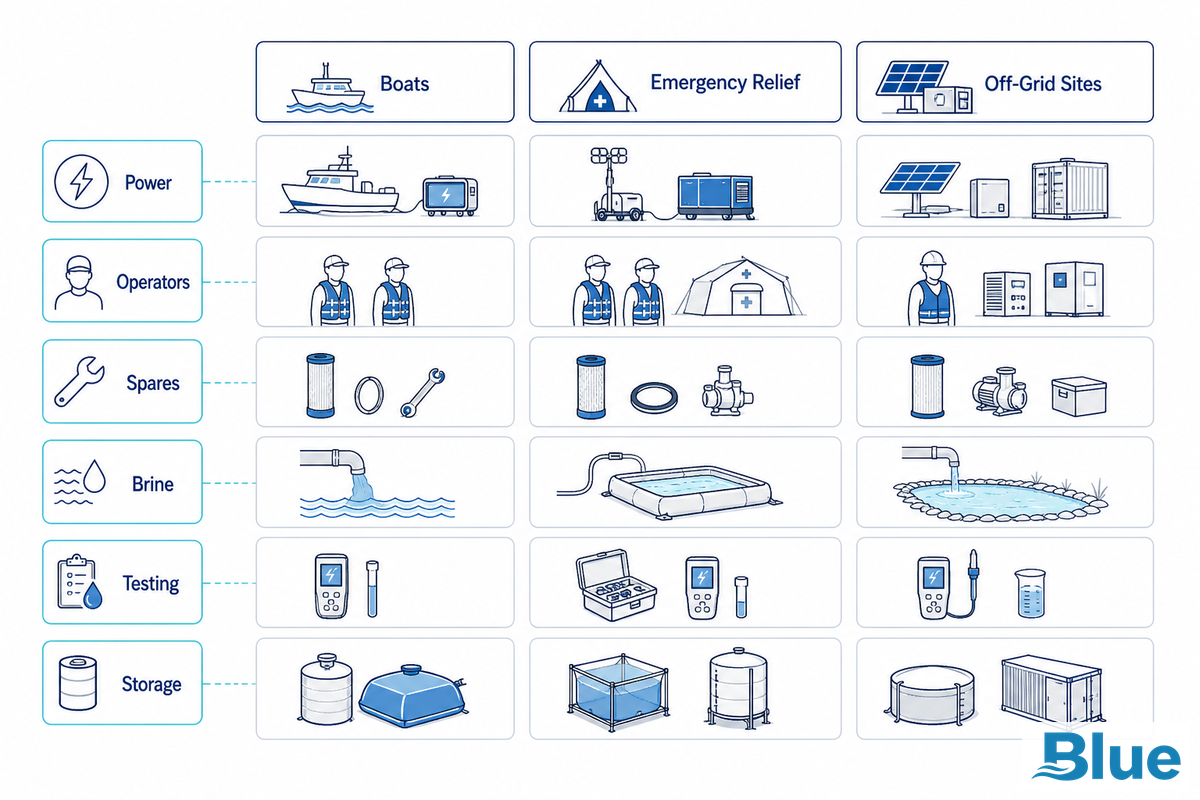
Think of the Hidden Bottleneck Map of portable desalination as your on-field checklist. What’s going to give after the box show up?
Not only the membrane, but the whole underpinning of the system with respect to the feed water, the brine, the power, the operators, the spares, the testing of the finished water and public-use requirements.
A low-cost handheld kit may help a camper make a litre of drinkable water from salt water in survival use, but that is not the same as a reusable emergency desalination kit for public service. Reverse osmosis seawater claims still need high-pressure pump data, reverse osmosis membrane records, fresh drinking water targets, clean drinking water tests, and potable drinking water acceptance criteria.
| Use case | Hidden bottleneck | Planning question |
|---|---|---|
| Boat or yacht | Battery draw, pickling, spares, and operator habit | Can crew maintain the watermaker while underway? |
| Life raft or survival cache | Manual labor and tiny output | Is the unit backup to stored water and rescue signaling? |
| Disaster relief point | Unknown contaminants and public use | Who tests finished water and controls storage? |
| Coastal work camp | Generator hours, brine route, and labor | Can the site run the unit long enough each day? |
| Island resort backup | Guest safety, taste, storage, and service support | Who owns compliance and monitoring logs? |
| Humanitarian deployment | Training, spare parts, local standards, and fuel | Can the unit operate after the first technical team leaves? |
| Off-grid farm or contractor site | Seasonal source-water changes | How often will salinity and turbidity be retested? |
| Military or remote industrial cache | Storage time, seals, membranes, and startup checks | What pre-deployment inspection is required? |
| Solar-only site | Sun hours, battery storage, and low daily output | Does the water budget survive cloudy days? |
Emergency preparedness must also have a demand side. The CDC emergency water supply recommendation is for 3 days of water supply, a gallon per person per day and then as much as possible. This isn’t to say that every emergency facility need to order a big desalinator, but it’s a starting point to compare stored water versus how quickly an individual could be rescued with the desalinator, as well as how many personnel it requires, and the risk profile of the water supply before blindly relying on the device’s output number.
EPA emergency guidance is even further limited, by also prohibiting boiling/disinfection to remove salts, heavy metals, and the vast majority of other contaminants. salt removal may be helped by a portable RO system in some contexts, but may not work for all contaminants. Multiple deployments in the US may also kick in the EPA public-water-system definition of an “EPA public-water system” which “provide water through constructed conveyance to at least 15 service connections or at least 25 individuals on average for at least 60 days per year”.
That risk is why field teams should treat emergency water as a use case, not a product label. Blue Membrane can support the membrane and desalination side, but the buyer still needs a testing source, operator guide, brine route, and site authority before serving a group for 60 days.
Can you desalinate water without electricity?
Yes, but output is usually low. Manual survival pumps and solar thermal devices can work off-grid, yet powered RO still needs pump pressure, storage, testing, and a daily water budget before the method is treated as a dependable supply plan.
Cost and Procurement: What Changes Price Before the RFQ
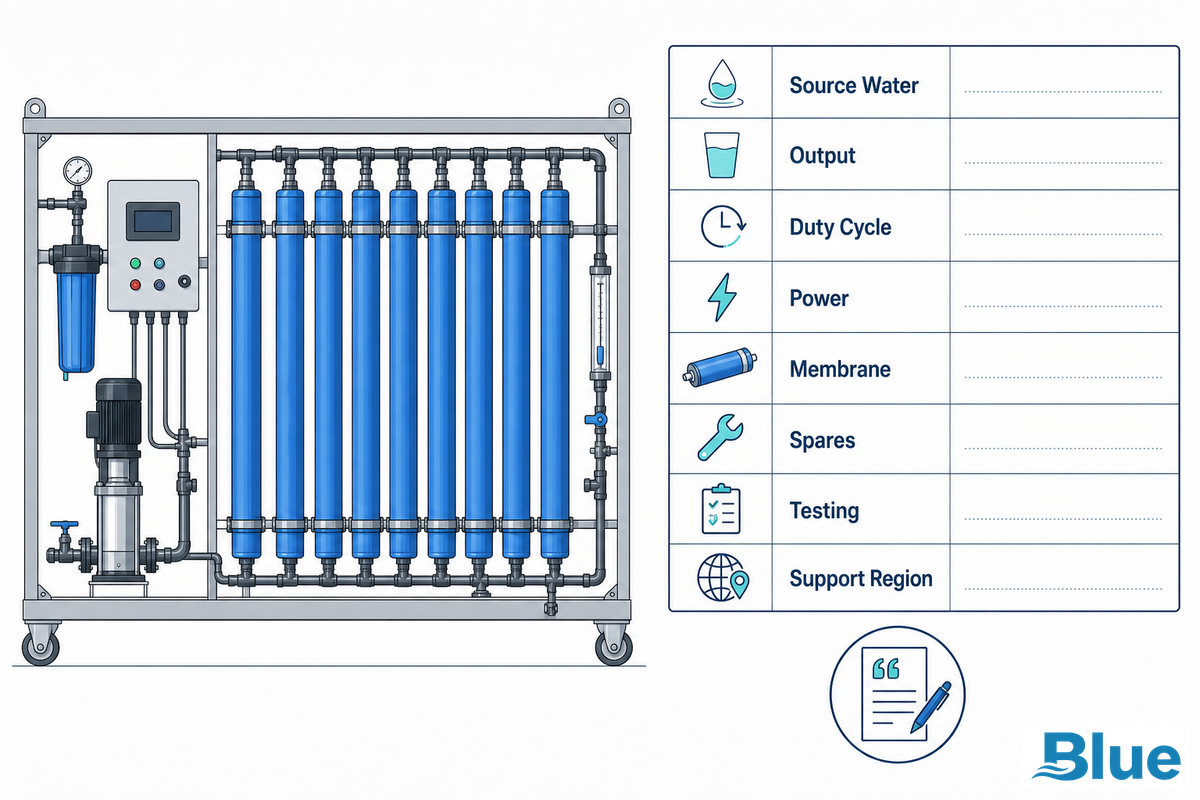
Portable desalination prices vary because the quote is not only a box. The 8-Line Portable RO RFQ Sheet lets buyers compare proposals without turning this guide into a product page.
Regulatory note: For group or public deployments, EPA public-water-system definitions can affect testing, monitoring, storage, and responsibility, so procurement should cover more than membrane price and pump size.
| RFQ line | What to send | Why it changes the proposal |
|---|---|---|
| Source water | Salinity, turbidity, organics, oil risk, microbiology notes | Sets pretreatment, membrane type, and cleaning plan |
| Target output | L/h, L/day, or GPD at real operating hours | Prevents undersized pump and membrane selection |
| Duty cycle | Hours per day, storage size, standby periods | Changes flushing, preservation, and spare parts |
| Power source | Generator, shore power, battery, solar, or manual | Changes pump, controller, and installation package |
| Membrane origin | RO membrane type, replacement model, supply route | Controls future replacement and uptime risk |
| Spares | Prefilters, seals, gauges, hoses, meters, pump parts | Prevents a low unit price from hiding field downtime |
| Testing and certification need | Finished-water targets, local rules, third-party needs | Separates salt reduction from safe drinking water acceptance |
| Support region and brine route | Service location, disposal plan, public-use responsibility | Shows whether the deployment can run legally and practically |
When these are available, buyers can evaluate Blue Membrane’s portable desalination solution instead of using the product page as a planning worksheet. If the reader require more information about seawater treatment, they can use Blue Membrane’s seawater RO systems page, the seawater RO systems guide, the nanofiltration membrane guide, or the Blue Membrane membrane technology overview.
2026 Trend Watch: Solar, Emergency Demand, and Membrane-First Procurement
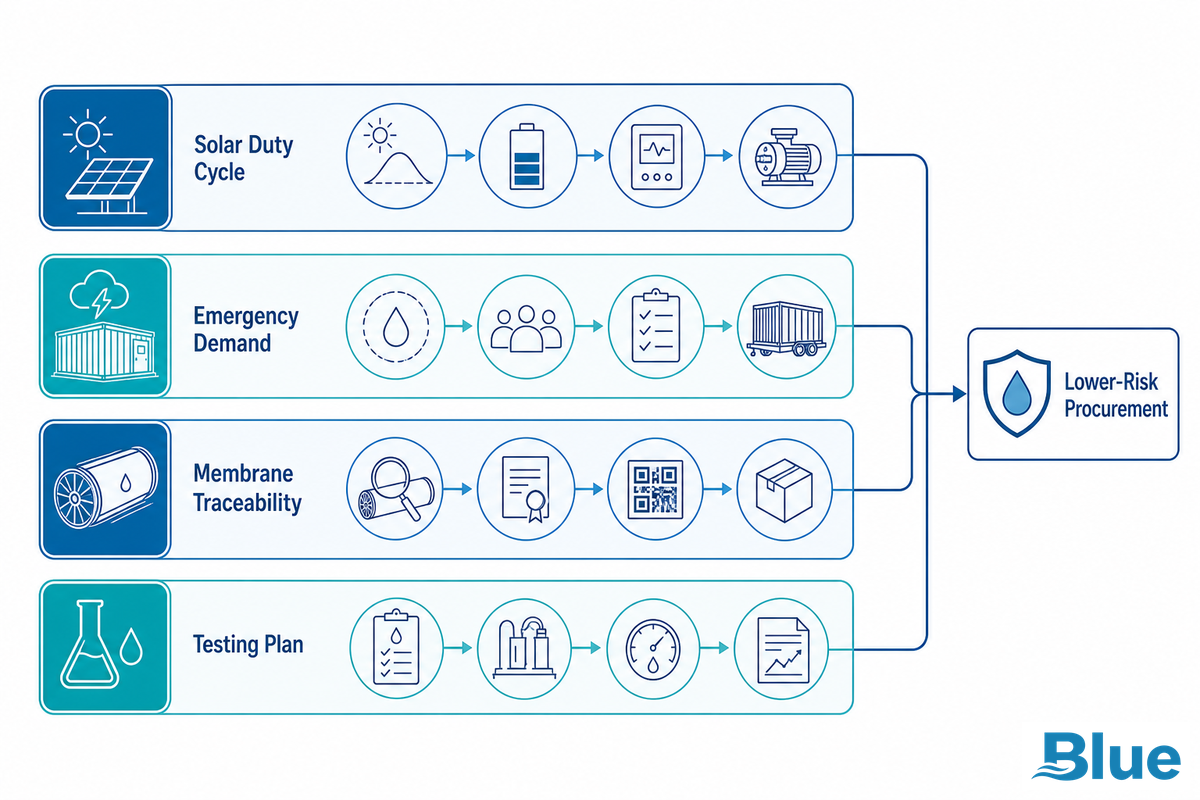
Search demand in 2026 includes inquiries for portable watermaker, portable reverse osmosis system, marine watermaker, emergency water maker, mobile desalination system, and solar desalination system versions. Interpret this as search behavior, not market size. A buyer needs to translate that search behavior into concrete actions.
The trend risk is overbuying the headline and underchecking the use case. Because DataForSEO search data, MIT prototype evidence, and EPA water-safety rules point to different questions, Blue Membrane buyers should ask for the membrane specification, solar or generator duty cycle, 6 hours per day assumptions, and site testing plan before treating trend terms as proof of fit.
- When discussing solar energy, it’s essential to specify the liters per day output based on local solar hours rather than simply referring to a solar panel label.
- For emergency demand, in addition to any portable desalination unit, there will be a need for stored water, operator training, testing, and public instructions.
- Procurement starting with the membrane require assessing the supplier’s support for membrane components, the replacement pathway, chemical tolerance, flushing protocols, and storage methods.
- Claims about finished water quality should be substantiated with testing results for specific contaminant classes, not merely a perception of pleasant taste.
In this context, a membrane manufacturer can add value without exaggerating claims. Blue Membrane is responsible for supplying high-performance membrane sheets and spiral wound elements with consistent chemistry and quality control. It remains the responsibility of the system integrators to align the membrane with the feed water characteristics, operating pressure, recovery rate, pretreatment requirements, and the user’s acceptable quality standards.
FAQ
What is a portable desalination unit?
A portable desalination unit is a movable system that removes dissolved salt from seawater or brackish water. Many are based on reverse osmosis technology, where a high pressure pump pushes source water across an RO membrane, producing fresh water and a brine concentrate. This category includes manual desalinators, marine watermakers, compact skid systems, trailer-mounted units, and portable seawater desalination kits.
Can a portable desalination unit make seawater safe to drink?
Seawater can become safe to drink only when the unit fits the source water, the membrane is maintained, pressure and pretreatment are correct, and finished water is tested against the rules for that use. For group applications, assign responsibility for storage, monitoring, and any public-water obligations before service begins.
How much water can a portable desalination unit produce?
Output depends on membrane surface area, feed water salinity, pressure, temperature, recovery rate, operating hours, and fouling control. Request vendors to provide liters per hour, liters per day, and gallons per day (GPD) under specific feed conditions. Then convert this information into a daily operating plan that accounts for operating hours, storage volume, reject water volume, and maintenance requirements. For relief sites, also add operator shifts, test delay, and reject-water handling before promising people served per day.
What is the cheapest way to desalinate water?
Cost depends on feed water salinity, output volume, energy use, source-water risk, and target water quality. Manual pumps may fit survival scenarios, while RO usually gives better performance for steady portable output, provided the buyer budgets for prefilters, membranes, testing, and power.
Can you desalinate water without electricity?
Hand pumps and thermal methods can work without grid electricity, but they trade power for low output and user labor. A solar RO still needs enough sun, battery capacity, pump pressure, flush water, a test kit, and treated-water storage before it can meet a real daily water budget.
How much does a desalination unit cost?
Unit price for a portable desalination package depends on intended output, source water quality, power package, membrane train, pretreatment, frame, certifications required, spares availability and service region. When purchasing B2B, have vendors quote the entire package including all necessary supplies and only compare equipment shells side by side if the budget and performance match those same specifications. A quote should separate equipment, consumables, freight, commissioning, testing, and post-install support, not hide them in one line.
How often do portable RO membranes and filters need replacement?
There isn’t a universal service interval for all water sources. Some Prefilters will reach their capacity very quickly if the water contain heavy oil or sediment, whereas a ro membrane will outlive its normal lifespan if the incoming water quality is managed, it’s protected from the presence of chlorine, flushed appropriately and kept free from contamination. Inquire with your vendor regarding their filter replacements, membrane model, product storage protocols and field guide to problem-solving.