Get in touch with Blue Membrane Company

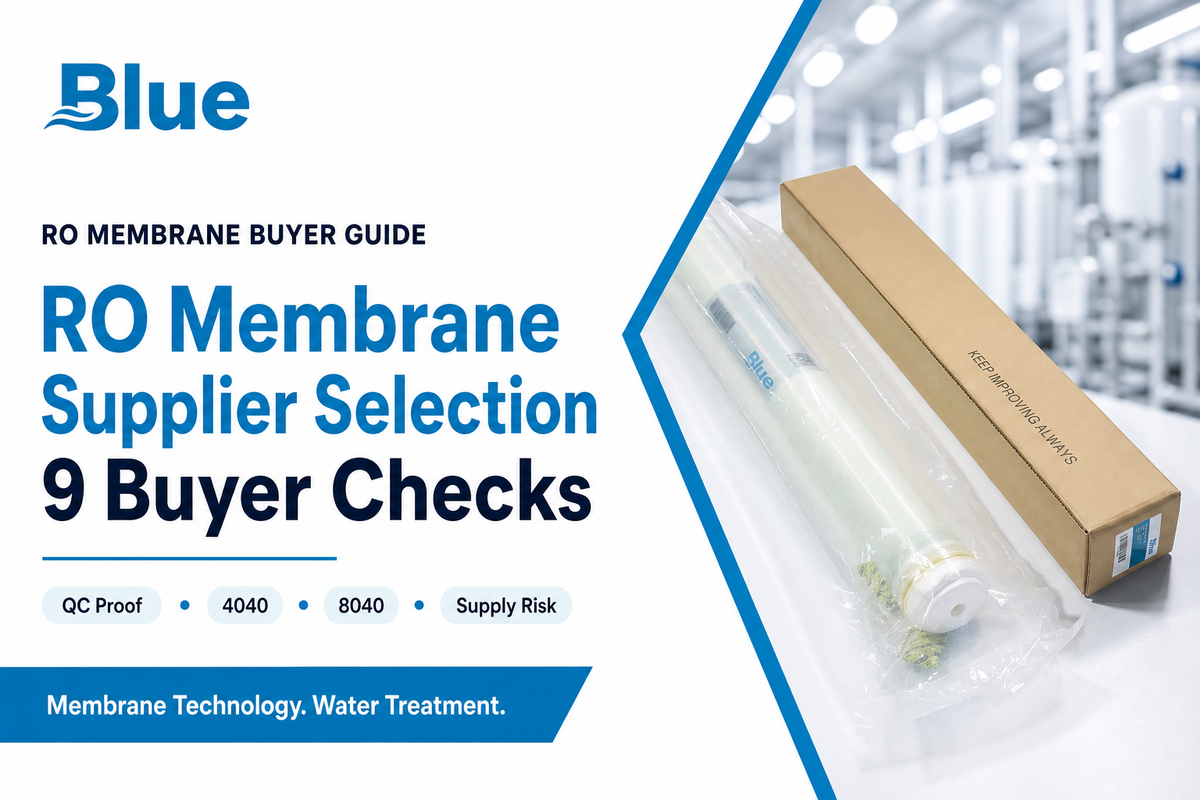
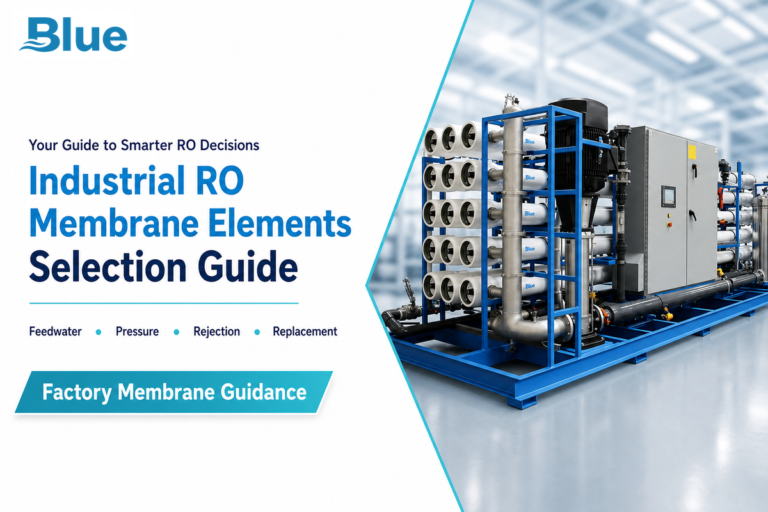
RO membrane supplier selection should start with water quality, not a logo. How to Choose RO Membrane Supplier is a procurement process for matching feedwater duty, test basis, factory proof, element fit, and support depth before price. For industrial, municipal, commercial, and OEM projects, narrow the list by application match, comparable test data, quality-control evidence, fouling guidance, and reliability of supply before requesting a final price.
Blue Membrane manufactures reverse osmosis membrane sheets and spiral wound elements for water treatment worldwide. Within this guide, the Blue Membrane brand context is used as first-party context, while outside sources form the basis for technical advice: EPA material, NSF/ANSI standard listings, WaterOnline trade references, RSC research, and patent publications.
Quick Answer: How to Choose an RO Membrane Supplier
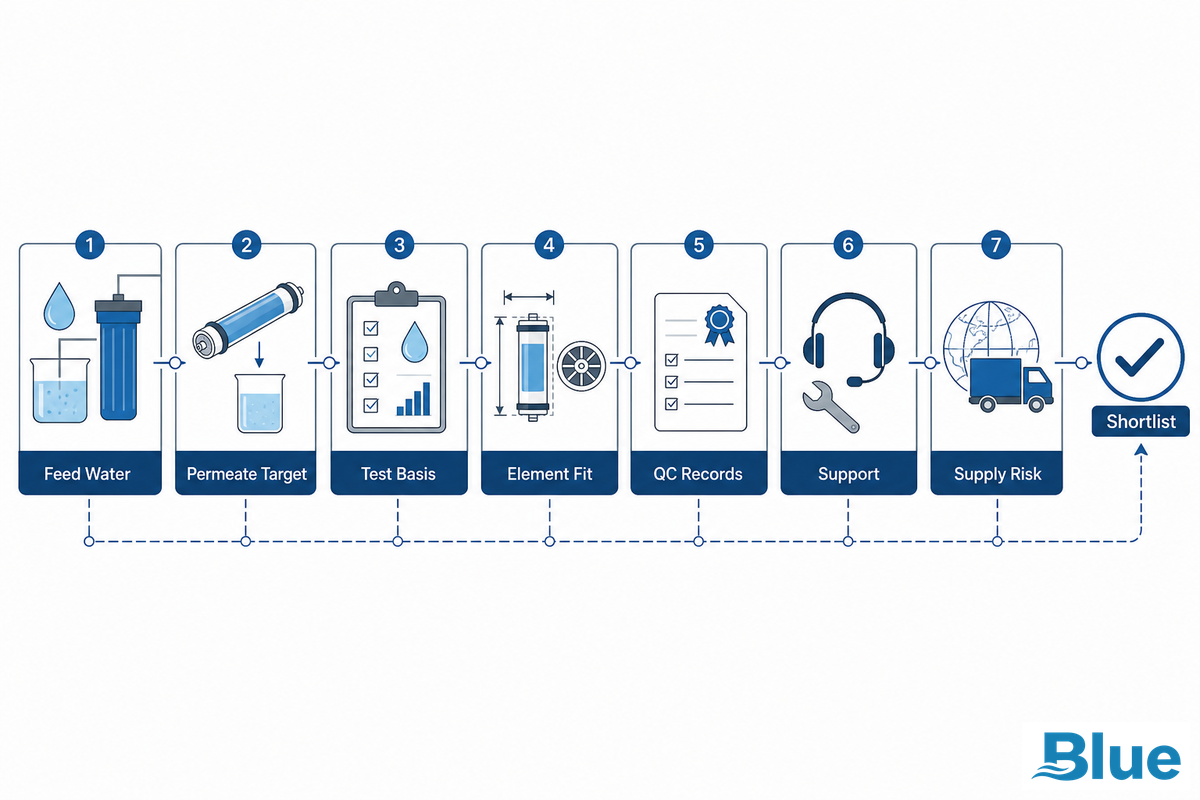
Start here: ask each ro membrane supplier to demonstrate the match of your feed water, target permeate specifications, pressure range, element size, fouling issues, and records needed for approval. EPA describes reverse osmosis as a membrane separation method employing pressure and semi-permeable membranes, so a supplier recommendation must tie the membrane to the system and water, not only to a catalog number. Search phrases such as ro membrane manufacturers, reverse osmosis membrane manufacturers, and top ro membrane manufacturers are useful only after the industrial buyer defines the duty and proof requirements.
For production use, treat the shortlist as a risk screen because a wrong membrane choice can delay commissioning or fail acceptance testing. Blue Membrane or any other factory should answer with test records, sample policy, and a specific RFQ response rather than a generic catalog line.
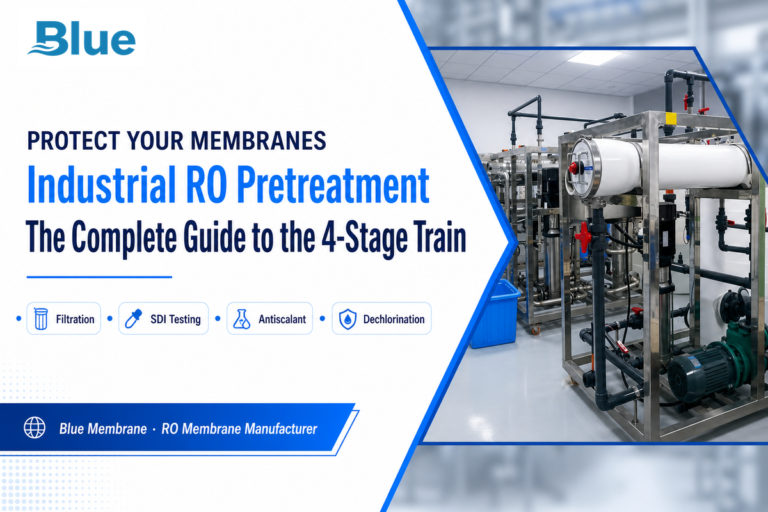
- Verify the feed water TDS, temperature, pH, oxidant residuals, silica, hardness, iron, organic materials, SDI, and microbiological levels.
- Specify the permeate target: conductivity, rejection ratio, recovery rate, flow rate, and permissible contaminants.
- Compare datasheets only when pressure, temperature, pH, feed composition, and recovery level are declared.
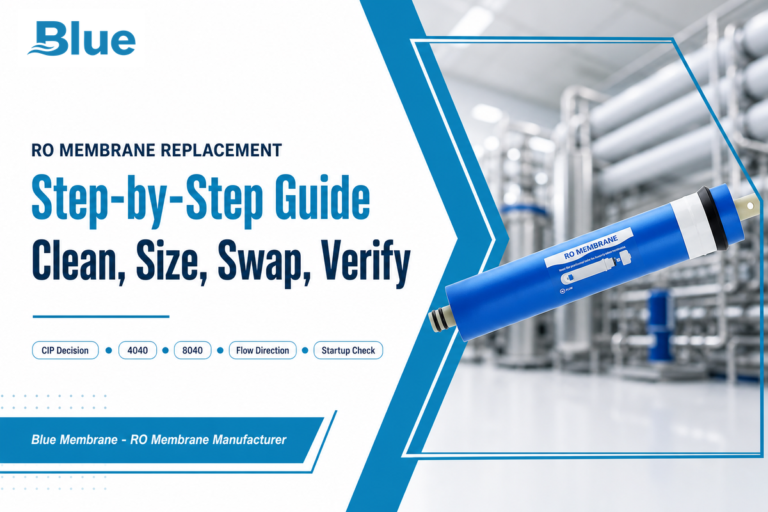
- Determine membrane element compatibility: 4040, 8040, couplers, brine seals, spacer length, and pressure vessel outline.
- Request QC information: test reports, lot traceability, storage instructions, cleaning guidelines, and warranty agreement.
- Differentiate supply source: manufacturer, distributor, trading outlet, or private-label OEM conduit.
- Price by maximum service risk, not solely unit charge.
Start With Feedwater, Water Quality, and Application
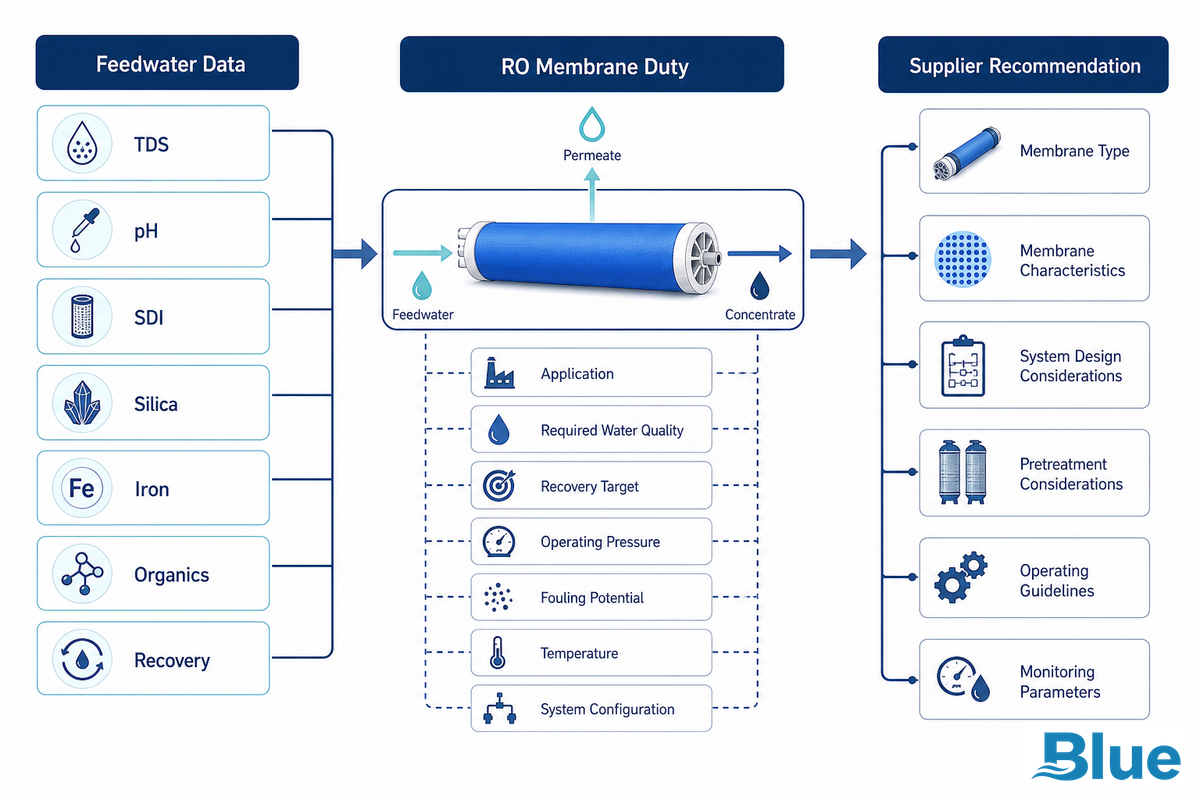
Start with the water. An agent that sells a membrane type before receiving water quality data is assuming the buyer takes the load. EPA advice points to the engineering fact: ro membranes perform on actual water. University of Nebraska-Lincoln extension software is home/point-of-use directed, thus this information is used solely for the fact that fouled or clogged membranes slow flow and reduce operation.
Industrial reverse osmosis uses may be brackish water polishing, ultrapure water pretreatment, wastewater reuse, commercial reverse osmosis, food and beverage processing, municipal supply, or sea water desalination. Each of these processes affects operating pressure, pretreatment levels, membrane durability, and cleaning tolerance. For a production application, the risk is a failed pilot or delayed commissioning because pretreatment and membrane chemistry were judged separately. Blue Membrane review should connect factory test records, feedwater data, and the exact duty before an RFQ moves forward.
| Feed or use case | Supplier question | Spec to verify |
|---|---|---|
| Stable municipal tap water below 500 ppm | Is a low-pressure RO membrane enough? | Pressure band, flow rate, rejection rates |
| Well water with iron or hardness | What pretreatment is assumed? | SDI, antiscalant, cleaning limits |
| Brackish water at 2,000-5,000 ppm | Is standard BWRO safer than low pressure? | Operating pressure and recovery rate |
| Wastewater reuse | How is fouling controlled? | Spacer, CIP range, pretreatment train |
| Ultrapure water production | Is a second pass required? | Conductivity and silica target |
| Commercial RO replacement | Does the membrane size match the housing? | 4040 or 8040 dimensions |
Compare Performance Data Under the Same Test Conditions
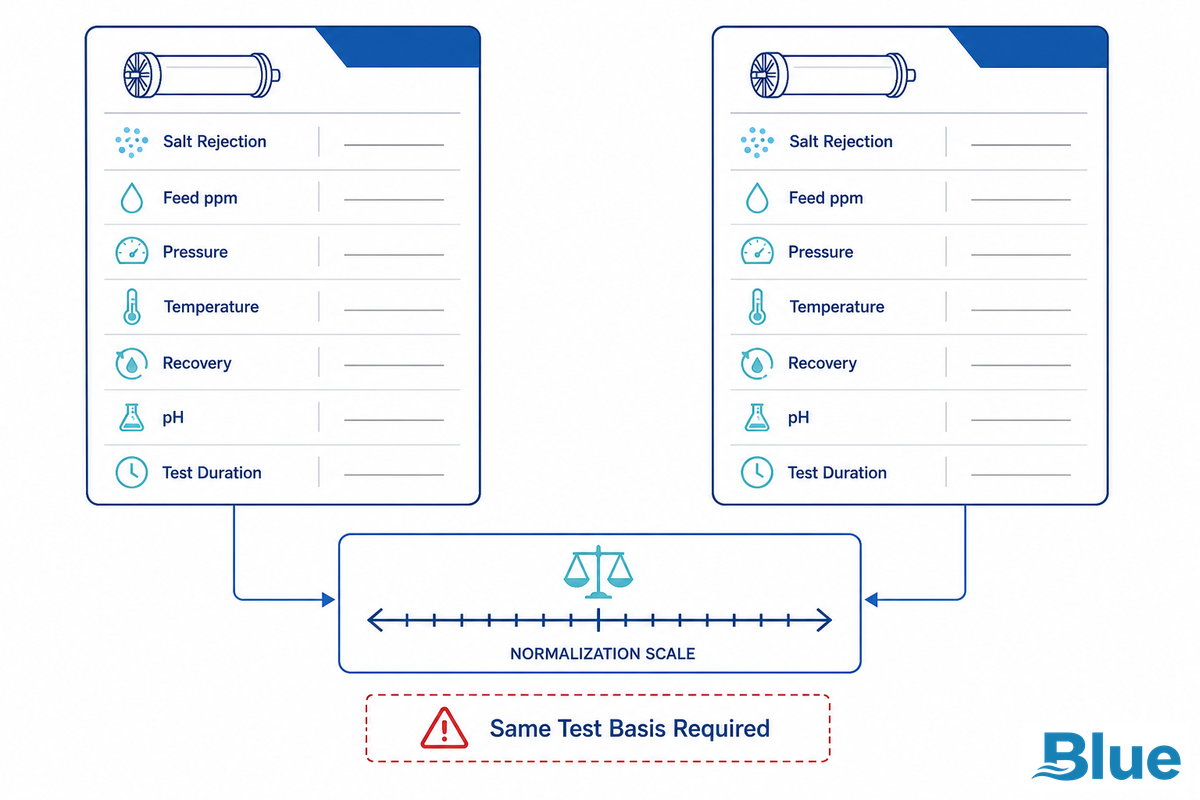
Rank rejection rate, GPD, permeate mass flow, recovery ratio, and operation pressure only when test prescription is available. NSF/ANSI 58 utility is confined primarily to point-of-use drinking water system context, not as an industrial 4040/8040 element-acquisition measure, and the current set of suppliers shows the 2024 edition was updated by NSF/ANSI 58-2025. For industrial element procurement, review also ASTM D4194-23: its RO/NF standard-condition testing states performance parameters, but its short-term results are not plant-design certifying. When two datasheets use different feed concentrations, the higher rejection number may reflect an easier test recipe rather than a better membrane. If a datasheet claims 99% rejection, ask which feed concentration, pressure, temperature, recovery, and test duration produced that result. Treat a 99.5% label the same way unless the test basis is identical. For an industrial buyer, the risk is a false comparison because the test basis is hidden; ask Blue Membrane or another factory to state feed concentration, pressure, temperature, recovery, and test duration in the RFQ file.
The Salt-Rejection-to-Service-Risk Matrix
| Metric | Ask for | Why it matters | Service risk if missing |
|---|---|---|---|
| Salt rejection % | Feed salt and ppm | NaCl and mixed feed do not compare cleanly | Wrong purified water expectation |
| Permeate flow | GPD or m3/day at stated pressure | Flow changes with pressure and temperature | Undersized ro system |
| Operating pressure | psi or MPa at test point | Higher pressure can inflate flow | Higher pump energy |
| Temperature | 25 C or 77 F basis | Water viscosity changes flow | Winter production shortfall |
| Recovery rate | 15%, 40%, 50%, or 75% basis | Concentration rises with recovery | Scaling and rejection drift |
| pH | pH 7-8 or stated range | Membrane surface behavior changes | False comparison |
| Spacer | 28 mil, 31 mil, or 34 mil | Fouling and pressure drop shift | Cleaning frequency rises |
| Element size | 4040, 8040, 2540, or 2521 | Housing and vessel count change | Retrofit failure |
| Cleaning limit | pH window and chemicals | CIP recovery depends on chemistry | Membrane damage |
Check Membrane Size, Membrane Type, Flow Rate, and System Layout
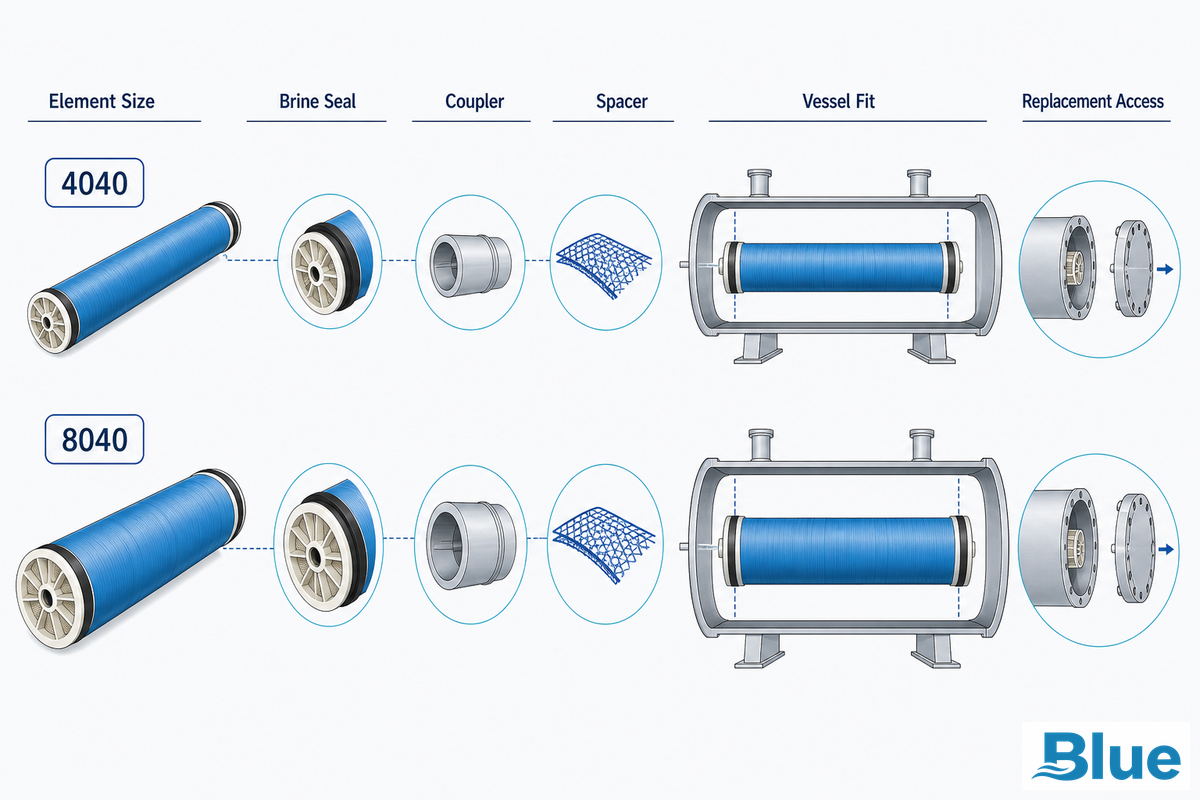
Even if a membrane element is technically superior, it can be the wrong buy. In most catalogs, a 4040 ro membrane implies 4 in diameter by 40 in length; an 8040 commercial ro membrane implies 8 in diameter by 40 in length. Verify your pressure vessels, brine seals, interconnectors, and O-rings. EPA membrane guidance mentions spiral-wound NF/ro systems, which is the most commonly quoted format in commercial and industrial systems. This is a production risk because an element that fits the datasheet may still fail the vessel layout, spacer length, or service access in the field. Ask the Blue Membrane factory team to confirm drawings, sample dimensions, and replacement tolerances before purchase approval.
Hidden danger: membrane area and feed-channel geometry change performance. Treat unusual element-format examples as prompts for compatibility questions, not as design proof. Element geometry is not represented by a single rejection number; it affects hydraulics, spacer fit, replacement access, and cleaning behavior.
- Inquire whether the vendor’s membrane element is a drop-in or requires adaptors.
- Determine the brine seal direction and composition prior to replacement.
- Avoid mixing membrane type and spacer design in the same pressure vessel, unless your design permits.
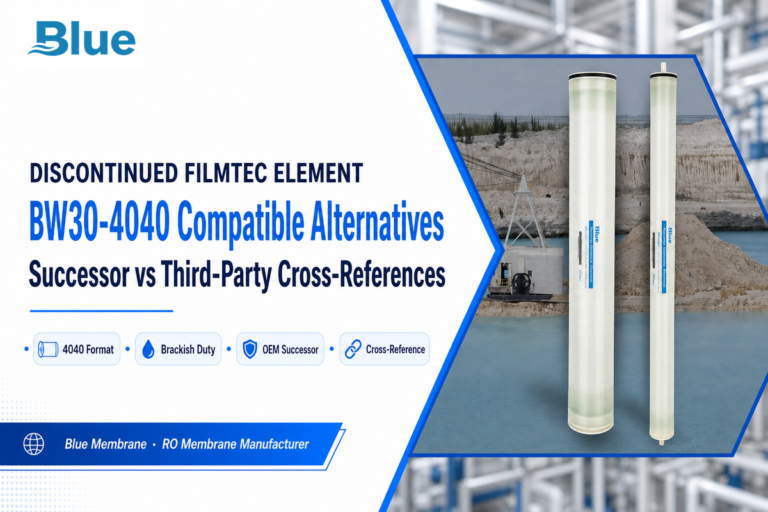
- If you’re replacing elements, ask for a cross reference listing the original and replacement model numbers, spacer, test basis and intended flow.
Verify Manufacturing and Quality-Control Evidence
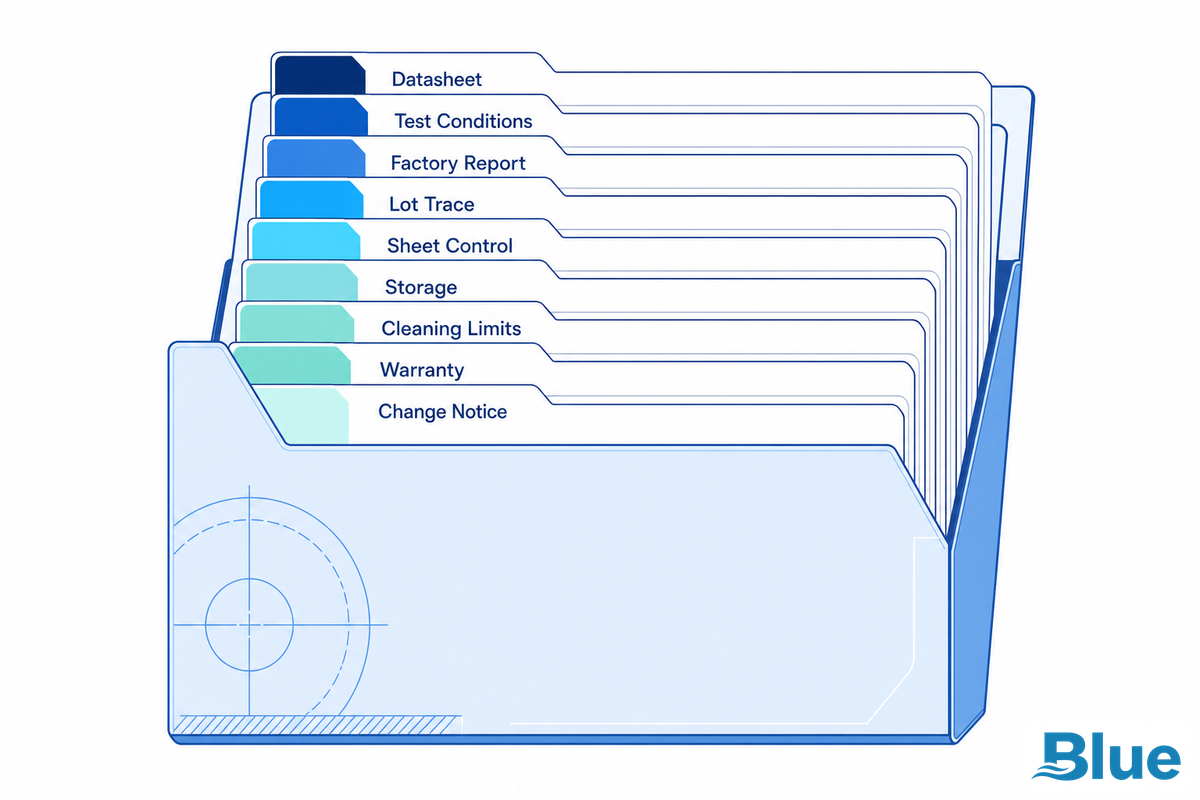
Procurement professionals must document membrane quality. Blue Membrane specifies its products on the basis of stable chemistry, controlled production, and high rejection performance in low, normal and high pressure applications. These are useful descriptors but ultimately buyers will need records from suppliers documenting reproducible results for the specific reverse osmosis membrane under consideration. If the factory cannot show repeatable test records, storage rules, and batch traceability, the risk is inconsistent performance because the buyer has no way to separate a qualified production lot from a one-off sample.
The 9-Document Supplier Proof Pack
| Document | What it proves | Buyer check | Red flag |
|---|---|---|---|
| 1. Product datasheet | Stated rejection, flow, size | Find pressure, ppm, temperature, pH | Only a headline number |
| 2. Standard test conditions | Comparable basis | Match 25 C, psi, recovery, feed salt | Missing test recipe |
| 3. Factory test report | Batch-level performance | Ask for sample report format | Only marketing PDF |
| 4. Lot or serial traceability | Recall and consistency control | Check code format | No traceable batch |
| 5. Membrane sheet control | Chemistry and casting stability | Ask what sheet variables are controlled | No process answer |
| 6. Packaging and storage note | Preservative and shelf risk | Check wet or dry storage | No storage limits |
| 7. Cleaning limits | CIP safety | Confirm pH, oxidants, detergent limits | Bleach allowed for polyamide TFC |
| 8. Warranty terms | Commercial accountability | Read exclusions for feed and misuse | Warranty only repeats price quote |
| 9. Change-control notice | Stable supply | Ask how changes are communicated | Silent model substitutions |
For background, check Blue Membrane’s low-pressure ro membrane and NF membrane specification sheets. They clearly outline why element form factors and test conditions matter. WaterOnline’s own design guidance documents this on the basis of your water quality, design and performance data, not blanket statements.
Evaluate Fouling Resistance, Cleaning Tolerance, and Maintenance Requirements
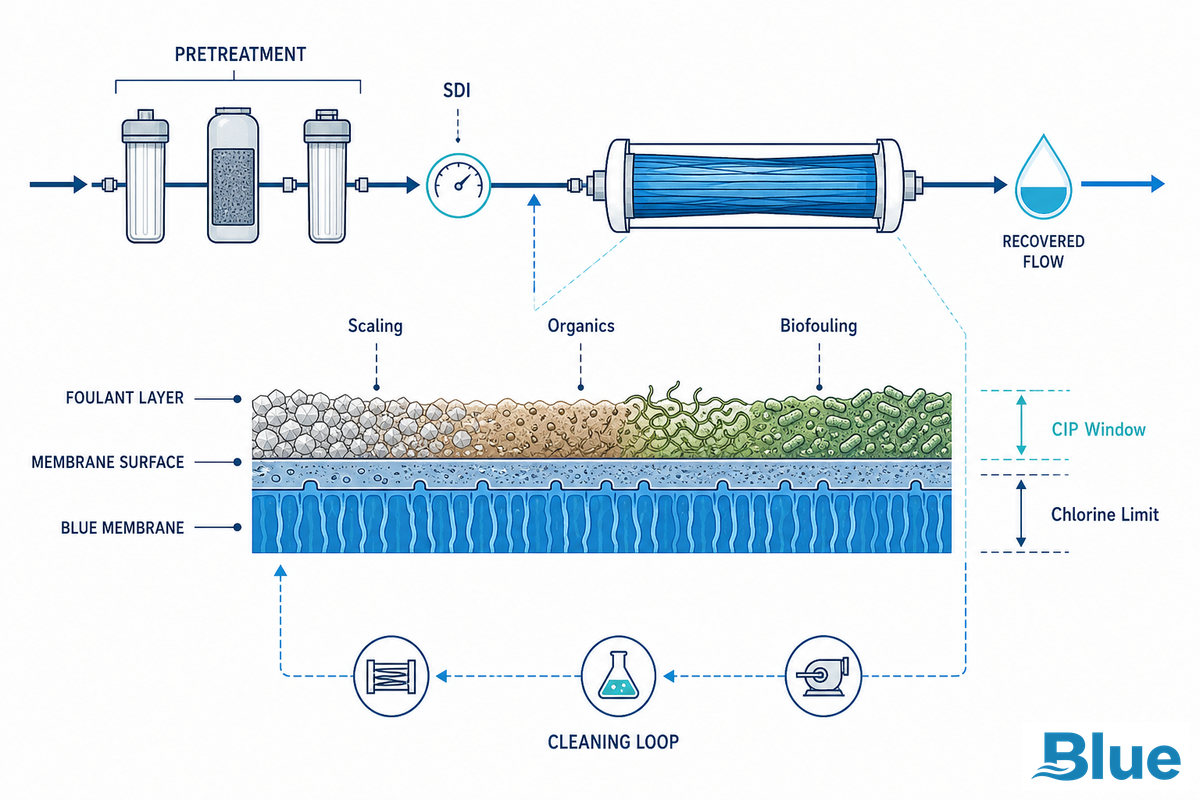
Fouling resistance will determine real world system performance. Pure water testing won’t tell you how the system will react to your water when contaminated with silica, iron, organics, oil, or biological contaminants. UNL reports how the system will be degraded by clogged ro membranes, reducing throughput. WaterOnline’s older guidance is relevant for understanding general high- and low-pH cleaning, but consult the manufacturer’s latest recommendations for specific cleaning solutions and chemical constraints. For production applications, the risk is repeated cleaning failure because a membrane that looks acceptable in clean-water data may not tolerate the actual foulant load. Blue Membrane factory review should connect pretreatment, cleaning chemistry, SDI method, and replacement planning before the element is approved.
This last step is where your vendor becomes more of a consultant than a supplier. Your vendor should discuss pretreatment options, the impact of various SDI levels on the ro membrane, acceptable cleaning parameters and windows, and chlorine sensitivities, oxidant limitations and the feasibility of performing pilot tests as opposed to replacing an element based on catalog comparison. Your provider must be knowledgeable about the ASTM D4189 SDI measurement method because results can be influenced by temperature and membrane filter manufacturer.
Engineering concern: Higher rejection does not guarantee improved performance. When the element requires more operating pressure, cleans poorly, or cannot be run in your standard chemical regimen, it may perform worse than an element that delivers lower purity water.
The recently issued patents are weak invention filings, not evidence of how a commercial membrane will work. They should only be used to establish a business question, asking how the supplier’s spacers, surface chemistry and cleaning guidance contribute to the longevity of the membrane under your feed conditions.
Manufacturer, Distributor, or Private-Label/OEM Partner?
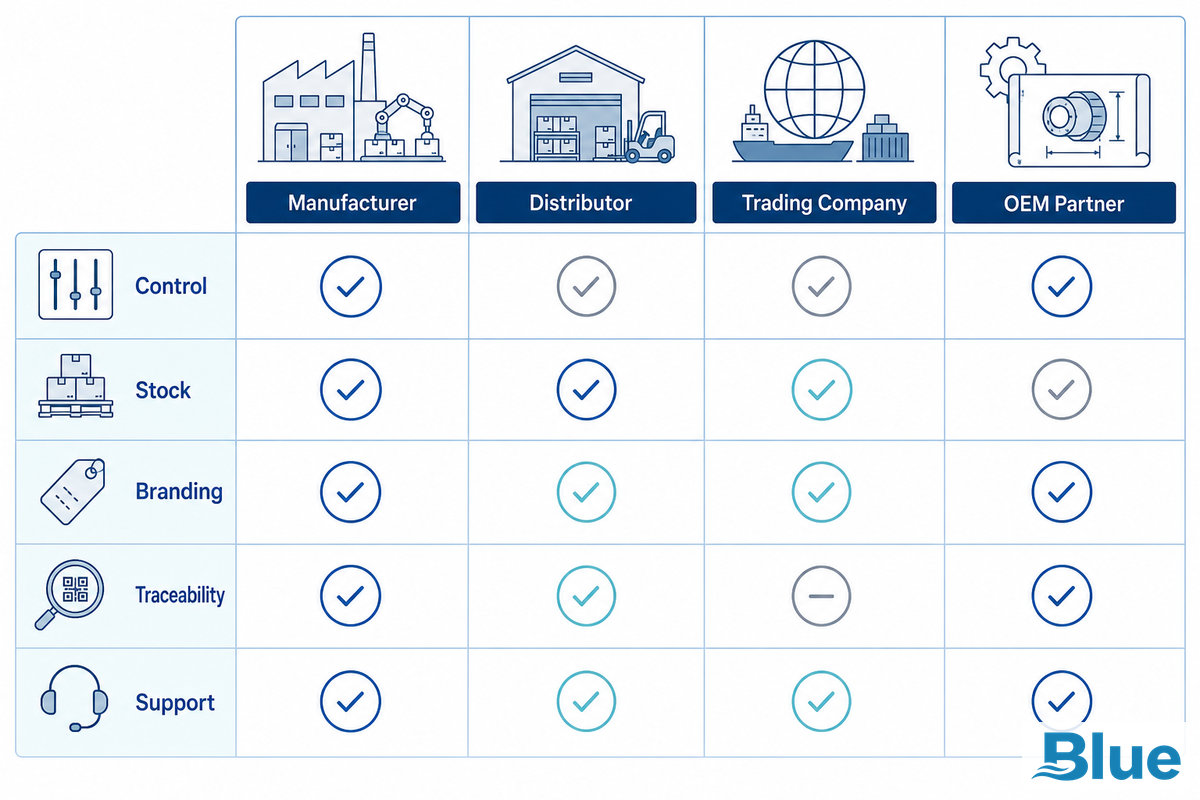
A direct manufacturer, distributor, trading company, or private-label/OEM partner can all be valid. The right source depends on technical accountability, local stock, branding needs, replacement speed, and support depth. The risk is assuming one source role is always better before checking factory records, lot control, and after-sales responsibility.
U.S.-origin wording needs supporting records. Avoid unsupported claims like “Made in USA” for U.S. market purposes. FTC states unqualified claims for made-in-USA items require that they be all or virtually all made in the United States. Regard the patent literature for membrane components as merely an impetus to ask smarter questions, not proof of capability.
| Supplier type | Best fit | Ask for | Main risk |
|---|---|---|---|
| Direct manufacturer | OEM, private label, custom element programs | QC records, change control, sample testing | Longer communication loop if support is weak |
| Distributor | Fast replacement, local stock, mixed brands | Stock age, storage conditions, cross-reference | Limited factory control |
| Trading company | Low-friction sourcing | Manufacturer identity and test records | Documentation gap |
| OEM partner | Private-label water systems | Packaging, label, batch traceability | Model substitution risk |
| Project supplier | Municipal or industrial bids | References, schedule, spare plan | Delivery and support risk |
The 4-Risk RFQ Screen for RO Membrane Buyers
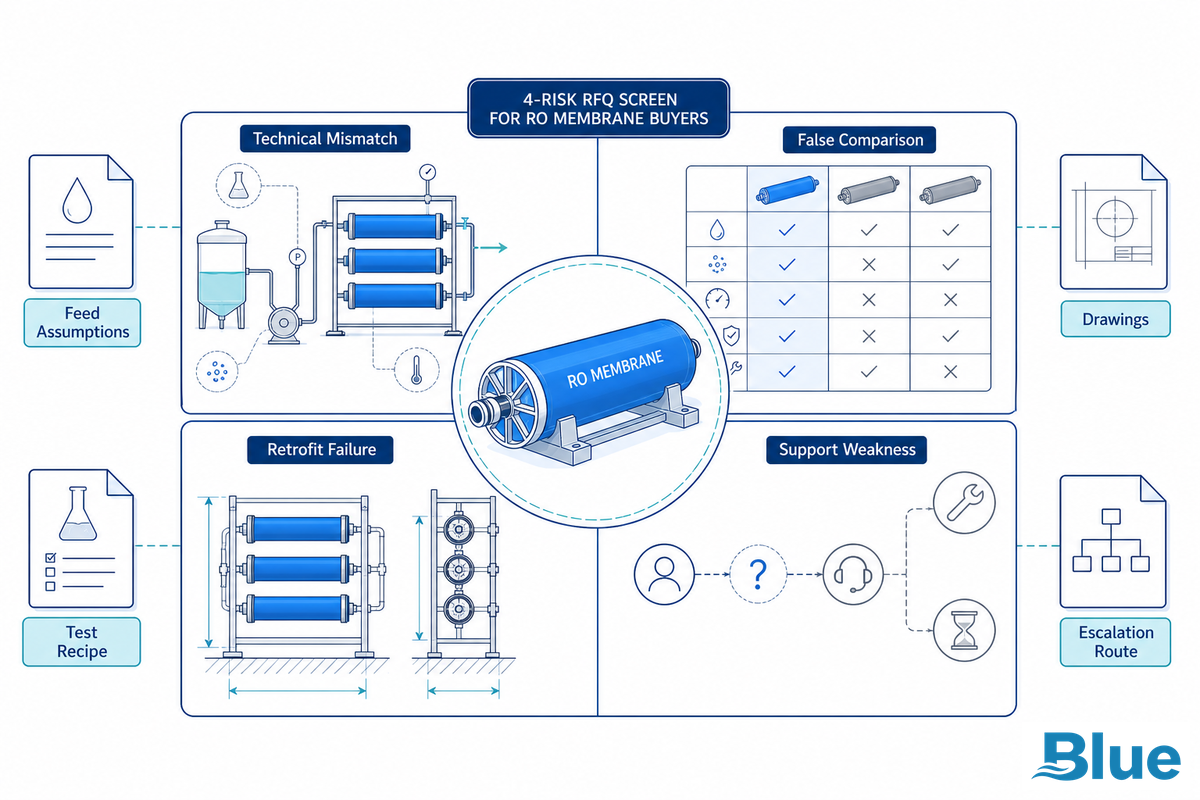
Well-developed RFQs require more than just a quote. They challenge suppliers to justify technical merit, adherence to documentation standards, security of supply and level of service support. Ensure the RFQ asks for specific information, so that suppliers can answer it with commensurate data. EPA and NSF/ANSI both reinforce this procurement tenet in distinct ways: water treatment claims are supported with specific conditions and limits, not just aspirational language.
| Buyer question | Risk caught | Document requested | Red flag |
|---|---|---|---|
| What feedwater assumptions are behind this model? | Technical mismatch | Application note | No feed analysis requested |
| What are the exact test conditions? | False comparison | Datasheet and test recipe | Only “99%+” language |
| Which element sizes are available? | Retrofit failure | 4040, 8040, 2540 drawing | No dimensional drawing |
| What pressure vessels and seals are compatible? | Installation risk | Cross-reference chart | “Universal fit” without details |
| What cleaning pH and chemicals are allowed? | Membrane damage | Cleaning guide | Allows oxidizer without limits |
| How is each batch tested? | Quality drift | Factory test report sample | No batch record |
| What is the storage and shelf-life rule? | Dead stock | Packaging note | No preservative guidance |
| What is normal lead time and emergency lead time? | Supply instability | Delivery policy | Only “fast shipping” |
| Who supports troubleshooting after startup? | Support weakness | Contact and escalation route | Sales-only contact |
Cost and Lifetime: Do Not Buy on Unit Price Alone
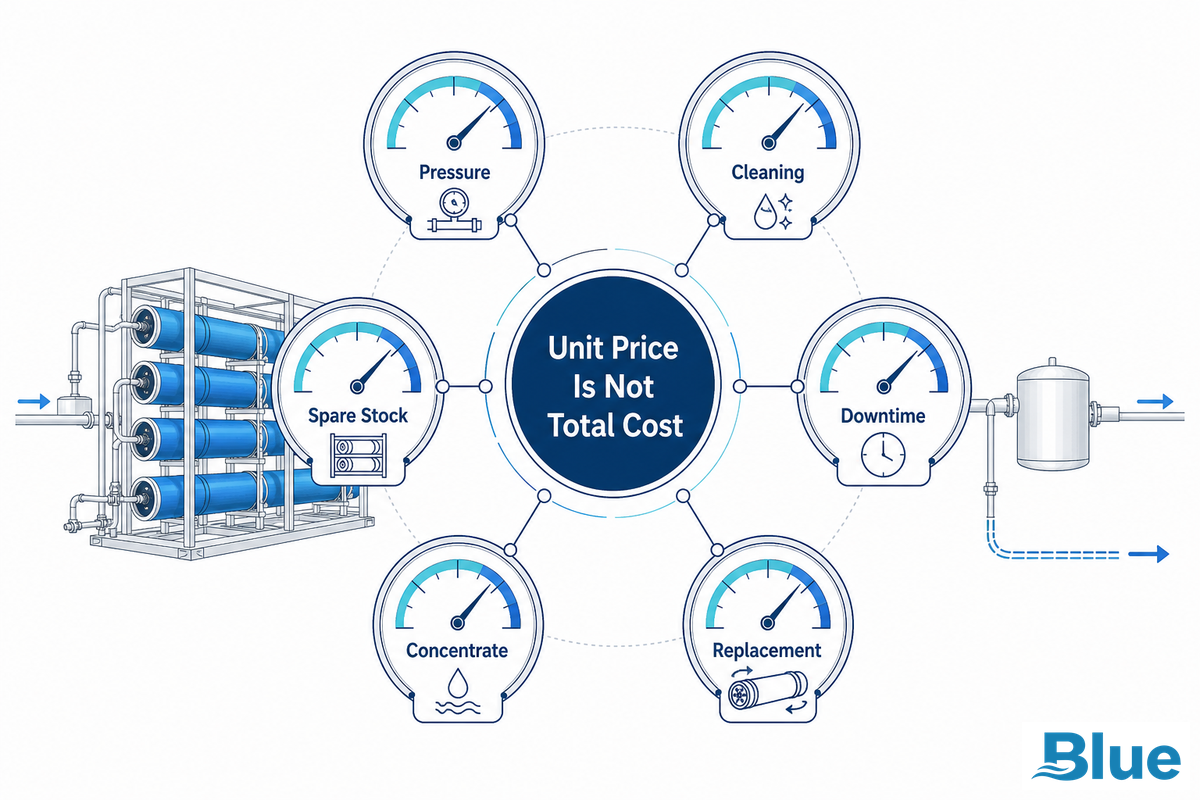
Lowest unit cost membrane could cost far more in practice if it leads to increased operating pressure, frequency of cleaning, downtime, replacement risk, concentrated wastewater disposal requirements, corrosion treatment, and labor associated with trouble-shooting. Consider membrane choice to be a systems-level decision. WaterOnline’s useful design guidelines correlate feed water analysis, permeate quality, scaling, hydraulics and pilot tests with system performance instead of simply with price. EPA further points out that RO/NF membranes separate a portion of the feed as concentrate and have substantial energy demands, and may require post-treatment for corrosion when lowering the pH of the purified water. Blue Membrane buyers should ask the factory to map price against energy, cleaning, replacement, and supply risk because the wrong purchase order can move cost from the invoice into plant operation.
Major cost drivers for many industrial applications are energy input to the pumps, pretreatment chemicals, membrane replacement, cleaning chemicals, labor costs, disposal of the concentrate stream, inventory of spares and loss of production when water quality deviates from ideal levels. Apparent savings achieved on the purchase order can easily be outweighed by 20 extra hours of unplanned cleaning, making the seemingly low-cost option the wrong one for the membrane.
- Ask for expected pressure range, not just membrane price.
- Query what assumptions about cleaning frequency (3, 6, or 12 months) would be realistic given your feed.
- Ask which failures void warranty coverage.
- How does the supplier handle out-of-stock situations for replacement membrane membranes?
What Is Changing in RO Membrane Selection for 2026?
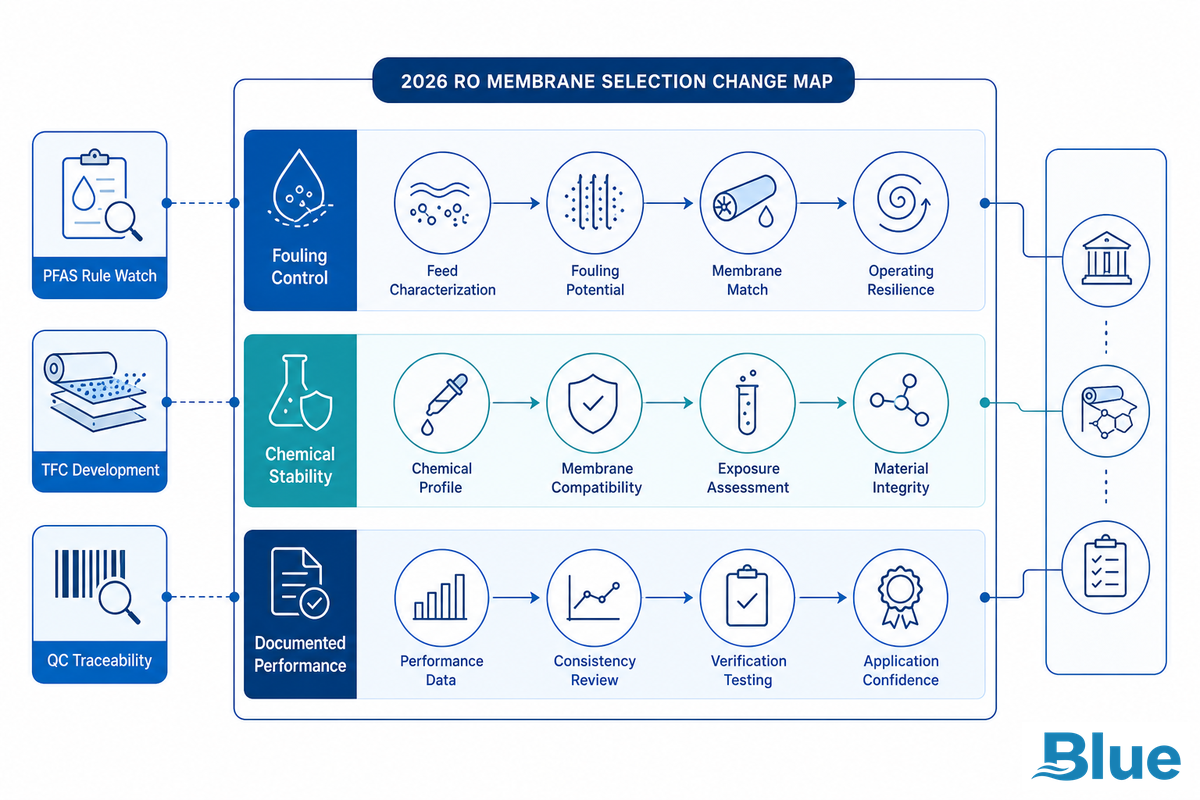
Wise selection efforts for 2026 will focus on water recycling, increased pressure for desalination, fouling control, chemical stability, cleaning resilience, and documented membrane performance. In 2025, an RSC assessment of thin-film-composite membranes highlights ongoing work on productivity, selectivity, resistance to chlorine and solvents, and fouling.
For an industrial buyer, the risk in 2026 is treating new chemistry as automatic improvement because the factory still needs to show application fit, cleaning limits, and production consistency. Patent publications from 2025 are weak signals that fouling monitoring, feed spacers, cleanability, permeability, selectivity, and longer life span remain open engineering problems. Buyers shouldn’t translate filings into a claim that every new membrane is better. Better question: can the supplier show the current membrane chemistry, current test basis, and current QC route for the duty you’re buying.
For Blue Membrane customers, this is where application review matters. EPA announced proposed PFAS drinking-water rule changes on May 18, 2026, including a proposal to uphold federal PFOA and PFOS Maximum contaminant Levels while allowing some systems to request 2 additional years, to 2031, for compliance. Blue Membrane positions its products around high rejection, permeability, service life, resistance to fouling, and stable membrane chemistry. Buyers should still make the RFQ concrete: name feed water, membrane size, operating pressure, recovery target, cleaning method, documentation needs, and private-label or distributor requirements.
Supplier Vocabulary Check Before You Shortlist
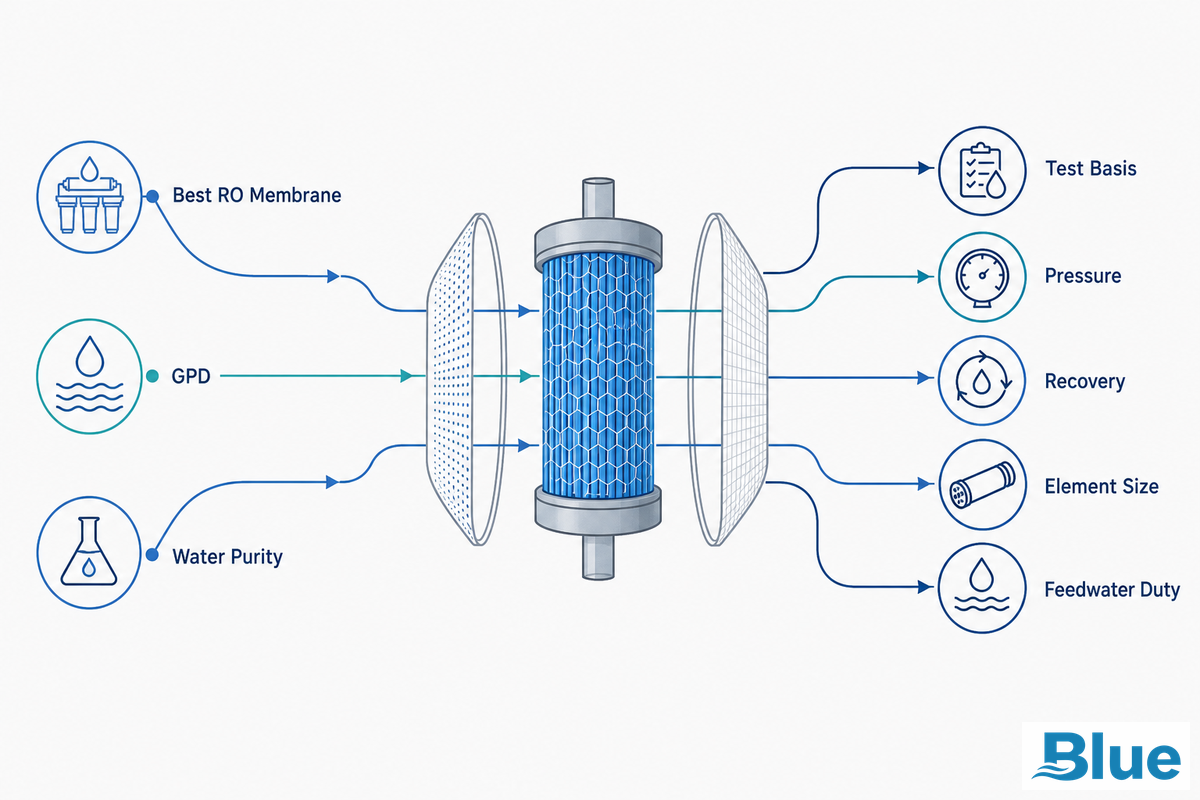
Use this vocabulary pass before selecting the right supplier. It keeps a reverse osmosis system discussion from sliding into consumer filter language and helps buyers ask about the correct ro membrane for industrial water treatment, water purification, and commercial reverse osmosis membranes. The risk is a vague RFQ because consumer terms hide pressure, recovery, pretreatment, and factory proof requirements.
| Term buyers use | Industrial reading | Number or condition to request |
|---|---|---|
| choose the right reverse osmosis membrane | Match membrane selection to source water, water sources, and specific water quality. | TDS at 500 ppm, 2,000 ppm, or 5,000 ppm |
| ro membrane type | Name low-pressure, brackish, seawater, or high-rejection duty. | 100 psi, 150 psi, 225 psi, or 800 psi basis |
| best ro membrane | Translate the phrase into water quality goals, not brand ranking. | 99.0%, 99.5%, or 99.7% rejection target |
| types of ro membranes | Separate pressure class, sheet chemistry, and element geometry. | 4040, 8040, 16 inch, or 18 inch module |
| types of ro membranes available | Ask what the supplier stocks and what it actually manufactures. | stock lead time in 2 weeks, 4 weeks, or 8 weeks |
| tfc membranes | Confirm polyamide thin film composite limits before cleaning. | pH 2-12, chlorine below 0.1 ppm if specified |
| specific contaminants | List silica, boron, nitrate, hardness, organics, iron, and bacteria separately. | ppm, mg/L, or conductivity target |
| water demand | Turn daily demand into membrane area and vessel count. | 2,000 GPD, 9,000 GPD, or 45 m3/day |
| maintenance requirements | Connect cleaning plan to fouling risk and warranty. | 3 months, 6 months, or 12 months between checks |
| types of reverse osmosis | Distinguish residential, commercial, industrial, brackish, and seawater duty. | 75 GPD, 100 GPD, 4040, and 8040 are not the same buying problem |
| gpd membrane | Read GPD only with pressure, temperature, feed concentration, and recovery. | 77 F, 25 C, 15% recovery, 40% recovery |
| poor water quality | Require pretreatment notes before comparing elements. | SDI 3, SDI 5, turbidity below 1.0 NTU |
| operational efficiency | Judge pressure, cleaning, downtime, and replacement together. | 20 hours of downtime can erase a lower unit price |
| water quality requirements | State permeate conductivity, total dissolved solids, and recovery. | conductivity, TDS, recovery %, pressure drop |
| water purity | Define the product water target, not a vague “pure” claim. | tap water, well water, municipal water, or surface water basis |
| reverse osmosis water | Clarify whether the target is process water, drinking water, or reuse water. | commercial and industrial water applications |
| osmosis membrane filter | Consumer wording; in B2B RFQs use membrane element and pressure vessel. | element model, spacer mil, vessel count |
| better rejection | Higher rejection is useful only when pressure and recovery still fit. | 99%, 99.5%, pressure psi, recovery % |
| high water production | Check whether high flow comes with the required rejection. | flow rate, GPD, m3/day, normalized permeate flow |
| water consumption | Ask how much feed becomes permeate and how much becomes concentrate. | 40%, 50%, 75%, or 85% recovery |
| residential membranes | Use only for disambiguation; B2B buyers need industrial and commercial data. | 75 GPD and 100 GPD are not 4040/8040 decisions |
FAQ
What should I ask an RO membrane supplier before ordering?
Ask for the membrane datasheet, standard test conditions, salt rejection and permeate flow data, element dimensions, compatible pressure vessels, cleaning limits, packaging and storage guidance, factory test report format, batch or serial traceability, warranty terms, sample policy, and expected lead time. Project teams should also ask the supplier to explain which feedwater assumptions sit behind the recommendation and whether the same membrane type has been used on brackish water, municipal supply, wastewater reuse, sea water desalination, or another comparable source. The point is to help you make informed decisions with evidence, not supplier slogans.
How do you choose a RO membrane?
To choose the right RO membrane, start with feed water quality and required permeate quality, then match the membrane type to salinity, fouling risk, pressure limits, flow demand, temperature, pH, recovery target, and system size. When choosing an RO membrane, compare datasheet values only when test conditions are similar. In B2B projects, also check whether the supplier can provide repeatable QC documentation and technical support after installation. Residential RO membrane questions such as 75 GPD versus 100 GPD is usually a small-system flow question; an industrial RO buyer must translate that into membrane area, pressure vessel count, recovery, cleaning plan, and replacement logistics.
What is the difference between an RO membrane supplier and manufacturer?
Manufacturers produce membrane sheets, elements, or both, and should be able to explain production control, testing, traceability, and product consistency. The seller may be a manufacturer, distributor, trading company, or OEM/private-label partner. Best choice depends on your need: direct technical accountability, local stock, private labeling, replacement speed, or broad catalog access.
Who are the top RO membrane suppliers?
Global manufacturers and regional specialists both appear in the market. Buyers should not choose from a name list alone. Shortlist suppliers by application fit, technical documentation, element interchangeability, sample availability, delivery reliability, and support history. A lesser-known supplier can still be viable if it shows stable membrane chemistry, consistent quality control, and a dependable supply chain.
Is 4040 or 8040 better for industrial RO systems?
Similarly, size isn’t necessarily the better option. While the 4040 configuration works well for smaller commercial or pilot applications, a 8040 element is often used on high-flow industrial skids. Whether you go with a 4040 or 8040 is a matter of the target permeate flow, the pressure vessel’s design, your pump capacity, recovery target, cleaning scheme, space constraints and your plans for replacing elements.
How long should an industrial RO membrane last?
Membrane life depends on feedwater quality, pretreatment, oxidant exposure, scale control, cleaning practice, pressure, recovery, temperature and storage conditions. Don’t trust suppliers that sell ‘one service life for everything’ without asking for water quality and operating data.
Related Blue Membrane Resources
- Low-pressure RO membrane engineering guide
- Seawater RO systems guide
- Nanofiltration membrane guide
- Nanofiltration membrane specification page
- Marine water makers buying guide
- Blue Membrane blog
References
- EPA overview of drinking water treatment technologies
- EPA Membrane Filtration Guidance Manual
- University of Nebraska-Lincoln Extension RO treatment guide
- NSF/ANSI 58-2024 standard listing
- WaterOnline design and care of RO systems
- WaterOnline membrane cleaning guidance
- WaterOnline membrane fouling and prevention
- RSC 2025 review of thin film composite membranes
- Patent publication on RO/NF fouling monitoring
- Patent publication on spiral wound membrane feed spacer