Get in touch with Blue Membrane Company

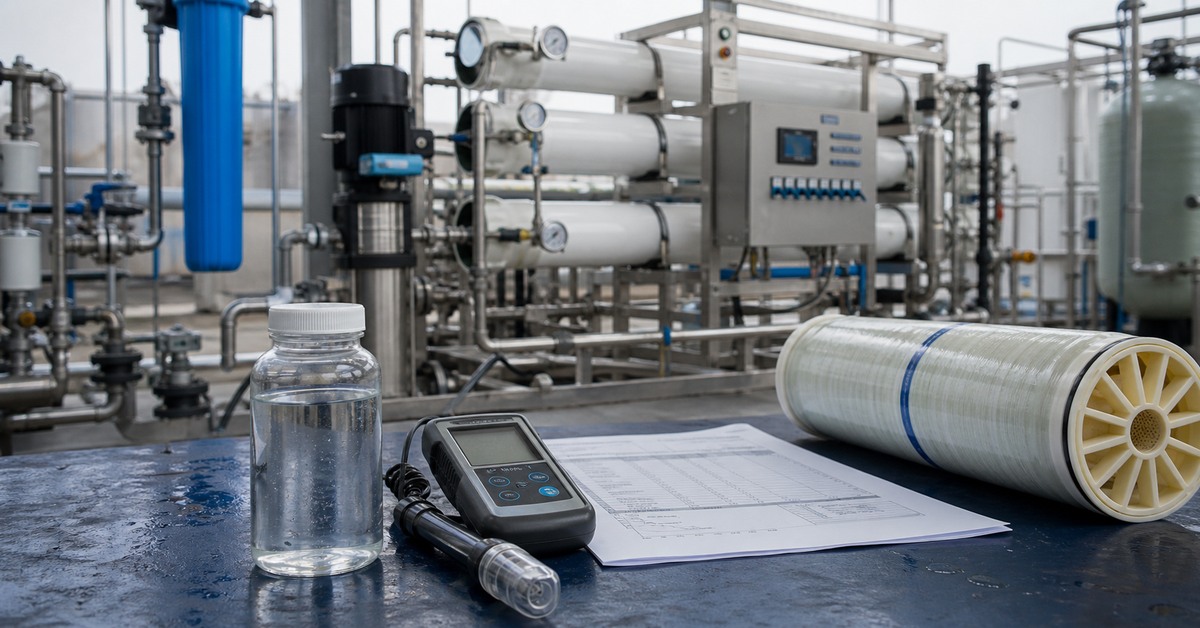
Engineering guide
Well Water Brackish RO Treatment begins with a water report, not a catalog page. Clean tap water can still carry enough dissolved salts, hardness, iron, manganese, silica, or sulfate to change the whole reverse osmosis design.
This post is for system integrators, OEM partners, distributors and industrial customers who need to know the feedwater. When the report is done, and you need to move to an engineered path, the Blue Membrane well water brackish RO treatment page is your next stop.
Quick Specs: Brackish Well Water Before RO
| Report item | Useful number | Why it matters before BWRO |
|---|---|---|
| Dissolved solids | 1,000-10,000 mg/L | USGS uses this band for brackish groundwater in its national assessment. |
| TDS guidance value | 500 mg/L | EPA secondary guidance flags taste, deposits, staining, and salty taste concerns at this level. |
| Chloride / sulfate | 250 mg/L each | The 40 CFR Part 143 secondary values often explain salty taste or sulfate-driven complaints before the buyer sees the full ion balance. |
| pH, iron, manganese | pH 6.5-8.5, iron 0.3 mg/L, manganese 0.05 mg/L | These values guide corrosion review, staining control, and front-end filtration before water reaches the membrane. |
Use the Blue Membrane water TDS salinity classifier for an initial screen that separates fresh, brackish, saline, and high-salinity inputs before deeper engineering review.
How to Confirm a Well Is Brackish Before You Size RO
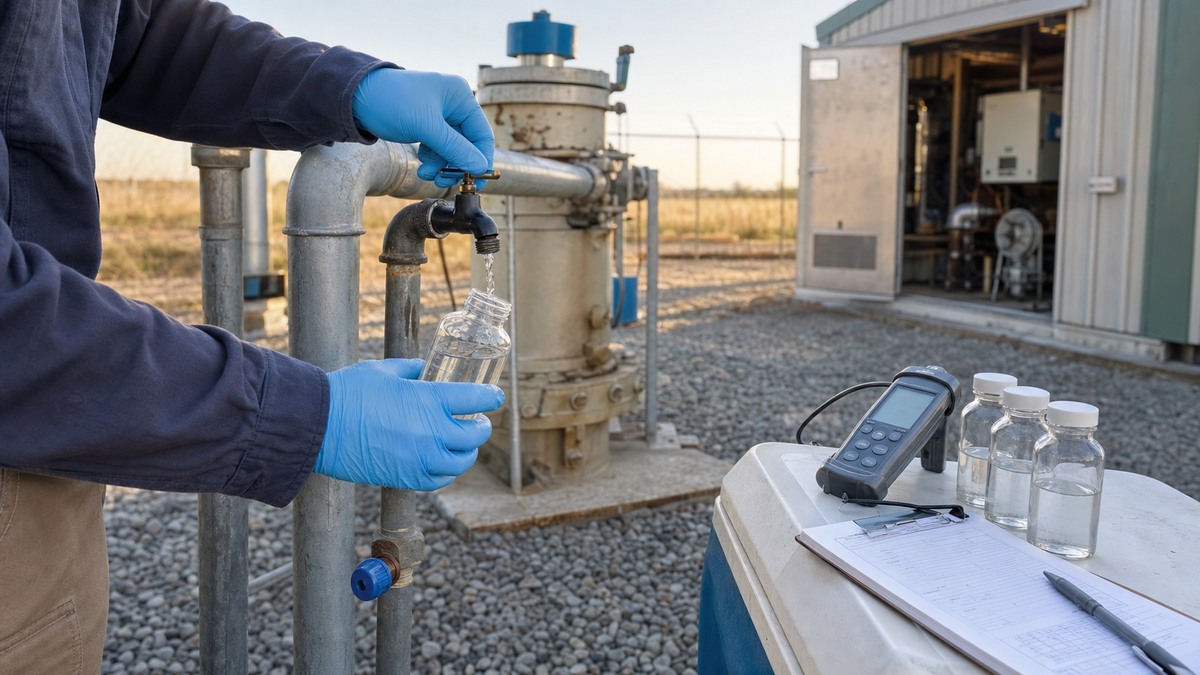
A handheld TDS reading alone is a symptom, not a cure. While conductivity is an indicator of dissolved salts, it doesn’t give the engineer any indication about the calcium, magnesium, bicarbonate, silica, iron, or manganese content that will reach the membrane. Two wells with similar TDS values may require very different pretreatment.
Begin with a certified lab report whenever water will be used for drinking, food service, process water or other regulated applications. EPA recommends that private well owners test their water at least once annually for total coliform bacteria, nitrates, total dissolved solids, and pH; RO screening then adds the specific ions and fouling indicators that affect membrane life.
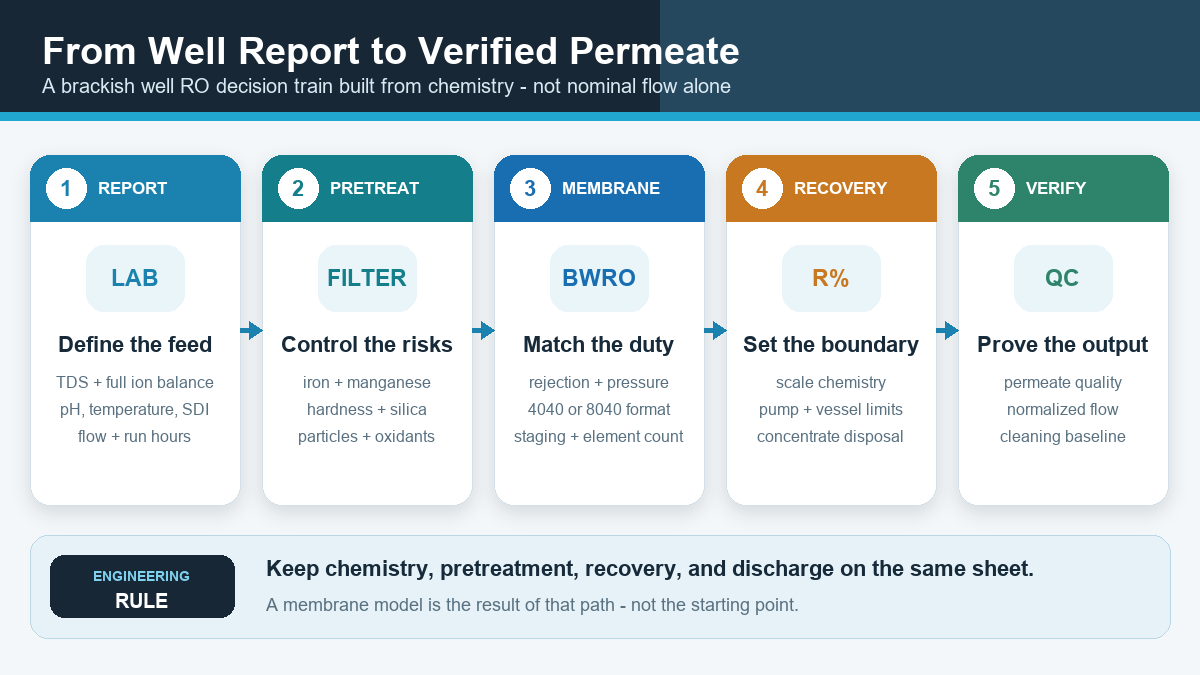
Engineering note: request TDS, conductivity, chloride, sulfate, hardness, alkalinity, silica, iron, manganese, turbidity or SDI, pH, temperature, bacteria where applicable, target permeate flow, daily run hours and discharge route. That is not just paperwork. It is the difference between a discussion about membrane specifications and a pure guess.
If the report is incomplete, hit pause on the system discussion and first check fit using the Blue Membrane feedwater compatibility checker. Clean inquiry packets save time for both the buyer and the application engineer.
Can well water be brackish?
Yes. USGS defines brackish groundwater as having more dissolved solids than fresh water, but less than seawater, and defines its brackish band at 1,000-10,000 mg/L dissolved solids. Geology, depth, agricultural irrigation return flows, coastal effects, evaporite deposits and prolonged water-rock contact can contribute to these higher values. Simply removing salt is not the whole problem; the entire chemistry needs to be compatible with RO.
Why Standard Well Filters Do Not Remove Dissolved Salts
Many well systems already incorporate sediment filtration, carbon, softening or an iron filter. While these units may be beneficial pre-RO, they are not capable of removing significant quantities of dissolved salts. Softening, for instance, is an exchange of ions, and does not make brackish water fresh; carbon reduces taste, odor, and certain chemicals but is not a desalinating device.
| Treatment step | Good fit | Salt/TDS boundary |
|---|---|---|
| Sediment filter | Sand, silt, visible particles | Does not remove dissolved ions |
| Carbon | Taste, odor, oxidant removal in some trains | Does not desalinate brackish water |
| Softener | Calcium and magnesium hardness control | TDS can stay high because ions are exchanged |
| Iron / manganese filter | Staining metals before RO | Protects the membrane; it does not remove chloride |
| Nanofiltration | Some hardness and divalent ion reduction | May not meet a low permeate TDS target |
| Brackish water RO | Dissolved salt reduction and permeate quality control | Needs pretreatment, recovery limits, and concentrate handling |
That is precisely why a conversation that starts around a filter often escalates into a discussion of membranes. As soon as dissolved solids becomes the key issue, brackish water reverse osmosis becomes the center of treatment, and earlier stages shift to protecting that membrane.
Where the Brackish Water RO System Fits
At project level, a brackish water RO system is a desalination step inside a broader water treatment system. It is usually discussed when treated water or product water must move toward potable water, process water, pure water, or high-quality water targets, and when the raw water has higher salinity than fresh water. Compared to RO used only for polishing, well-water brackish service puts more weight on pre-treatment, water recovery, recovery rates, brine handling, energy consumption, and cleaning and replacement intervals. For example, a 5,000 GPD duty at 65% recovery, 3,000 mg/L feed TDS, and 150-225 psi feed pressure is a different membrane conversation than a 500 GPD pilot at 50% recovery and 1,200 mg/L feed TDS.
A reverse osmosis system can desalinate brackish water because pressure pushes feedwater across a semi-permeable membrane while most dissolved ions remain in the concentrate stream. That does not make the product automatically salt-free, and it does not remove every contaminant without additional treatment. If safe drinking water, high-quality drinking water, or a supply of safe drinking water is the goal, local water standards, post-treatment, and verification testing still matter after reverse osmosis water leaves the membrane.
| Project signal | Design meaning |
|---|---|
| Raw water from an aquifer or other inland water sources shows 1,000-10,000 mg/L TDS | Treat brackish water using reverse osmosis only after full water chemistry review, not from TDS alone. |
| High salt, chloride, sulfate, or salts and other contaminants drive the complaint | RO can remove dissolved salts, but the brine and reject route become part of sustainable water management. |
| Scaling and fouling risks show up in silica, hardness, iron, biology, or SDI | The membrane used should be selected with pretreatment and foulant control in mind, because these conditions can foul RO elements even when nominal gallons per day looks correct. |
| Water for use in irrigation, wastewater treatment reuse, power generation, or industrial applications has different limits | Water use defines the permeate target, environmental impact review, discharge route, and whether additional treatment is required. |
| Nanofiltration membranes, low-pressure BWRO, or reverse osmosis membranes all appear possible | The efficient solution depends on ion rejection targets, high pressure requirements, concentrate chemistry, and whether the project must deliver desalinated water rather than partial softening. |
These treatment challenges grow sharper when salinity levels of brackish water shift seasonally, when saltwater influence appears near an estuary, or when contaminants from brackish water must be controlled for water purification rather than only equipment protection. Some arid regions also evaluate fossil aquifers and other non-traditional water resources to address water scarcity. In those cases, water treatment solutions must balance recovery, disposal, minimizing environmental impact, and long-term water resource management before the RO package is finalized, and the package should be designed to efficiently operate inside those limits.
Pretreatment Map for Brackish Wells
No cookbook fits every brackish well; think risk map. California guidance on RO treatment in drinking water identifies pretreatment, recovery, power, and concentrate management as planning factors. For a brackish well, the site chemistry can make one train straightforward and another much harder to stabilize.
| Feed issue | Membrane risk | Pretreatment question |
|---|---|---|
| Iron above 0.3 mg/L or manganese above 0.05 mg/L | Staining, fouling, pressure rise | Should iron and manganese removal use oxidation/filtration, greensand, catalytic media, or another front-end step? |
| Hardness plus alkalinity | Calcium carbonate scale at higher recovery | Is antiscalant, softening, pH adjustment, or lower recovery the cleaner route? |
| Silica | Hard-to-clean scale if concentration is pushed too far | Does the recovery target need to be capped before silica becomes the limit? |
| Turbidity or SDI | Particle fouling and short cleaning cycles | Is multimedia filtration, cartridge filtration, UF, or source correction needed? |
| Oxidant exposure | Membrane chemical stress | Where will dechlorination or oxidant control sit before the pressure vessels? |
More front-end choices are explored in Blue Membrane’s industrial RO pretreatment guide. Fouling-resistant RO membrane elements should also be considered when water supply has organic or particulate fouling potential.
How to Choose the BWRO Membrane Path
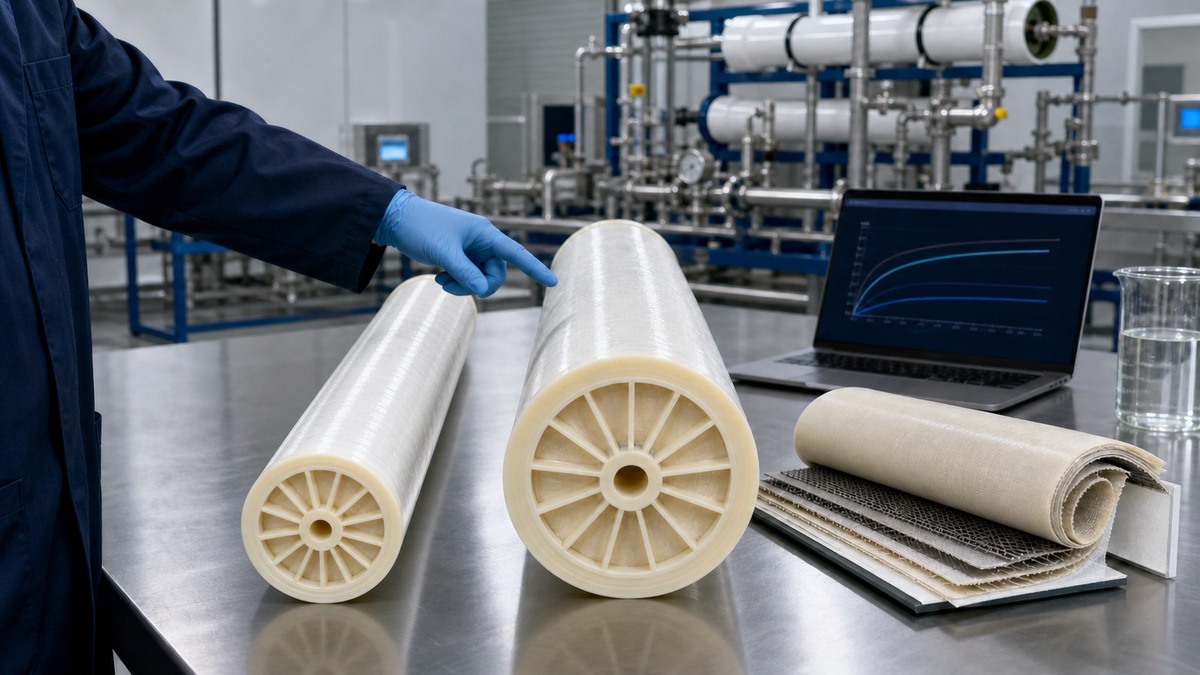
Choice of membrane element is a matter of feedwater characteristics and system duty. Moderate-TDS brackish wells with low particle load and a constant water temperature will be treated differently from warm wells with higher silica, iron carryover, and prolonged service hours. Element diameter can also shape the skid: the 4040 size often works for smaller skids and pilot tests, while the 8040 format fits higher flow targets with a different pump and vessel layout.
| Feed / duty signal | Membrane path to discuss | What to verify |
|---|---|---|
| Lower brackish TDS, clean feed | Low-pressure BWRO element | Permeate target, pump pressure, temperature correction |
| Higher salinity or tighter permeate target | Standard BWRO membrane path | Osmotic pressure, element count, pressure vessel staging |
| Fouling-prone well | Fouling-resistant membrane review | SDI, iron carryover, biological risk, cleaning plan |
| Small skid or staged trial | 4040 format review | Flow per element, vessel count, space, service plan |
| Industrial flow target | 8040 format review | Feed pump, recovery, concentrate line, spare element plan |
Blue Membrane manufactures reverse osmosis and advanced separation membrane products, including membrane sheets and spiral wound elements, for municipal, commercial, industrial and specialty purification applications. Element-specific selection starts with Blue Membrane’s brackish water RO membrane elements product page, while the brackish membrane sizing selector can be used once flow and water chemistry are available.
“A brackish well project is easier to size when the inquiry arrives with chemistry, flow, recovery intent, and discharge limits in the same packet. The membrane can then be matched to the water, not only to a nominal capacity.”
Recovery, Concentrate, and Scaling Boundaries
Recovery can appear to refer to an efficiency of saving water, but in a brackish well it represents a factor of how many times dissolved ions will concentrate in the concentrate line. The concentrate will be double the level of dissolved ions at 50% recovery, and approximately quadruple the concentration level at 75% recovery. Higher recovery may be appropriate, but considerations for silica, scaling, pump head, and concentrate disposal must be evaluated before the recovery rate is a commitment.
A simple planning example shows why this matters: a 3,000 mg/L feed TDS becomes roughly 6,000 mg/L on the concentrate side at 50% recovery, about 12,000 mg/L at 75% recovery, and about 15,000 mg/L at 80% recovery before ion-specific scale chemistry is checked. A 65% recovery case is often a useful middle check before the design jumps from conservative to aggressive, and even a 500 mg/L seasonal feedwater shift can change the pressure and scaling discussion.
Elevated TDS, or total dissolved solids, can result in tastes, costs of treatment, mineral deposits, and may cause corrosion and staining, or it can create limits on use for irrigation, according to USGS data. But that added solids content doesn’t simply go away inside the RO skid; it leaves the process in the reject stream.
Advantages and limitations in brackish well RO
| Advantage | Limit to respect |
|---|---|
| Strong dissolved-salt reduction compared with conventional well filters | Requires pretreatment when iron, particles, oxidants, or scale formers are present |
| Can be scaled from small skids to industrial flows | Pump, vessel, and element choices change with feed pressure and duty |
| Recovery can reduce waste volume when chemistry allows | Concentrate disposal, silica, hardness, and antiscalant limits may cap recovery |
Before a high-recovery target is written into a purchase spec, run the Blue Membrane RO recovery concentrate calculator. Projects centered on water production should use it in conjunction with the high recovery BWRO design guide.
Failure Patterns That Show Up First in Brackish Well RO
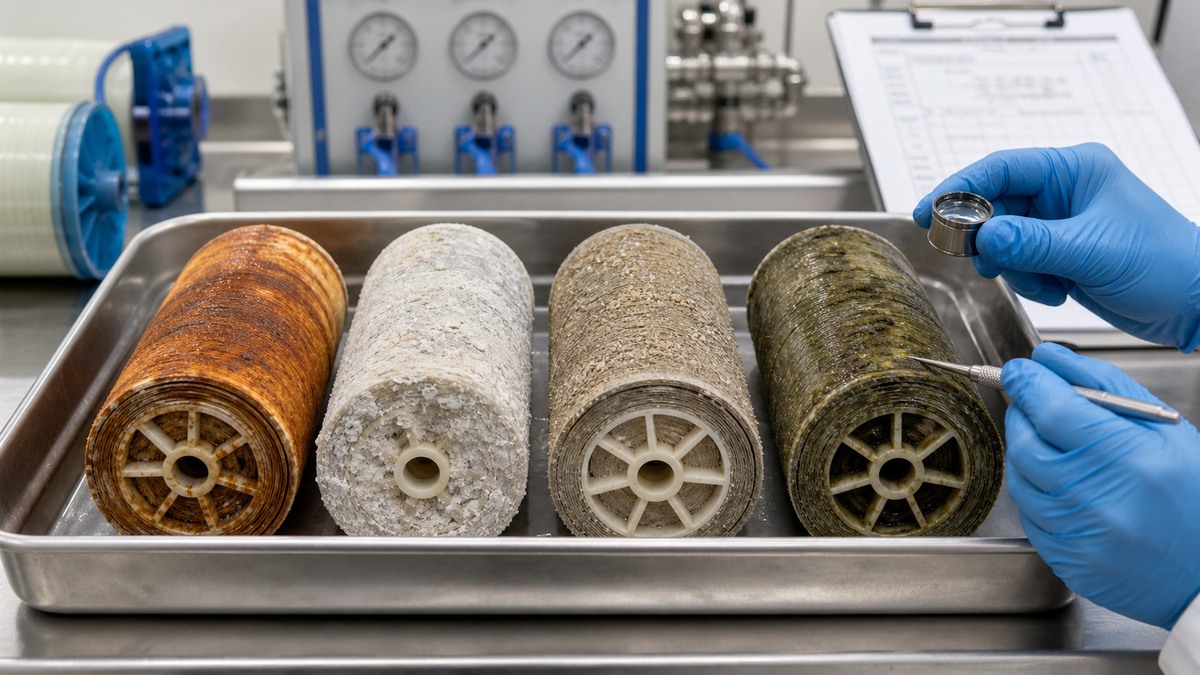
The RO membrane element itself is often the initial suspect in system troubles due to its cost of replacement, but symptoms of field performance problems like a drop in flow normalized for pressure, an increase in permeate TDS, a shorter clean frequency, or a drop in operating pressure may actually stem from a different source including improper pretreatment, well cycling, excess oxidant carryover, fluctuating on-site chemistry, or an outmoded recovery objective.
| Symptom | Likely feed-side check | Corrective route |
|---|---|---|
| Feed pressure rises fast | Particle load, iron carryover, cartridge filter loading | Recheck pretreatment, SDI, filter change interval, and cleaning record |
| Permeate TDS drifts upward | Feed TDS increase, seal leak, membrane damage, temperature shift | Normalize data before replacing elements |
| Flow drops after recovery increase | Scale saturation, silica, antiscalant dose, pH | Lower recovery and run a scaling review |
| Elements fail after chemical exposure | Oxidant slip, cleaning chemical error, upstream dosing change | Audit chemical injection points and membrane compatibility |
Make sure that feed and concentrate pressure and flow rates, permeate flow and TDS, pH, temperature, and the date of cleaning are all recorded and maintained together in a common log, because even one month of this information can eliminate a potentially premature membrane element change-out.
The 9-Point Well Report-to-Membrane Fit Map
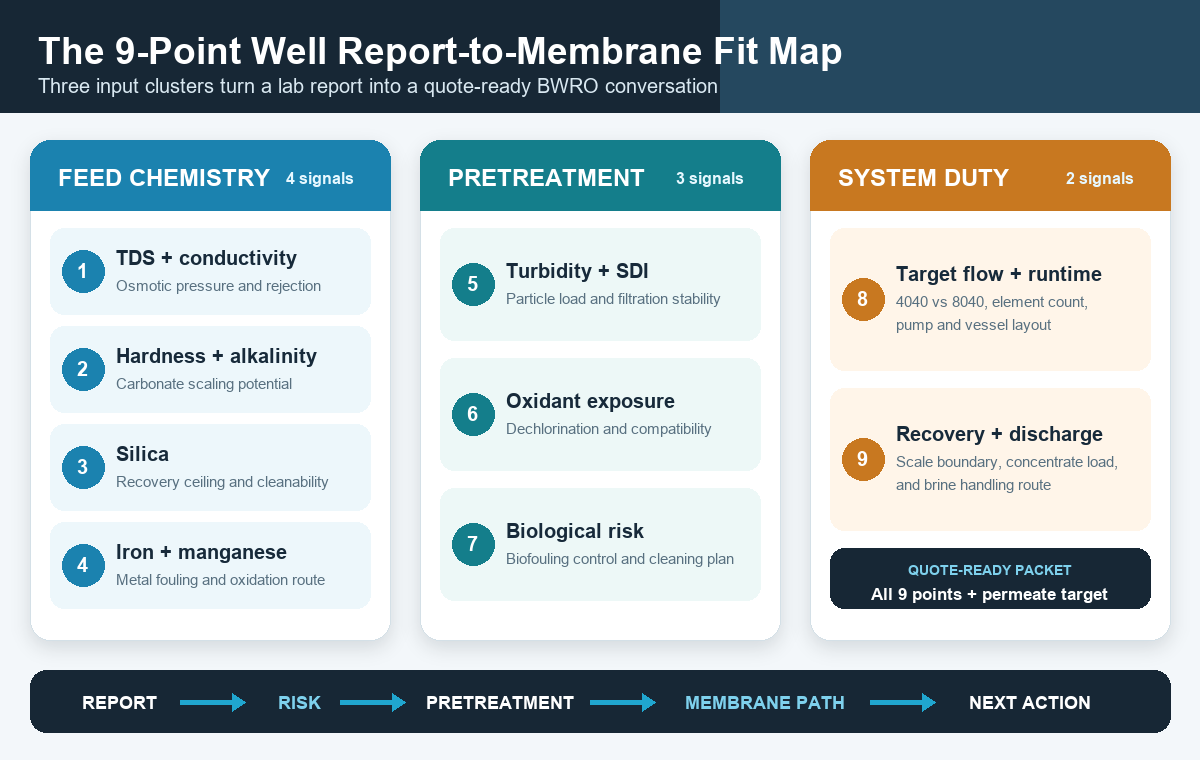
Use this 9-point map as a handoff tool. Treat it as a quote-readiness checklist: it shows which threshold, selection, and recovery questions should be answered before a buyer asks for a membrane path or a system decision. The intent is to turn a lab report into a membrane and system conversation without pretending that one table can replace design work.
| Report signal / project type | What it suggests | Pretreatment question | Membrane path to discuss | Next action |
|---|---|---|---|---|
| TDS 1,000-10,000 mg/L | Brackish groundwater band | Check full ion balance | BWRO element review | Send lab report and permeate target |
| Chloride or sulfate near 250 mg/L | Taste or nuisance limit is near | Separate salt issue from hardness issue | RO rather than softener-only path | State target use and required permeate quality |
| Hardness plus alkalinity | Calcium carbonate scale risk | Softening, antiscalant, pH control, or recovery cap | Conservative BWRO flux review | Run scaling and recovery check |
| Iron above 0.3 mg/L or manganese above 0.05 mg/L | Metal fouling risk | Oxidation and filtration need review | Membrane after verified pretreatment | Add before/after pretreatment test data |
| Silica present | Recovery may be chemistry-limited | Can the reject stream carry the concentrated silica? | Lower recovery or staged review | Avoid writing recovery first |
| High SDI or turbidity | Particle loading risk | Is filtration stable during pump cycling? | Fouling-resistant review if risk remains | Send SDI trend or turbidity data |
| pH outside 6.5-8.5 | Corrosion or scale behavior may shift | Is pH adjustment part of the front end? | Membrane plus post-treatment review | State final water use |
| Oxidant residual before RO | Chemical stress risk | Where is dechlorination verified? | Membrane compatibility check | Share dosing points and control logic |
| Flow, hours, recovery, and discharge route | Project duty is now clear | Can the concentrate path handle the salt load? | 4040, 8040, or multi-vessel review | Move to the solution page with a complete packet |
If the last row remains blank the project is not yet ready for pricing. If the last row is filled, the project has a stronger baseline for field implementation planning and the Blue Membrane solution page can translate the report into a system path.
What Is Changing in Brackish Groundwater Projects
Inland projects are beginning to show interest in wells previously ignored for being too saline, too hard, or too cumbersome to discharge. USGS describes brackish groundwater as an unconventional water source that may help ease water-supply pressure in some locations.
This does not make every brackish well an RO candidate. Early screening becomes more valuable. Farm wells, inland community wells, factory process wells, and remote facilities can each yield a different answer once discharge rules, energy costs, pretreatment space, and target permeate water quality are added.
This represents a very real change for the buyer: fewer projects can be answered based solely on TDS. Most require chemistry-driven screening before membrane selection, recovery targets and concentrate management are finalized.
When to Use Blue Membrane’s Well Water BWRO Solution Page
Proceed from guide reading to system selection when you have 7 pieces of information: current water analysis, desired permeate flow rate, total daily operating hours, input pressure if available, desired recovery, reject water disposal location, and any existing pretreatment systems. This set of inputs allows an engineer to discuss membrane chemistry, element size, vessel layout, cleaning requirements and spare element inventory with greater clarity.
Blue Membrane is dedicated to high-quality membrane sheets and spiral wound elements for current water treatment technologies, with attention to rejection, permeability, service life, resistance to fouling, chemical resistance and stable supply chains for OEMs, distributors, and integrators.
Once these inputs are prepared, advance to the well water BWRO solution page. Should the quantity of the reject water be an issue, check the concentration factor before submitting your inquiry.
FAQ
What is the best way to treat brackish well water?
Answer.
Dissolved salt reduction usually puts brackish water RO at the center of the train. The surrounding process changes with the well report: filtration for particles, iron or manganese treatment where needed, scale control, oxidant control, then BWRO and post-treatment if the final use requires it. Buyers should also settle the reject discharge path early, because concentrate handling can become the project limit even when the membrane choice is clear.
Can you use reverse osmosis on well water?
Answer.
Yes, after testing. Well water can carry scale-forming minerals, metals, particles, bacteria, or oxidants.
Can well water be brackish?
Answer.
Yes. USGS uses 1,000-10,000 mg/L dissolved solids as the brackish groundwater band in its national assessment. Visual clarity does not keep a well outside that band. Taste, corrosion, staining, mineral buildup, and treatment cost can be warning signs, but a lab report is the better guide.
What is the best filter for brackish water?
Answer.
No single filter fits every brackish well. Sediment filters, carbon, softeners, and iron filters can protect RO, but they do not replace a BWRO membrane for dissolved salt removal.
Is a water softener enough for salty well water?
Answer.
No, not when chloride, sulfate, or total dissolved solids are driving the complaint. Softening exchanges calcium and magnesium for sodium or potassium. Hardness scale may drop, but the dissolved ion load remains in the water.
What TDS level needs a brackish RO membrane?
Answer.
There is no single purchase trigger, but the USGS brackish groundwater band starts at 1,000 mg/L dissolved solids, while EPA secondary guidance lists 500 mg/L TDS as a nuisance value for public water systems. If the well is above those values and the final use needs lower dissolved solids, BWRO review is reasonable.
What should I send before asking for a BWRO quote?
Answer.
Send the latest lab report, target permeate flow, daily operating hours, feed pressure if available, target recovery, reject discharge route, and a note on existing pretreatment. Pictures of the well head, pressure tank, filters, chemical dosing points, and available space can also shorten the first engineering pass. If the well feeds a process line, add peak demand, average demand, cleaning windows, allowed downtime, and any post-treatment target. Drinking-water or food-service projects should send local compliance requirements rather than assuming the RO skid alone sets final water quality.
References and Sources
- USGS – Brackish Groundwater and its Potential to Augment Freshwater Supplies
- USGS – Geochemical Database for the Brackish Groundwater Assessment
- EPA – Secondary Drinking Water Standards
- eCFR – 40 CFR Part 143, National Secondary Drinking Water Regulations
- EPA – Protect Your Home’s Water
- USGS – Chloride, Salinity, and Dissolved Solids
- California Water Boards – Drinking Water Treatment for Nitrate