Get in touch with Blue Membrane Company

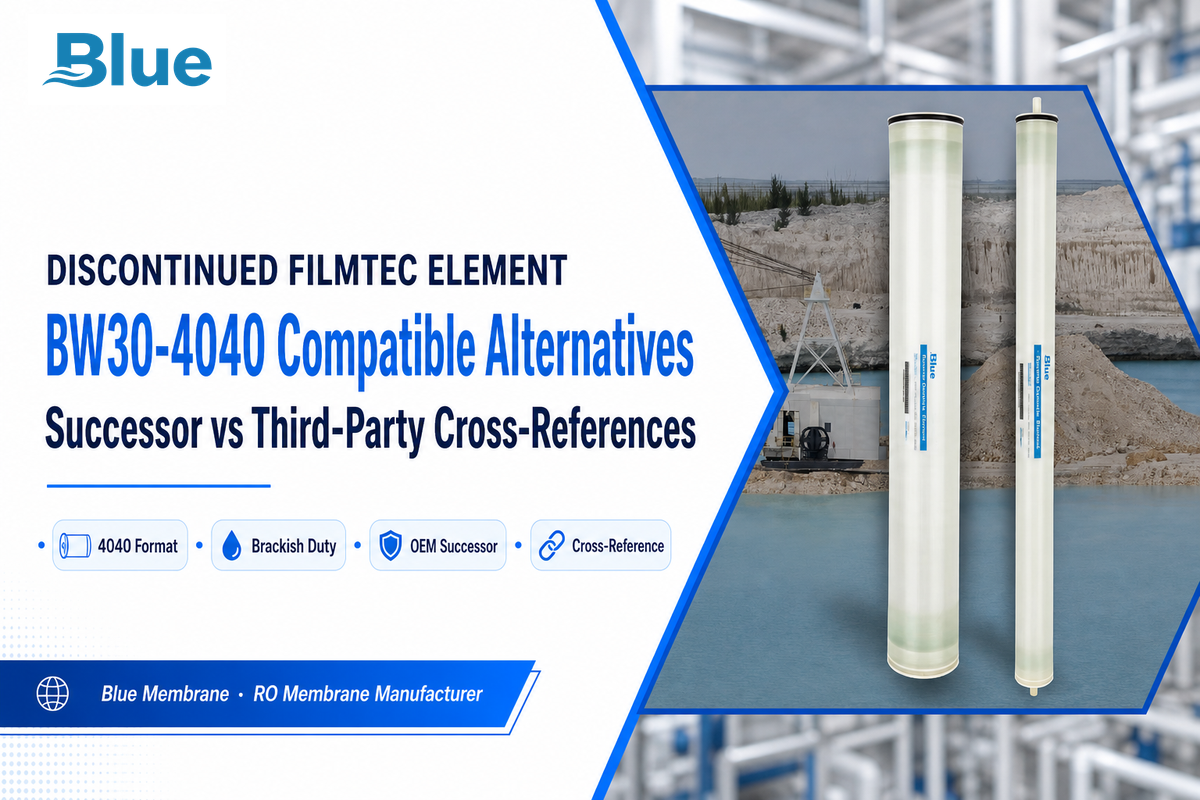
FilmTec BW30 4040 compatible alternatives are OEM-successor or third-party reverse osmosis elements built to the same 4-inch by 40-inch housing footprint and comparable flow/rejection specs as the discontinued FilmTec BW30-4040, so a failed or unavailable element can be replaced without swapping the pressure vessel.
Quick Specs
| Housing format | 4040 — nominal 4 in. diameter × 40 in. length |
| Legacy BW30-4040 rated flow | 2,400 GPD |
| OEM successor (BW30 PRO-4040) rated flow | 2,600 GPD, 85 ft² active area |
| Salt rejection | 99.5% minimum (both generations) |
| Max operating pressure | 600 psi |
| Named alternative manufacturers | Axeon, Vontron, LG Chem, CSM, Toray |
If you’re hunting for FilmTec BW30 4040 compatible alternatives because your old membrane can’t be re-ordered, let alone found, it’s not your imagination-across numerous independent RO distributors, DuPont has phased out the legacy BW30-4040 as a new production item sometime around 2022 (there’s no DuPont document specifying the exact date of discontinuation), and most vendor pages list the BW30 PRO-4040 in its stead. Yet, the term “compatible” can be rather elastic throughout the reverse osmosis world; a membrane with perfect spec matches but which won’t even properly seal inside your housing isn’t, strictly speaking, a compatible replacement.
Short answer: DuPont’s BW30 PRO-4040 is its official replacement, with a number of other manufacturers including Axeon, Vontron, LG Chem, and CSM/Toray offering compatible 4040-format brackish-water elements. Ensure the dimensions match your existing housing prior to evaluating spec sheets.
Key Takeaways
- DuPont’s designated successor shows roughly an 8% increase in potential output compared to the discontinued membrane. Keep in mind that even with individual elements (which are permitted by DuPont’s specifications to run up to 15% below the rated capacity), this 8% represents a spec-sheet difference rather than a guarantee of real-world gains.
- Whether branded as an “equivalent” or something similar, 4040 and 8040 housing types are never interchangeable.
- At least five different manufacturers-Axeon, Vontron, LG Chem, CSM, and Toray-produce 4040 brackish-water elements intended for the same housings.
- There are four different tiers of compatibility, from manufacturer-published specifications down to unsupported marketing claims.
- Even when the specifications line up, the physical configuration (such as the size of the O-ring or the end-cap configuration) may still be incompatible.
What Happened to the FilmTec BW30-4040? Discontinuation, Successor, and What “Compatible” Really Means
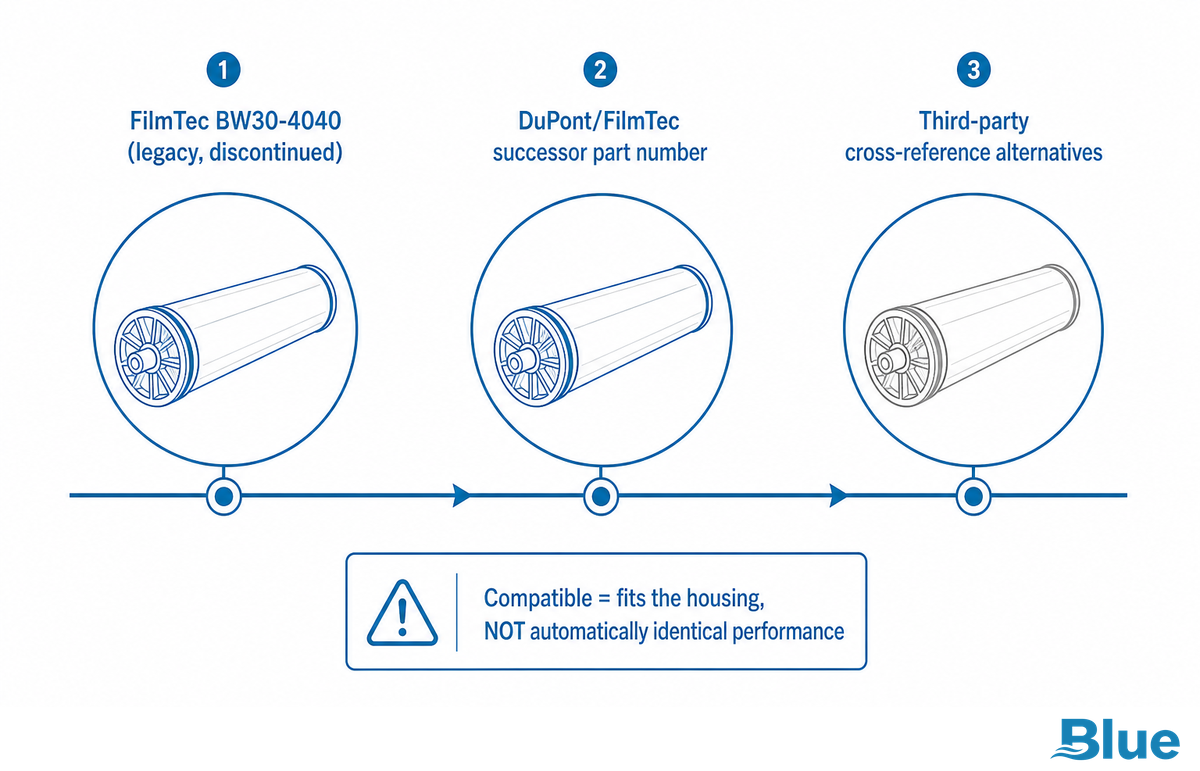
DuPont discontinued the original FilmTec™ BW30-4040 as a new-production item around 2022, based on consistent reporting from independent RO distributors rather than any single dated DuPont notice. DuPont’s current BW30 PRO-4040 occupies the same FilmTec brackish-water 4040 segment and is the product distributors now list as its replacement.
Despite extensive searching on three separate occasions for a formal DuPont discontinuation announcement, no single notice was ever located, so the BW30 PRO-4040 is better described as a manufacturer-marketed replacement than an “officially recognized” successor in the sense of a formal product recall or transition notice. A number of independent retailers, including wateranywhere.com and pureaqua.com, now list the BW30 PRO-4040 in place of the original BW30-4040, which can no longer be purchased new.
We’ll be using two terms throughout this article: an OEM successor refers to a replacement product manufactured by the original equipment manufacturer (for example, DuPont’s BW30 PRO-4040 replacing the DuPont BW30-4040). A third-party cross-reference (often advertised as a “compatible” or “equivalent” membrane) refers to a product made by a different company that’s dimensioned and rated to be a replacement for an original part. Both types of replacements can be valid; however, you shouldn’t solely rely on the brand name. The Cross-Reference Confidence Ladder below provides more guidance.
What is the FilmTec BW30 4040 reverse osmosis membrane?
A FilmTec™ BW30 4040 reverse osmosis membrane element is a brackish water reverse osmosis membrane — a spiral-wound, thin-film composite built for brackish-water feed (roughly 2,000-10,000 ppm TDS). Original 4040 units delivered 2,400 GPD of permeate with at least 99.5% salt rejection at up to 600 psi, using applied pressure to push water across a semi-permeable membrane so salts stay in the waste concentrate.
This FilmTec membrane element has long ranked among standard water reverse osmosis membrane elements for light industrial duty, drinking-water applications, packaged brackish RO skids, and food-and-beverage processing — part of a broader water filtration system built to separate salts from water under applied pressure, doing double duty as a general industrial reverse osmosis membrane wherever brackish-duty performance was needed. Because this model is discontinued, most searches for it online now surface compatible replacement parts rather than the original listing.
Before selecting an alternative from the list below, first ensure that you’re in fact looking at a brackish duty element – check how brackish water RO membrane elements compare to seawater elements and low pressure membranes since the element nameplate code identifies candidates to be included in the analysis.
4040 vs 8040: Confirm Your Housing Format Before You Shop for Alternatives
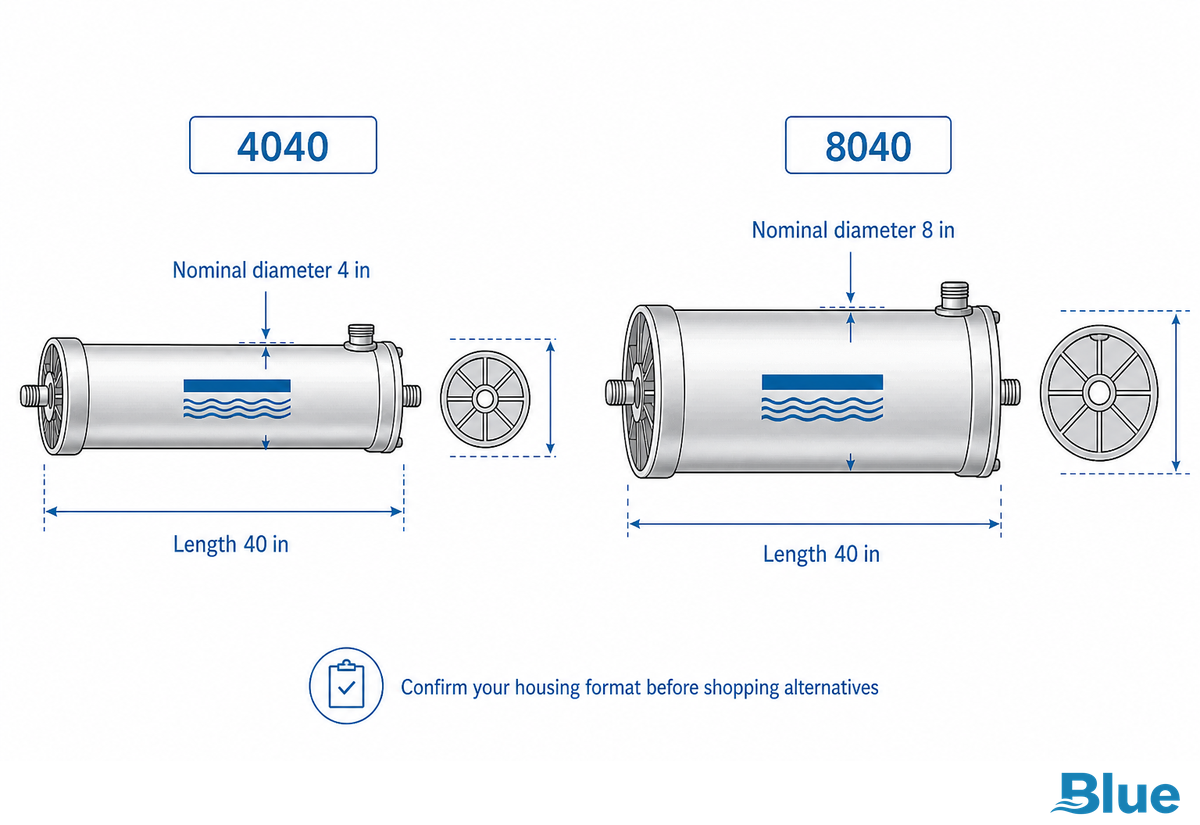
4040 housings measure approximately 4 inches across by 40 inches long (DuPont’s own BW30 PRO-4040 product data sheet confirms a nominal 4-inch I.D. pressure vessel fit and a 40.0-inch element length for the 4040 format); 8040 housings measure approximately 8 inches across by 40 inches long, and they can never be substituted, regardless of how a vendor describes equivalent performance. That element is literally not designed to physically fit inside the housing for the other configuration, a fact that no amount of data or correlation can change. A system containing a BW30-4040 element is open to any option listed in our comparison table below.
An 8040-format element would require an entirely different housing product line.
What is the difference between 4040 and 8040 membranes?
Typical 4040 elements deliver about 2,400-2,600 GPD from 78-85 ft² of active area, while an 8040 element using the same membrane chemistry delivers roughly 4-5 times that GPD and area in a physically larger housing built for higher-flow systems. Because both formats are sometimes sold under similar model numbers (BW30-4040 versus BW30-400/34), the housing dimension — not the model prefix — determines the required fit.
| Format | Nominal dimensions | Typical brackish flow |
|---|---|---|
| 4040 | 4 in. dia. × 40 in. | 2,400-2,600 GPD |
| 8040 | 8 in. dia. × 40 in. | ~10,000-12,000+ GPD (varies by series) |
Format Mix-ups – The Big Mistake (Mostly Avoidable) One of the most frequent and entirely preventable mix-ups occurs because most elements share a similar-looking brand name for both formats. Imagine your first time as a maintenance tech at a small-medium commercial laundry when you’re asked to replace a failing RO element; your old one says “BW30-4040” on a faded label, but purchasing orders BW30-400/34 because the prefixes look enough the same. The element doesn’t ship damaged; it doesn’t even ship the wrong dimension – it just simply won’t fit into the 4-inch nominal-diameter, 40-inch nominal-length vessel because 400/34 denotes an 8040-length housing dimension. Correcting this error simply cost 5 minutes and a tape measure: check your vessel’s actual dimension.
Not Sure It’s a BW30? Ruling Out XLE, SW30, and TW30 4040 Look-Alikes
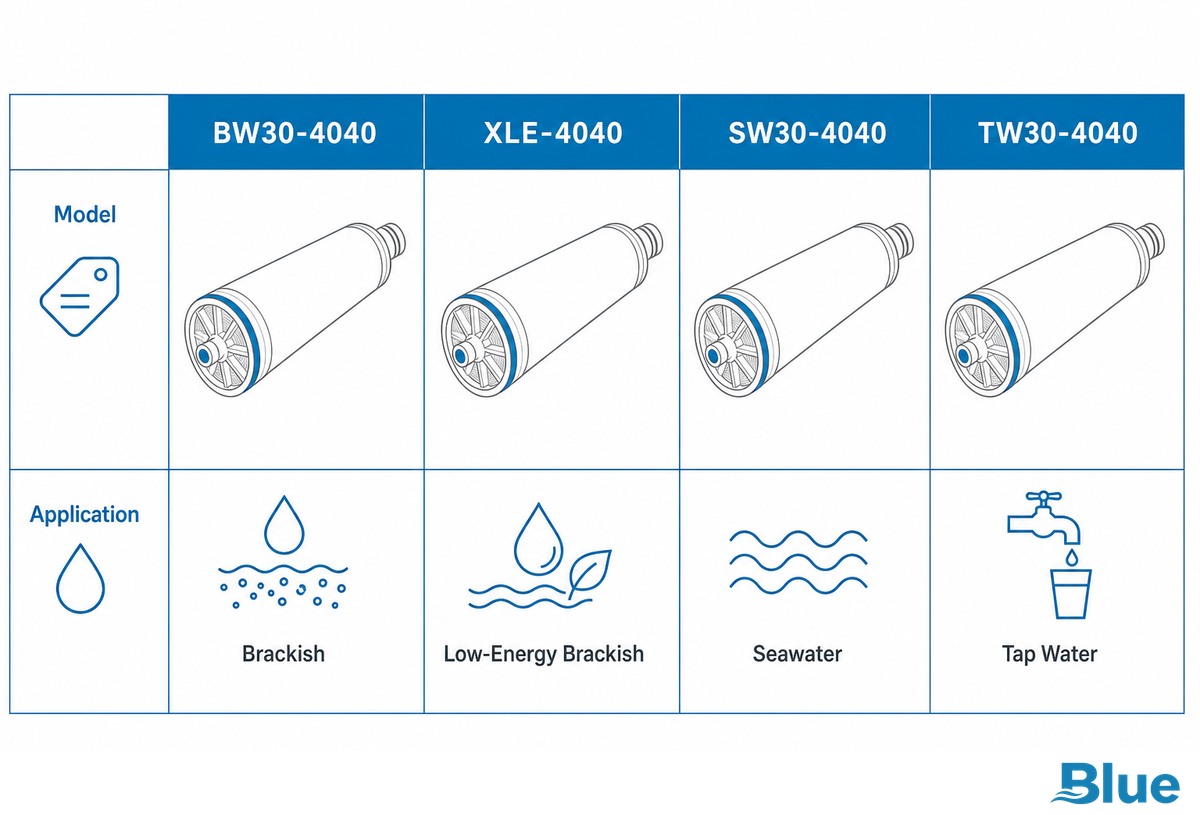
BW30, XLE, SW30, TW30 – Different Duty Classes Whether your vessel nameplate reads BW30, XLE, SW30, or TW30, you’re dealing with four distinct duty classes which are designed for differing feed-water conditions, even though they may have identical 4040 housing dimension. Picking the wrong duty class before shopping your alternative can quickly lead to selecting an element that, while closely resembling the original specifications, won’t provide adequate performance, or will ultimately place too much stress on your existing equipment.
| Prefix | Duty class | Typical max pressure |
|---|---|---|
| BW30 | Standard brackish water — this guide’s focus | 600 psi |
| XLE | Extra-low-energy brackish — lower feed pressure, lower flux | ~300-600 psi |
| SW30 | Seawater — high-TDS, high-pressure duty | ~1,000-1,200 psi |
| TW30 | Light tap-water/POU duty — low TDS feed | ~150-300 psi |
What’s a BW30, What’s an SW30, What’s an XLE, What’s a TW30? The SW30 class membranes are designed to withstand higher pressure than the standard BW30 membranes and are also built to withstand higher pressure drops as the membrane fouls – that’s why using an SW30 as a BW30 substitute impacts not only your housing size, but your feed pump size as well. Of course, that doesn’t impact the question of vessel fit: an element that measures 40-inches nominal length by 4-inches nominal diameter (a “4040”), no matter the duty, should be dimensionally compatible with the vessel (often labelled “4×40” or “4 x 40” by various manufacturers and occasionally “2400 GPD” without the comma on old bw30-4040 data sheets and 2300 GPD on some third-party listing of the same component). You may want to verify exactly which GPD figure is represented by each element being quoted. In addition, if you find your nameplate reads BW60-1812-75, you’re likely working with a much smaller element housing which doesn’t meet any of the formats listed below.
So, read your element nameplate carefully and make sure you read the full element code (including duty prefix) before making a decision. That duty prefix alone provides significant information about the feed-water conditions to which the element is optimized, and also tells you what operating pressures an alternate will need to withstand. Refer to our full element lineup page for detailed information on duty class performance related to feed water conditions.
BW30-4040 Compatible Alternatives Compared: OEM Successor vs Third-Party Cross-References
BW30 PRO-4040 beats the now-discontinued BW30-4040 on paper by about 8% rated flow (2,600 vs. 2,400 GPD), but no fewer than five third-party manufacturers (Axeon, Vontron, LG Chem, CSM, Toray) build 4040-format brackish elements as purportedly interchangeable replacements, and each backs its numbers to varying degrees with independent evidence. The DuPont data sheet for its own BW30 PRO-4040 makes clear that the output flow of an individual element will be no less than 15% under rated capacity under standard conditions – a one-way tolerance, not a two-sided spec – and that 15% minimum (200 GPD on the 2,400 GPD figure) already is a greater difference than the 200 GPD (8.3%) discrepancy between the old and new rating, so interpret that particular figure as a spec-sheet distinction rather than a reliable field performance gain.
✔ OEM Successor (BW30 PRO-4040)
- Same Brand Family, No Guessing on Chemistry or Warranty Language.
- Full published datasheet with test conditions disclosed
- Rated ~8% Higher Flow (subject to ± 15% under test conditions).
⚠ Third-Party Cross-Reference
- Often lower unit price ($55 – $140 range, depending on brand and level).
- Varying degrees of independent proof (from full datasheets to purely marketing copy).
- Avoids single-OEM lock-in for multi-vendor procurement
| Element | Rated flow (GPD) | Salt rejection | Max pressure | Evidence tier | Limitations |
|---|---|---|---|---|---|
| BW30-4040 (legacy) | 2,400 | 99.5% min | 600 psi | OEM-published (retired) | No longer manufactured new — existing stock only, not specable for new systems |
| BW30 PRO-4040 (DuPont OEM successor) | 2,600 | 99.7% typ / 99.5% min | 600 psi | OEM-published datasheet | Individual elements can run up to 15% below rated flow per DuPont’s own tolerance — don’t treat the 200 GPD gain as guaranteed |
| Axeon HF1-4040 | 2,500 | ~99.0-99.5% (typical brackish range) | ~225-600 psi | Datasheet-matched (partial) | Confirm current-revision datasheet — Axeon’s HF-series numbering has been revised more than once |
| Axeon HF4-4040 (low-energy) | 2,500 | ~99.0% typical | ~100-225 psi (low-energy duty) | Datasheet-matched (partial) | Lower operating-pressure duty — not a straight swap if your feed pump is sized for 600 psi |
| Axeon HF5-4040 | Vendor-listed, not independently cross-checked here | Vendor-listed | Vendor-listed | Marketing-only (this research pass) | Marketed as a higher-rejection step-up from HF1 — request the current HF5 datasheet before quoting |
| Vontron brackish 4040 | Vendor-listed, not independently cross-checked here | Vendor-listed | Vendor-listed | Marketing-only (this research pass) | Chinese-manufactured; broad brackish product range — request the specific SKU’s dimensional and pressure sheet, not a general brochure |
| LG Chem BW 4040 UES | Vendor-listed, not independently cross-checked here | Vendor-listed | Vendor-listed | Marketing-only (this research pass) | LG’s brackish-membrane patents (e.g. US9737859B2) are assigned to its NanoH2O subsidiary — a separate patent lineage from DuPont’s FilmTec filings; confirm current distribution channel |
| CSM RE4040-BE | Vendor-listed, not independently cross-checked here | Vendor-listed | Vendor-listed | Marketing-only (this research pass) | South Korean-manufactured — verify which distributor’s datasheet you’re actually being quoted against |
| Toray brackish 4040 element | Vendor-listed, not independently cross-checked here | Vendor-listed | Vendor-listed | Independently confirmed active manufacturer, spec not verified | Confirmed still actively producing brackish RO elements as of 2025 trade coverage — request the specific 4040 model datasheet, since Toray’s brackish lineup spans several series |
Availability from US distributors, e.g., Applied Membranes. “Made in USA” branding may be important for some government contracts. Each element here is a membrane for commercial water treatment aiming for the same outcome: reliable operation and production of high quality water at commercial scale, though specific price and RO filtration reliability can vary by brand. You may be shopping for an RO system upgrade, a commercial reverse osmosis retrofit, or just membranes for your commercial water treatment. Either way, the basic parameters are the same.
Confirm dimensions against our compatibility reference chart before getting a quote. Also review the cross-reference confidence ladder below before accepting a spec sheet as fact.
The Cross-Reference Confidence Ladder: How to Judge Whether an “Equivalent” Membrane Really Is One
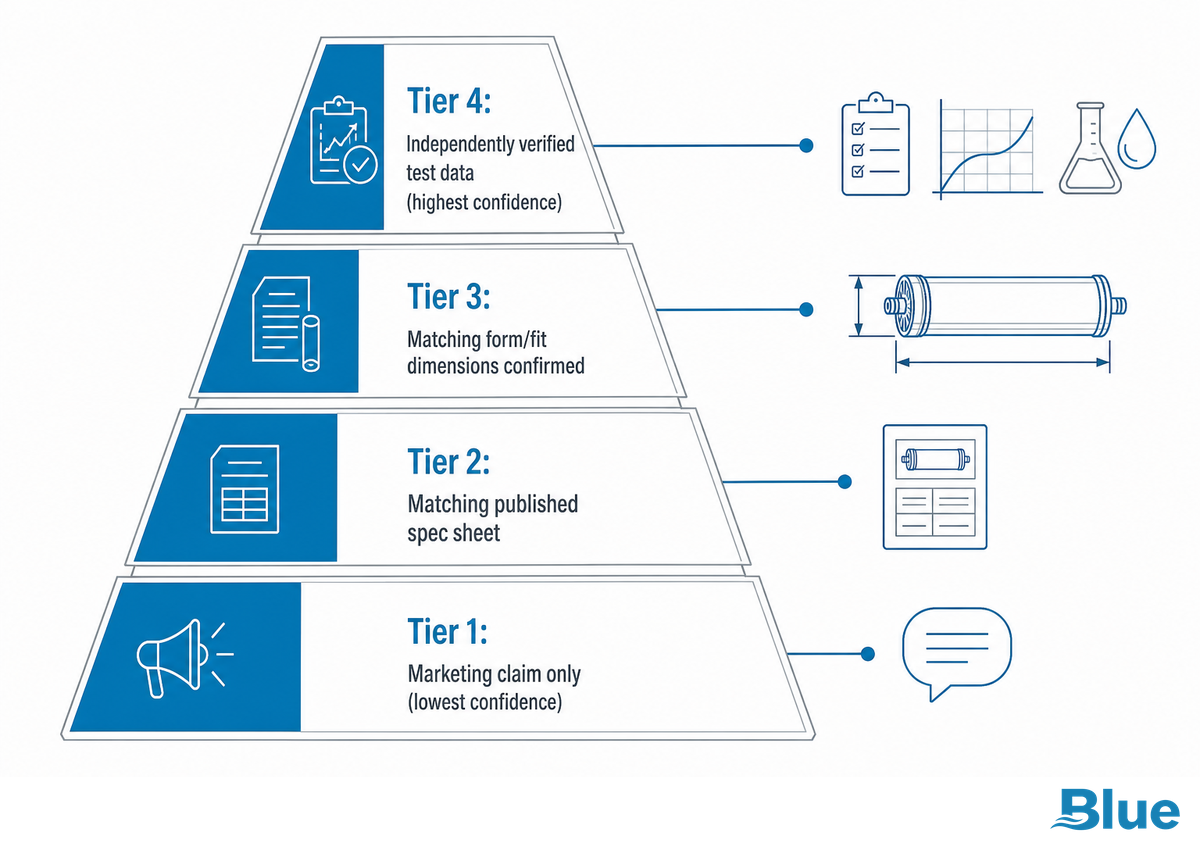
The Cross-Reference Confidence Ladder, described below, provides a four-tiered assessment of “compatibility” or “equivalency” claims. None of the three competitive third-party vendor listings examined in this guide specify whether their equivalency claims come from manufacturer cross-references, independent tests, or simply promotional materials. This guide fills that gap by providing you with the tools to differentiate and compare independently verifiable data versus general marketing statements.
- Tier 1, OEM-published cross-reference: The OEM specifically lists the replacement part number in its own documentation. (Highest level of trust.)
- Tier 2, Third-party datasheet parameter match: A competitor brand put their full datasheet on display and the numbers align with your original element.
- Tier 3, Independently tested data: A lab or independent researcher (not the seller) has tested the unit’s performance – not just the seller’s own numbers.
- The weakest evidence tier, Tier 4, marketing claim only, is when the listing mentions the element is “equivalent” or “compatible” without providing a datasheet, test results or a cross-reference chart to back up the claim. Treat this as unverified.
“A high headline salt-rejection number doesn’t guarantee a membrane rejects every contaminant in your feed water, boron and some other species aren’t always fully rejected by any RO membrane, which is exactly why we tell buyers to ask which evidence tier a ‘compatible’ claim actually sits on before ordering.”
Blue Membrane Technical Team, Applications Engineering
That caveat isn’t just internal caution – DuPont’s own FilmTec Reverse Osmosis Membranes Technical Manual states the same point directly: boron and some other contaminants are not always completely rejected by RO membranes, which is exactly the kind of gap a headline salt-rejection percentage alone won’t reveal.
Here’s how this plays out: You’re in charge of finding replacement membranes for a brackish water RO skid with 12 housings. A listing shows an “equivalent to BW30-4040” membrane for $68 and lists three marketing bullet points but nothing else. Run through the tier list and it’s firmly in Tier 4. You e-mail the vendor requesting the current datasheet; if they send one listing the active area, rejection percentage and maximum pressure, the item moves to Tier 2 and you have a candidate to add to your RFQ. If they can’t produce a datasheet, the answer is also clear.
Which Alternative Fits Your Priority?
- Warranty continuity matters most → BW30 PRO-4040 (same brand family; no cross-reference issues)
- Budget-driven bulk replacement → Axeon HF-series (lowest unit cost; check with vendor for latest datasheet)
- High-fouling feed water → look for a wider feed-spacer variant; ensure the membrane has fouling-resistant chemistry before purchase
- Light-commercial, NSF-adjacent system → focus on a brand that documents current NSF/ANSI 58 scope, not one that simply mentions the standard.
Housing, O-Ring, and End-Cap Fit: Physical Compatibility When Swapping Brands
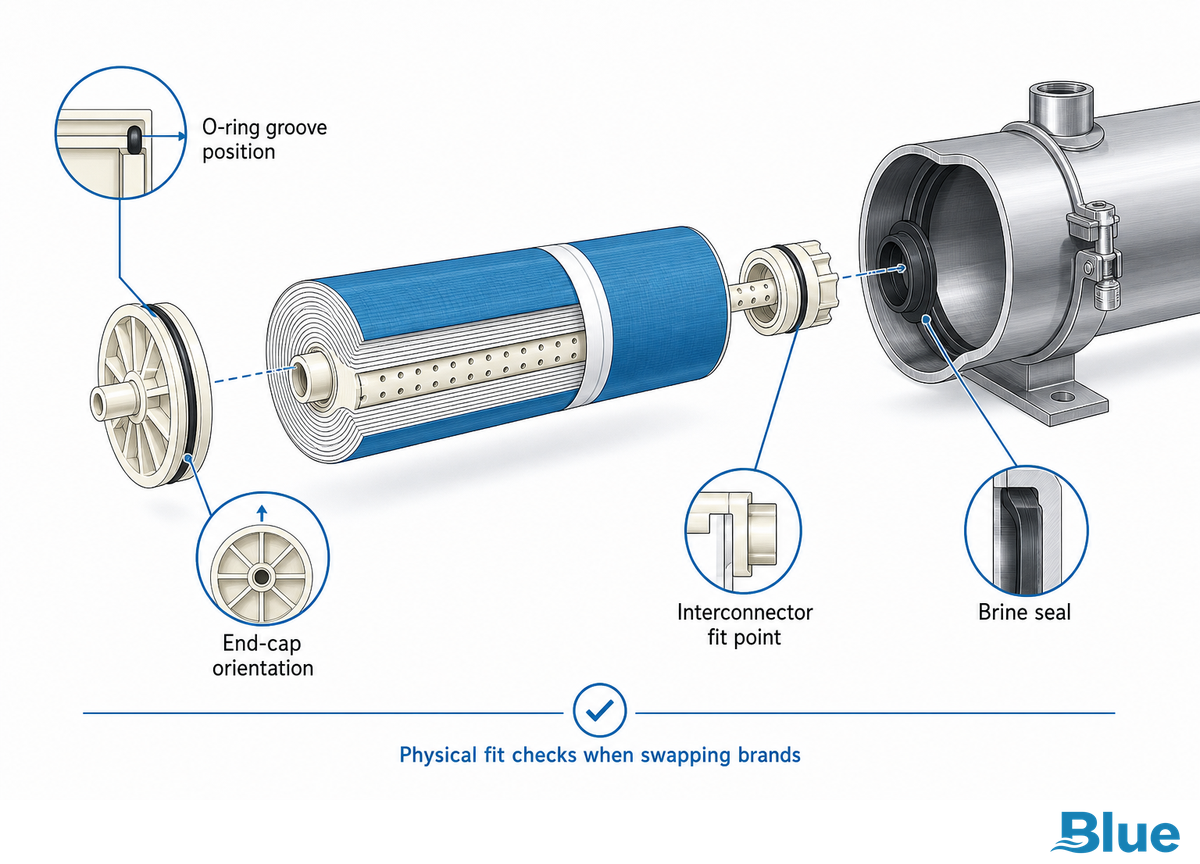
Housing swaps fail for 3 reasons completely unrelated to the membrane’s chemistry: o-ring diameter, end cap type (ATD vs standard), and spacing between the interconnectors of the elements in multi-element housing. This is the Format-First Swap Rule in practice: match housing format & fit before ever attempting to compare membrane chemistry, because a spec-perfect membrane that won’t seal is just a non-compatible alternative. Period.
- Ensure o-ring OD matches the brin e- seal groove inside the housing (dimensions vary by 2-3 mm, even between different brands’ “4040” size elements).
- Check end cap style; ATD vs standard. A non-ATD cap on one membrane won’t seat correctly into an ATD cap on another.
- Verify interconnector spacing if you use multiple elements in your housing; a mismatch will cause leaks between elements even if they individually seal in their housings.
📐 Engineering Note
Blue Membrane’s own customized/OEM-format elements are held to a ±0.5 mm dimensional tolerance on end-cap and seal geometry, with permeate-flow tolerance held to ±15% across the industrial product line – tighter than the up-to-15%-below-rated variance disclosed in typical FilmTec-class datasheets – and all industrial lines are qualified against ASTM D4516 performance-test methodology. Ask any third-party vendor for their own dimensional tolerance figures before assuming “4040” alone guarantees a drop-in seal.
A common failure mode looks like this: an installer swaps a legacy element for a lower-cost third-party brand in an eight-element skid, and every spec number on the new datasheet matches. During startup, one housing shows a persistent 15% permeate-quality drop compared to the others – not a membrane defect, but an ATD end-cap from the new brand seating slightly differently against an older-style housing collar, letting a small volume of feed water bypass the seal. A compatible o-ring kit is the fix, not a different membrane – but it costs a service call that a five-minute end-cap comparison against the original element would have avoided.
If your feed water also runs on the fouling-prone side, physical fit and chemistry both matter – see fouling-resistant RO membrane elements for feed-spacer options built to lessen the impact of fouling and reduce the same seal-bypass risk under higher-fouling conditions.
Brackish Water Duty: Matching Alternative Membranes to Your Feed Water Chemistry
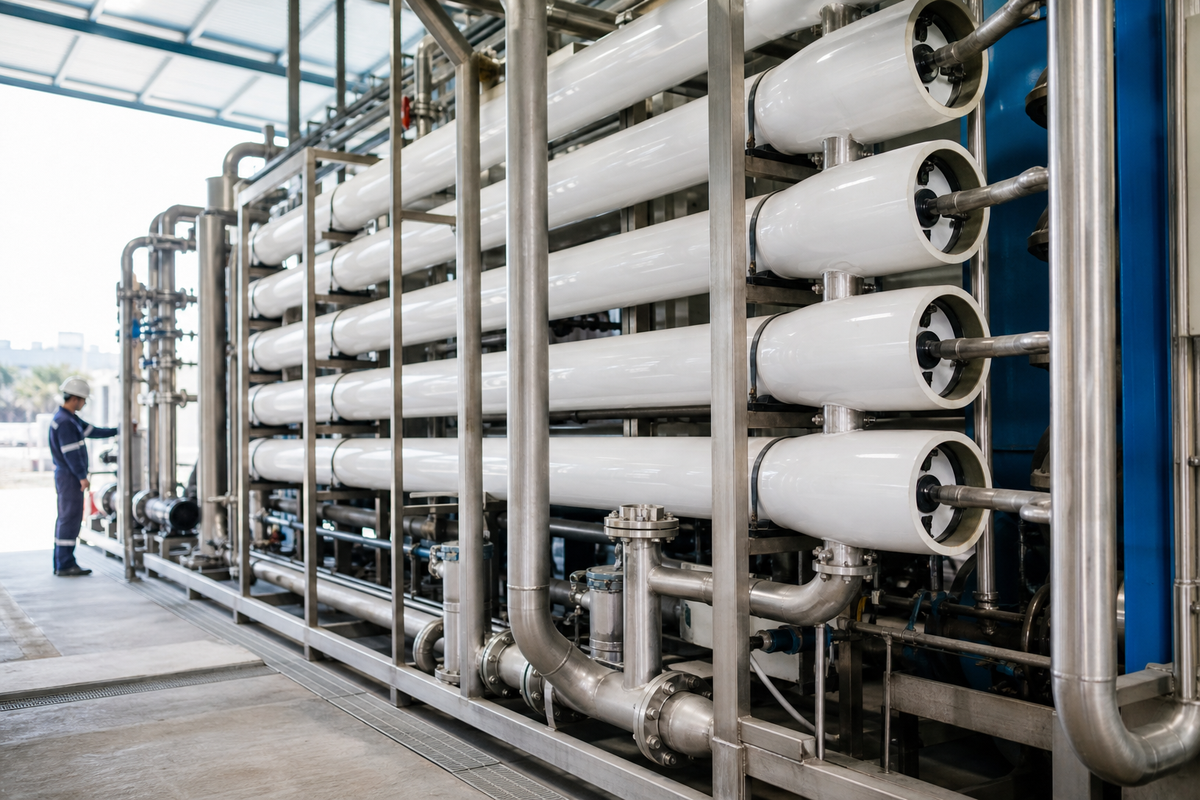
If your feed water tests roughly 2,000-10,000 ppm TDS, you’re squarely in BW30-class brackish duty, and any 4040 alternative you shortlist needs to be rated for that range – not just sized to fit the housing. Feed water above that ceiling pushes toward seawater-class elements (SW30), while feed well below it may not need brackish-grade rejection at all, though every tier still needs to deliver the highest quality water your process specification calls for.
2,000-10,000 ppm
Typical BW30-class feed TDS range
A 4040 element rarely works alone. Most packaged systems pair it with upstream sediment pre-filtration – commonly a 1 micron sediment cartridge – plus a carbon-block water filter stage to protect the thin-film chemistry from free chlorine, and some processes add a DI cartridge downstream of the membrane for additional polishing beyond standard reverse osmosis water quality. After installation, verify actual performance with a TDS meter at the permeate tap rather than trusting the vendor’s rated-rejection number alone, and confirm the element’s chemical compatibility across a wide pH range – commonly cited as roughly pH 2-11 for cleaning cycles – before committing to an aggressive clean-in-place protocol; mismatched CIP chemistry is a common way to shorten service life faster than fouling alone.
Periodic cleaning with a manufacturer-approved chemistry provides effective cleaning without damaging the membrane’s active layer, while the hard shell exterior on most commercial elements protects the spiral-wound pack itself during shipping and installation – a separate concern from the cleaning protocol.
What is the life of 4040 membrane?
While not a definite number – typically between 3 and 5 years for brackish, with excellent feed-water prep and frequent cleaning – a 4040 element will fail when it can’t pass the feed-water with a tolerable pressure and flow, due to either scale, biological growth or organic fouling. Chlorine taste in the product-water, decreased permeate flow/pressure, or increasing element differential pressure can signal end-of-life. These don’t necessarily indicate a bad element.
Systems supplied by a well, or some other naturally brackish source have their own unique pretreatment requirements – read about well water brackish RO treatment for a primer on pre-treating your water in order to maximize membrane life, and high-recovery brackish RO system design recommendations if you’re looking at a complete new system installation.
RO Membrane Replacement & Procurement: An RFQ Checklist to Avoid OEM Lock-In
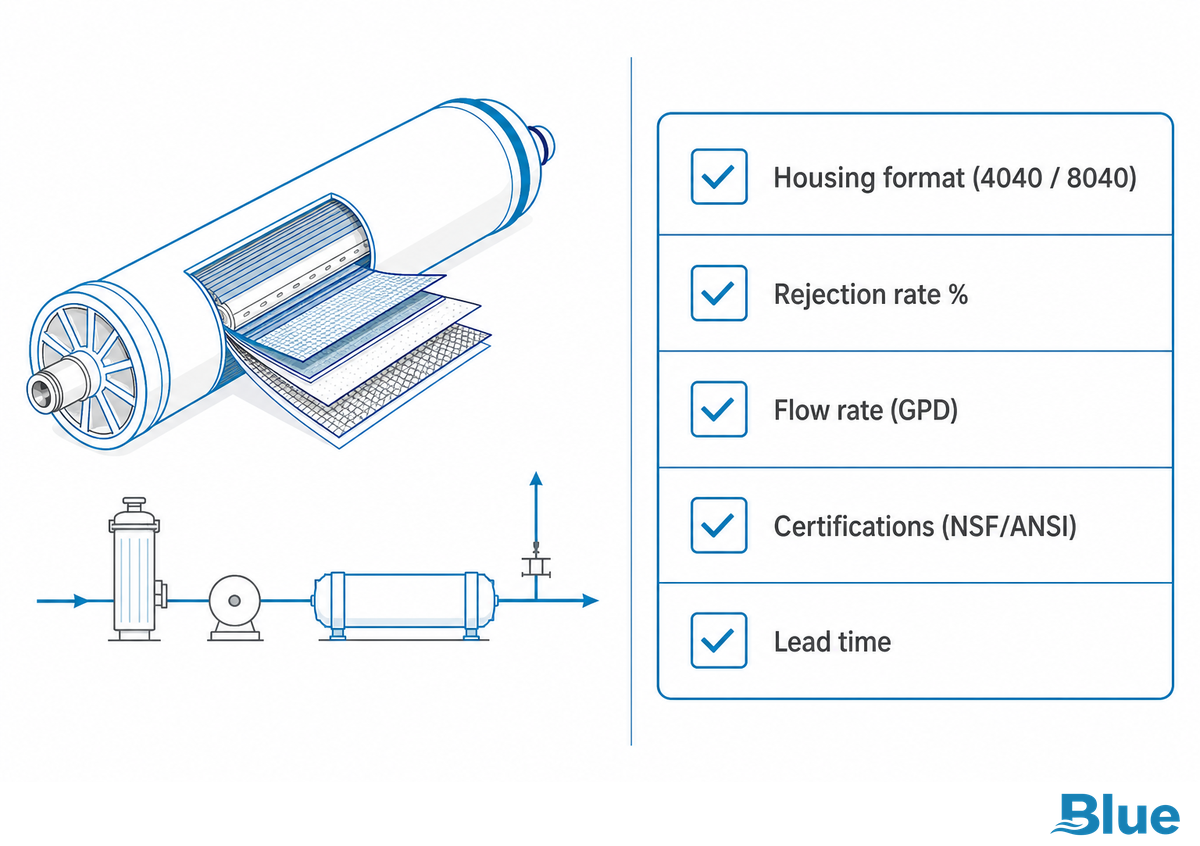
Your RO membrane RFQ must have all of these four parameters at minimum: active area, salt rejection, max operating pressure, and rated flow – along with a fifth line requesting the Confidence Ladder evidence tier of the number(s) you’re quoted. Sending identical four-line requests to multiple vendors allows for an apples-to-apples comparison of offers, rather than a comparison of marketing fluff. Don’t forget to also identify the GPM rating of your feed pump (not your system capacity, also expressed as GPD – the two numbers apply at different locations within the system and using one for the other is an easy recipe for a too-small pump).
RFQ checklist — copy these into your quote request:
| Parameter | Recommended range | Why it matters | How to verify |
|---|---|---|---|
| Active membrane area | 78-85 ft² | Directly drives rated flow at a given pressure | Request current-revision datasheet, not a brochure |
| Salt rejection | 99.0-99.7% | Determines product-water quality for your process | Ask for stabilized (not initial) rejection figure |
| Max operating pressure | ≤600 psi (brackish duty) | Must match your feed pump’s output, not exceed housing rating | Cross-check against your pressure vessel’s own rating plate |
| Rated flow | 2,400-2,600 GPD | Sets system throughput; up to 15% below-rated variance is normal per DuPont’s own tolerance | Ask whether the number is per-element average or worst-case |
| Evidence tier | Tier 1 or 2 preferred | Distinguishes a documented cross-reference from a marketing claim | Request the datasheet link directly, not just a spec table on the sales page |
The facilities manager of a beverage plant operating three brackish RO skids sends this five-line RFQ to the two vendors the company was referred to, after her contact at the OEMs simply disappeared without returning a quote request. Vendor #1 calls back within a day with a complete data sheet and a Tier 2 cross-reference. Vendor #2 responds with a one-line price, no details to back it up.
You’d already know which vendor to bet on from the checklist alone before either of them got back to her.
After narrowing down your candidate to one element or one BWRO system, you can check it against your total flow rate, making sure your system is capable of processing. If you’re working to re-spec any of the BWRO system rather than an individual element, you can consult our packaged BWRO systems guide.
Who Actually Makes These Membranes? FilmTec, DuPont, and the Wider OEM Landscape
FilmTec is the trademarked membrane brand now owned by DuPont, tracing back to FilmTec Corporation’s original thin-film composite technology, which passed to Dow and then to DuPont after the 2017 DowDuPont merger and 2019 split. Distributor listings may show “FilmTec BW30 PRO-4040,” “DuPont FilmTec,” or the legacy “Dow FilmTec BW30-4040 Brackish Water Reverse Osmosis Membrane” name, but the underlying membrane chemistry traces to the same lineage.
DuPont’s current marketing literature-not Dow’s-carries the FilmTec trademark on the BW30 PRO-4040 product page, and DuPont continues to use the BW30 designation across its brackish-duty datasheets; any 4040-format FilmTec RO membrane shares the same general dimensions covered in this guide.
Other brand families named throughout this guide are not simply relabeled DuPont technology. LG’s brackish membranes, for instance, rely on independent patents filed by its NanoH2O subsidiary (e.g. US9737859B2), separate from DuPont FilmTec patents, and similar independent membrane R&D is underway elsewhere, including at India’s Council of Scientific and Industrial Research. That is exactly why an RFQ soliciting responses from a diverse range of manufacturers is a legitimate strategy rather than a compromise: thin-film composite brackish membrane technology is an actively pursued field across several distinct organizations, not the monopoly of one manufacturer.
Another indicator you’ll sometimes encounter, often for membranes suitable for residential-adjacent or light-commercial use, is a mention of NSF/ANSI 58 certification. Be skeptical of that designation when encountered alone, as the NSF/ANSI 58 standard itself has been through many revisions (currently to 2024/2025 editions, and is not a static standard at 2022), and even NSF’s consumer guidance is clear that a certification doesn’t imply performance across *every* potential contaminate, but rather to a *specified* tested scope. You should inquire what edition the membrane has been tested to and which list of contaminants was included. If you’re in the residential-adjacent range, we’ve detailed NSF/ANSI 58 certification status for compatible RO elements in our NSF/ANSI 58 certified residential RO elements page.
Q: What is the BW 4040 membrane?
A BW 4040 membrane is a brackish-water reverse osmosis element built in the 4-inch by 40-inch housing format, originally rated for 2,400 GPD of permeate at 99.5% minimum salt rejection.
BW stands for Brackish Water use (in contrast to low-energy tap water use, or high-pressure seawater use), while 4040 describes the approximate outer diameter and length of the membrane housing. Original BW30-4040 units were rated for 2,400 GPD and had a minimum salt rejection of 99.5% at 600 psi. Its successor in Dow/DuPont’s catalog is the BW30 PRO-4040, with 2,600 GPD and identical performance characteristics in brackish-duty class.
Q: What is the difference between 4040 and 8040 membranes?
The difference is housing diameter and throughput: a 4040 is roughly 4 inches across, an 8040 is roughly 8 inches across, and neither fits the other’s pressure vessel.
Another big factor separating the 8040 size element from a 4040 element is that the active membrane area scales with the larger diameter of the 8040, and so typically an 8040 element has many times the flow and active area as a 4040 of the same chemistry. Don’t be fooled, the model numbering of different brands for the two sizes may appear similar – always confirm your actual housing size dimensions.
Q: Is the FilmTec BW30-4040 still available new?
No — DuPont stopped producing the original BW30-4040 as a new-build item around 2022, and current distributor listings position the BW30 PRO-4040 as its official replacement product.
New-old-stock might still be available for purchase through some distributors, but there appears to be no more new manufacturing or updated product literature from DuPont targeting the 8040 format – instead, focus should be placed on its replacement the PRO-4040. I have not located any official DuPont announcement of this model’s discontinuation, so consider it discontinued based on consistently convergent feedback from multiple distributors.
Q: Can I mix brands in a multi-element housing?
Physically, often yes — most 4040-format elements from different brands will fit the same multi-element housing, but mixing brands is not generally recommended for consistent, predictable system performance over time.
If mixing different brands within the same vessel, the varied flow and rejection rates across multiple elements could potentially create complications when troubleshooting problems later. Should you choose to mix during a staggered transition over several replacement cycles, make sure you thoroughly log which element, by brand and location within the housing assembly, is what.
Q: Do compatible/cross-reference membranes void my system warranty?
It depends on your system manufacturer’s warranty terms, not on the membrane brand alone — check before assuming either way.
While some original equipment manufacturers’ warranty statements require specific OEM-branded replacement parts, others allow for non-OEM branded parts as long as they meet or exceed the original manufacturer’s specified criteria. This illustrates why using the RFQ Checklist and the Confidence Ladder, referenced above, for making purchase decisions are so critical, not just for product performance, but also for avoiding warranty complications. With a Tier 1 or Tier 2 verified cross-reference, you’ll have supporting documentation in the event of an issue, unlike with a purely promotional, Tier 4 claim. Before installing any non-OEM element, review your system’s warranty documents closely, and if there’s any doubt as to whether it could void your warranty, inquire in writing with the system manufacturer about coverage for that particular element before making your purchase.
Q: What is the best reverse osmosis membrane for a commercial RO plant?
There isn’t one universal “best” element for every plant — the right choice depends on your feed-water TDS, fouling tendency, housing format, and the documented evidence tier behind the vendor’s compatibility claims.
For commercial water desalination plants using brackish water sources that require reverse osmosis membranes, opting for an OEM successor like the BW30 PRO-4040 presents the lowest risk from a procurement standpoint, while third-party options can deliver substantial cost savings after validating their documented tier evidence and confirming a precise physical match. Instead of searching for a single “best” brand, use the RFQ Checklist and the Confidence Ladder, detailed earlier, when evaluating the various brands that align with your housing size and feed water chemistry.
The Team Behind This Report
This guide was compiled by Blue Membrane’s applications engineering team from manufacturer datasheets, EPA and NSF/ANSI standards documentation, and cross-checked patent-assignment records, including a direct pull of DuPont’s own BW30 PRO-4040 product data sheet and a side-by-side review of the legacy BW30-4040’s original spec numbers. Where a claim (like the current NSF/ANSI 58 edition or a specific third-party brand’s exact spec numbers) could not be independently verified against a manufacturer-issued source, we said so directly rather than presenting an estimate as fact. Reviewed by the Blue Membrane technical team.
References & Sources
- Environmental Technology Verification Report, Watts Premier Ultra 5U.S. Environmental Protection Agency
- Environmental Technology Verification, Physical Removal ReportU.S. Environmental Protection Agency
- NSF/ANSI 58-2022: Reverse Osmosis for Drinking WaterAmerican National Standards Institute
- Standards for Water Treatment SystemsNSF International