Get in touch with Blue Membrane Company

Updated July 2026 | Reviewed by the Blue Membrane technical team
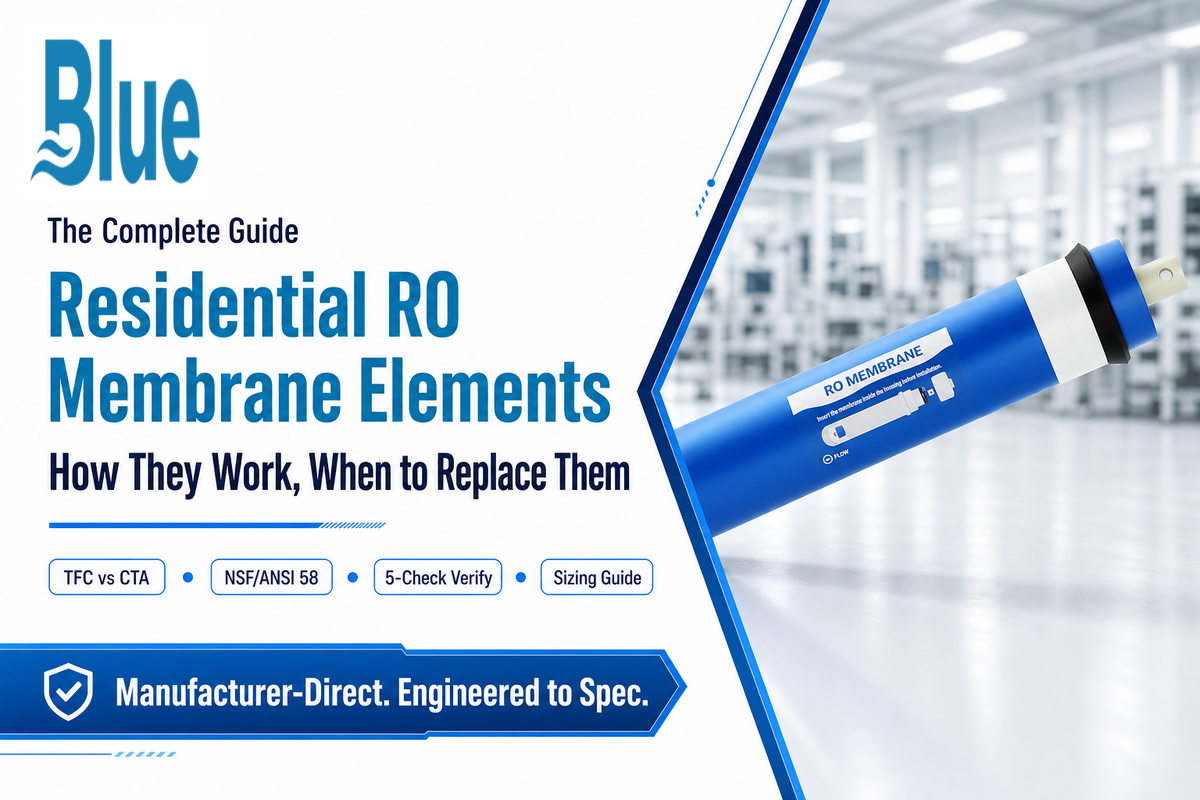
The RO membrane element is the spiral-wound cartridge that does the filtering in the household RO system. This is the part under the kitchen sink that people never have to think about, except when it’s time to replace it. This residential reverse osmosis (RO) membrane sits at the core of most home drinking-water filtration systems and RO water filtration setups sold for home use today, regardless of any specific vendor.
Residential RO elements are the spiral-wound, thin-film composite (TFC) cartridges inside a home reverse osmosis system, typically rated 50-150 GPD, that force feed water through a reverse osmosis membrane to reject dissolved solids and most regulated contaminants. Each element sits between a sediment/carbon pre-filter stage and a storage tank.
Key Points
- The GPD doesn’t correlate to a higher grade of filter as water flux is the other side of the scale for salt rejection with standard TFC chemistry according to scientific membrane research.
- RO membranes themselves release a very small amount of PFAS, even though they’re removing a very large amount of PFAS.
- NSF/ANSI 58 is designed to certified the entire system at point of use — if a component already has undergone testing for 58, it will not need separate testing for NSF/ANSI 61.
- EPA’s program to certify efficiency for point-of-use RO systems began only in November 2024-before that, there was no federal standard for efficiency of RO systems for residential use.
- In 2024, NSF conducted 107 enforcement actions relating to the use of false certification claims–ensuring the authenticity of third party certification is a well established issue, not an isolated occurrence.
Quick Specs
| Typical GPD range | 50-150 GPD (residential point-of-use) |
| Common diameters | 1.8″-3″ (1812 / 2012 / 2512 / 3012 series) |
| Dominant chemistry | TFC polyamide, spiral-wound (CTA is legacy) |
| Typical service life | 2-5 years, condition-dependent |
| Governing standards | NSF/ANSI 58 (system) / 61 (materials) / 372 (lead) |
What Is a Residential RO Membrane Element?
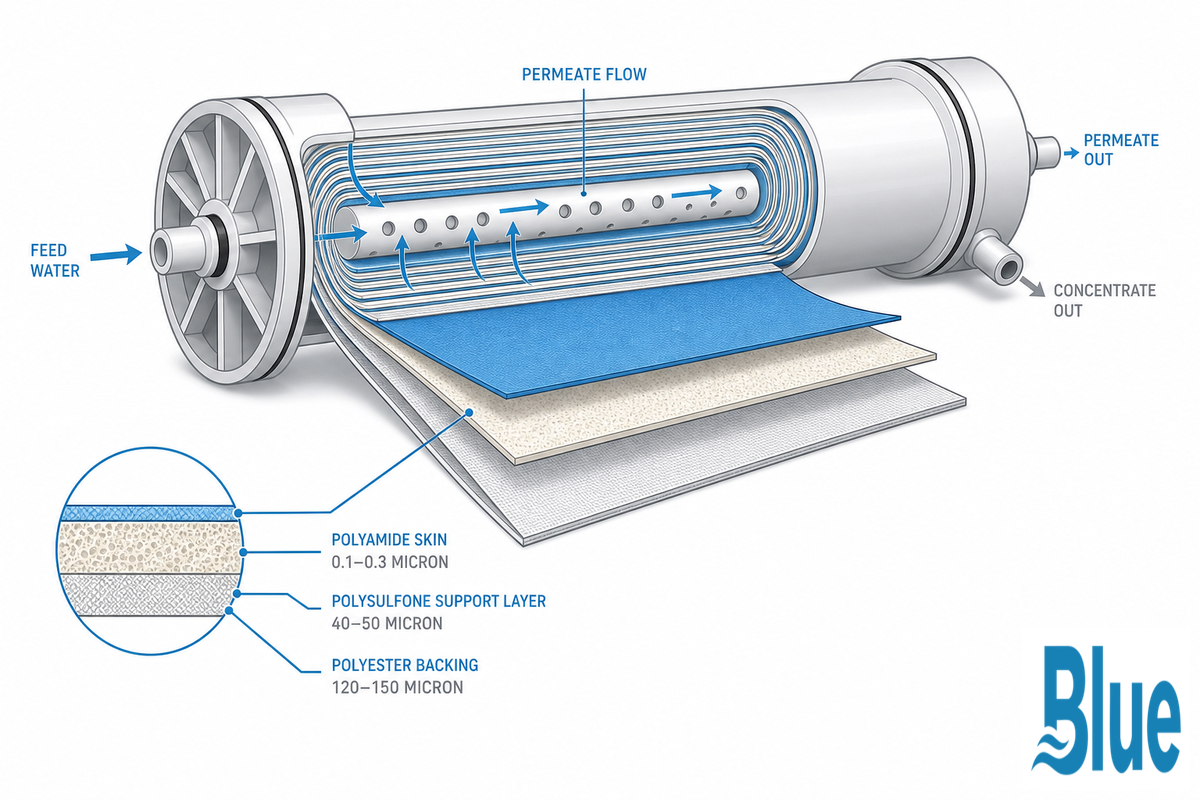
The home water purification element is actually a type of RO membrane, the same component category governed by NSF/ANSI 58, the standard most residential point-of-use RO systems are certified against. Feed water is supplied to the spiral-wound RO membrane at pressure, where the water is split into permeate, the product water, and a concentrated solution (concentrate or brine).
💡 Pro Tip: Before replacing or upgrading an element, testing your water first is worth the $15-30. If your feed water already meets safety standards for the contaminants you’re worried about, a smaller-GPD element — or no RO system at all — may be all you actually need.
It is made up of several flat layers wound into a spiral around a hollow permeate tube, sealed inside a hard plastic housing connected to the feed water supply, permeate line, and concentrate line — one link in a larger chain of filter elements, not the whole system. A sediment and carbon prefilter take out impurities and chlorine before water enters the membrane, and another postfilter gives water a finishing taste once it comes out of the tank. What people call “the RO membrane” is really just the middle link in a much larger filtering train.
A common mistake follows directly from that confusion: because retailers list “RO membrane” and “RO system” almost interchangeably in search results, buyers regularly order the wrong part — a 50 gallon-per-day cartridge when the housing calls for a 150 gallon-per-day one, or a full system when they only needed the replacement cartridge. That gap in how these products are marketed is structural, not a buyer error: in practice, the cartridge carries no system-level branding once it’s out of the box, which is exactly why buying advice in this guide is built around exact model-number matching, day one, rather than generic size guessing.
How Residential RO Elements Actually Filter Water
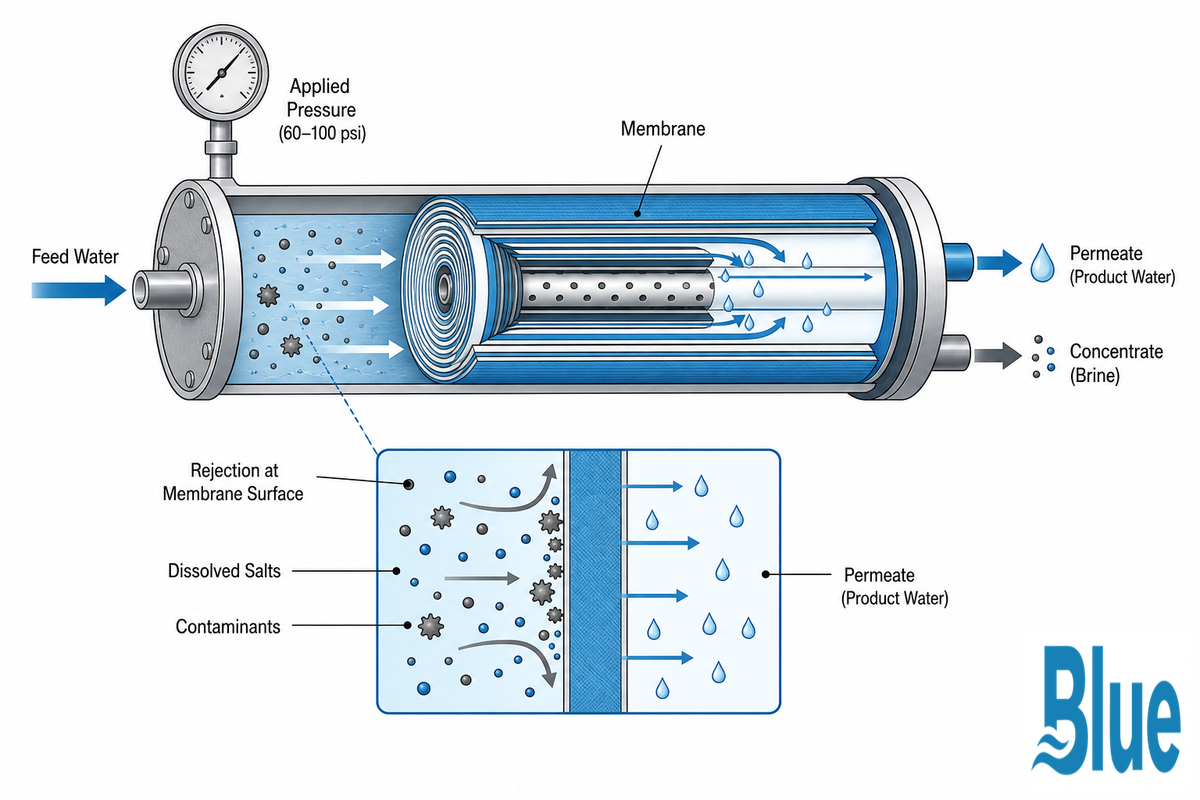
Water will flow, of its own volition, from an area of low concentration of dissolved solids to one of higher concentration of dissolved solids. This is natural osmosis. Reverse osmosis applies pressure greater than the natural osmotic pressure across the semipermeable membrane to reverse this process, forcing water to flow away from the feed side to the pure side and leaving dissolved salts, metals, and many organic molecules behind at the membrane surface.
- Carbon and sediment pre-filter remove sediment and chlorine from water prior to it contacting the membrane.
- As water is forced through the polyamide layer of RO membrane under pressure it separates into concentrate and permeate
- The sixth, a carbon post-filtration layer, removes tastes, making the water safe for your use
The membrane structure, as manufactured inside the element and consisting of three layers, typically operates around 60 to 100 psi in residential service. A 0.1 to 0.3 μm thin polyamide skin does the actual rejecting, with a 40 to 50 μm polysulfone support layer and a 120 to 150 μm polyester backing layer below it to absorb the pressure. The membrane manufacturer, Aquaporin AS, described the product ion in a 2024 patent application: an aqueous solution of a polyfunctional amine monomer is laid down next to an organic solution containing an acyl halide monomer, which react with each other at the interface, forming the polyamide film itself; the interfacial polymerization creates the pores and thus sets the membrane’s rejection properties.
| Layer | Thickness | Job |
|---|---|---|
| Polyamide skin | 0.1-0.3 μm | Rejects dissolved salts and most organics |
| Polysulfone support | 40-50 μm | Structural backbone under the active layer |
| Polyester backing | 120-150 μm | Carries the applied pressure |
The U.S. EPA’s WaterSense program, which covers entire point-of-use systems, but not separately sold replacement elements, states a minimum requirement that a certified RO system’s membrane must provide one year of service. Average, uncertified point-of-use RO systems produce five or more gallons of wastewater (reject water) for every gallon of treated water, and certified WaterSense systems must be able to do it with 2.3 gallons or less of reject water.
Key takeaway: the element splits one incoming stream into two outgoing ones, and the ratio between them — the recovery rate — is set by a flow restrictor downstream, not by the membrane alone. Water-treatment practitioners commonly pair a 550mL/min restrictor with a 75 GPD element to hit rated rejection at roughly a 4:1 waste-to-product ratio — a real-world example of how the restrictor, not the element rating alone, determines what actually comes out of the faucet.
That’s why trying to use a higher-rated GPD element on your system usually doesn’t deliver the improvements people were expecting; once the water starts moving fast enough to make full use of the high-GPD element, the flow restrictor become the limiting factor.
Membrane Technology: TFC vs CTA vs NF
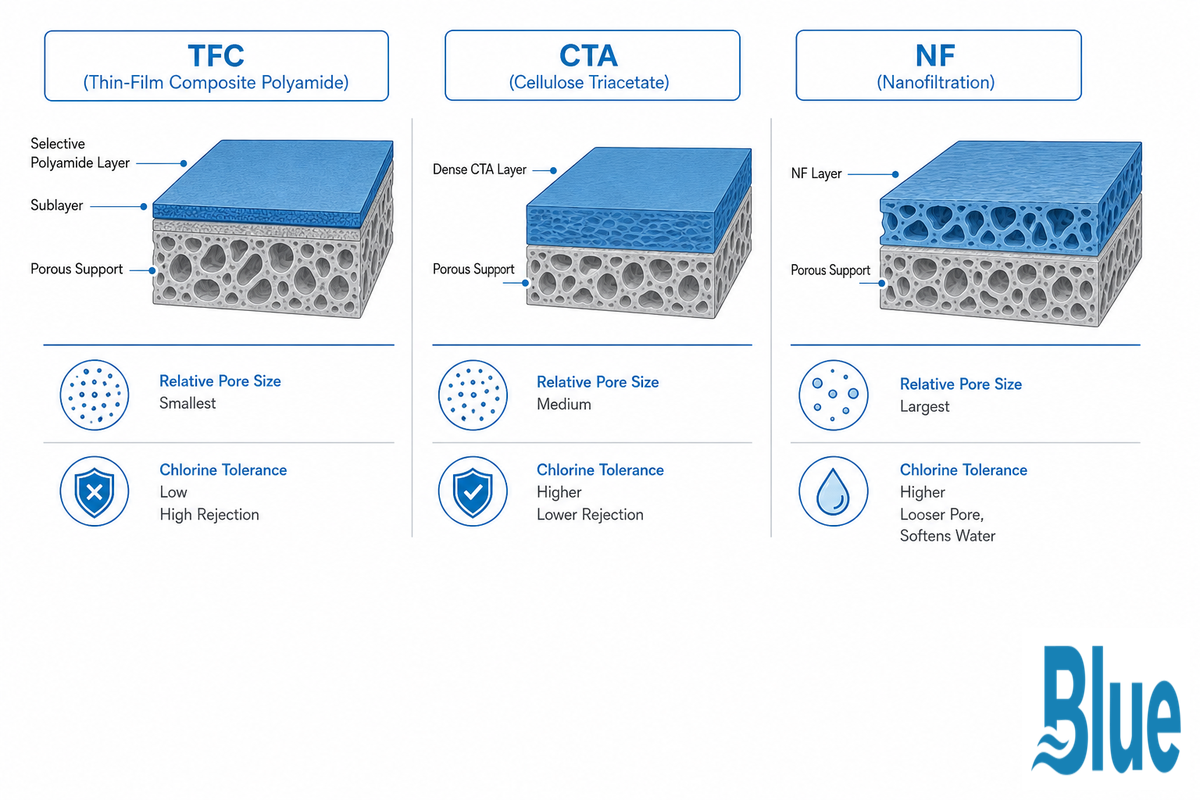
The prevailing technology is the thin-film composite (TFC) polyamide, which displaced the earlier generation cellulose triacetate (CTA) membrane technology. One 2024 patent application from a leading membrane manufacturer refers to it plainly: “Cellulose triacetate membrane” is an “early innovation in the field,” and “thin film composite membranes are the industry standard today.” TFC is more than just more recent technology than CTA.
| Property | TFC (polyamide) | CTA (cellulose triacetate) |
|---|---|---|
| Contaminant rejection | Higher | Lower |
| Chlorine tolerance | Low — degrades under continuous chlorine exposure | Higher — tolerates some residual chlorine |
| pH operating range | Wide | Narrow |
| Residential market share | Dominant | Legacy / niche |
“TFC rejects more” carries a significant trade-off with it. According to a 2022 peer-reviewed paper on thin-film nanocomposite (TFN) membranes published in PMC (an open-access biomedical repository of the National Institutes of Health): “To improve water flux, the rejection rate has to be reduced.” If you run a TFC membrane faster, you tend to reduce its rejection rate, unless you engineers work to mitigate that effect. For example, a 2023 paper described a TFN membrane engineered to overcome that trade-off by increasing water permeability 2.2-fold to 2.7-fold while increasing rejection by 2.6 to 3.4 percentage points-only possible if there’s an underlying trade-off with regular TFC membranes.
Which Membrane Type Should You Look For?
- Municipal water, chlorinated: TFC membrane with an appropriate carbon pre-filter. (Never use a TFC membrane without a pre-filter.)
- Well water with higher pH and non-chlorinated: CTA is more forgiving, with a somewhat lower rejection rate.
- Softer, not fully purified: Nanofiltration (NF), a wider pored cousin of RO that throws out big organics and hardness ions while allowing more of the small, singly-charged salts through
Standard membranes for water treatment span far beyond residential use. The same thin-film composite membrane chemistry, built into an advanced membrane variant, also powers seawater RO desalination and commercial reverse osmosis systems running at far higher pressures than any residential element ever sees.
Sizing & Housing Compatibility
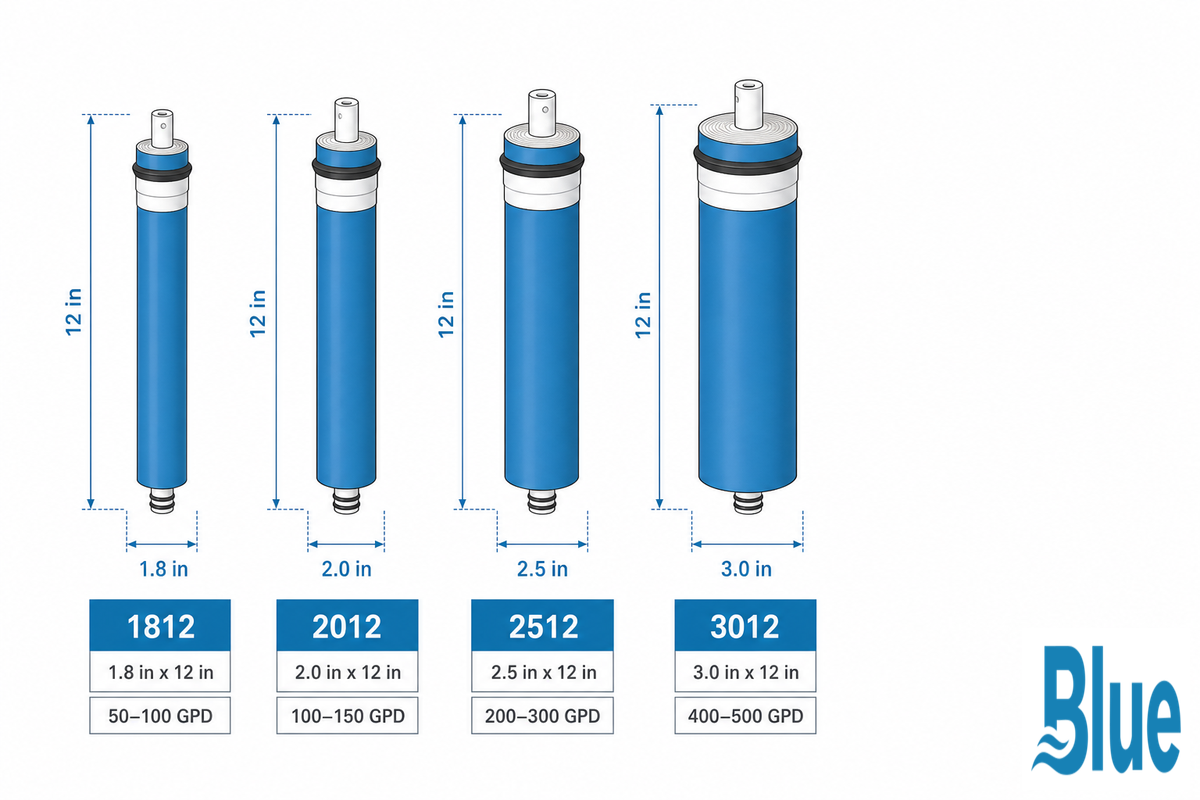
Residential elements are marketed by a rounded diameter and length code – 1812, 2012, 2512, 3012 – in which the first two digits are the rounded diameter in tenths of an inch and the last two are the rounded length in inches. Water-treatment forum experts invariably point to the 1812-50 as by far the most common configuration for residential installations, which aligns with the fact that under sink drinking water installations dominate the residential market. A patent for a residential RO system describes the size range succinctly: spiral wound elements “dimensioned to have a diameter of approximately 2.5 to 3 inches or less and a length of approximately 18 inches or less” for the compact end of the range.
| Code | Nominal size | Typical GPD band |
|---|---|---|
| 1812 | 1.8″ x 12″ | 50-100 GPD (most common under-sink) |
| 2012 | 2.0″ x 12″ | 100-150 GPD |
| 2512 | 2.5″ x 12″ | 200-300 GPD (light commercial) |
| 3012 | 3.0″ x 12″ | 400-500 GPD |
📐 Engineering Note: Manufacturing tolerance on element diameter typically runs within ±0.5mm across the industry. An element built to the tight end of tolerance can still seat and seal properly in a housing built to the loose end, but stacking tolerances in the wrong direction is a common cause of a “close enough” element that leaks at the O-ring.
What the GPD sizing tables rarely explain: The typical daily usage for a household drinking and cooking system is well below the rating, 2 to 5 GPD being a good average. Sizings are really based on convenient delivery of a pitcher full rather than total capacity. Using a GPD sizing selector and a housing cross-reference chart should guide you toward the correct element form factor more quickly than eyeballing the biggest number.
Standard residential RO membrane housing comes in a handful of membrane size codes, and those same housings sized for elements for home kitchens also accept elements for commercial light-duty use, which makes for simpler plumbing systems across both markets.
One nuance a size code alone won’t tell you: matching diameter and length gets an element to physically seat, but it doesn’t guarantee it meets the same performance and safety bar as the one it’s replacing. NSF/ANSI 58, the standard most residential RO products are actually certified against, is written at the point-of-use system and contaminant-reduction level, not as a universal dimension-only interchangeability spec — which is exactly why the certification, not just the size code, is what buyers should be matching. The Water Quality Association’s own glossary defines production rate itself as gallons or liters over a 24-hour period, not an instantaneous flow number — one more reason a same-size-code swap can still under- or over-deliver relative to the housing’s original rating.
What Gets Removed: Contaminant Rejection & PFAS
A healthy rejection membrane rejects 90%-99% of dissolved solids, depending on contaminant and feed water composition, and whether it’s new or near end-of-life. Its job is removing soluble salt from water and other dissolved contaminants, leaving pure water — permeate water — on the low-pressure side. Rejection isn’t one number, it’s a function of what you’re measuring.
A common mistake is treating a single “90%-99%” spec as a guarantee across every contaminant; the gap between headline TDS rejection and one specific ion’s actual rejection is exactly what trips up buyers relying on a spec sheet alone.
| Contaminant | Typical rejection |
|---|---|
| Total dissolved solids / salt | 90-99% |
| Long-chain PFAS (PFOA, PFOS) | Often >95% |
| Short-chain PFAS (PFBA, PFBS) | More variable, 70-95% |
| Lead, arsenic, heavy metals | Generally >90%, contaminant-specific |
On April 10, 2024, EPA finalized the nation’s first national drinking water standard for PFAS chemicals, including MCLs of 4.0 ppt for PFOA and PFOS. EPA lists reverse osmosis, along with activated carbon and ion exchange, as one of the technologies identified in its PFAS Action Plan as proven for removal.
EPA’s 4.0 ppt PFOA/PFOS limit is a sharp tightening from the agency’s own 2016 combined lifetime health advisory of 70 parts per trillion for the two chemicals — not just a newly enforceable number, but a far stricter one.
Here’s something to watch out for: as of April 2024, existing certification standards for PFAS filters haven’t yet been updated to guarantee removal at EPA’s newly finalized, stricter drinking-water level. The standard by which NSF itself currently tests and certifies for combined PFAS (NSF/ANSI 53 and 58) is a generous 20 parts per trillion, five times more lax than the EPA’s standard of 4.0 parts per trillion, though the standard committee is now actively re-balloting to make the two standards meet in the middle. Product that earned certification prior to that update would therefore not be meeting the current federal bar.
Counterintuitive: a 2024 study published in Environmental Science & Technology found that RO membranes can themselves leach trace PFAS — PFOS, PFBA, PFHxA, PFNA, and PFOA — into treated water, at concentrations two to four orders of magnitude below levels already found in some countries’ drinking water. “Removes PFAS” and “contains zero PFAS-related chemistry” aren’t the same claim.
Why Pretreatment Comes First
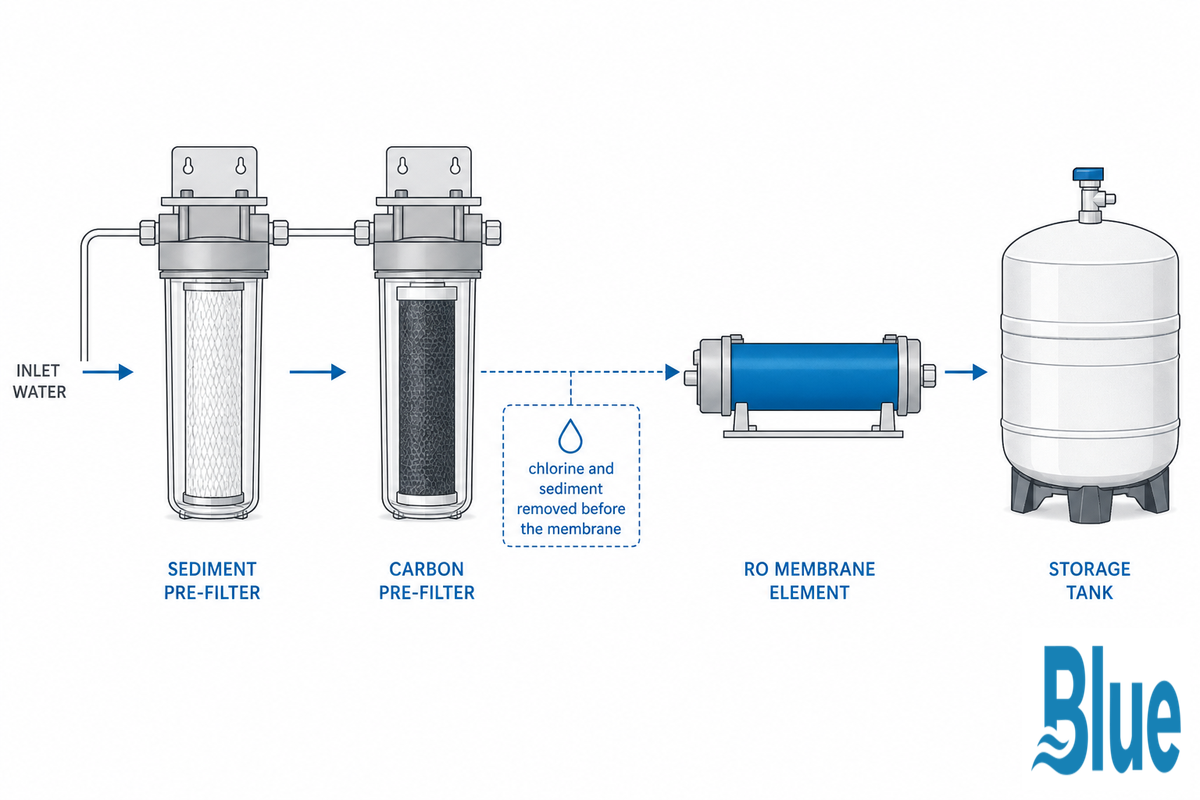
A polyamide membrane, such as that used in a TFC element, is chemically sensitive to free chlorine; even as little as 0.1 ppm of chlorine exposure over several months will damage the membrane considerably. That’s why a sediment pre-filter and carbon pre-filter should be installed in series in front of any properly constructed RO system – it’s not an optional accessory, it’s part of the RO system design.
⚠️ Important: Industry technical guidance commonly targets a Silt Density Index (SDI) below 5 — ideally under 3 — and free chlorine under 0.1 ppm ahead of the membrane. Properly sized carbon pre-filtration, not the membrane itself, stands between chlorinated tap water and a shortened element lifespan.
One of the many patents describing a chlorine-resistant filtration approach plainly outlines the problem: “RO membrane subject to degradation by chlorine, iron, manganese, hydrogen sulfide, and to bacterial attack,” and explicitly why the pre-filters-both the sediment filter and GAC-precede the RO membrane element, rather than follow it. That failure mode is structural, not incidental: skipping or undersizing pre-filters is arguably the single most consistently cited reason for RO membrane premature failure among independent water treatment specialists, year after year-a design error, not a product defect. Since RO membranes aren’t equipped to handle hardness, iron, manganese, or microbiologically unsafe water, the water supply itself must be microbiologically safe before installing an RO system.
NSF/ANSI 58 vs 61 vs 372: What Certification Actually Covers
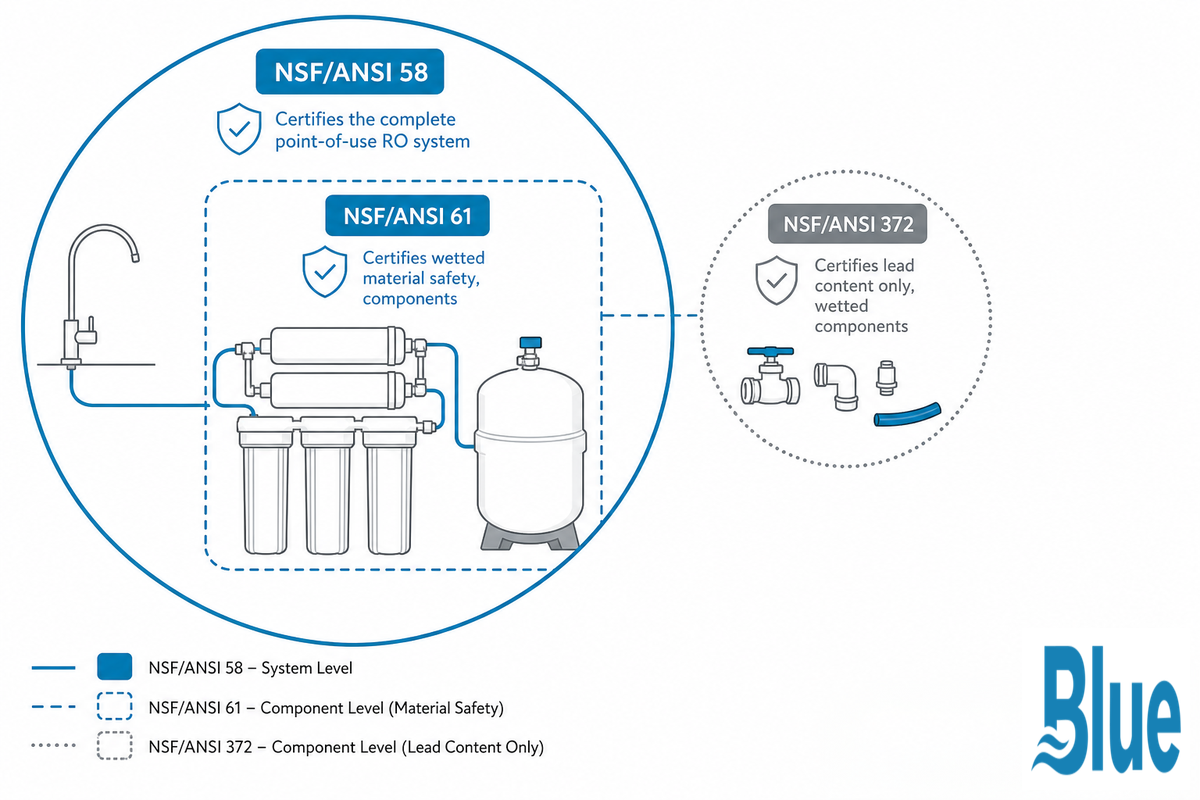
There are three NSF/ANSI standards you may encounter with RO products, which most people confuse. Here’s the real story on each.
| Standard | Certifies | Applies to |
|---|---|---|
| NSF/ANSI 58 | TDS reduction (required claim) + up to 16 optional contaminant claims, efficiency, recovery, structural integrity | The complete point-of-use RO system |
| NSF/ANSI 61 | Chemical health effects of water-contact materials (does wetted material leach anything harmful) | Components, including separation membranes |
| NSF/ANSI 372 | Lead content only — weighted-average wetted-surface lead ≤0.25%, solder/flux ≤0.2% | Wetted components, folded into the 58 material requirements |
What you’re likely missing: per NSF’s own knowledge base, materials that have already been tested under standards like NSF/ANSI 58, and are found to be safe and compliant with its requirements for use in drinking water contact applications, should not be “additionally required” to seek NSF/ANSI 61 certification – the process already assesses that specific risk profile. Elements properly tested and verified to NSF/ANSI 58 don’t need a separate, additional 61 label to show they’re okay to come in contact with drinking water. Lead content specifically, not other regulated compounds, falls under the NSF/ANSI/CAN 372 standard.
“The EPA’s September 1, 2023, deadline for establishing more stringent requirements for mitigating lead content was an important step in combating lead content in drinking water… [it] addresses point-of-use drinking-water treatment systems, including under-the-sink filters, pour-through systems, countertop systems, refrigerator filters, reverse osmosis systems, and filters attached to the sink faucet.”
Another point that’s worth knowing: as of 2013, the lead-content process that once sat inside NSF/ANSI 61 (its Annex G, to be precise) was retired and completely incorporated into NSF/ANSI 372. If the spec sheet or product description you’re looking at only mentions “NSF/ANSI 61” as its lead-free assurance, without any reference to NSF/ANSI 372, you may want to take another look.
Signs Your Element Needs Replacement
While typical residential elements may last for 2 to 5 years, calendar time isn’t the best indicator of need– water quality, usage and a pre-treatment regime can impact this timeframe by years in either direction. Performance signals are the more reliable guide.
Replacement Decision Table
| Signal | Warning | Replace |
|---|---|---|
| Permeate flow decline | ~10% below baseline | 15-20%+ after a cleaning cycle doesn’t restore it |
| Normalized salt rejection | Drops below ~95% (from an initial 97-99%) | Drops below ~90%, or below your product’s rated claim |
These flow and TDS targets are signs of operational performance drift– they tell you when to examine your element or schedule a replacement. They don’t by themselves prove that your element is continuing to satisfy your stated claim of reduction in arsenic, lead or PFAS; for this, you need to follow the product manufacturer’s suggested replacement period tied to your product’s specific certification, not an arbitrary percentage pulled from some water filter blogger’s advice column.
💡 Pro Tip: Practitioners on water-treatment forums consistently report the same lived pattern — a slowing faucet trickle, sometimes down to 15-25% of normal flow, shows up before TDS creep becomes obvious on a home test strip. If your flow has visibly slowed, don’t wait for the TDS number to confirm it.
Here’s an easy in-home check: The rejection rate = ((feed TDS — permeate TDS) / feed TDS) x 100 — the same formula the Water Quality Association’s own technical glossary uses to define percent rejection. Use the rated-vs-real GPD calculator tool to do it quickly; if your permeate TDS starts rising above about 20% of your tap water TDS, that’s a common signal that the membrane is wearing out or failing internally. Flow decline and rising TDS are two separate variables, not one — treat a slip in either as a signal worth checking, since relying on just one can miss a membrane that’s degrading on the other axis.
Replacement membrane costs scale with GPD reverse osmosis membrane rating — a 50 gallon-per-day (GPD) RO membrane element typically costs less than a 150 GPD version. Matching replacement RO membranes to actual usage, not the biggest GPD RO membrane available, is the simplest path to lower replacement costs over the system’s life.
| Spec category | Typical value |
|---|---|
| Most common size code | 1812 (1.8″ x 12″), 50-100 GPD |
| Larger under-sink code | 2012 (2.0″ x 12″), 100-150 GPD |
| Light-commercial code | 2512 (2.5″ x 12″), 200-300 GPD |
| Largest common code | 3012 (3.0″ x 12″), 400-500 GPD |
| Dominant membrane chemistry | TFC polyamide — higher rejection, chlorine-sensitive |
| Legacy membrane chemistry | CTA (cellulose triacetate) — lower rejection, more chlorine-tolerant |
| System-level certification | NSF/ANSI 58 |
| Wetted-material certification | NSF/ANSI 61 |
| Lead-content certification | NSF/ANSI 372 |
| Typical service life | 2-5 years, condition-dependent |
| Manufacturing diameter tolerance | ±0.5mm, typical across the industry |
Verifying Authentic vs Counterfeit Elements: The 5-Check Decision Tree
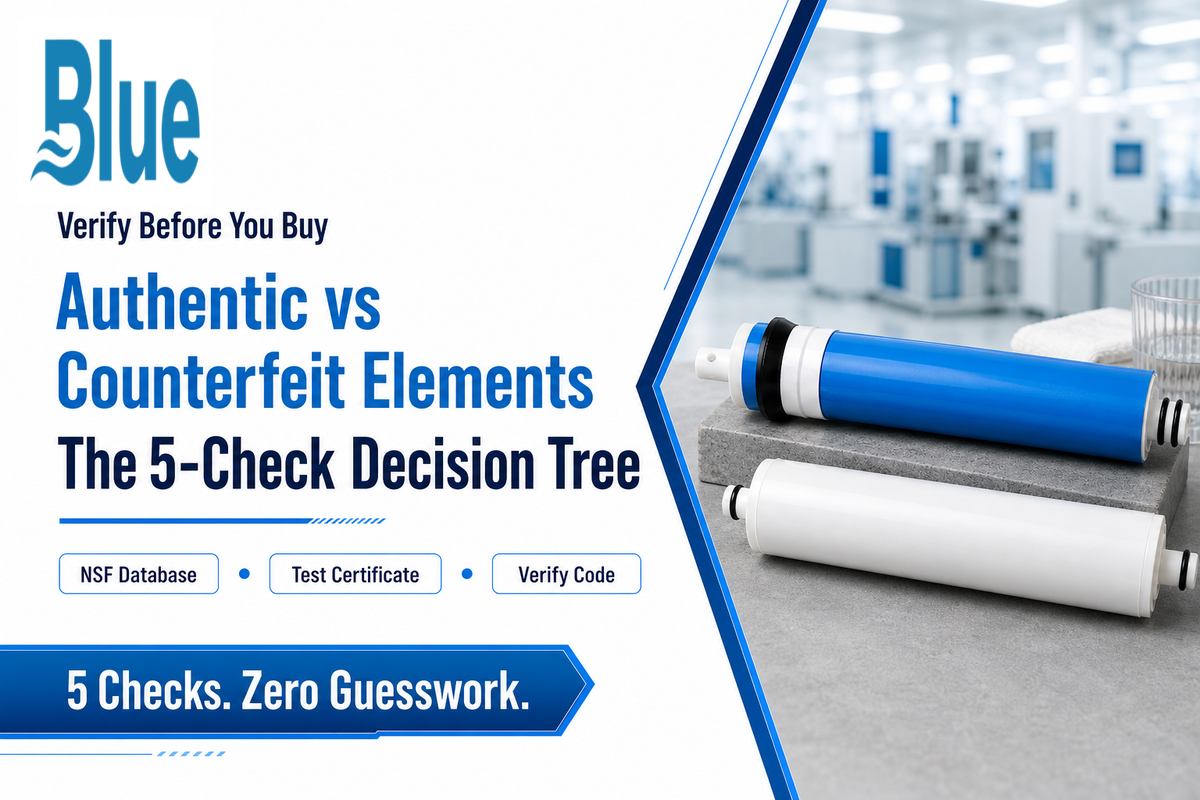
Fake and incorrectly-labeled RO membranes are a pervasive, real-world issue, not just some isolated cautionary tale. In 2024, NSF’s own Public Notices database recorded 107 actions concerning bogus certification claims– of which 88 were for trademark/claims infringement and 19 were for unauthorized use of certification marks– virtually all connected to products advertised for sale on platforms such as Amazon. Check these five points before you assume that an extremely low price is a really good bargain or that a lack of expected performance means you purchased a phony element.
The 5-Check Element Authenticity Decision Tree
- Look for the product verification code. Prominent manufacturers, such as FilmTec, imprint counterfeit-proof, unique-serial-number verification codes on genuine reverse osmosis membrane elements that may be verified using a brand-specific app or a standard QR code reader. No scannable code on an element that claims a specific brand name is a warning sign.
- Verify through the official NSF listing. NSF provides an accessible, searchable, certified product database online. A claim of “NSF certified” made by any seller or on a product description is unsupported by NSF records if it can’t be found in its certification database.
- Ask for the test certificate, not just the claim. Legitimate sellers can easily produce the actual test certificate if you ask for it. Anything less, or a certificate that has a different model number, is cause for suspicion.
- Test the output once it’s installed. True-to-spec elements should come close to their rated rejection rate when measured by a simple TDS meter. Major discrepancies warrant a closer look, but don’t immediately assume counterfeit.
- Consider other reasons for poor performance before assuming “fake.” Chemical degradation from overly-aggressive cleaning agents, physical damage caused by a faulty check valve, or natural end-of-life fouling can mimic many of the same problems customers blame on counterfeits. One documented industrial case found the symptoms of “counterfeit” were actually caused by chemically-damaged media — not a fake product at all.
Major brands — Dow FilmTec, Membrane Solutions, and others — all sell high flow reverse osmosis membrane elements alongside standard-flow versions, and the same 5-check process applies regardless of which high flow claim is printed on the box.
One clarification: buying a licensed private-label product from the manufacturer that originally built it’s a valid, common supply chain, not a red flag. What crosses the line is using an official certification mark with no authorization and no basis in the actual test performance of the product it’s attached to. One of the best ways to mitigate the risks identified in steps 1-3 is to buy directly from a manufacturer that casts and winds its own residential elements in-house — there’s no re-boxed unknown in the supply chain to verify.
Industry Outlook: What’s Changing for Residential RO Buyers
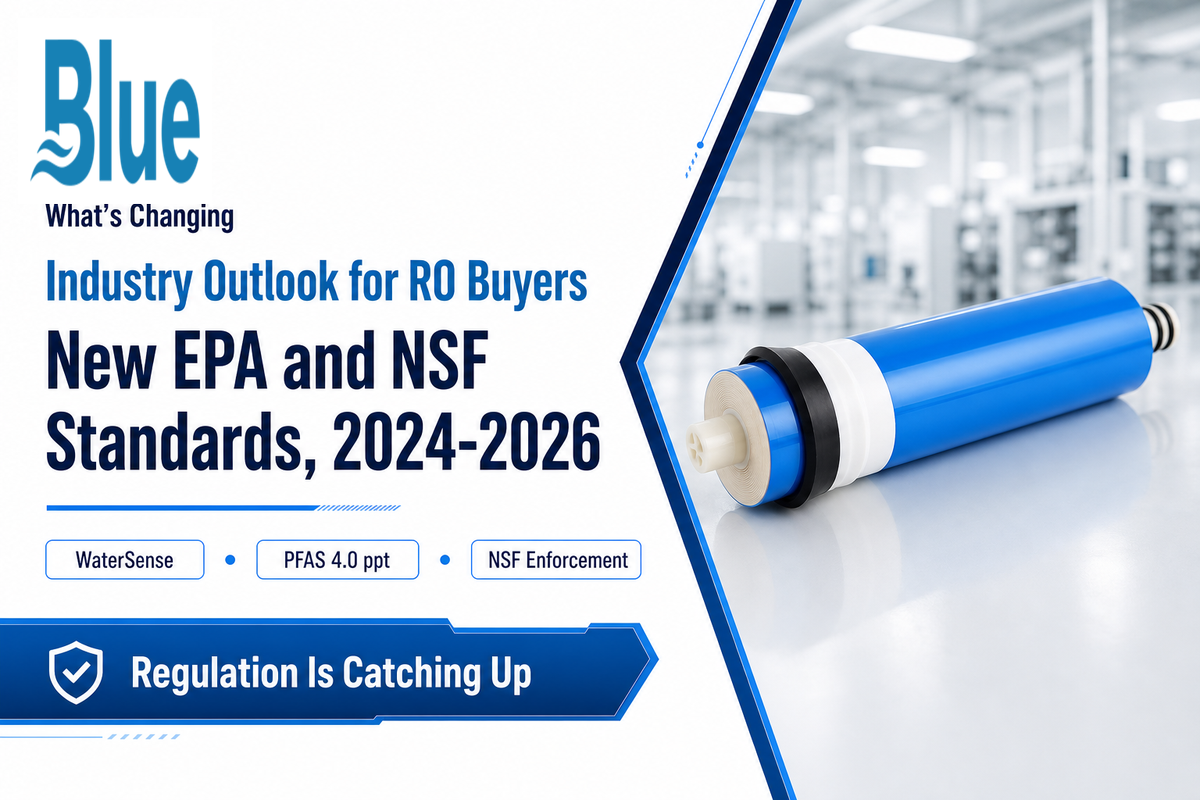
Whether you call it RO water, reverse osmosis water, or just filtered drinking water, home drinking RO filtration is heading into a period of more federal scrutiny, not less. Two independent developments in late 2024 suggest that the RO consumer space will see significant regulatory action in the years ahead, particularly around efficiency and certification. It’s not about the size of the RO market itself, but rather that after decades with little oversight, accountability is starting to catch up to a popular and growing product category.
- In November 2024, the EPA introduced its first WaterSense specification for point-of-use RO systems, filling a gap in product category definitions.
- December 2024 brought another indicator: NSF’s enforcement arm issued a public notice to a supplier that was claiming false NSF certification on an RO product, one of 107 enforcement actions against suppliers of water treatment equipment in 2024.
The practical takeaway for buyers heading into 2027 purchasing decisions: NSF’s own PFAS-reduction certification threshold (20 ppt combined PFAS) still hasn’t been updated to match EPA’s stricter, legally enforceable 4.0 ppt standard finalized in April 2024. A certification badge earned before that update closes doesn’t automatically mean a product meets today’s federal PFAS bar — worth confirming directly rather than assuming.
Regulatory watch: direction here isn’t moving in a straight line. EPA proposed in May 2026 to extend PFAS compliance deadlines to 2031 (from the original 2029) and to reconsider some contaminant limits on procedural grounds, with a public hearing scheduled for July 7, 2026 — worth checking current status before treating any compliance date as fixed.
Frequently Asked Questions
Q: How often should you replace a residential RO membrane element?
View Answer
Most residential RO membranes last 2-5 years, but a much more reliable trigger than the calendar is performance. You should begin to look at replacing your membrane when your permeate flow drops to around 10-15% below its rated capacity or when normalized salt rejection drops to below approximately 90-95% of its rated capability. In any case, a general guideline does not supersede your product’s own stated life and certification claims – when the two conflict, stick with the manufacturer’s spec.
Q: What’s the difference between TFC, CTA, and NF membranes?
View Answer
The industry standard today for residential systems is TFC (thin-film composite) with higher rejection, though TFC is chlorine-sensitive. CTA (cellulose triacetate) is the technology it displaced – higher chlorine tolerance, but with lower rejection rates and a more limited operating pH range. Nanofiltration (NF) employs a looser membrane structure that allows some monovalent salts to pass through, as well as effectively softens water and removes some larger organics.
Q: Does reverse osmosis remove PFAS and contaminants like cryptosporidium?
View Answer
RO has been identified by the EPA as one of the effective proven methods for removing PFAS compounds, and it’s typically considered effective for removing Cryptosporidium oocysts due to their relatively large size. However, to date (as of April 2024), RO membrane performance testing standards haven’t been set to measure performance against the newly tightened EPA drinking water limits, although standards bodies are actively addressing this. For additional peace of mind against specific types of cysts, check to see if your system has been tested under NSF/ANSI 53 specifically for cyst reduction in addition to general RO performance testing.
Q: What size RO membrane element do I need for my housing?
View Answer
Most common under-sink systems use a 1812 (1.8″x12″) element with a 50 to 100 GPD capacity. Your existing membrane will have its model number imprinted on it – make sure your replacement has the same dimensions (diameter), end configuration and brine seal orientation before purchasing.
Q: How do I know if my RO membrane element is genuine and not counterfeit?
View Answer
Before concluding a seemingly poor-performing membrane is counterfeit, run a five-point check: verify any certification code issued by the manufacturer; check NSF’s public certified product database directly, rather than relying on the seller’s claim of certification; ask for a copy of the actual test certification document, not just a claimed one; conduct a simple TDS test of the RO output after installation; and determine whether failure modes such as chemical damage, check valve malfunction, or standard end-of-life fouling are responsible. NSF logged 107 enforcement actions for false claims of certification in 2024 alone, primarily associated with online marketplaces. Note that Private Label and Licensed OEM manufacturing, when properly documented, is not counterfeiting.
Q: Is a residential RO membrane element covered by NSF/ANSI 58 certification?
View Answer
NSF/ANSI 58 certifies the entire POE RO system, not just the RO membrane element, although the membrane materials and performance are part of the 58 testing process. Lead contamination falls under NSF/ANSI 372 certification, while general material safety standards fall under NSF/ANSI 61. A membrane already tested for a given application under NSF/ANSI 58 typically doesn’t require a separate NSF/ANSI 61 evaluation.
About This Guide
The reason this article exists is that 90% of residential RO element information on the internet is either just a product spec sheet or an abstract explanation of how RO technology works, none of which would help a buyer to assess a certification claim, compare the specifications on a replacement product, or recognize a listing that uses the same words as another but doesn’t offer a comparable element. Because Blue Membrane makes residential RO elements at our own factory, we’ve created this information completely separate from our own products: The laws, standards, and patent guidance referenced here are the same no matter whose element you choose to install.
References & Sources
- Point-of-Use Reverse Osmosis Systems (WaterSense) – U.S. Environmental Protection Agency
- Per- and Polyfluoroalkyl Substances (PFAS) National Drinking Water Standard – U.S. Environmental Protection Agency
- Identifying Drinking Water Filters Certified to Reduce PFAS – U.S. Environmental Protection Agency
- Exploring PFAS Presence and Potential Leaching from Reverse Osmosis Membranes – National Institutes of Health (PMC)
- Review of Thin Film Nanocomposite Membranes and Their Applications – National Institutes of Health (PMC)
- NSF/ANSI 58: Reverse Osmosis Drinking Water Treatment Systems – NSF International
- NSF/ANSI/CAN 372 Technical Requirements – NSF International
- NSF Public Notice: KES (Unauthorized NSF Certification Claim) – NSF International
- Forever Chemicals and the Advancement of Filtration Standards – NSF International
- Water Matters: A Closer Look at NSF/ANSI/CAN 372 Low-Lead Certification – Water Conditioning & Purification Magazine
- NSF/ANSI 58-2022: Reverse Osmosis Drinking Water Treatment Systems – ANSI Webstore
- Glossary of Terms – Water Quality Association
Related Articles
- Residential RO Membrane Elements (50-1600 GPD) – Blue Membrane’s manufacturer-direct residential element specs and RE-series models
- Brackish Water RO Membrane Elements Guide – the brackish-water analog of this element-engineering guide
- Low-Pressure & Ultra-Low-Pressure RO Membrane Elements – for feed water where standard-pressure TFC elements are oversized
- Nanofiltration Membrane (NF) Guide – when NF is the better fit than full RO desalination
- How Nanofiltration Membranes Soften Water Without Salt or Brine – a salt-free alternative to ion-exchange softening