Get in touch with Blue Membrane Company

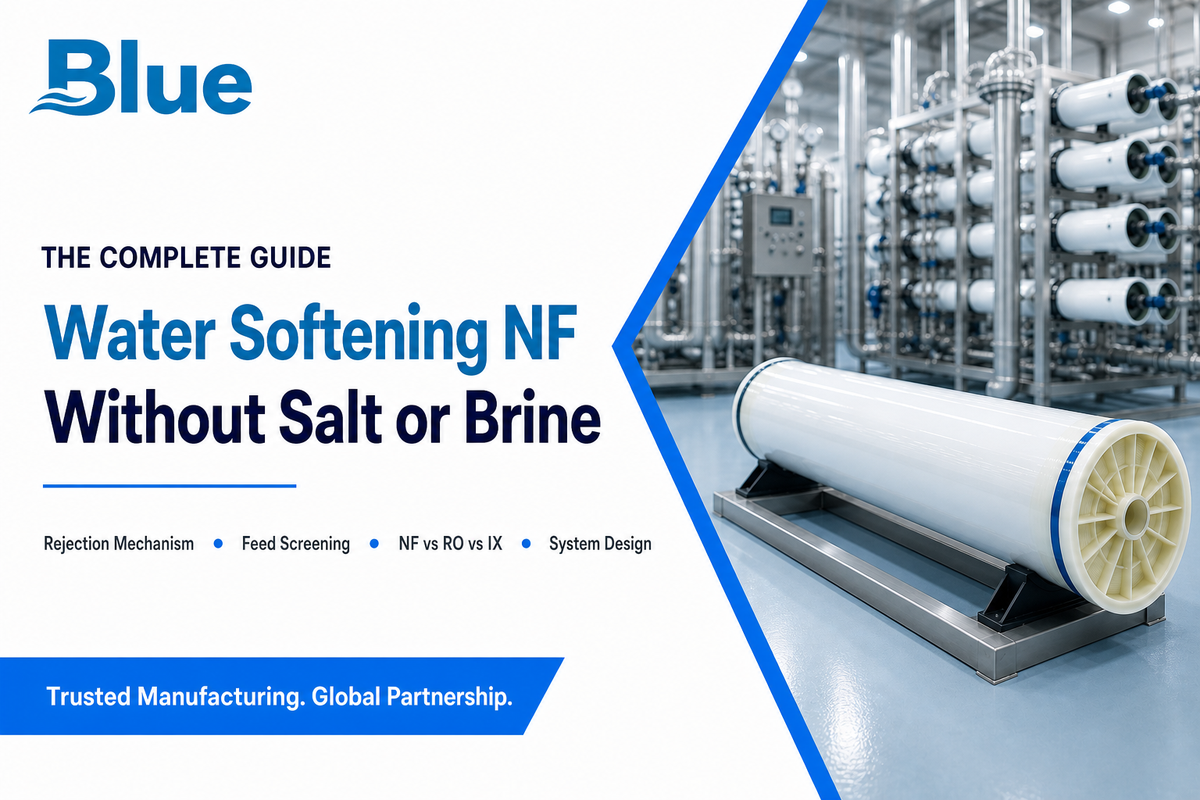
Water softening NF is nanofiltration membrane treatment for hardness removal — one of the physical-separation options in industrial water treatment, not a chemical exchange. Where a conventional ion exchange (IX) softener trades calcium and magnesium for sodium, an NF membrane just rejects the hardness-causing ions, largely reported as CaCO3-equivalent hardness, at the membrane surface and lets the rest of the water pass through under moderate pressure. No salt goes in, and no sodium-heavy brine comes out the drain.
Quick Specs
| Divalent (Ca²⁺/Mg²⁺) rejection | 90–98%, typically |
| Monovalent (Na⁺) pass-through | 40–70%, membrane-dependent |
| Operating pressure | 50–150 psi (vs. 150–600+ psi for RO) |
| System recovery | typically 75–85%, brackish-feed systems |
| Cleaning interval (pretreated) | 3–6 months |
| Sodium added to permeate | None |
How It Works nanofiltration softens water by physically blocking calcium and magnesium ions at the membrane surface. It generally removes 90 to 98% of hardness and no sodium is added to the treated water. It functions at 50-150 psi, which is well below the 150-600+ psi of a full reverse osmosis system on the same feed water. That’s the main reason for so many industrial customers comparing it to ion exchange softening as a replacement for its functionality with less power draw.
This walk through the process explains just how membrane works its separation magic, shows you a useful 4-input check to see if your feed water will cut the mustard, gives you a no-holds-barred look at where NF fits in the market alongside reverse osmosis and ion exchange, what you’ll need up stream to a system, what to do about ongoing care for your membrane and, what’s happening at the legislative level with regard to the class.
What Nanofiltration Actually Removes, and What It Leaves Behind
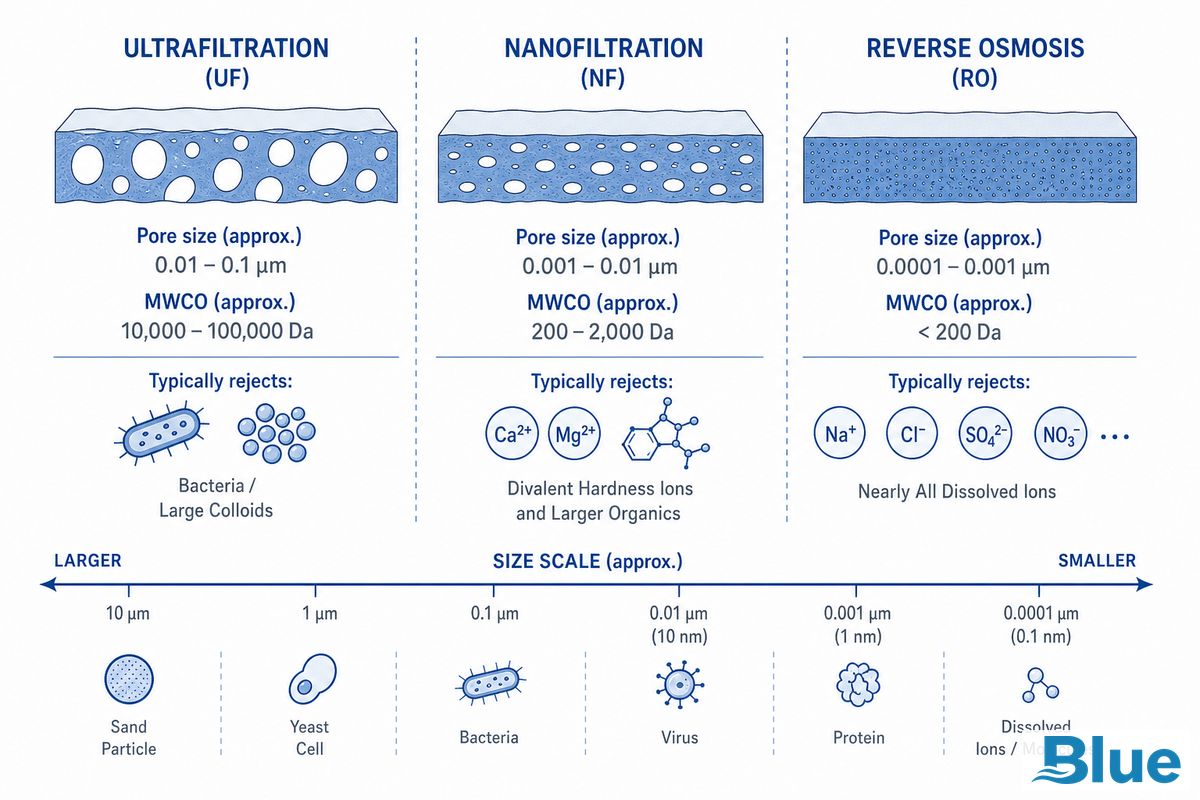
Nanofiltration sits at a specific position in the filtration spectrum, between ultrafiltration and reverse osmosis. Ultrafiltration membranes are open enough that most dissolved ions, including the calcium and magnesium that cause hardness, pass straight through — it only removes particles and larger organics. Reverse osmosis sits at the opposite end, so tight that nearly everything dissolved is excluded, hardness included. NF removes what ultrafiltration leaves and what reverse osmosis over-removes.
Its pore sizes are on the order of 10 angstroms, according to the Texas Water Development Board’s membrane technology reference — tight enough to reject the divalent ions responsible for hardness, but porous enough to allow many of the monovalent ions (potassium, chloride, sodium) that don’t cause hardness. Reverse osmosis, by contrast, also strips most useful minerals along with a meaningful fraction of the water itself as concentrate.
| Technology | Nominal pore size | Rejects hardness ions? | Typical pressure |
|---|---|---|---|
| Ultrafiltration (UF) | 0.01–0.1 micron | No | 10–50 psi |
| Nanofiltration (NF) | ~10 angstroms (~0.001 micron) | Selectively — divalent yes, most monovalent no | 50–150 psi |
| Reverse osmosis (RO) | <0.001 micron | Yes, along with nearly everything else dissolved | 150–600+ psi |
Which Is Better, UF or NF, for Water Softening?
View Answer
UF isn’t softening technology in any sense; it’s pores are simply too large to exclude the dissolved calcium and magnesium. In fact, hardness passes straight through a UF system. If UF is to be installed then it should always be upstream of an RO system or other, finer process to remove particulates and much of the larger organics in the water before that finer membrane process.
The 2-Gate Rejection Model, Why NF Rejects Hardness but Not Salt
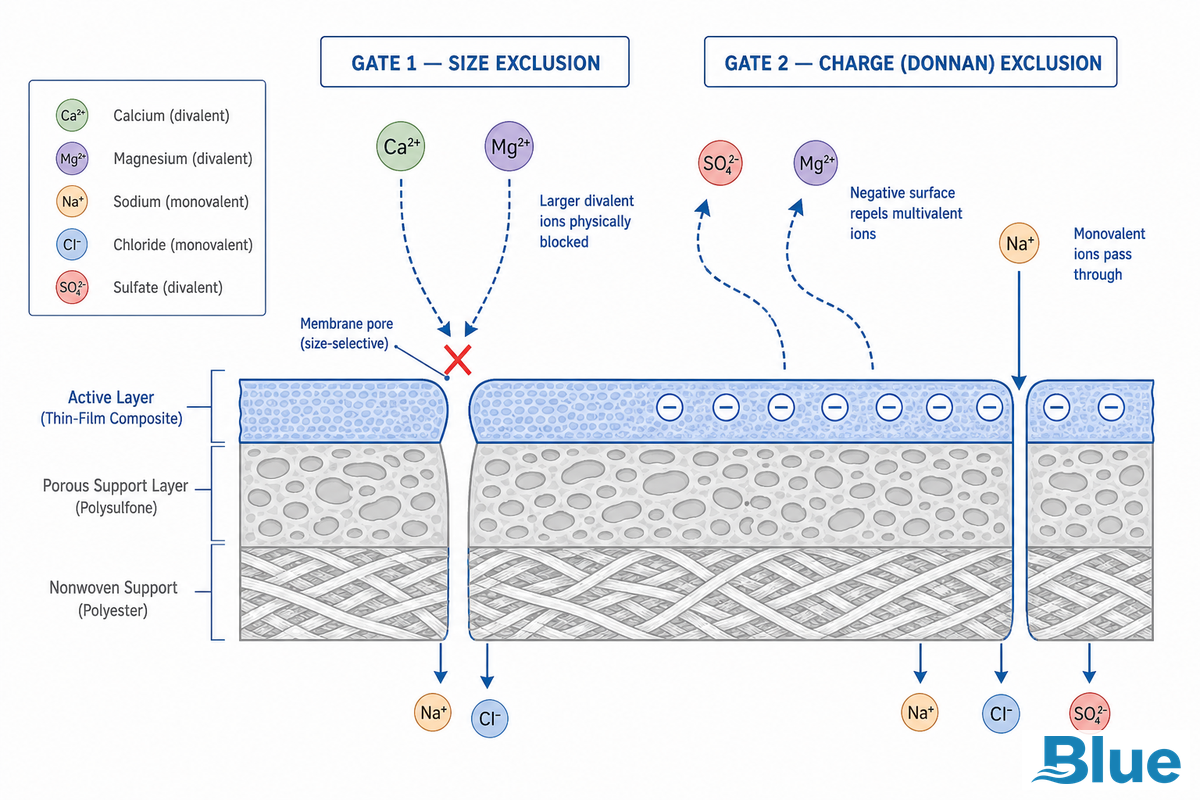
The 2-Gate Rejection Model explains NF’s selective rejection as two independent barriers a dissolved ion has to clear, not one.
Gate 1 – size exclusion. (Specialty ceramic membrane NF variants exist for high-temperature or solvent-heavy feed streams, but the polyamide chemistry described here covers the large majority of industrial softening installs.) Physical pore structure in the membrane is small enough to block larger, more hydrated ions. calcium and magnesium ions carry a larger hydration shell than sodium, so they’re more likely to be sieved out on size alone.
Gate 2 – charge exclusion (Donnan effect). A fixed surface charge on the polyamide thin-film composite active layer, typically negative, does the second stage of the work. Ions with a higher charge – the +2 charge on calcium and magnesium versus the +1 charge on sodium – experience much stronger electrostatic repulsion from that charged membrane surface. This is the dominant reason divalent ions get rejected so much more efficiently than monovalent ones, independent of size alone.
Real performance data bears this out clearly: a peer-reviewed study of NF treating reverse-osmosis concentrate reported 97.4% rejection of CaSO4 and 95.2% rejection of MgSO4, versus only 79% rejection of NaCl under the same conditions – roughly a 16-to-18-point gap purely attributable to ionic charge, since sodium and chloride are both smaller and less hydrated than the divalent pair yet pass through at a far higher rate. A related low-pressure NF softening study found the selectivity can run even higher in some membrane chemistries: 98.5% MgCl2 rejection against only 46.2% LiCl rejection in the same test.
One caveat worth stating plainly: this divalent-versus-monovalent split isn’t a fixed universal ratio. A 2025 membrane-transport study found that sodium and chloride rejection itself climbs as the membrane’s surface charge becomes more negative and as feed pH shifts, while calcium chloride stayed well-rejected across the pH range tested – meaning the exact amount of monovalent “pass-through” is membrane-chemistry- and operating-condition-dependent, not a constant you can assume across every NF product on the market.
The practical upshot for a buyer: the water coming out the other side is softened but not stripped bare. Because roughly 40-70% of the monovalent minerals stay in solution, NF permeate keeps a mineral character much closer to natural water than RO permeate does – a distinction that matters for anything downstream sensitive to near-zero-TDS water, from boiler feed chemistry to food and beverage processing that would otherwise need costly remineralization. In practice, industrial buyers evaluating this trade-off in the field find it’s the deciding factor between NF and RO for a given application; Blue Membrane engineers its N-Series active layer specifically around that 90-98% divalent rejection window rather than chasing the near-total rejection a full RO membrane targets.
The 4-Input Feed Water Screening Check
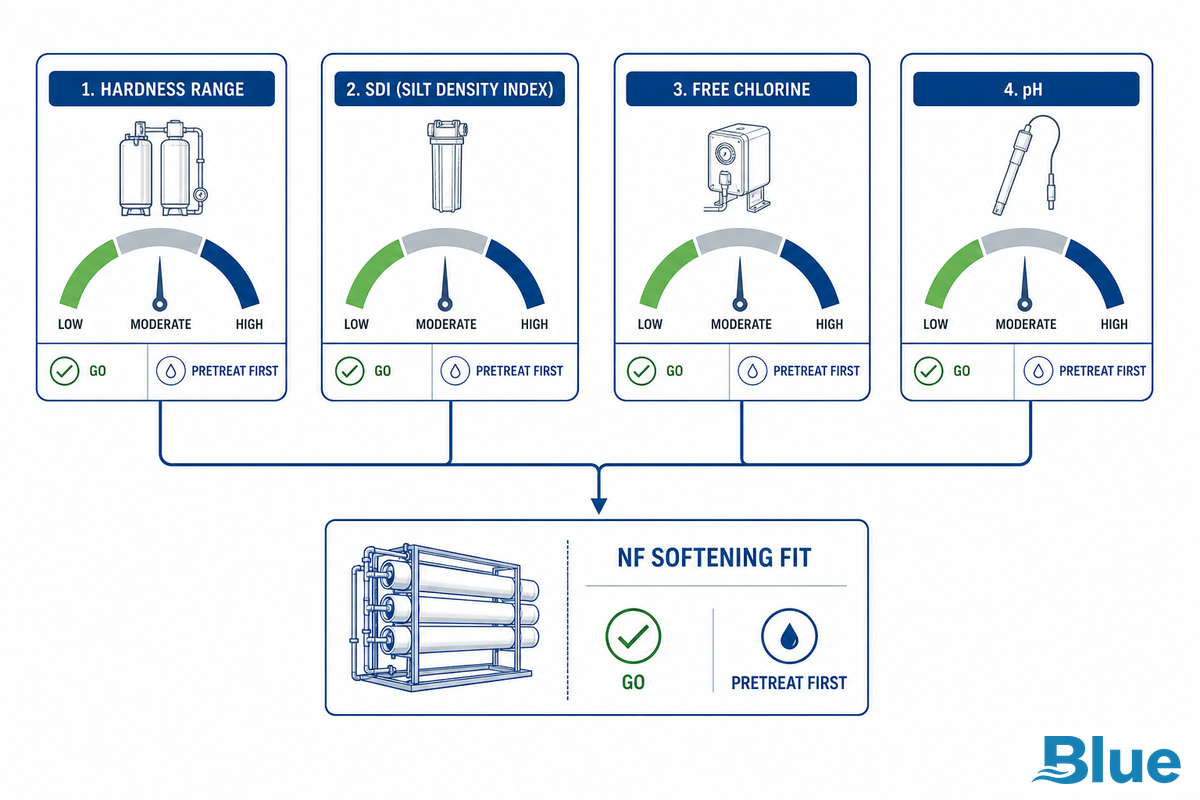
Before evaluating any specific water softener membrane product, it helps to self-screen your own feed water first. The 4-Input Feed Water Screening Check is a fast, four-parameter self-screen – hardness, fouling index, free chlorine, and pH – for whether your feed water is a realistic NF candidate before you request a vendor quote.
| Input | Screening range | If out of range |
|---|---|---|
| Total hardness | 200–500 mg/L as CaCO₃ is the sweet spot NF was designed around | >500 mg/L: still workable, but plan for lower recovery + more antiscalant |
| Silt Density Index (SDI) | <5, ideally <3 after pretreatment | Above range: add or upgrade multimedia/cartridge pretreatment first |
| Free chlorine | Non-detect at the membrane inlet | Any measurable residual: add activated carbon or metabisulfite dosing upstream |
| pH (continuous operation) | 6.5–8.0 typical range | Below 6.5: consider pH adjustment to reduce carbonate fouling risk |
⚠️ Important
SDI is a widely used empirical screening indicator, not an absolute measurement of fouling potential. Per ASTM D4189, SDI results vary with test temperature and the specific filter used, so treat the <5 / <3 figures above as directional screening guidance – not a hard pass/fail cutoff you’d defend to an auditor.
Most published guides stop at “check your feed water” and leave it at that. A better question is, “What are people getting wrong when they fail to check their feed water?” – and the evidence change what most buyers assume they know.
A commonly cited assumption is that nanofiltration membranes will foul more quickly in hard water than in soft water. Evidence doesn’t bear this out as a universal truth. One peer-reviewed 2024 review compiling utility monitoring data found a German water treatment plant with high hardness (115 mg/L calcium) but relatively low organic carbon (2.9 mg/L DOC) didn’t exhibit significant fouling over four weeks, and a Canadian plant with a hardness of 647 mg/L-more than three times the target for sweet spots in the screening table above-but 8 mg/L of organic carbon had 210 days without scale or biological fouling reaching the membranes. It wasn’t the hardness that was the driver of fouling, but the combination of low organics with the high hardness. The review similarly characterized fouling in NF chemistry with high severity by membrane rather than feed water hardness; in one test, a NF chemical resulted in approximately 75% loss of irreversible flux, while another produced the lowest fouling in the test. Your chosen membrane (along with your full feed water profile, not solely the hardness) has a larger impact on fouling than a single hardness value alone.
“NF-softened water can carry a measurably higher corrosion risk toward distribution piping than the harder water it replaced, because stripping out calcium, magnesium, and alkalinity lowers the Langelier Saturation Index, and a lower LSI means more aggressive, corrosive water.”
Findings summarized from Choi, Choi & Hong, published in Desalination, 2015
This is a critical point, because it challenges the inherent assumption that less hard is inherently better for the piping and other equipment in your distribution system.
Corrosion also has a regulatory dimension for anyone supplying potable-adjacent water to a distribution network: EPA’s Lead and Copper Rule directly links corrosion control to the lead and copper action levels, and WHO guidance addresses similar international corrosivity concerns. Making a purchasing decision solely based on hardness removal percentage can lead to a different problem further down the line. While NF shouldn’t necessarily be excluded, the selection process requires more than a simple rejection rate: a thorough analysis of the full feed water profile should be conducted alongside the four input variables mentioned above.
NF vs Reverse Osmosis vs Ion Exchange, A Condensed Comparison
Comparing nanofiltration vs reverse osmosis (and ion exchange) is the natural next question once you understand how NF’s selectivity works. For most users looking for a starting point technology list, the four areas that differentiate the main three softening processes are: their hardness removal capability, the impact they’ve on the water’s mineral composition, their energy consumption, and the need for ongoing chemical treatment with regeneration.
| Category | Ion Exchange | Reverse Osmosis | Nanofiltration |
|---|---|---|---|
| Hardness removal | Near-complete (≥99%) | Near-complete (≥99%, plus nearly all other dissolved solids) | Selective, 90–98% divalent |
| Sodium added to product water | Yes — mechanism replaces Ca/Mg with Na | No — near-total demineralization | No — retains 40–70% of monovalent minerals |
| Operating pressure / energy | Low pressure, but ongoing regeneration energy/chemical cost | High (150–600+ psi) | Medium (50–150 psi) |
| Regeneration / chemical need | Salt regeneration every 8–12 hours of continuous duty | Antiscalant only, no salt regeneration; higher specific energy consumption | Antiscalant only, no salt regeneration; lower specific energy consumption |
| Feed water pretreatment need | Minimal — mainly resin-fouling protection | Extensive — SDI <5, multi-stage pretreatment train | Moderate — SDI <5, single or dual-stage pretreatment |
| Media / element lifespan | Resin bed usually 10–15 years | Elements commonly 2–5 years | Elements 3–7 years, application-dependent |
| Concentrate / waste stream character | Sodium-chloride brine | Fully concentrated, all dissolved solids | Divalent-concentrated, no added sodium chloride |
| Typical system recovery | Not membrane-based — near-total water utilization minus backwash | 65–85% | 75–85% |
| Corrosivity of product water | Sodium addition can shift downstream water chemistry | Near-zero-TDS permeate is usually the most aggressive/corrosive of the three | Retains some buffering minerals, but can still lower LSI enough to raise corrosion risk (see the corrosivity finding above) |
Is NF Better Than RO for Industrial Water Softening?
See Answer
Better is contingent upon subsequent treatment requirements of the water. If hardness removal alone, whilst preserving original mineral balance, is the objective-for boiler feed, cooling tower makeup, and general process applications-NF frequently proves superior due to lower operating pressure, diminished energy consumption, and a smaller volume of reject water for management. In contrast, if processes genuinely demand near zero total dissolved solids-certain pharmaceutical and ultrapure applications-RO emerges as the optimal choice despite higher energy expenses, as NF won’t strip enough of the non-hardness dissolved solids to meet such stringent specifications.
When existing pressure vessels or piping are already specified to accommodate a particular spiral-wound element configuration, interoperability with standard 8-inch (8040), 4-inch (4040), and 2.5-inch (2540) formats is just as significant as the membrane chemistry itself-most NF elements, including Blue Membrane’s N-Series water softening NF elements, are designed as an OEM replacement / drop-in replacement for housings intended for prominent brands such as Dow FilmTec NF90 and NF270. OEM cross-referencing deserves a fuller treatment of its own; we’re developing a dedicated FilmTec-replacement guide.
For a more in-depth analysis of technology selection across the full spectrum of seven factors influencing a procurement decision, rather than the four presented here, refer to our dedicated guide on NF vs. RO vs. ion exchange when it’s published.
System Design and Pretreatment Requirements
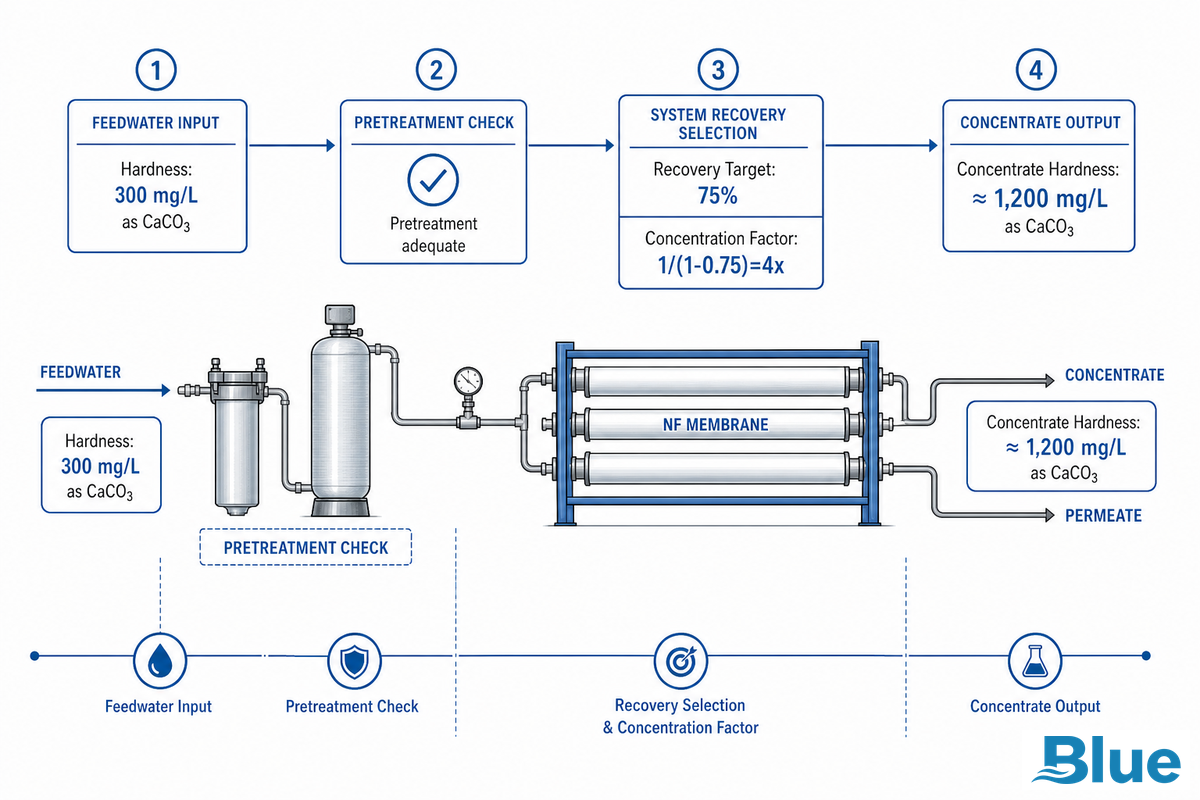
A well-engineered nanofiltration system’s reliability is contingent upon feed water quality upstream of it. Design parameters below are representative of pretreatment trains common to most industrial groundwater softening installations.
| Parameter | Target |
|---|---|
| Turbidity (post-cartridge filter) | <1 NTU |
| SDI | <5 (≤3 recommended — see the ASTM D4189 caveat above) |
| Free chlorine at membrane inlet | Non-detect |
| Permeate flux (8040 elements) | 14–18 L/m²·h (LMH) design target |
Actual field recovery rates frequently diverge from specification sheet expectations, with system designers of membrane systems often reporting recovery at the lower end of the design range in practice-a factor that underscores the importance of performing the worked calculation presented below over relying solely on the headline number.
📐 Engineering Note
System recovery, defined as the fraction of feed water that becomes usable permeate rather than concentrate, represents a primary design trade-off. As a purely illustrative, roughly 75% recovery example (not a universal figure), assume a system designed for that target on feed water containing 300 mg/L hardness. In such a scenario, the hardness in the reject stream would be approximately four times higher than in the feed (1 / (1 – 0.75) = 4), resulting in a concentrate hardness of around 1,200 mg/L (expressed as CaCO₃). This level of concentration dictates whether antiscalant dosing is necessary, as a concentrate that exceed the Langelier Saturation Index of >0 requires treatment to prevent scaling on the last elements in the array. Always perform this calculation for your own feed hardness before establishing a target recovery rate, not after selecting a skid design.
It’s a common field report of rapid flux decline if a membrane hit a highly fat/oil/grease and/or particulate laden water without prior pretreatment – one documented industrial pilot was producing far less throughput in 15 min. from startup. Experience with installation on city or well-water also points to an interesting tidbit that buyers primarily looking at only hardness reduction may overlook – failure to dechlorinate upstream of the membrane, drastically reducing the device lifespan because the residual chlorinated compound is destructive of the membrane’s active layer, and even permeate itself, being low in mineral content, is measurably more corrosive to downstream pipework — a point that surprises buyers focused only on hardness removal. Why does upstream pretreatment quality matter this much? Concentration polarization: the buildup of rejected material on the membrane surface, in a boundary layer of water, increases the tendency for colloids to stick, and the well-known membrane fouling literature explains how this reduces the electrostatic repulsion that would otherwise keep colloids at bay. Undersized or neglected upstream pretreatment compounds the fouling mechanism the membrane is already working against.
Application Snapshot, Boiler Feed, Cooling Towers, and Process Water
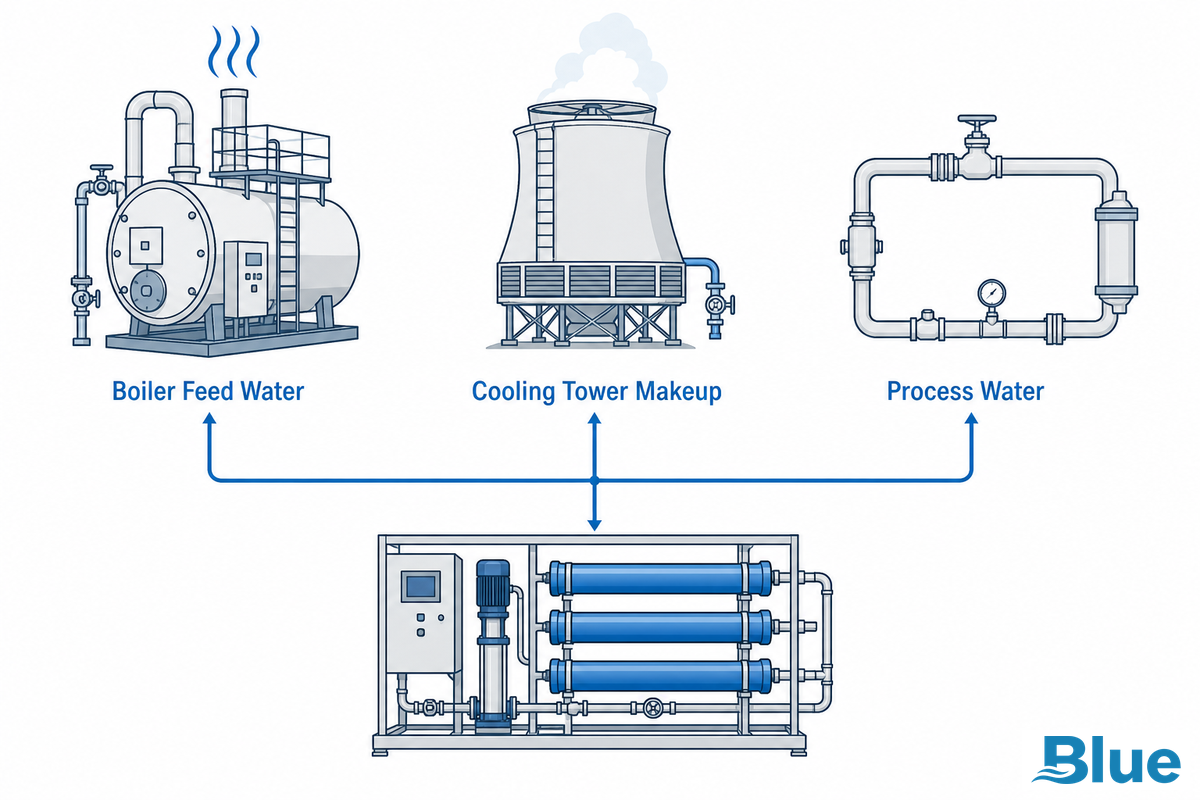
There are three frequently-recurring industrial applications where NF softening gets specified, and each carries its own version of the same underlying risk: get the hardness spec wrong, and the cost shows up later as unplanned downtime, wasted water, or product-quality problems. Blue Membrane engineers its N-Series elements against exactly these three duty cycles, since a spec sheet number in isolation doesn’t tell an industrial buyer whether a given application will actually behave in the field.
Boiler feed water treatment. A boiler needs hardness removal to prevent scale failure on heat-transfer surfaces — even a thin scale layer can force a costly unplanned shutdown for descaling — but the same boiler system also needs a stable, predictable mineral balance for its internal water chemistry program. This is a real trade-off: NF’s partial demineralization, hardness out but most sodium and alkalinity retained, fits that chemistry target far more directly than a full RO strip, which would otherwise need costly re-mineralization to get back to the same balance.
Cooling tower makeup. Cooling towers concentrate whatever hardness sits in the makeup water every time they cycle, so the makeup water’s starting hardness has an outsized, and expensive, effect on how many cycles of concentration a tower can run before it’s forced into a wasteful blowdown. Softening the makeup water with NF extends achievable cycles of concentration meaningfully — often into the 6-10 cycle range on properly pretreated feed — without adding the sodium load a salt-regenerated softener would put into that same blowdown stream.
General industrial process water. Food and beverage, pharmaceutical, and general manufacturing applications often need hardness controlled without the risk of over-treating the water and creating a downstream product-quality problem — a balance NF handles well in the field. One city-scale illustration of the same trade-off at municipal water-plant scale: Maple Grove, Minnesota’s public works department evaluated NF softening against lime softening for its 50 MGD supply and rated NF’s capital cost as medium against lime’s high capital cost, while still rating NF’s own ongoing power and concentrate-disposal cost as high in the same comparison — a real cost trade-off, not a free win.
Each of these three applications carries enough sizing and chemistry nuance for its own guide — Blue Membrane’s ISO 9001-certified engineering team fields sizing questions on all three regularly, and a detailed Boiler Feed Water NF Specification guide covering ours in full is in the publishing queue.
Membrane Care, Fouling, Cleaning, and Lifespan
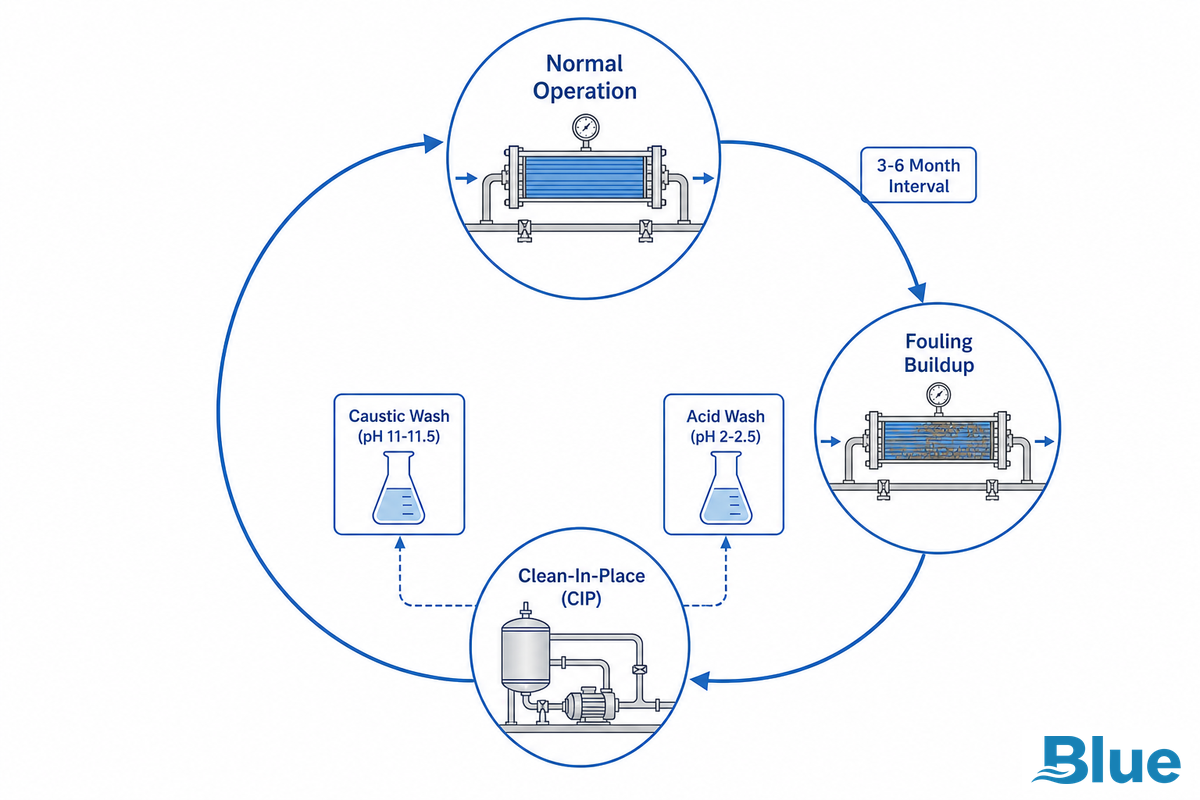
Two lessons from the field outweigh what any check list for proper maintenance can offer. For one thing, clean-in-place (CIP) isn’t a clean slate: an analysis of 500 hours on an NF membrane, peer-reviewed, demonstrated that after each cleaning chemical, membranes are slightly more fouling-prone than they were after the previous cleaning cycle, instead of starting fresh. This is exactly the wear pattern that makes chemistry-resistant construction, like Blue Membrane’s alkali-resistant NF membrane line, worth the premium on sites running frequent caustic CIP cycles. For another thing, as just reviewed, your membrane chemistry matters more than your feed hardness: that same 2024 autopsy analyzed fouling across 82 NF membrane elements and confirmed what the data from field trials showed-namely, organic/biofouling caused about half of all fouling, with mineral scale playing a supporting role even in harder water/brackish feeds.
How Often Do Industrial NF Membranes Need Cleaning?
Show Answer
Most normal, pretreatment cleaned groundwater at typical 200-500 mg/L hardness, that meets SDI requirements and does not have a detectable level of chlorine, can be cleaned once every 3-6 months. There are typically two main cleaning chemistries for most applications: a caustic clean (high pH) that addresses biofouling and organics, and a dilute acid (low pH) clean for carbonate and mineral scale. CIP cleaning performance decreases over cycles, so following changes in flux and rejection rates will give the best indications of when cleaning is necessary.
The service life of an element vary dramatically by application. Typically, an element for boiler feed water applications will last for 4 to 6 years; an element for heavy industrial service may last from 5 to 7 years; and one for a light industrial application or pharmaceutical application (where feed water generally is already fairly clean) may last 3 to 5 years, provided the pretreatment measures outlined earlier are indeed employed. Field experience generally supports similar ranges for element life, with typical comments for elements that are cleaned on a regular schedule and not only reactively once they’ve been fouled to some extent being 3 to 5 years. Water treatment operators offer a useful field diagnostic here. Slow, low permeate flow generally suggests a healthy tight-pore membrane is performing its work as expected. However, steady fast flow may indicate an neglected pre-filter, which is allowing the chlorine to pass through to contaminate the membrane. Blue Membrane’s own per-element factory test reports give buyers a documented rejection and flux baseline to track field performance against over that service life. Further discussion of fouling prevention protocol and the full spectrum of planning element lifespans will be presented in upcoming NF Membrane Fouling Prevention and NF Membrane Lifespan guides.
Cost Factors and Procurement Path

There’s no one-size-fits-all industrial membrane cost or per-gallon number that holds true across every location – feed water chemistry, flow rate, and local utility costs swing that metric too much to be honestly reported as one figure. What’s consistent, however, is the shape of the cost comparison. A 2024 engineering analysis of a 50 MGD municipal facility in Maple Grove, MN reported up to $60.6 million in initial capital cost for an NF softening facility (or ~ $67M with 2-3 years of inflation) with about $6.5M in annual operating cost, of which ~$4.1M was power, and ~$1.05M per MGD was lost in concentrate. A prior, separate study from 2023 put a 32 MGD lime softening facility at roughly $125M and $12.6M in annual cost ($8.8M debt, $1.2M labor, $2.6M power/chemicals/sludge) – this is a different capacity and analysis date so isn’t a perfect side-by-side, but the one true apples-to-apples comparison comes from that same 2024 study, which rated both technologies at the identical 50 MGD capacity: lime rated high on both capital and operating cost, while NF rated medium on capital but still high specifically on power cost and concentrate/sewer discharge cost. That’s a municipal-scale data point and not a direct replacement for industrial-site smaller builds, but it highlights the key trade-off – lower initial investment, a higher real on-going power and disposal cost, and smaller equipment footprint – that we observe at industrial scale.
Key Cost Drivers
- membrane element cost and expected replacement interval (see lifespan figures above)
- Energy cost at 50-150 psi operating pressure, compared against the alternative’s regeneration or higher-pressure energy draw
- Antiscalant and cleaning chemical dosing, driven by recovery target and feed water chemistry
- Downtime-avoidance value – no regeneration cycle means no scheduled offline window every 8-12 hours
Because those four drivers move independently, the honest next step is a feed-water-chemistry-specific quote rather than a generic per-gallon estimate – request one against your actual hardness, flow rate, and recovery target rather than a rule-of-thumb number pulled from a different site’s water.
Industry Outlook, What’s Changing in Industrial Water Softening
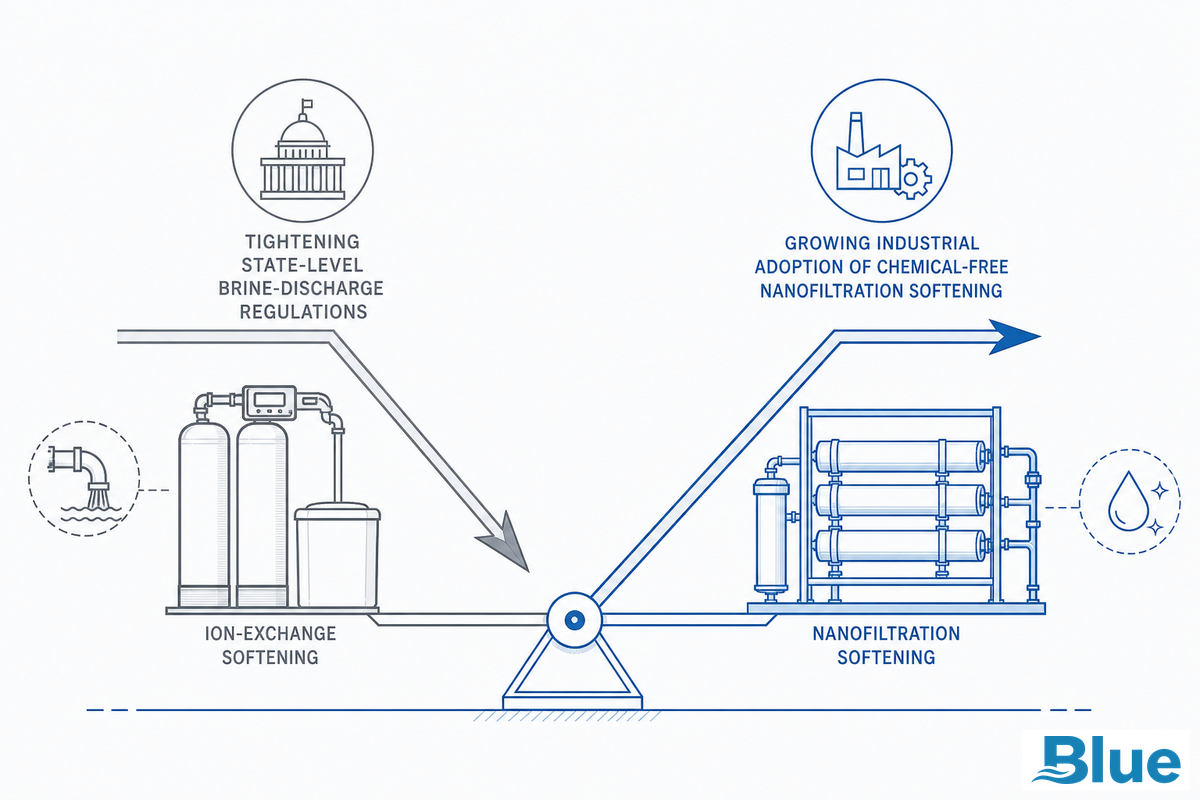
The regulatory ground under salt-based softening is shifting, and the federal framework matters more to industrial buyers than the residential-appliance headlines suggest. EPA’s National Pretreatment Program, under 40 CFR Part 403, governs how industrial and commercial facilities discharge wastewater to a municipal treatment plant – prohibiting discharges that cause pass-through or interference at the receiving plant, and requiring local pretreatment limits where a facility’s discharge chemistry warrants it. Procurement decisions usually need to satisfy a facility’s own NPDES-linked discharge permit, not a state softener law.
Direction at the municipal level is clear, even if the method is local rather than federal. Malibu, California, city ordinance outlaws self-regenerating (salt-based) water softeners and their brine disposal entirely within its Civic Center service area, framed around sodium discharge regulations for softener effluent-though the ordinance’s list of technology-neutral, compliant-alternative technologies (which includes electronic, magnetic, carbon, and exchange-tank systems) does list membrane-based softening as one of those compliant, non-brine-discharging alternatives. Waukesha, Wisconsin, went a compliance-focused route; given the city identified its largest source of chloride to its wastewater plant as softening salt, it set a January 1, 2025 deadline for its largest volume users to reduce salt usage. Waukesha’s own notice regarding the requirement notes a nearby case-the city of Madison, Wisconsin had estimated it would cost $2 billion to build a separate facility for treating chloride, rather than reducing it at source-as an illustration of how much cheaper source reduction is than chloride treatment. This is the pattern to watch: not one overarching law, but individual utilities discovering it’s less expensive to shift softening technology upstream rather than treat chloride downstream.
Third-party market research estimates project the nanofiltration membrane market growing in the high single to low double-digit CAGR through the early 2030s, providing directional context for where capital is flowing but not a number upon which to hang a standalone procurement business case. If you’re designing or replacing an industrial softening system today, the immediate step is to verify your own facility’s discharge permit and local pretreatment regulations before finalizing an ion exchange specification, since whatever technology you specify must be defensible under whatever future chloride discharge limits your receiving utility institutes.
Frequently Asked Questions
Q: What are the disadvantages of nanofiltration for industrial water softening?
View Answer
NF cannot reduce hardness to the same degree as ion exchange (90-98% versus near-total), still creates a reject stream for disposal although it’s not sodium brine, and still requires a more stringent pretreatment routine to achieve a reasonable cleaning interval than a salt-regenerated ion-exchange system. NF also does not guarantee reduced impacts to downstream infrastructure – remember how stripping alkalinity can increase the potential for corrosion of piping within a distribution system?
Q: How does nanofiltration remove water hardness without adding sodium to the water?
Read Answer
NF removes these ions by physically excluding them from the membrane surface through a combination of size exclusion and charge (Donnan) exclusion — this is the 2-Gate Rejection Model referred to previously – instead of by exchanging them for sodium ions as an ion-exchange resin does. No ion exchange takes place, so there are no sodium byproducts added to the treated water stream, or to be discharged as brine.
Q: What feed water pretreatment does nanofiltration softening require?
View Answer
For a 4-Input Feed Water Screening, minimums are SDI less than 5 (less than 3 preferred, with caveats from ASTM D4189 noted in 4-Input above), <1 NTU after cartridge filter, zero detectable free chlorine at the membrane inlet, and 6.5-8.0 for continuous feed pH. The 4-Input above step-by-step process of screening your own feed water against these values prior to seeking a system quote.
Q: Can nanofiltration membranes replace an existing ion exchange softener?
See Answer
Yes, in the vast majority of cases, provided the feed water meets the four-input screening criteria and the site has the capability to discharge the concentrate/reject stream. Many NF elements can also be designed for a 8040/4040/2540 configuration so can be readily fitted into the housings that originally accepted elements for most leading brands – always check this with your system designer before starting a retrofit.
Q: What is the typical operating pressure for NF water softening systems?
Show Answer
50–150 psi.
About This Guide
Blue Membrane produces NF, RO, and ultrafiltration membrane elements at our ISO 9001-certified Nantong, Jiangsu facility, and we see the same water softening technology-selection question arise time and time again from both OEM and industrial customers: is nanofiltration truly appropriate for this particular feed water, or was that an decision made from a spec sheet in isolation from water chemistry? This document provides the mechanism, selection criteria, and research we’d want to review prior to that conversation – it is not a sales tool for any specific membrane series, but the necessary building blocks for a solid, defendable technology selection.
References & Sources
- Membrane Technology Reference, Report R363 — Texas Water Development Board
- ASTM D4189, Standard Test Method for Silt Density Index (SDI) of Water — ASTM International
- Nanofiltration Rejection Performance Study — National Institutes of Health / PMC
- Membrane Fouling Autopsy Study, Membranes journal, 2024 — National Institutes of Health / PMC
- Corrosion Effects of Membrane-Softened Water, Desalination, 2015 — Choi, Choi & Hong
- Nanofiltration: Principles and Applications — University of Edinburgh
- Industrial Wastewater NPDES Program — U.S. Environmental Protection Agency
- 40 CFR Part 403, General Pretreatment Regulations — U.S. Electronic Code of Federal Regulations
- Municipal Code Chapter 9.40, Ordinance 451 — City of Malibu, CA
- Water Softener Chloride Compliance Notice — City of Waukesha, WI
- Municipal Softening Technology Evaluation Memo — City of Maple Grove, MN Public Works & Engineering
- Membrane Softening Glossary Definition — Water Quality Association
- NSF/ANSI 44 Technical Requirements — NSF International