Get in touch with Blue Membrane Company

Top 13 Industrial RO System Manufacturers: Which Fits Your Project?

Last updated: October 2026
The best industrial reverse osmosis system manufacturers for a first shortlist include Pure Aqua for configurable brackish-water skids, H2O Innovation for custom membrane projects, and Fluence for modular desalination. Blue Membrane, Applied Membranes and MARLO also offer complete packages. Match the supplier to your feedwater, required output and installation scope before comparing prices.
An industrial water system includes multiple brand components, and a membrane brand component is just one part of the system. These systems purify water as part of a defined treatment process. The company delivering the plant is also responsible for integrating pumps, pressure vessels, controls and treatment stages, and then explaining how the equipment will be tested and supported. This report evaluates 13 complete-system manufacturers and engineering providers based on these responsibilities.
Use the list to find companies you want to contact for your project. A few offer repeatable packages, while others engineer several water treatment processes around the plant. These water treatment solutions overlap in capability. A standardized RO skid can contain custom controls, while a large project integrator may also provide packaged equipment.
Industrial RO Manufacturers at a Glance
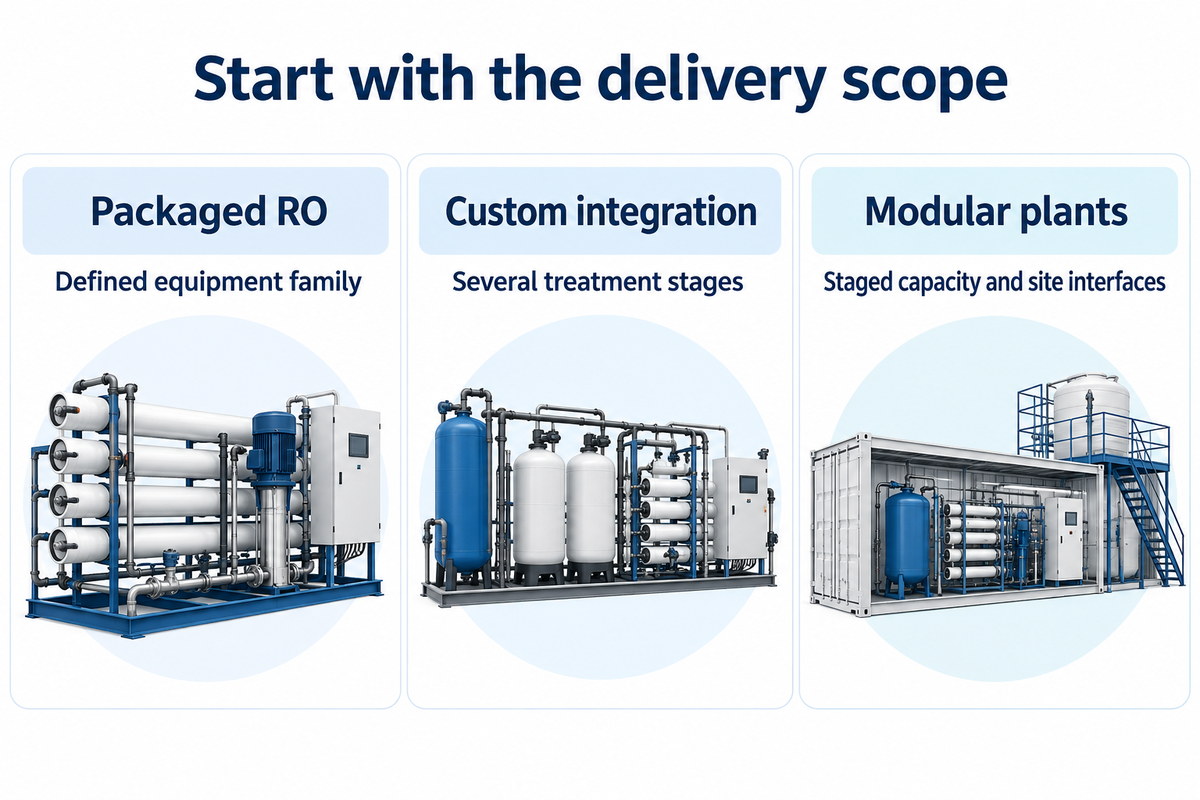
The shortlist below compares complete industrial RO suppliers by the equipment and project responsibilities they publish. Start with the purchasing fit, then read the relevant company profile.
Quick Picks
- Best for factory-built brackish packages with membrane supply: Blue Membrane.
- Best for configurable industrial brackish-water skids: Pure Aqua.
- Best for US-built packages with in-house integration: Applied Membranes.
- Best for custom membrane projects with factory and field support: H2O Innovation.
- Best for complex water-reuse projects: Aquatech.
- Best for modular desalination capacity: Fluence.
Disclosure: This guide is published by Blue Membrane. We list ourselves first because this is our website, not because we claim to be the market leader. The other 12 manufacturers are grouped by what they are best for, in no particular order within each group.
How We Selected These Manufacturers
We selected companies based on identifiable industrial RO systems or complete-system engineering capabilities, supported by official product, manufacturing, company-history, or service information. Company information was verified against official web sites and other sources in October 2026. The shortlist covers suppliers in North America, Europe and China with international offerings. Membrane-only brands, residential-only companies, trading companies without system delivery capabilities and directories were excluded. Related companies were grouped under their existing supplier identity. This is a select short-list rather than a complete market listing.
13-Supplier RO Delivery Comparison
The 13-Supplier RO Delivery Comparison matches the system range and delivery capabilities of each company to an exemplar industrial purchasing requirement.
Capacity values below describe the named product family, not every system that a company can build. Gallons per day and cubic metres per hour remain in their published units. Dates identify the company unless a predecessor, group lineage or brand formation is indicated. The purchasing limits describe the scope of the product, and not a score for the company’s quality.
| No. | Company Name | Headquarters | Founded Year | Best For | Brief Introduction | System Range and Delivery Scope | Key Advantages | Potential Disadvantages | Official Website |
|---|---|---|---|---|---|---|---|---|---|
| 1 | Blue Membrane | Nantong, Jiangsu, China | Not publicly disclosed | Brackish packages plus membranes | Membrane and complete-system producer | High-recovery, packaged and well-water BWRO; 1–500 TPD catalogue | Factory wiring, plumbing and PLC/HMI | Larger duties require separate engineering | https://bluemembrane.com/ |
| 2 | Pure Aqua | Santa Ana, California, USA | 2001 | Configurable brackish skids | System designer and builder | RO-400: 28,000–173,000 GPD; controls and pretreatment options | In-house engineering and construction | RO-400 is a brackish-water family | https://pureaqua.com/ |
| 3 | Applied Membranes | Vista, California, USA | 1983 | Integrated US manufacture | Membrane and system manufacturer | K Series, J Series, custom and mobile RO | Fabrication, panels, controls and testing in-house | K-Series: water must be pretreated by softener or antiscalant | https://www.appliedmembranes.com/ |
| 4 | AXEON Water Technologies | Temecula, California, USA | 1989 | Packaged membrane systems | System and component manufacturer | X-Series; published capacity up to 570,000 GPD | Packaged, mobile and containerized configurations | X-Series capacities up to 570,000 GPD | https://www.axeonwater.com/ |
| 5 | MARLO | Racine, Wisconsin, USA | 1973 | Process-water packages | Family-owned equipment manufacturer | MRO-8H: 36,000–432,000 GPD; separate MRO-SW line | Custom pre-piped and pre-wired skids | Brackish and seawater use different families | https://www.marlo-inc.com/ |
| 6 | SAMCO Technologies | Buffalo, New York, USA | 1972 | Multi-process industrial projects | Engineering, fabrication and integration provider | Custom RO, wastewater treatment and zero liquid discharge | Concept-to-commissioning integration | Custom scope needs a complete process design basis | https://samcotech.com/ |
| 7 | Marmon Industrial Water / Graver Water | Warren, New Jersey, USA — Graver business address | 1948 — Graver Water Conditioning Company predecessor | Industrial and utility makeup water | Equipment manufacturer and system integrator | ROFlex, ElectroFlex EDI, clarification and ion exchange | Equipment manufacture through startup and aftermarket | ROFlex alone does not include every EDI stage | https://graver.com/ |
| 8 | H2O Innovation | Quebec City, Canada | 2000 | Custom membrane project support | System builder and service provider | Custom NF/RO; welding, assembly, controls and FAT | Factory acceptance testing and field startup assistance | Performance scope is project-specific | https://www.h2oinnovation.com/ |
| 9 | Lenntech | Netherlands, near Delft | 1993 | Turnkey treatment with published sizing | Design and manufacturing company | LT-RO1-htec and LT-RO2-htec; approximately 2–100 m³/h | Design, build, commissioning and aftermarket parts | Larger duties can require multiple skids | https://www.lenntech.com/ |
| 10 | Aquatech | Canonsburg, Pennsylvania, USA | 1981 | Complex reuse and desalination | Industrial water project provider | Engineered RO, reuse and zero liquid discharge | Integration across several treatment processes | Integrated projects extend beyond the RO package | https://www.aquatech.com/ |
| 11 | Veolia Water Technologies | Paris, France — Veolia group headquarters | 1853 — Veolia group lineage | RO with high-purity treatment | Water-technology systems and services business | SIRION, ORION, NURION and TERION | Standard packages and integrated RO-CEDI | Different purity duties need different product families | https://www.veoliawatertechnologies.com/ |
| 12 | Xylem | Washington, DC, USA | 2011 — Xylem corporate formation | Defined factory-tested packages | Global water-technology company | Vantage M83: 30–90 gpm; other Vantage and Micro Flex families | Pre-engineered, assembled and factory-tested M83 | M83 is a single-pass family | https://www.xylem.com/ |
| 13 | Fluence | Minneapolis, USA | 2017 — formation of the current Fluence brand, not original incorporation | Modular desalination expansion | Modular system and water-technology provider | NIROBOX SW: 500–1,500 m³/day permeate; BW modules also available | Pretested containers; startup supervision and training | NIROPLANT/NIROSITE: minimum three NIROBOX units | https://www.fluencecorp.com/ |
Packaged RO Systems and Factory-Built Skids
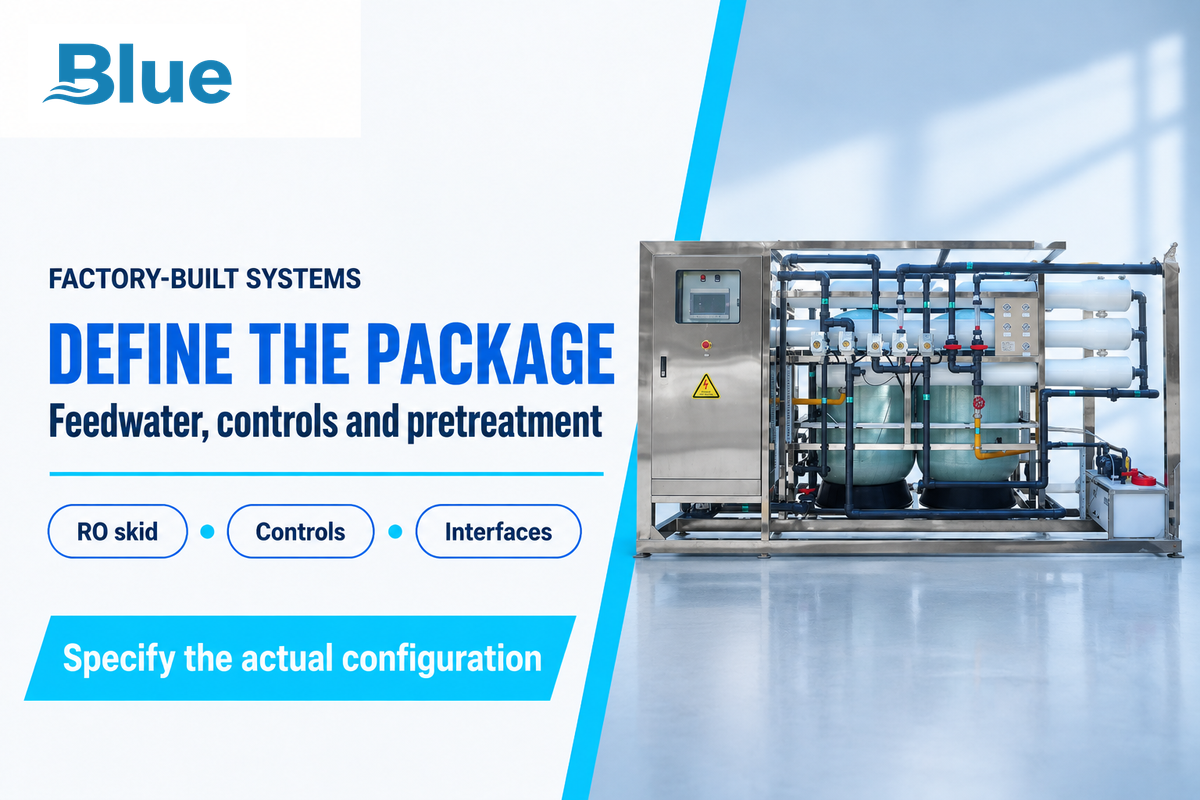
Package manufacturers give buyers identifiable packages or product families around which to define an industrial RO purchase. Factory assembly can reduce site work, but the selected package still needs the correct feedwater envelope, controls and surrounding treatment equipment. Several companies in this group also undertake custom engineering.
1. Blue Membrane: Best for brackish packages plus membranes
Headquarters: Nantong, Jiangsu, China · Founded: Not publicly disclosed · Type: Membrane and complete RO system manufacturer
Official website: https://bluemembrane.com/
Main products: High-recovery, packaged and well-water brackish RO; skid and containerized seawater systems.
Blue Membrane’s brackish catalogue separates high-recovery, packaged and well-water configurations instead of treating them as one hydraulic design. The published high-recovery band is 75–90%, while packaged and well-water configurations are listed at 50–75%; stainless framing, SS316L high-pressure wetted parts and PLC/HMI controls give buyers concrete construction details to compare. Having membrane supply and complete-system assembly within the same offering can suit an equipment distributor or plant buyer who wants a single discussion about the package and replacement elements. The catalogue range is 1–500 TPD, so a larger production duty calls for separate engineering rather than an assumption that a listed skid can simply be enlarged.
2. Pure Aqua: Best for configurable brackish skids
Headquarters: Santa Ana, California, USA · Founded: 2001 · Type: Water-treatment system designer and manufacturer
Official website: https://pureaqua.com/
Main products: RO-400 industrial brackish-water systems.
Quality / certification scope: According to the company, ISO 9001:2015, as described on the company’s regional treatment page.
Pure Aqua identifies RO-400 as an industrial brackish-water family covering 28,000–173,000 gallons per day with feed TDS of 1,000–5,000 ppm. According to its product information, in-house engineering and construction can be paired with selectable pretreatment, variable-frequency drives and remote-monitoring options, making the family useful when buyers need more than a bare membrane rack. A practical distinction is that the basic controller and optional supervisory functions are separate choices, so an operator-facing automation specification belongs alongside the production requirement. RO-400 is a brackish-water line; a seawater project moves to a different system family rather than using the same package at a higher salt concentration.
3. Applied Membranes: Best for integrated US manufacture
Headquarters: Vista, California, USA · Founded: 1983 · Type: Vertically integrated membrane and treatment-system manufacturer
Official website: https://www.appliedmembranes.com/
Main products: K Series Industrial; J Series; custom and mobile RO.
Quality / certification scope: According to the company, ISO 9001:2015 certified and UL listed facility, according to AMI.
Applied Membranes combines membrane rolling with system engineering, skid fabrication, electrical-panel work, PLC programming and performance testing. Its official company description identifies a 160,000-square-foot facility in Vista and support from design through startup, commissioning and ongoing operation, which makes the company relevant to buyers seeking an integrated US manufacturing contact. K Series Industrial, J Series and custom or mobile systems provide several starting points for matching commercial and industrial applications to a delivery format. The company’s overall portfolio spans more than one industrial family; a particular K-Series package requires softener or antiscalant pretreatment, plus chlorine removal when chlorine is present.
4. AXEON Water Technologies: Best for packaged membrane systems
Headquarters: Temecula, California, USA · Founded: 1989 · Type: Membrane filtration system and component manufacturer
Official website: https://www.axeonwater.com/
Main products: X-Series industrial RO systems.
Quality / certification scope: According to the company, its quality system is ISO 9001 compliant.
AXEON offers membrane filtration systems as well as components, with the X-Series providing a named industrial RO starting point. The company describes X-Series capacities up to 570,000 GPD and offers custom, packaged, mobile and containerized configurations, giving integrators several ways to fit treatment equipment into a larger plant or transportable installation. This combination is useful when the project needs a recognizable membrane-system platform but the arrangement, controls or surrounding equipment still need application engineering. The 570,000-GPD figure is the published upper end of that family; larger duties require a different selected design, with actual output matched to the water conditions.
5. MARLO: Best for process-water packages
Headquarters: Racine, Wisconsin, USA · Founded: 1973 · Type: Family-owned water-treatment equipment manufacturer
Official website: https://www.marlo-inc.com/
Main products: MRO-8H, MRO-8H-1L and MRO-SW systems.
MARLO has supplied water treatment equipment from Racine since 1973 and describes itself as a family-owned manufacturer. Its MRO-8H range covers 36,000–432,000 GPD, while custom skid-mounted packages can be supplied pre-piped and pre-wired, making the offering a practical starting point for process-water or boiler-feed pretreatment projects. The broader water-treatment portfolio also gives a buyer a way to discuss water softeners and other preparation stages alongside the reverse osmosis equipment rather than treating the membrane skid as an isolated purchase. Brackish and seawater duties use distinct product families, including MRO-SW for seawater, so the MRO-8H range is not an interchangeable specification for both sources.
Custom Engineering and Integrated Water Treatment
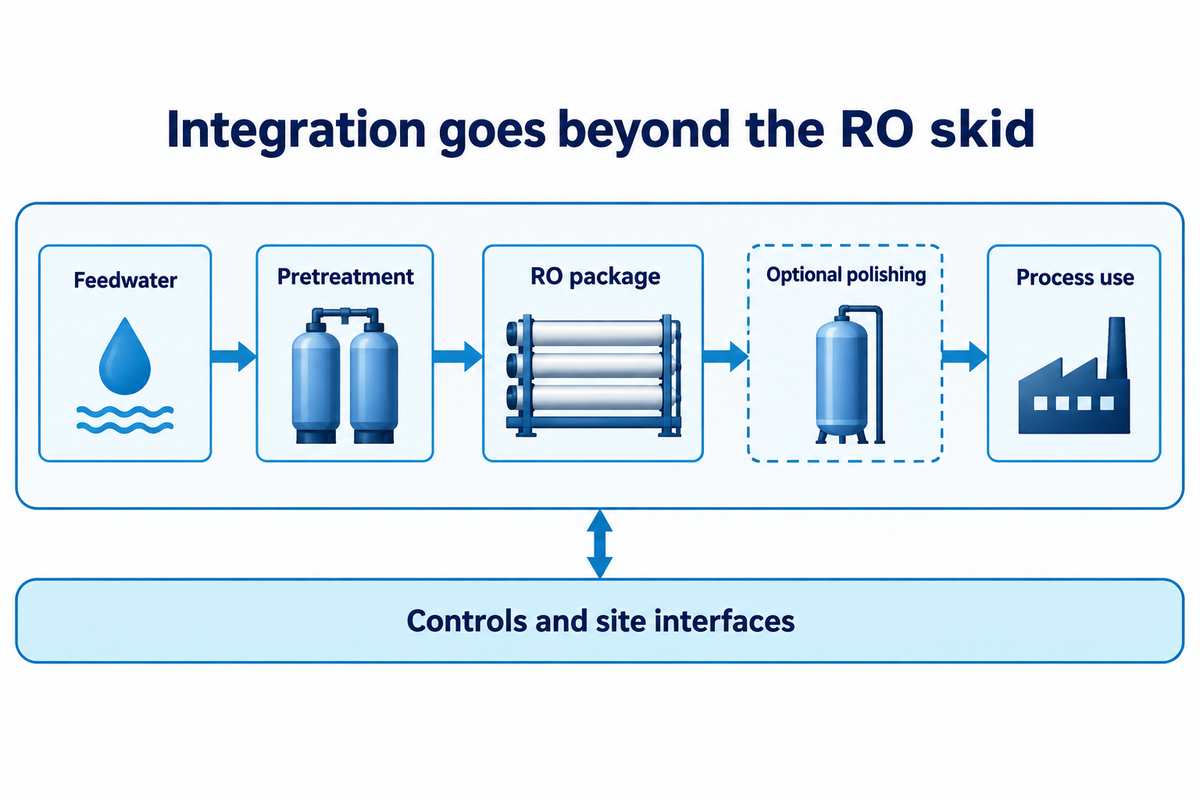
Custom engineering becomes useful when the RO equipment must work with several other treatment stages or an existing plant. The following companies describe integration, manufacturing or commissioning capabilities that extend beyond selecting membranes. The group identifies a purchasing starting point, not an exclusive business category.
6. SAMCO Technologies: Best for multi-process industrial projects
Headquarters: Buffalo, New York, USA · Founded: 1972 · Type: Custom industrial water-treatment engineering and integration company
Official website: https://samcotech.com/
Main products: Custom RO and integrated water/wastewater treatment systems.
SAMCO describes in-house engineering and fabrication teams working from concept to commissioning, for industrial water purification, wastewater reuse and zero liquid discharge applications. A published offshore project provides a concrete RO example: production of 26,500 gallons of potable water per day, while the company’s wider process offering brings several treatment stages into the same engineering discussion. That background makes SAMCO a useful candidate when an existing plant’s chemistry, production requirements and discharge arrangements matter as much as the selection of the RO rack itself. Custom integration needs a defined process basis and interface scope before a meaningful equipment quotation can be compared with a catalogue package.
7. Marmon Industrial Water / Graver Water: Best for industrial and utility makeup water
Headquarters: Warren, New Jersey, USA — Graver business address · Founded: 1948 — Graver Water Conditioning Company predecessor · Type: Industrial water-treatment equipment manufacturer and system integrator
Official website: https://graver.com/
Main products: ROFlex RO, ElectroFlex EDI and integrated pretreatment systems.
Quality / certification scope: According to the company, ISO 9001:2015 quality management system; Burlington and Warren sites named; Intertek identified.
The Graver Water business brings RO together with clarification, filtration and ion exchange for industrial and utility water applications. Its official history traces the Graver Water Conditioning Company predecessor to 1948, while the present Marmon Industrial Water offering includes custom and semi-custom equipment, manufacture, erection, startup and aftermarket support. ROFlex and ElectroFlex EDI give buyers named treatment stages to discuss when makeup water needs more than salt reduction alone, particularly in power and other high-purity water applications. Those are distinct offerings: an ROFlex package by itself should not be assumed to include the full downstream electrodeionization stage.
8. H2O Innovation: Best for custom membrane project support
Headquarters: Quebec City, Canada · Founded: 2000 · Type: Water-technology system builder and service provider
Official website: https://www.h2oinnovation.com/
Main products: Custom nanofiltration and reverse osmosis systems.
Quality / certification scope: According to the company, UL-certified electrical panel assembly, as stated on its manufacturing page.
H2O Innovation’s manufacturing description includes pipe and frame welding, skid assembly, PLC programming, factory acceptance testing and field startup assistance. The same description lists electrical-panel assembly as UL certified, a useful specific detail about the controls work rather than a blanket claim about every delivered water purification system. For a custom membrane project, the combination of mechanical assembly, controls and startup support gives the owner identifiable work packages to discuss with one provider. The company engineers NF/RO systems around the application, so the project design basis establishes performance and acceptance requirements instead of a single universal model rating.
9. Lenntech: Best for turnkey treatment with published sizing
Headquarters: Netherlands, near Delft · Founded: 1993 · Type: Industrial water-treatment design and manufacturing company
Official website: https://www.lenntech.com/
Main products: LT-RO1-htec and LT-RO2-htec; skid-mounted and containerized RO.
Quality / certification scope: According to the company, ISO 9001:2015, ISO 14001:2015 and ISO 45001:2018 listed with downloadable certificates.
Lenntech publishes LT-RO1-htec and LT-RO2-htec families covering approximately 2–100 cubic metres per hour, alongside skid-mounted and containerized arrangements. Its scope includes design, build and commissioning, with a dedicated aftermarket parts department, so buyers can consider the equipment and its ongoing consumable support in the same supplier discussion. The company, established in 1993 near Delft, also lists quality, environmental and occupational-health management certifications with downloadable certificates on its website. Larger flow requirements can involve multiple skids, which adds site connections and coordination compared with treating the installation as one self-contained unit.
Large Projects, Water Reuse and Modular Plants
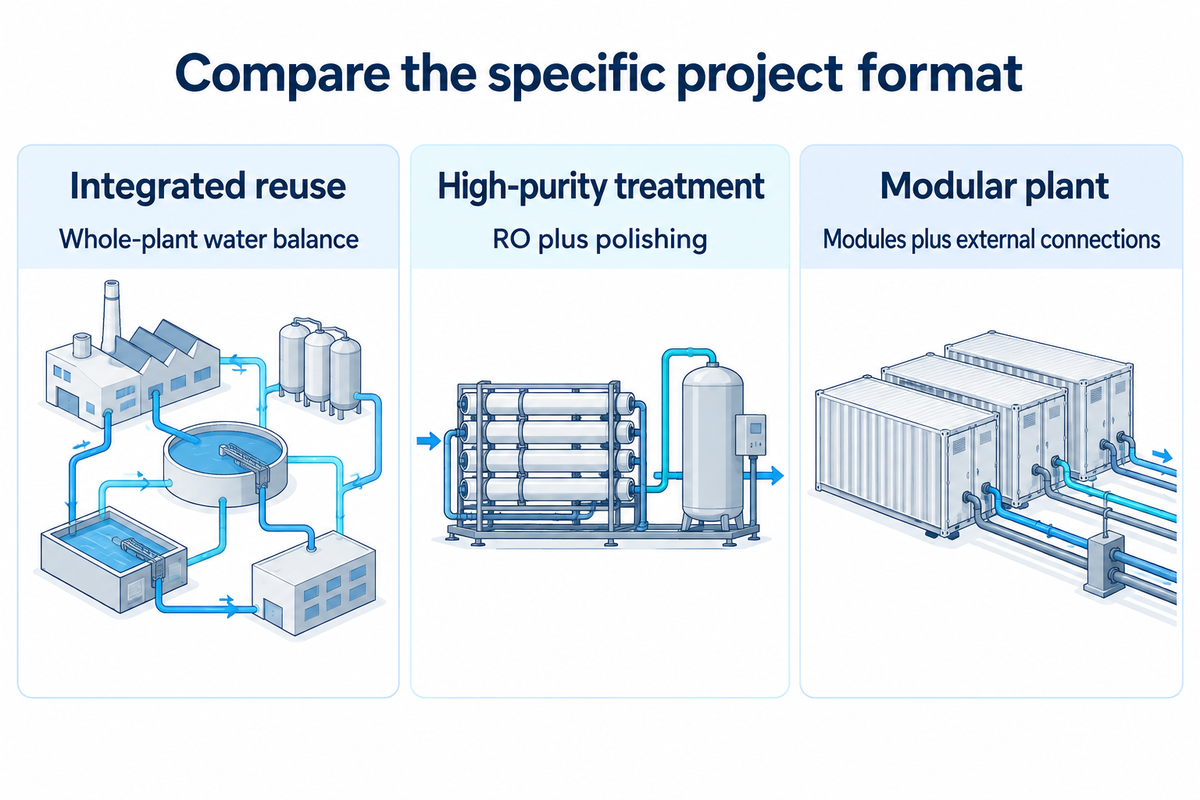
These companies offer broader project, high-purity or modular plant capabilities. Their delivery formats vary: Aquatech emphasizes integrated projects, Veolia combines several treatment technologies, Xylem also offers defined packages, and Fluence supplies containerized modules. Compare the specific business and product being quoted rather than assuming every group company delivers the same scope.
10. Aquatech: Best for complex reuse and desalination
Headquarters: Canonsburg, Pennsylvania, USA · Founded: 1981 · Type: Industrial water and process-technology project provider
Official website: https://www.aquatech.com/
Main products: Engineered RO, water reuse, desalination and zero liquid discharge solutions.
Aquatech combines engineered RO with water reuse, desalination and zero liquid discharge in industrial projects. Founded in 1981 and headquartered in Canonsburg, the company describes offices across the United States, India, Europe, the Middle East and China, together with a process offering that extends to resource recovery. That breadth makes it a candidate where membrane technology is one part of a larger water balance, such as a plant seeking to recycle process streams while managing concentrate. An integrated reuse or zero-liquid-discharge project includes treatment stages and interfaces beyond the RO package, so its project scope is wider than the membrane skid alone.
11. Veolia Water Technologies: Best for RO with high-purity treatment
Headquarters: Paris, France — Veolia group headquarters · Founded: 1853 — Veolia group lineage · Type: Water-technology systems and services business within Veolia
Official website: https://www.veoliawatertechnologies.com/
Main products: SIRION, ORION, NURION and TERION.
Veolia Water Technologies lists SIRION, ORION, NURION and TERION among its standard treatment offerings, giving industrial users several routes from RO to more demanding purity requirements. TERION combines reverse osmosis with continuous electrodeionization for demineralized water in power applications, a concrete example of why a buyer may prefer an integrated purification system over a standalone desalting step. The business sits within Veolia, whose group history reaches back to 1853; that lineage should be read as group history rather than the launch date of every current product or operating unit. Different process-water and high-purity duties call for different product families, so one brand name does not make their performance specifications interchangeable.
12. Xylem: Best for defined factory-tested packages
Headquarters: Washington, DC, USA · Founded: 2011 — Xylem corporate formation · Type: Global water-technology company; Evoqua is part of Xylem
Official website: https://www.xylem.com/
Main products: Vantage M43, M83, M284 and Micro Flex RO.
Quality / certification scope: According to the company, M83 systems are factory-tested in an ISO 9001 certified facility.
Xylem’s Vantage M83 is a pre-engineered, pre-assembled package using 8-inch membranes, with nominal flows of 30–90 gpm across its model configurations. According to the product page, the units are factory-tested at an ISO 9001 certified facility and provide connections for functions such as pretreatment equipment, chemical feed and alarms. That defined package can suit an industrial buyer who wants the core reverse osmosis equipment assembled before delivery, while other Vantage and Micro Flex families provide different configuration options within the portfolio. M83 is a single-pass family, so a more demanding purity target may need a different configuration or an additional downstream treatment stage.
13. Fluence: Best for modular desalination expansion
Headquarters: Minneapolis, USA · Founded: 2017 — formation of the current Fluence brand, not original incorporation · Type: Integrated water-technology and modular treatment-system provider
Official website: https://www.fluencecorp.com/
Main products: NIROBOX SW and BW; NIROPLANT and NIROSITE assemblies.
Fluence offers NIROBOX SW models producing 500, 1,000 or 1,500 cubic metres of permeate per day in preassembled, pretested 40-foot containers. Its published support scope includes startup and commissioning supervision, operator training and operation-and-maintenance support, making the modular approach relevant when a plant needs staged desalination capacity rather than a fully site-built arrangement. The current Fluence brand formed in 2017, while the Australian entity register records earlier names for the continuing legal entity. NIROBOX BW’s 1,000, 1,500 and 2,000 cubic metres per day figures describe feed capacity, not permeate output, so they cannot be compared directly with the SW production ratings. NIROPLANT and NIROSITE modular assemblies each start at three NIROBOX units, which sets the minimum equipment count for these larger plant formats.
How to Choose an Industrial RO System Manufacturer
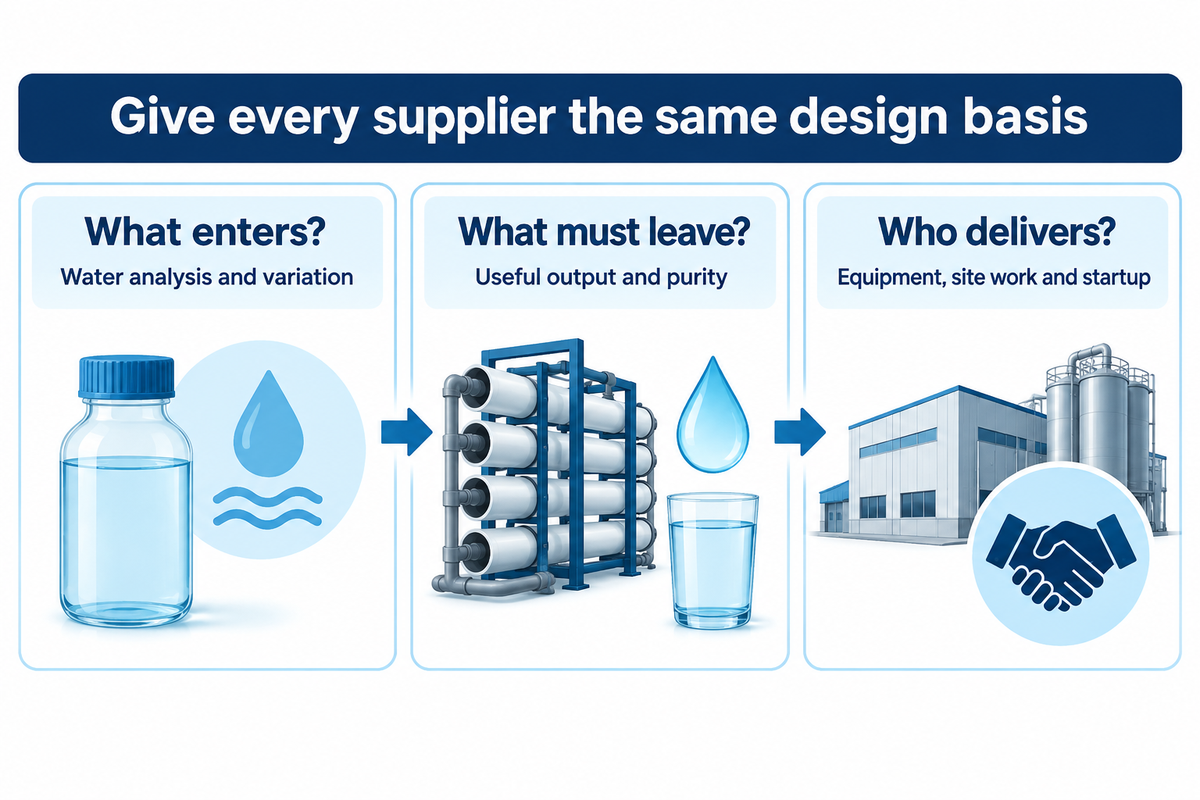
Choose the supplier whose equipment and delivery responsibilities match the job your plant needs done. A membrane name or large catalog capacity does not answer the three purchasing questions: What water will the system receive? What must the system produce? Who will make the installed equipment work?
What are key metrics when sizing an industrial reverse osmosis plant?
Some of the key metrics include permeate flow, feedwater composition and temperature, product water quality, recovery, and operating hours, and the utilities available. Specify the water quality and quantity required at the point of use, and work backwards through storage, distribution and treatment. A daily volume alone can hide a peak-hour shortage, while a large nominal flow rate can be misleading if it assumes warmer or less saline feed water than your site provides.
A complete water analysis should describe the salt load and the constituents that influence design including hardness, silica, iron and manganese if relevant. Give the engineer seasonal or process-related variation rather than one convenient sample. A manufacturer is then able to identify the membrane array, pressure, pretreatment and cleaning approach for the operating envelope. A high rejection figure does not replace a specification for product water for the application.
1. Define useful production at the point of use
State RO water requirements, when they occur, and how much process interruption can be tolerated. This includes the tank and the arrangement of the distribution system. A buffered demand is not the same as a demand that requires a continuous, uninterrupted supply. Indicate the normal production requirement for a continuous process, and the requirements that occur at startup, cleaning and changeover, including any peaks, so a system is not sized to average requirements that may look adequate.
For high-purity water, state the downstream process limit as well as total dissolved solids (TDS) and conductivity, together with the different finishing and storage requirements for boiler makeup, product rinsing or bottled water production. The requirement “pure water” is too general to state as an acceptance condition. A shared, measurable specification makes offers comparable even when the proposed treatment trains differ.
2. Put pretreatment inside the supplier discussion
A reverse osmosis water filtration system requires feed water that meets its membranes’ requirements. A cartridge filter does not perform all pretreatment functions. Suspended and colloidal material may require media filtration or other upstream filtration systems; calcium and magnesium may influence the choice of a softener or antiscalant strategy. For the removal of Chlorine, activated carbon or other suitable treatment may be required, depending on the design of the membranes and the feed.
The relevant purchasing question is who engineers and supplies those stages. If separate vendors provide the pre-treatment and RO package, both need the same inlet-water limits and operating sequence. Our industrial RO pretreatment guide covers those treatment choices in more detail. Here, use them to establish which manufacturer is responsible for delivering acceptable water to the membrane inlet.
3. Match the treatment train to the required purity
Industrial reverse osmosis water purification can be the main desalting step and not the final step. A high-purity application may need polishing after RO, while a drinking-water application can require a different finishing arrangement, such as remineralization where appropriate. This is where suppliers with integrated RO and electrodeionization offerings, such as Veolia or the Graver business, enter a different purchasing conversation from a quote for one skid alone.
Define your water purification needs and the boundary around the whole system. Does the purchase end at the permeate outlet, or does it include storage, recirculation and delivery to production? For steam applications, the boiler-feed water RO guide explains why the boiler’s requirements matter. The supplier comparison should follow that process need instead of treating every low-TDS output as equivalent high-quality purified water.
4. Compare the proposed construction and controls
Review the materials in contact with water separately from the frame and enclosure. Stainless framing does not describe every pump, pipe or pressure vessel. Likewise, an industrial RO package with a microprocessor is not automatically the same as a PLC-controlled package with plant communication, remote monitoring and a complete alarm history. Pure Aqua’s selectable control options illustrate why the quotation should name the actual configuration.
When considering the operators who will use the filtration equipment after commissioning, they need easy to understand alarms, access to service points and the ability to see process operating values. A more advanced controller or high-efficiency pump can support the process function when it suits the duty and maintenance resources. Over-engineering a system does not guarantee extra value. Extra features that nobody will operate or support do not automatically make the purchase more cost-effective.
5. Evaluate factory evidence and certification scope once
Look for references to the specific location where the product is manufactured, the test plan, delivery documents and certificates. Read the holder, site, scope and validity of the certificates. A quality management system certification is not the same as a product approval, nor is a UL certificate for a panel assembly the same as a certificate for a complete water treatment plant. Distinctions such as these are made for the shortlist, and so do not need to be reiterated as warnings for each company card.
Ask for evidence pertaining to performance statements. What are the feed conditions, and what temperatures and operating settings are being discussed? The test records of a factory should identify what was measured, and a manufacturer may have substantial engineering capability, but still need a project-specific test arrangement to demonstrate the duty your plant is purchasing.
6. Confirm who handles installation and startup
Determine what is included in the “turnkey” delivery. What will the supplier’s team do on-site and what must the owner or local contractor finish first? Identify the responsible parties for unloading, placement, pipe connections, electrical work, chemical preparation and startup. This is especially important when considering a skid-mounted system being installed inside an operating factory.
Identify external connections and site services for containerized equipment. A pre-assembled container reduces the work within the enclosure, but it still requires an intake, power and product water outlet. The delivery of the container and the point in time that production can use clean water are separate milestones in the project schedule.
7. Establish the service arrangement for your location
Name the organization that will respond to a service request, the location from which it will respond and the parts it can provide. An international office is useful context, but it is not a promised arrival time for a technician at your plant. Separate remote troubleshooting from field attendance, and distinguish a manufacturer’s employee from a locally appointed service partner.
Replacement parts also need a clear route. Discuss pumps, instruments, controller components and RO membranes, with the correct specifications recorded in the equipment documentation. A supplier’s willingness to sell an element is only part of maintaining the system. Our RO membrane replacement guide explains the operating evidence that should inform replacement decisions.
8. Compare operating requirements over the same duty
Evaluate energy efficiency, chemical use, cleaning access and concentrate handling using the same feed water and required product water. The percentage of water recovery isn’t sufficient. A high-recovery design may suit a site where concentrate handling is restrictive, but it still has to work with the feed chemistry and the rest of the treatment train.
Water recycling projects also require a mass balance. Recovered water must be accounted for and concentrated waste must be handled appropriately. Identify where the recovered water will go and what happens to the remaining concentrate. A supplier of broader industrial water treatment can integrate these streams, while a package manufacturer may supply only a portion of the arrangement. Both can be appropriate, based on their responsibilities.
Industrial RO System Costs and Quotation Scope
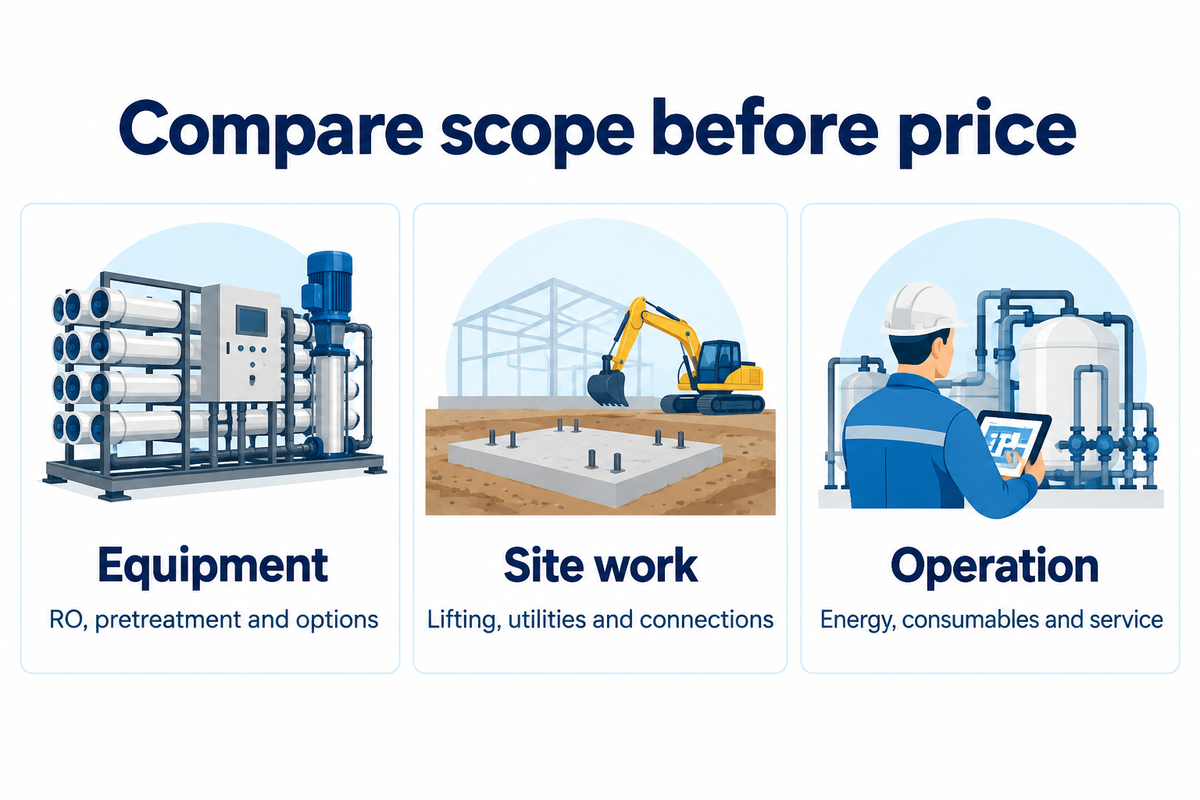
Evaluate the installed treatment scope prior to cost comparison. The cost of a membrane rack or a packaged unit may not include pretreatment, tanks, civil work, freight, utilities, startup or downstream polishing. Therefore, two offers with the same stated capacity may cover a different scope of work.
How much does it cost to build a reverse osmosis system?
SAMCO’s published budgeting examples illustrate the spread: a 100-gpm commercial-quality RO/NF system is described at about US$250,000, while a high-end 100-gpm system with stainless piping and advanced instrumentation can reach about US$1 million. These are the supplier’s published examples, accessed in October 2026, rather than current quotations or a price range for identical equipment. They show why capacity alone cannot establish an industrial project budget.
One should assess the actual feedwater and required purity, materials, and boundaries of the plant and associated piping. Different project costs do not follow the same structure. The project estimate should reflect equipment purchases as well as costs incurred before useful production. A low equipment figure is not a complete answer if essential supporting work and services are not included.
Separate equipment, site work and ongoing operation
Regarding Equipment scope, verify the RO package boundary and treatment equipment. Establish the following regarding the equipment boundary: Feed pumps, cartridge housings, chemical dosing, a CIP system, instruments and required controls. Also, verify if the equipment proposal includes separate water filtration or polishing stages. A list of component brand names does not establish scope.
Site scope includes equipment setting and system interconnection. Lifting, foundations, access, power and pipeline connections can be performed by different parties. A container or skid can simplify assembly while leaving substantial external work. The client should know responsibilities for external work in order to coordinate with the manufacture of the equipment.
Operating scope covers the resources required to keep producing useful water: power, chemicals, consumables, labor, servicing and concentrate management. The balance between initial purchase and ongoing expense will differ by site. For the brackish-water part of that calculation, see our brackish-water RO operating cost guide. Use the manufacturer’s proposed operating conditions when comparing alternatives.
Keep optional equipment visible
Options can change both the capital and operational cost of the plant. They also affect how the plant will be operated, so optional items should appear as named choices rather than disappear inside a general description of a premium package. These can include remote monitoring, standby pumps, additional instrumentation and automatic CIP functions, and a higher grade of construction materials. The same is valid for initial spare parts and operator training.
A useful quotation provides the reason and position for each option, which lets the buyer remove unnecessary features without inadvertently removing critical elements to the assured function. It eases redefinition of the scope. The addition of a treatment stage, for example, is a new purchase and not a discount negotiation on the previous unit.
Factory Acceptance, Site Commissioning and After-Sales Support
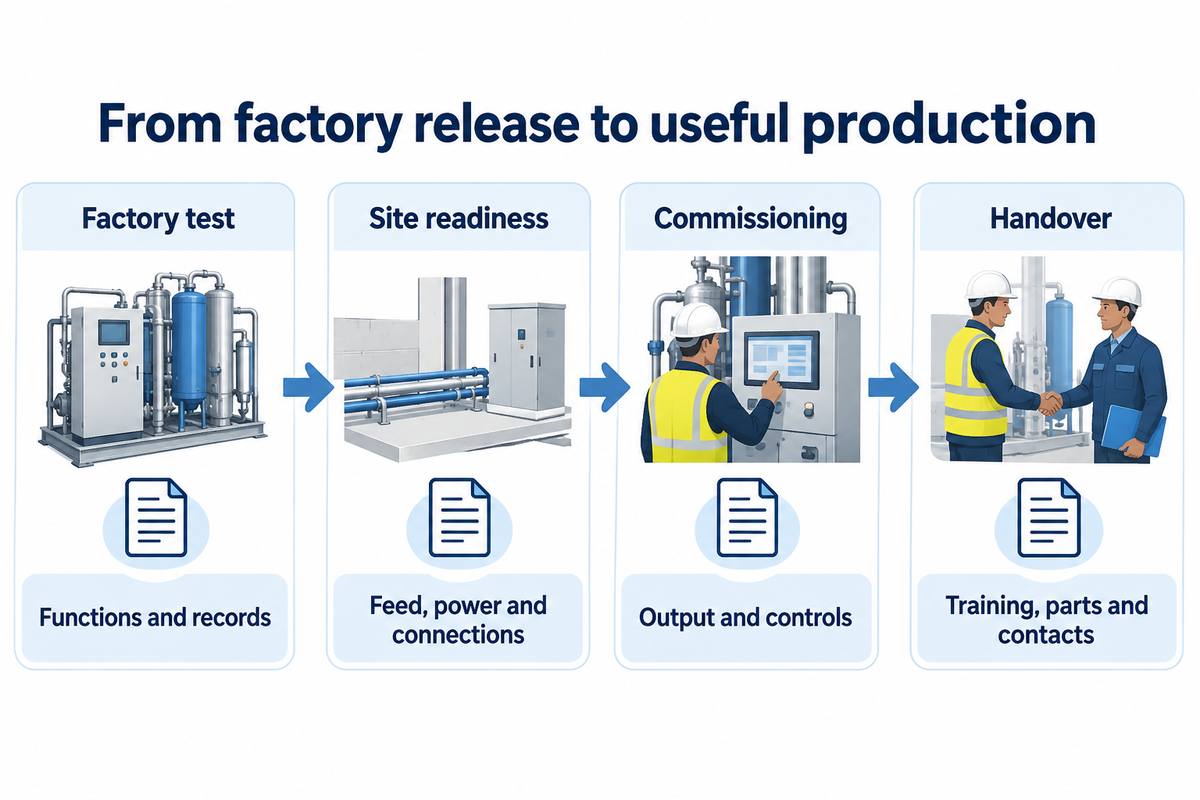
Factory acceptance tests (FATs) check equipment before shipment. Site commissioning is performed at the user’s site to bring the equipment to work in conjunction with the site’s utilities, feed and surrounding process. Both should not be equated to a simple functional test to verify that the system is on.
From factory release to useful production
- Agree the factory test scope. Identify the functions, measurements and documents covered before shipment.
- Confirm site readiness. Complete the feed, power, discharge and product-water connections needed for startup.
- Commission the installed system. Set operating conditions, demonstrate controls and document the resulting output.
- Hand over the operating record. Deliver training, manuals, spare-part identification and the agreed service contacts.
Understand what the factory test demonstrates
H2O Innovation explicitly lists factory acceptance testing, Xylem describes factory-tested M83 packages, and Fluence describes pretested NIROBOX containers. Those statements establish useful manufacturing capabilities. For example, Fluence’s NIROBOX support scope includes commissioning supervision and operator training. The actual project test plan then determines whether the work covers controls, interlocks, mechanical operation, measurements of water production, or a defined combination.
A test using available factory water is not automatically a performance demonstration on a site’s actual source. Results must be interpreted in the context of the test. Decide how deviations will be recorded and resolved before shipment, and ensure the final equipment documentation reflects the package that was delivered.
Make startup a handover of operating knowledge
The goal of commissioning should be to train the plant staff to operate the equipment in a way that allows them to know when a change has occurred. Record the starting operating conditions, instrument readings, settings and water-quality results under the agreed duty.
Cover cleaning and maintenance in your handovers. A clean-in-place, or CIP, arrangement is only useful if the team understands its connections and the applicable procedure. Operators also need to know where to find the specified consumables, how alarms are escalated, what adjustments belong to the manufacturer or service specialist, etc.
Look beyond the initial spare-parts shipment
The use of after-sales support should make ownership of the equipment easier after the first set of consumables. Part numbers, drawings, manuals and configuration records help the plant obtain the correct replacements. They also reduce the dependency on an individual support contact who may be unavailable when a component requires attention.
The service plan deserves the same consideration as transport for equipment purchased in other countries. Remote access may be of some value in supporting diagnosis, but it cannot physically replace a worn part. A named local arrangement (of service), an agreed route of technical escalation, and an appropriate spare-parts stock support provide different kinds of service. Choose the combination that fits your plant’s operating schedule and tolerance for downtime.
Frequently Asked Questions
Who makes the best RO systems?
Pure Aqua is a useful choice for configurable brackish skids, H2O Innovation for custom membrane projects, and Fluence for modular desalination. The best shortlist starts with the required treatment and delivery scope.
For a US-built package with in-house integration, Applied Membranes also belongs in the comparison. MARLO offers defined industrial RO families, while Blue Membrane combines brackish-water packages with membrane supply. These recommendations describe purchasing fit. They do not rank companies by independently tested efficiency, price or market share, because those comparisons require equivalent project conditions and offers.
Can an industrial reverse osmosis system handle brackish or seawater feed?
Yes, when it is designed for that source. Brackish-water and seawater systems use different design conditions, so a brackish package should not be assumed suitable for seawater.
The supplier needs the salinity, temperature, fouling risks and required output before selecting the equipment. Several companies in this guide offer separate product families for the two duties. Blue Membrane’s seawater RO systems are a separate starting point from its brackish-water range. The source-water classification helps identify the right family; the full analysis establishes the design.
What is an industrial reverse osmosis system and how does it differ from household RO?
An industrial RO system uses pressure and a semi-permeable membrane to reduce dissolved contaminants for a process. Its design addresses plant-scale flow, controls, treatment stages and maintenance requirements.
A household unit usually serves a small point-of-use demand. Industrial equipment must fit the production schedule and the surrounding process, including upstream water preparation and downstream storage or polishing. Commercial water purification systems can sit between those scales, but the label alone does not establish suitability for commercial applications or a factory process. The required output, operating conditions and installation responsibilities are the useful distinctions when buying equipment.
What contaminants can an industrial reverse osmosis water system remove?
RO can reduce many dissolved salts and other contaminants, including certain heavy metals. Removal varies by contaminant, membrane and operating conditions; no single percentage applies to every substance.
Specify each impurity and its outlet limit. High-quality water treatment means meeting that application specification; filtered water is not automatically suitable for every process.
Should I buy membranes directly or purchase a complete RO system?
Buy membranes for a defined replacement or integration job; buy a complete system when you need the pumps, vessels, controls and treatment arrangement delivered as a working package.
A supplier of spiral-wound membranes can provide the separation element without owning the engineering of the whole plant. In a new installation, someone still has to select and integrate the equipment, define the operating envelope and commission it. If your team already has that capability, component procurement may be appropriate. Otherwise, a complete-system manufacturer or integrator gives the project a clearer engineering contact. Several companies here offer both products and integrated systems.
Can a manufacturer overseas provide local commissioning and spare parts?
Yes, through its own field team or a service partner, but the arrangement must cover your actual location. International sales alone do not establish local support.
Specify which startup activities require attendance, who will perform them and how technical questions will be escalated. For ongoing support, identify stocked consumables and critical replacement components separately from items shipped to order. Remote troubleshooting, operator training and local mechanical work solve different problems. The best arrangement for your plant is the one that names the responsible people and organizations and fits the required response, rather than relying on a general promise of worldwide service. Discuss the handover documents and the language used for training as well. A local technician needs access to the correct drawings, control information and parts identification to work effectively. If the service partner changes, the owner should still have those records. For a continuously operated plant, decide which failures the site team can address with stocked parts and which require a specialist visit, then use that distinction when agreeing support.
Choose Suppliers for the Work They Will Deliver
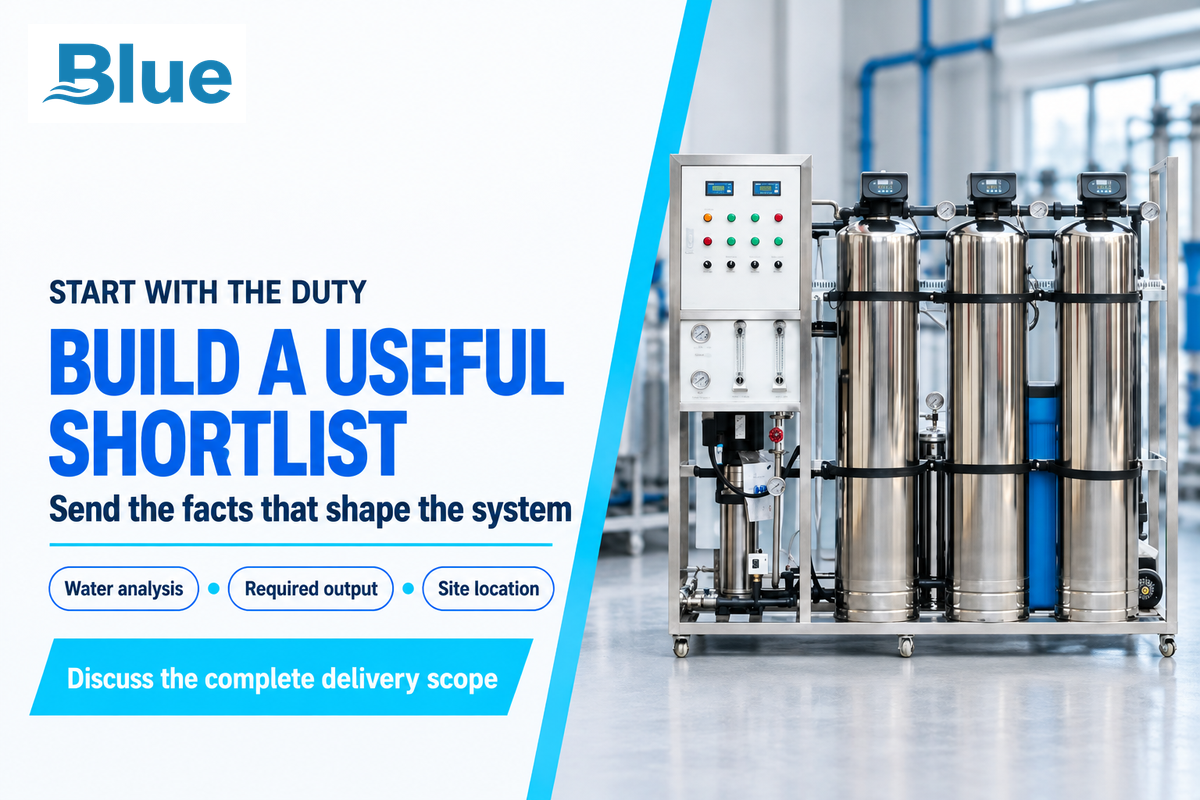
A strong industrial RO shortlist links a production demand to a credible delivery scope. Use the company cards to find the appropriate packages, engineering capabilities and support services, and compare these to the same feedwater and product-water requirements. Keep membrane supply, complete-system manufacture and wider project integration distinct throughout that process.
Start with the duty, then compare the delivery. The useful question is whether the proposed package, site work and support arrangement will produce the water your operation needs.
At Blue Membrane, we supply high-recovery, packaged and well-water configurations for brackish-water treatment, alongside membrane elements and seawater equipment. To discuss a brackish-water RO package, send your water analysis, required production and site location. Those details let us discuss a suitable configuration and its delivery scope without treating every industrial application as the same job.
References & Sources
This guide draws upon company histories, product families, manufacturing capabilities and service descriptions from companies’ official home pages (company, product and quality pages), reviewed in October 2026. Supplier Web sites are shown in the comparison table and company profiles. Cost examples are attributed to SAMCO’s published RO/NF system-cost article and are not current quotations.
- Australian Government ABN Lookup: Fluence Corporation Limited entity-name history — used to distinguish the 2017 name change from the earlier continuing entity.
Engineering support
Need a membrane or RO system recommendation before your next quote?
Send feedwater data, capacity target, vessel size, operating pressure or replacement model details. Blue Membrane can help compare RO/NF grades, replacement options and system paths before you lock the specification.
RO / NF
Industrial membrane element selection
SWRO / BWRO
Desalination and brackish water systems
OEM match
Replacement and cross-reference support
RFQ checklist
What to include for faster model matching
- Water source and duty Well water, seawater, wastewater reuse, boiler feed, process water or potable water.
- Operating targets Feed TDS, flow rate, recovery, salt rejection target, temperature and pressure limits.
- Replacement context Current membrane model, element size, vessel count, fouling issue or cleaning history.
For urgent replacement checks, include photos of labels and vessel layout when available.