Get in touch with Blue Membrane Company

Last updated: October 2026
The best options when choosing a ro membrane manufacturer in China include Blue Membrane for OEM and custom RO membrane elements, Vontron for broad industrial sourcing, KeenSen for application support, and BlueStar Toray for Toray-based industrial projects. The right shortlist starts with the element format, feedwater duty and manufacturing responsibility.
Quick Picks
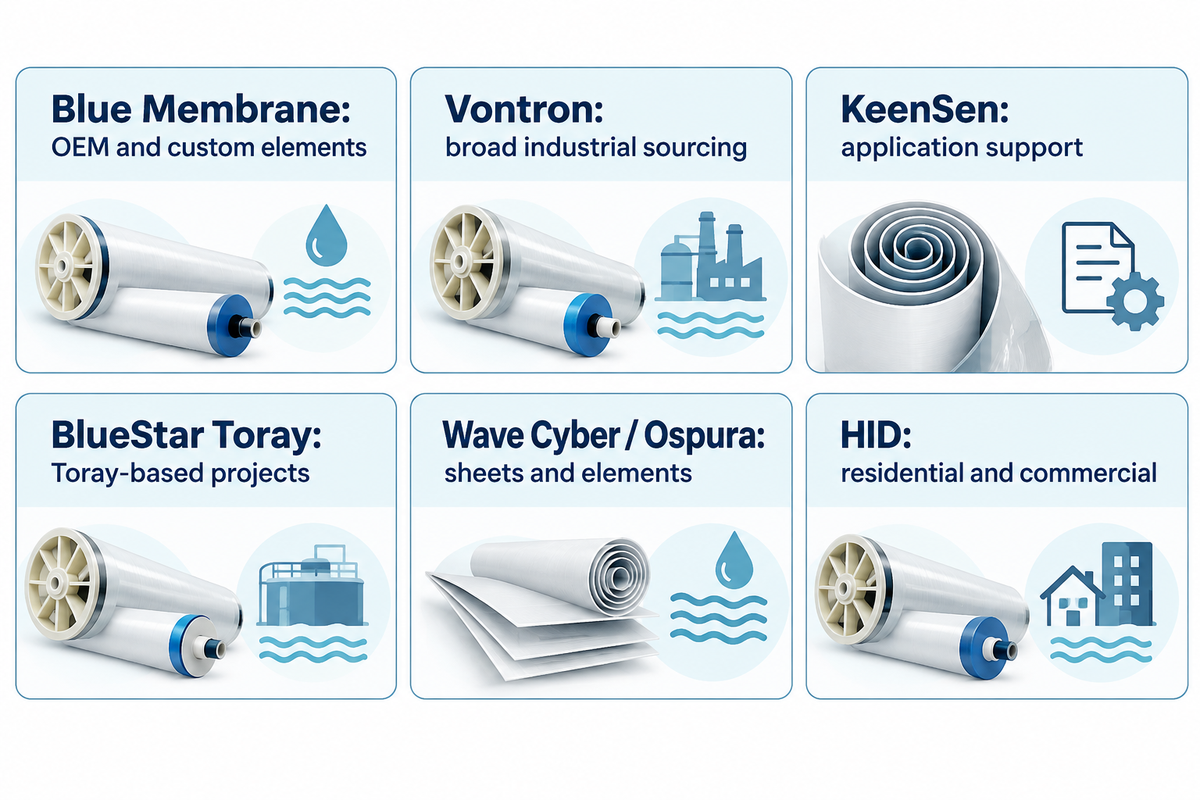
- Best for OEM and custom RO membrane elements: Blue Membrane
- Best for broad industrial RO product sourcing: Vontron
- Best for application engineering and diagnostic support: KeenSen
- Best for Toray-based industrial projects in China: BlueStar Toray (TBMC)
- Best for sourcing RO sheets and elements within a pressure-component group: Wave Cyber / Ospura
- Best for residential and commercial elements backed by in-house sheet production: HID Membrane
Disclosure: This guide is published by Blue Membrane. We list ourselves first because this is our website, not because we claim to be the market leader. The other 9 manufacturers are grouped by what they’re best for, in no particular order within each group.
How We Selected These RO Membrane Manufacturers
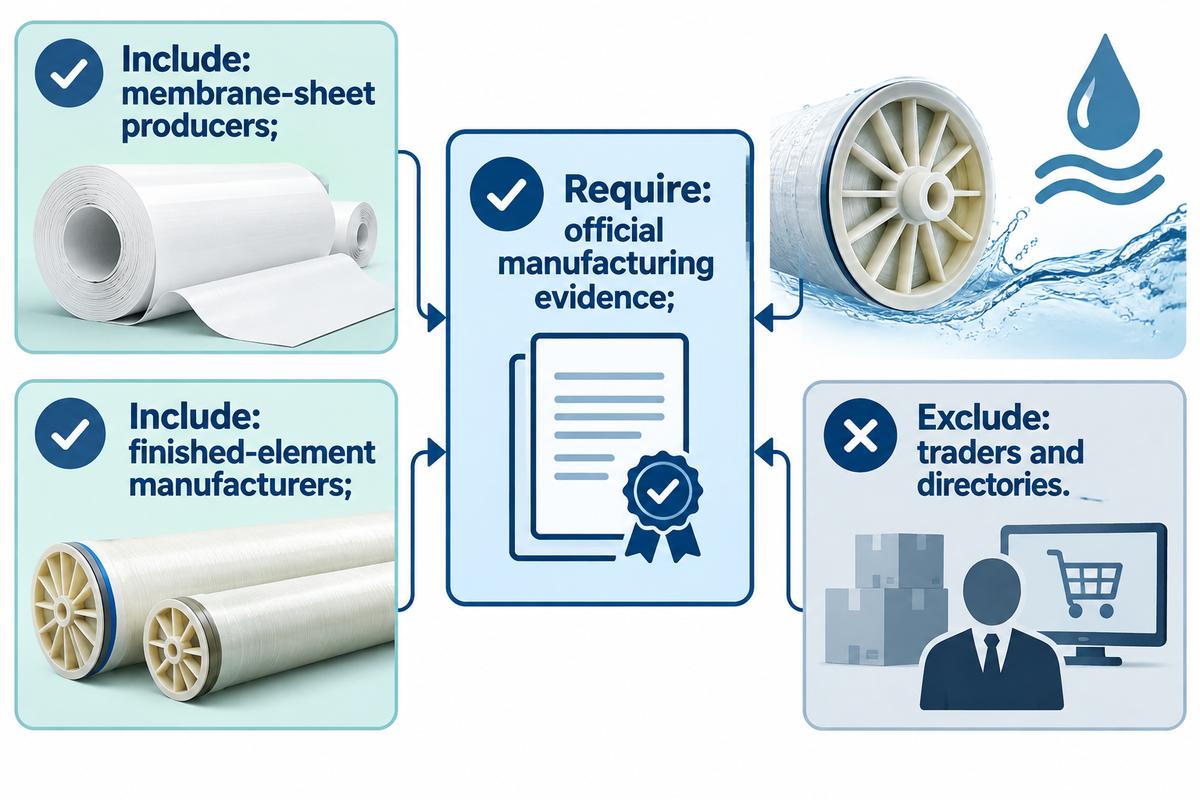
Profiles were developed for companies in China with discernable ro membrane-sheet or finished spiral-wound element lines and official manufacturing evidence. Trading companies, distributors, sourcing platforms, directories, media websites and used-equipment dealers weren’t included. We checked locations, company and product information against official websites and public sources in October 2026. Application fit determined the groups; geographic variety was secondary to manufacturing evidence.
“Best for” identifies a purchasing application supported by the published product range and manufacturing role. Numbers indicate display order, with Blue Membrane first as disclosed above. Product limits, handling requirements and warranty conditions remain part of the purchasing comparison.
China RO Membrane Manufacturers Compared
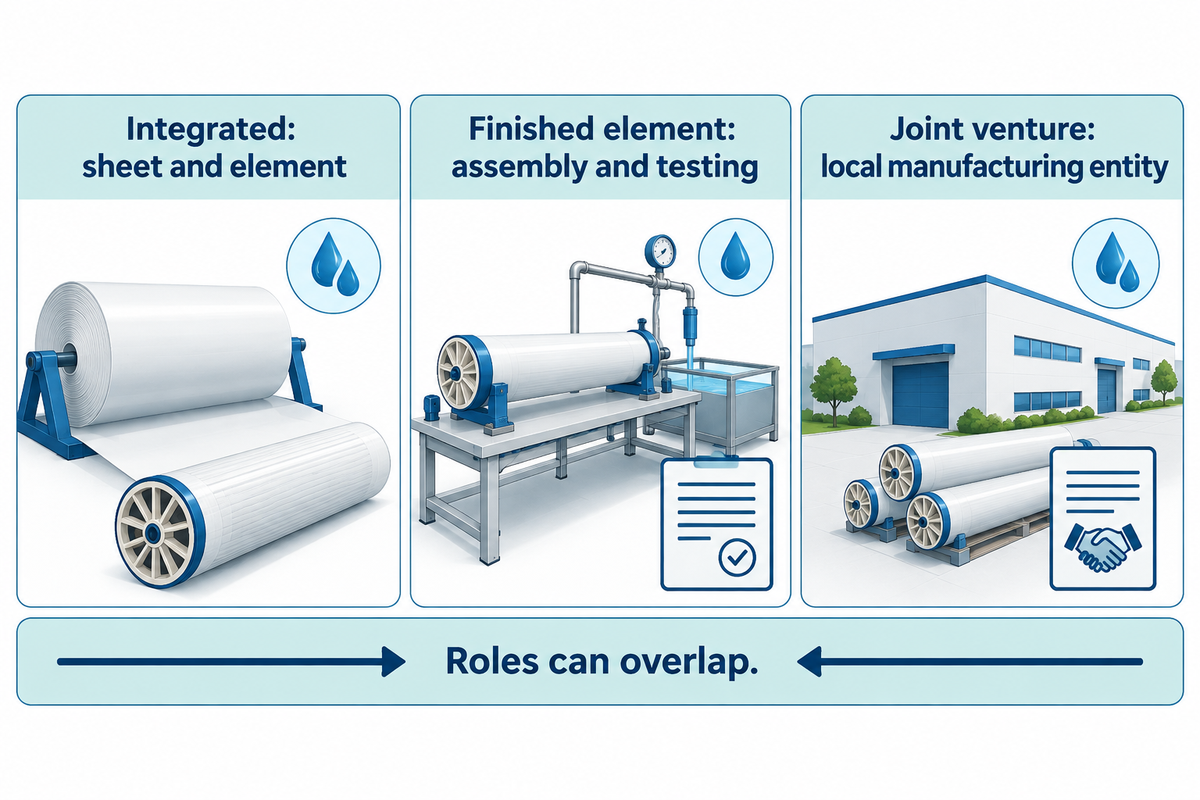
The 3-Role Manufacturing Split
An integrated producer makes sheets and elements; a finished-element producer may use purchased sheet; a Chinese joint venture is the local manufacturing business. These roles can overlap: a joint venture may manufacture both sheet and elements. The order should identify the sheet maker, the element assembler and tester, and the Chinese entity accepting the purchase.
The table separates the company you buy from, the manufacturing it describes and the work its RO portfolio suits. Related businesses are counted once: Wave Cyber and its Ospura subsidiary occupy one entry. BlueStar Toray is identified as a Chinese joint-venture manufacturer, rather than being assigned its Japanese parent’s founding year.
| No. | Manufacturer | Headquarters / China production base | Founded | Best For | RO products and manufacturing role | Key advantages | Potential disadvantages | Official website |
|---|---|---|---|---|---|---|---|---|
| 1 | Blue Membrane / BlueTong Technology (Nantong) Co., Ltd. | Nantong, Jiangsu | Not publicly disclosed | OEM and custom RO membrane elements | BE custom elements; C/Z/H industrial families; element manufacturing, with in-house sheet/winding stated for Z1 | Defined BE geometry, seals, end caps and branding | BE customization covers small formats; industrial projects use separate C/Z/H specifications | bluemembrane.com |
| 2 | Vontron Technology Co., Ltd. | Guiyang, Guizhou | 1999 | Broad industrial RO product sourcing | RO sheet and spiral-wound element manufacturing; ULP, brackish, fouling-resistant and seawater families | Automated sheet and winding lines; multiple industrial duties | ULP application scope is below 2,000 ppm feed TDS | en.vontron.com |
| 3 | Hunan KeenSen Technology Co., Ltd. | Changsha, Hunan | 2008 | Application engineering and diagnostic support | RO sheets and elements; industrial, commercial and household lines | Published selection, water-analysis and fault-diagnosis services | Warranty requires complete, continuous operating records | keensen.com |
| 4 | Hunan OVAY Technology Co., Ltd. | Zhuzhou, Hunan | 2014, predecessor | Seawater projects comparing energy and rejection variants | RO materials and elements; OV-U, OV-L, OV-SW, OV-X and OV-FR | Separate seawater LE, HR and other model choices | OV-SW has a defined chlorine and continuous-operation chemical envelope | ovay.com.cn |
| 5 | BlueStar Toray / TBMC | Beijing | 2009, Chinese joint venture | Toray-based industrial projects in China | Chinese membrane-making and winding operation; TOUGH and TBW RO families | Local manufacture and Toray application channels | Wider Toray sales coverage does not make every offered model China-made | tbmc-bj.com |
| 6 | Wave Cyber / Guangdong Ospura | Shanghai parent; Guangdong membrane subsidiary | 2001 / 2011, respectively | RO sheets and elements within a pressure-component group | RO sheet and element production; SW, BW, ULP, XULP and FR families | Membrane and pressure-component manufacturing within one group | Published FR options use standard industrial formats, not every compact commercial size | wave-cyber.com |
| 7 | Beijing OriginWater Membrane Technology Co., Ltd. | Huairou, Beijing | 2006 | Industrial RO across reuse and desalination duties | RO manufacturing within a multi-membrane producer; FLM-BW, LP, ULP, XLP and SW models | Model-specific industrial and seawater product pages | Individual-element flow tolerance varies by model | originwatermem.com |
| 8 | HID Membrane Co., Ltd. | Zhenjiang, Jiangsu | 2008, company history | Residential and commercial elements with in-house sheet production | Composite-polyamide flat-sheet production and element rolling/testing; TFC and industrial lines | Supplies both sheet and finished elements | Wetted elements need continued moisture and preservation control | rotec-hid.com |
| 9 | N-Tech Environmental Protection Science and Technology (Changzhou) Co., Ltd. | Changzhou, Jiangsu; separate Sichuan base | 2016 | Industrial brackish-water and reuse projects with documented Chinese production | RO sheet coating and finished elements; BW, SW, FR, ULP and ELP families | Named BW-8040/BW-4040 models and documented Chinese membrane production | BW feedwater scope is up to 10,000 mg/L TDS; seawater uses SW family | en.n-techcz.com |
| 10 | Shandong JOZZON Membrane Technology Co., Ltd. | Dongying, Shandong | 2011, company profile | Dry RO elements for distribution and industrial supply | Coating, laminating and spiral winding; JBW, JSW, JEC and JRW families | Dry-element production and industrial application range | Dry elements require a startup stabilization period | jozzongroup.com |
Profiles contain information connecting products to purchasing uses. Establishment dates refer to the named business. Production milestones and parent-company history are identified separately.
OEM and Custom RO Membrane Elements
1. Blue Membrane: Best for OEM and custom RO membrane elements
Headquarters: Nantong, Jiangsu, China · Founded: Not publicly disclosed · Company: BlueTong Technology (Nantong) Co., Ltd.
Official website: bluemembrane.com
Main products: BE residential/custom elements; C1/C2 low-pressure, Z1 brackish-water, Z2 fouling-resistant and H1/H2 seawater RO elements.
Blue Membrane makes membrane sheets and winds Z1 elements in-house, according to its Z1 page. Its contact page identifies BlueTong as the company and Nantong as the factory/office location. Company identity Z1 manufacturing statement
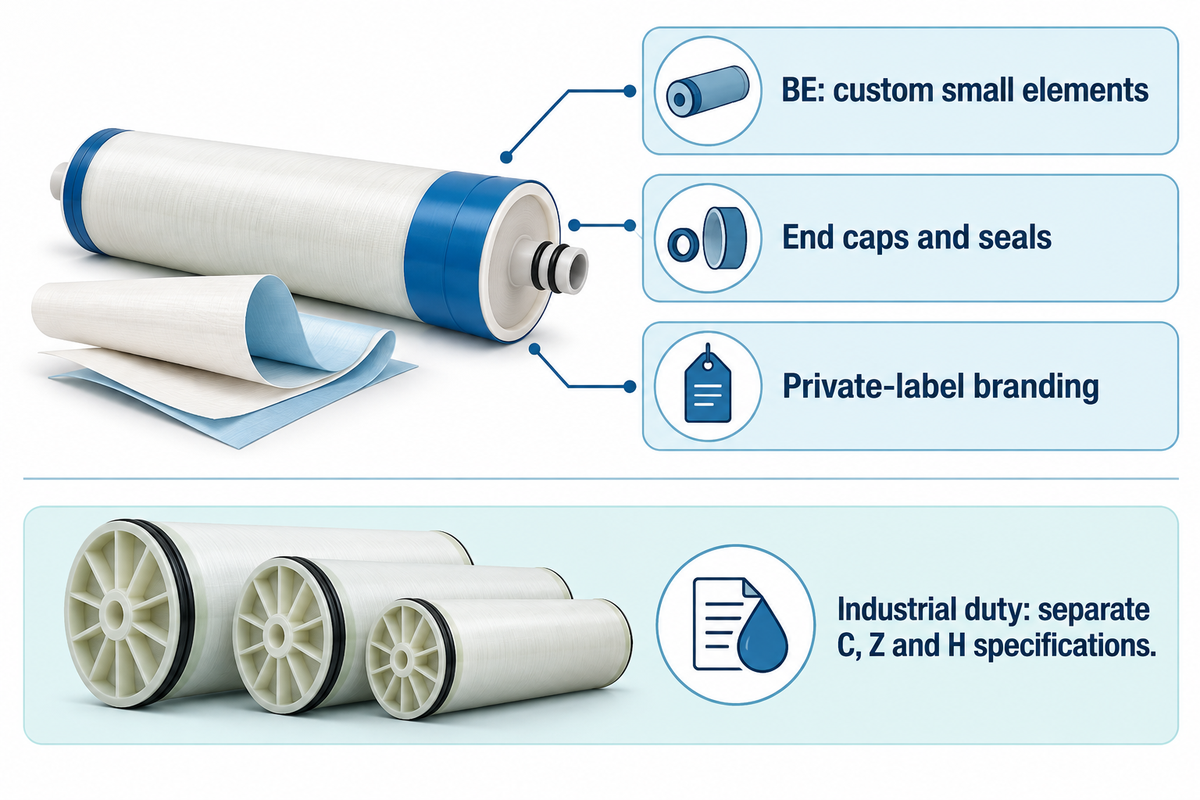
For the BE series, the customization envelope published by Blue Membrane is 35–90 mm diameter, 180–333 mm length, rated output of 50–1,600 GPD and dimensional tolerance of ±0.5 mm. End-cap design, seal configuration and private-label branding are included in the published options. These are BE configuration and catalog-output figures; the GPD range isn’t a field-production guarantee. BE customization
Blue Membrane offers 4040/8040 industrial options in its C, Z and H ranges, separately from the BE customization envelope. Associated product pages give each model’s test solution, concentration, pressure, temperature and pH. RO product families
Potential disadvantages: BE customization is limited to small residential and commercial element formats; industrial 4040/8040 projects require selection from separate C, Z or H series specifications.
Industrial Portfolios and Application Support
2. Vontron: Best for broad industrial RO product sourcing
Headquarters: Guiyang, Guizhou, China · Founded: 1999, according to the company profile · Type: Integrated membrane-sheet and element manufacturer.
Published qualifications: Vontron’s company profile lists CNAS, NSF, ISO, CQC and RoHS credentials. This is the manufacturer’s published qualification list; the applicable model or management-system scope remains specific to the relevant document.
Official website: en.vontron.com
Main products: ULP ultra-low-pressure, brackish-water, fouling-resistant, seawater, heat-sanitizable and other industrial RO elements.
Vontron Technology Co., Ltd. manufactures membrane sheets and finished elements using a fully automated dry-type sheet-production line and an automated spiral-winding line, according to its company description. Its headquarters is in Guiyang; Beijing houses its marketing center.
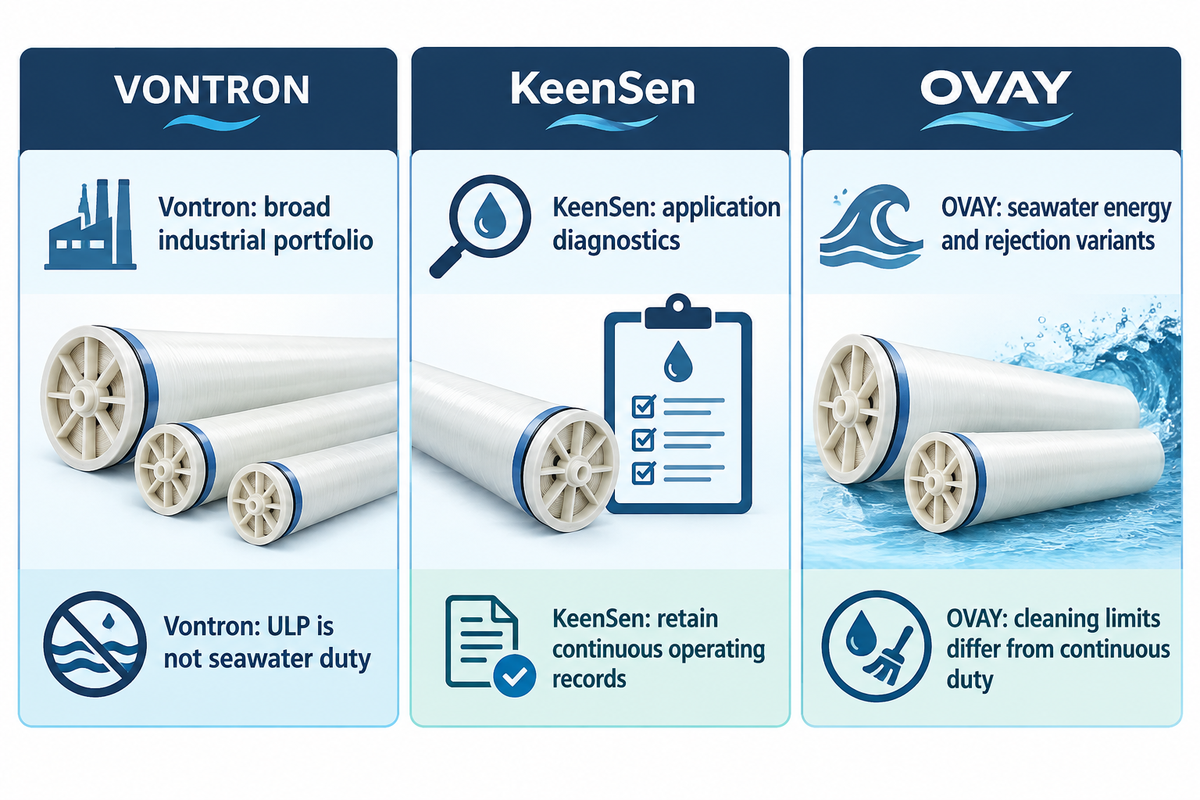
Vontron suits industrial sourcing across several feedwater duties, with ULP21-4040, ULP32-8040, PURO fouling-resistant grades and SW seawater elements in its catalog. Select the grade for the plant’s feedwater duty.
Potential disadvantages: Vontron describes its ULP series as normally suitable for surface, underground and municipal water below 2,000 ppm TDS. A low-pressure ULP quotation therefore doesn’t cover seawater duty or every higher-salinity process stream; those applications require a different family. This is a published feedwater application boundary, not a rejection-test condition.
3. KeenSen: Best for application engineering and diagnostic support
Headquarters: Changsha, Hunan, China · Founded: 2008 · Type: Integrated membrane-sheet and element manufacturer.
Official website: keensen.com
Main products: Industrial, commercial and household RO; XLP, ULP, brackish-water, fouling-resistant and seawater families.
Hunan KeenSen Technology Co., Ltd. combines automatic membrane-sheet and element-production capability with selection, system application, water-quality analysis, fault diagnosis and maintenance services. Its profile gives its Changsha address and establishment year.
KeenSen’s XLP-4040 and XLP-8040 target low-salinity surface, groundwater and municipal feeds below 1,000 mg/L. Its other RO families cover different duties, including brackish water and seawater.
Potential disadvantages: The published warranty requires users to retain true, complete and continuous operating records. Operators without reliable historical data face a practical limitation when pursuing a performance claim. A technical-service offer should therefore be paired with the site’s ability to produce the required records.
4. OVAY: Best for seawater projects comparing energy and rejection variants
Headquarters: Zhuzhou, Hunan, China · Founded: 2014, predecessor established in December · Type: Membrane-material and finished-element manufacturer.
Official website: ovay.com.cn
Main products: OV-U ultra-low-pressure, OV-L low-pressure, OV-SW seawater, OV-X extremely-low-pressure and OV-FR fouling-resistant RO elements.
Hunan OVAY Technology Co., Ltd. manufactures RO membrane materials and finished elements on production lines in Zhuzhou. The original business was established in 2014 and later converted to the joint-stock company.
OV-SW offers LE, HR, XLE and XHR variants in compact and industrial formats for comparing intended energy/rejection trade-offs. These are product-selection categories; plant energy consumption requires a project-specific comparison.
Potential disadvantages: For the OV-SW series, the published chemical envelope requires free chlorine below 0.1 ppm and distinguishes continuous-operation pH 2–11 from cleaning pH 1–13. The wider cleaning range isn’t a continuous operating allowance. Oxidant exposure and cleaning arrangements must fit that specific series envelope.
Chinese Joint-Venture and Group Manufacturing
5. BlueStar Toray (TBMC): Best for Toray-based industrial projects in China
Headquarters: Beijing, China · Founded: 2009, Chinese joint venture · Type: China joint-venture membrane-sheet and element manufacturer.
Company milestone: The official timeline records a Beijing water-contact product hygiene approval in 2014. This is a historical company milestone, separate from the approval status of a currently ordered model.
Official website: tbmc-bj.com
Main products: TOUGH brackish-water, ultra-low-pressure, fouling-resistant and seawater RO families; TBW high-rejection RO for ultrapure-water applications.
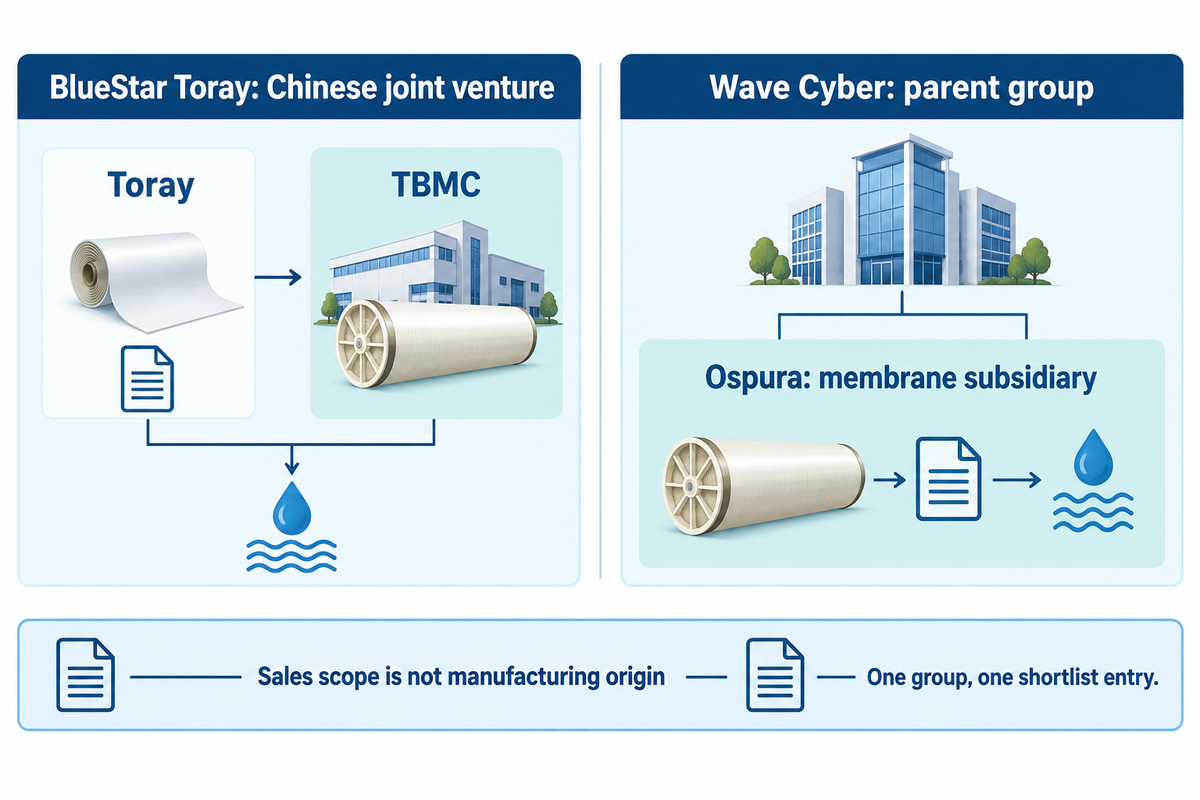
BlueStar Toray is the Chinese manufacturing business, not simply a sales office carrying a foreign logo. Its profile identifies the Sinochem Bluestar and Toray investment relationship and describes an intelligent membrane-making and roll-winding system. Toray’s own history records the Chinese joint venture’s establishment in 2009; the local company timeline records formal production in 2011. Toray Industries’ 1926 founding date belongs to the Japanese parent.
TBMC suits industrial projects using Toray technology, Chinese manufacturing and local application channels. Its development milestones include several TOUGH RO families and the introduction of TBW for ultrapure-water duty.
Potential disadvantages: TBMC also acts as Toray’s China sales and application window across a wider membrane portfolio. That sales scope shouldn’t be read as a statement that every Toray model offered is manufactured at the Chinese joint venture. A China-origin purchase needs a model-specific country-of-manufacture commitment.
6. Wave Cyber / Ospura: Best for RO sheets and elements within a pressure-component group
Headquarters: Shanghai parent; Guangdong membrane subsidiary · Founded: Wave Cyber in 2001; Guangdong Ospura in 2011 · Type: Integrated sheet and element manufacturing group.
Official website: wave-cyber.com
Main products: Ospura SW, BW, ULP, XULP and FR RO elements, residential OSP elements and RO membrane sheets.
Wave Cyber (Shanghai) Co., Ltd. identifies Guangdong Ospura as its wholly owned membrane subsidiary. The official group description covers RO sheets and elements as well as pressure tanks and membrane pressure vessels. These businesses count as one entry here, rather than two manufacturers competing for separate places.
Its RO product chart identifies industrial and compact formats, including BW-8040-400, ULP-4040, SW-2540/2521 and residential OSP models. Buyers combining membrane sourcing with pressure-component procurement can assess related manufacturing businesses within one group, while retaining separate specifications for the element and vessel.
Potential disadvantages: The illustrated FR range lists FR-4040 and FR-8040-400(34), while compact commercial sizes appear under other families. A buyer needing a short commercial element with fouling-resistant duty can’t assume every compact format has a matching FR catalog option. This is a boundary of the published chart, not a statement that custom supply is impossible.
Industrial, Residential and Distribution Specialists
7. OriginWater Membrane: Best for industrial RO across reuse and desalination duties
Headquarters: Huairou, Beijing, China · Founded: 2006 · Company: Beijing OriginWater Membrane Technology Co., Ltd.
Official website: originwatermem.com
Main products: FLM-BW, FLM-LP, FLM-ULP, FLM-XLP and FLM-SW RO elements, alongside separate NF, UF and MF technologies.
Beijing OriginWater Membrane Technology Co., Ltd. provides membrane research, manufacturing and application capabilities, including RO products. Established in 2006 in Huairou, Beijing, it’s the specific manufacturing business within the wider OriginWater group covered here.
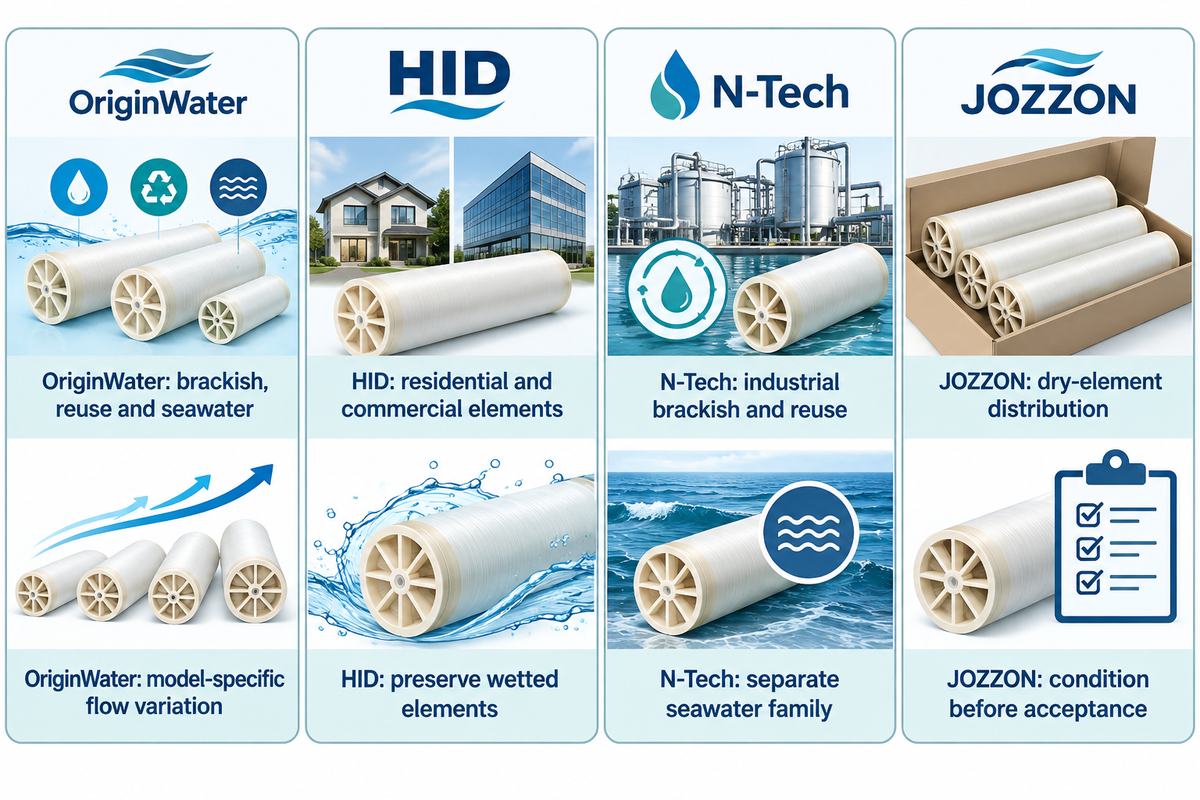
OriginWater covers industrial brackish/reuse and seawater duties with FLM-BW8040-LPB(440) and FLM-SW8040-HF(400), respectively.
Potential disadvantages: Published individual-element permeate-flow variation is model-specific: ±20% for FLM-BW8040-LPB(440), versus ±15% for FLM-SW8040-HF(400). Buyers comparing nominal output must retain each model’s own tolerance and test conditions; the worked example below shows the numerical effect.
8. HID Membrane: Best for residential and commercial elements backed by in-house sheet production
Headquarters: Zhenjiang, Jiangsu, China · Founded: 2008, according to company history · Type: Integrated membrane-sheet and element manufacturer.
Published quality documentation: HID’s certification page displays an ISO 9001 certificate image. A quality-management document describes its stated organizational scope; it does not establish an element’s salt-rejection performance.
Official website: rotec-hid.com
Main products: TFC residential and commercial elements; industrial tap-water, brackish-water and seawater RO elements; composite-polyamide RO flat sheet.
HID describes in-house flat-sheet production and finished-element manufacturing and testing, using automatic flat-sheet production and element-rolling lines. Its history dates its origin to Shenzhen in 2008 and its move to Zhenjiang to 2010.
HID suits residential or commercial supply programs seeking a supplier that also produces RO sheet. TFC-1812 and TFC-2012 are household formats; its commercial and industrial catalogs cover additional duties, with industrial seawater applications requiring the appropriate family.
Potential disadvantages: HID’s element-handling instructions require membranes to remain moist after initial wetting. A distribution or sample program that opens and wets stock therefore needs preservation controls; it can’t return used samples to ordinary dry storage.
9. N-Tech: Best for industrial brackish-water and reuse projects with documented Chinese production
Headquarters: Changzhou, Jiangsu, China · Founded: 2016 · Company: N-Tech Environmental Protection Science and Technology (Changzhou) Co., Ltd.
Official website: en.n-techcz.com
Main products: BW brackish-water, SW seawater, FR fouling-resistant, ULP ultra-low-pressure and ELP low-pressure RO membrane elements.
According to its website, N-Tech combines membrane development, design, production and application services, with a Changzhou base and a separate Sichuan manufacturing operation. Its RO product information describes composite membrane coating and automated production lines. In a September 2024 factory-visit report, the Changzhou Water Resources Bureau recorded officials viewing seawater and reverse osmosis membrane production at the company. Government factory-visit record
N-Tech’s BW-8040 and BW-4040 serve industrial brackish-water treatment and reclaimed-water reuse, with the BW family targeting total dissolved solids of 10,000 mg/L or less. The BW family’s listed test basis is 2,000 ppm NaCl, 225 psi, 25°C, pH 7–8 and 15% recovery, with individual-element output variation of ±15%.
Potential disadvantages: The published BW range addresses brackish and lower-salinity duties; seawater orders need the separate SW family and its own model selection. A BW quotation shouldn’t be treated as covering the full RO portfolio.
10. JOZZON: Best for dry RO elements for distribution and industrial supply
Headquarters: Dongying, Shandong, China · Founded: 2011, company profile · Company: Shandong JOZZON Membrane Technology Co., Ltd.
Official website: jozzongroup.com
Main products: JBW brackish-water, JSW seawater, JEC low-energy and JRW low-pressure RO families, including dry membrane elements.
JOZZON’s Dongying facility has coating, laminating and spiral-winding production lines for membrane materials and finished elements, according to its About page. Its product pages distinguish RO families from UF, NF and gas-separation products.
JOZZON offers dry elements for distribution and industrial supply programs involving transport, storage and subsequent startup.
Potential disadvantages: JOZZON states that its dry elements pass through a stabilization period after startup: rejection rises while flow can decline before settling. Immediate first-flush readings are therefore a poor basis for accepting or rejecting a delivery; the order needs a defined conditioning and test procedure.
How to Choose an RO Membrane Manufacturer from This China Shortlist
For water duty and mechanical format, look for a manufacturer of membrane element or sheet. The same holds true for the performance basis and production responsibility. A known name helps create a short list, and the order specifies a particular membrane element or sheet grade. This section applies the checks below to the China-based manufacturers above. For the full supplier-qualification and RFQ process, including document review, risk screening and lifecycle cost, see our guide to choosing an RO membrane supplier.
Separate Sheet Supply from Finished-Element Supply
An integrated producer makes membrane sheet and the finished spiral-wound element, with responsibility for leaf assembly, winding and element testing. A reseller of completed elements doesn’t become a manufacturer by applying a private label.
For sheet procurement, define a roll or cut sheet of a given grade and usable dimensions. Define handling requirements and lot-level test documentation. For finished-element procurement, identify the maker responsible for assembly and final testing. A sheet procurement result does not inspect the final element’s seals. An assembled-element procurement result does not disclose the maker who formulated or coated its sheet.
A specific OEM membrane factory is relevant when the element drawing, end-cap geometry, sealing arrangement, or label is part of the product. The purchase specification should show what, if any, of those components is customized. Changing branding solely is a different scope of work from developing a new mechanical configuration.
Reverse osmosis membrane manufacturers may offer membranes, finished assemblies or both. Ask which membrane products are made at the named plant and which are purchased for assembly; that answer tells who can evaluate a sheet defect or a winding problem.
For specialty orders, identify the sheet chemistry and construction. If the specification requires cellulose rather than a thin-film composite material, resolve that before comparing an existing product family. A general claim of expertise in water doesn’t point to a suitable element.
Who makes reverse osmosis membranes?
Integrated sheet-and-element producers and genuine finished-element manufacturers both make RO products.
Distinction is where production responsibility starts. In the case of this China-centered list, the manufacturer must disclose their RO products and their actual production role; an equipment integrator or a seller who merely puts a label on a finished element doesn’t qualify on this basis alone.
Match the RO Family to the Feedwater and Product-Water Duty
A low-pressure drinking water element, a brackish-water industrial RO element and a seawater element are provided to meet different feed and hydraulic conditions. Start with the source-water analysis, temperature range, target product-water quality and intended recovery. A total-dissolved-solids figure helps classify the feed, but the individual ions and contaminants matter to the process design as well.
Seawater buyers may prioritize salt passage and a specified constituent; reuse buyers may need a fouling-management strategy; purifier OEMs may first need a mechanically compatible small element. Put that application-specific requirement in the request. Water-analysis scope for RO applications
Select Ultra-low-pressure, high-rejection and fouling-resistant families to shortlist models based on the intended design, and then evaluate each against the water analysis, operating projection and cleaning plan for the specified service.
Describe the complete ro system, including upstream filter and pretreatment. Replacing a cartridge doesn’t in itself resolve a mismatch between the raw water and selected membrane.
For seawater reverse osmosis, request a projection of the actual salinity and temperature. A seawater desalination proposal and a wastewater treatment proposal address different feed conditions, even if the element formats are similar.
Water and wastewater treatment covers many duties. Indicate whether the order supports water purification, process water production, or recycling, and provide the outlet limits. This makes water treatment solutions comparable among suppliers.
Where fluoride or nitrate is an acceptance concern, request contaminant-specific evidence for the selected model. For heavy metals, including lead, identify the dissolved species and sampling method; a general salt-rejection number does not establish removal of every impurity.
Nanofiltration and reverse osmosis are separate options to evaluate against the separation duty. Don’t select a level of filtration based on a particle-size analogy alone; a drawing of a water molecule doesn’t prove performance for the proposed feedwater.
For commercial and industrial applications, turn phrases like clean water or quality water into measurable criteria.
A supplier asked to purify water needs those limits, the feed analysis and the required flow, rather than an undefined product-water label.
What are the different types of RO membranes?
Types of membrane can be distinguished based on the material used, the construction of the module, and the type of water service. A thin-film composite membrane can be a spiral-wound element of brackish water, or a seawater element; these classifications, however, may overlap. For this shortlist, the useful buying groups are residential or commercial elements, industrial low-pressure elements, brackish-water elements, seawater elements and fouling-resistant families.
Put Every Performance Claim on Its Test Basis
Test elements against the design basis and requirements, and record stable, typical, average and minimum rejection in separate fields. Keep values for solute, concentration, and design requirements (e.g. temperature, pressure, pH, recovery, allowed variation of flow) separate.
Specific requirements on the permeate quality will depend on the actual feed composition and design. ASTM D4194-23 covers short term characterization under standard conditions; evaluation of sodium-chloride rejection values needs to be done against the plant’s natural-water feed and design. ASTM D4194-23 scope
Compare duty and energy of pumps for the same project. A model’s listed test pressure is a measurement condition; actual installation pressure follows the operating design. Avoid assigning a savings percentage solely because two catalog tables use different test pressures.
Project reverse osmosis water output for the installation’s operating conditions. When using a GPD catalogue value, identify the gallon convention and retain the specified test conditions.
Check Mechanical Interfaces Beyond the 4040 or 8040 Label
Compatibility depends on the matching of the interconnectors and length of the product water tubes, as well as the direction of brine seals. The nominal dimensions of the product help narrow the selection. The hydraulic assessment requires evaluation of effective area, feed-spacer configuration, allowable pressure drop and position in the array.
Select a replacement against the installed element and vessel information, applicable drawing and system design, covering interfaces and operating conditions. Brand-to-brand cross-references, including Blue Membrane’s RO compatibility chart, provide candidate models for that comparison.
The element quote, vessel drawing and installation scope should agree before purchasing releases the order. A nominally correct element can still require work from the system integrator.
Plan membrane replacement from the installed vessel and connection drawings. Before installing a proposed alternative, agree the startup checks and record the original operating data so the changeout can be evaluated on the same basis.
Separate Continuous Duty, Cleaning Limits and Storage Conditions
Continuous operation within a boundary of a maximum pressure, temperature or pH range doesn’t suggest that range is a normal operating condition. Retain the manufacturer’s distinction between normal operation, cleaning and short-duration exposure. Storage and start-up instructions for the element selected are to be included, particularly for elements that are distributed over a long distance or are dry at the time of purchase.
OVAY separates continuous-operation limits from chemical-cleaning conditions, while JOZZON describes stabilization after dry-element startup. These requirements address different stages of an element’s life. The warehouse, commissioning team and operator need the instructions for the delivered model and supply condition.
Be specific about the conditions, packaging and preservation in the purchase order. Agree how the factory informs about a change in preservation, packing and/or handling instructions. The warehouse and commissioning teams need the instructions for the delivered version, rather than a procedure copied from a different element family.
Attach Certification to the Product or Facility It Actually Covers
Certification covers the listed model, materials, facility or management-system scope. For an NSF claim on a homepage, coverage remains specific to the listing. An ISO management-system certificate covers the specified organization and activities; individual membrane-element salt rejection is a separate performance measure.
For drinking-water purchases, distinguish NSF/ANSI 58 system or applicable component coverage from NSF/ANSI/CAN 61 health-effects requirements. Neither label should be extended to a different model by resemblance. Keep the exact listing and scope with the product being purchased, rather than treating a brand’s entire range as one certified item. NSF/ANSI 58 scope NSF/ANSI/CAN 61 scope
Define Sample Acceptance and Warranty Evidence Before Production
You must agree the identity of the sample, its conditioning procedure, test basis and acceptance criteria before using it to approve a larger order. Typically, the model revision and lot reference are tracked as well in order to connect the approved sample to the subsequent delivery. A first wetting or first-flush reading of a sample shouldn’t be used in lieu of the manufacturer’s specified stabilized test.
The warranty conversation should cover both what the supplier promises and the evidence the operator must retain. KeenSen’s published requirement for complete, continuous operating data illustrates how documentation affects a claim. Packaging, storage, operation and cleaning records can therefore be part of the commercial evaluation, alongside price and the datasheet.
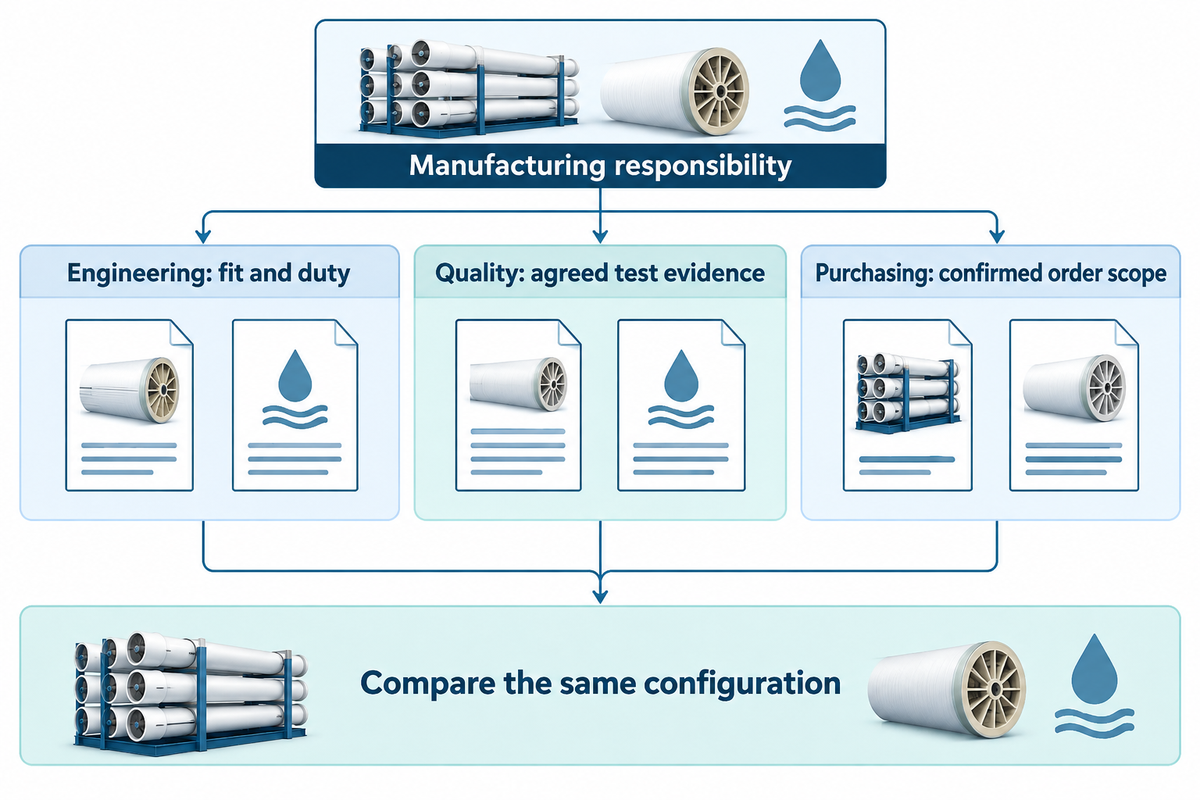
For an OEM project, have the approved drawing, label and packaging revision in the same approval set. A technically acceptable membrane does not resolve a changed tube connection or an incorrect private-label specification. Each team should have clear acceptance criteria. Engineering owns fit, quality owns the agreed test evidence, and purchasing owns the confirmed order scope.
Agree on a sampling plan. Define consistent quality through an agreed sampling plan, traceable lot identification and recorded acceptance tests. A description such as high-performance or advanced membrane still needs a specific model, test basis and contractual acceptance range.
Compare the Complete Offer on a Common Configuration
Compare quoted elements for the same intended duty, test basis, format, quantity, and supply condition. Ensure packaging, freight terms, inspection scope, payment terms, warranty, and confirmed lead time are aligned. Without the same configuration, a lower unit price may describe a product with a different duty, a more restrictive test basis, different format, a narrower delivery obligation.
Request a dated quotation for the selected model, quantity, and delivery terms. Compare the complete technical and commercial offer: a household element, an industrial brackish water element, and a seawater element buy different duties, even when all three are described as an RO membrane.
Keep lower-priced alternatives under consideration while test basis or drawing resolution is pending, and describe the open items in the written comparison. Award against the documented offer rather than assumptions of the manufacturer’s reputation.
A cost-effective offer accounts for element life, pretreatment, energy and replacement work within the proposed duty. For commercial applications, evaluate the assumptions made and purchase price together, rather than treating a lower unit price as a complete operating-cost calculation.
For scalable water solutions, ask how the proposed model, spare supply and warranty process support the next project stage. Different industrial needs and water treatment applications require their own acceptance criteria; a larger order does not resolve a mismatch in the first design.
Evaluate sustainable operation using the tender’s specified energy, water recovery or waste measure. Assess what the proposed element can remove under the stated conditions and what pretreatment remains necessary.
A Model-Specific Flow-Tolerance Example
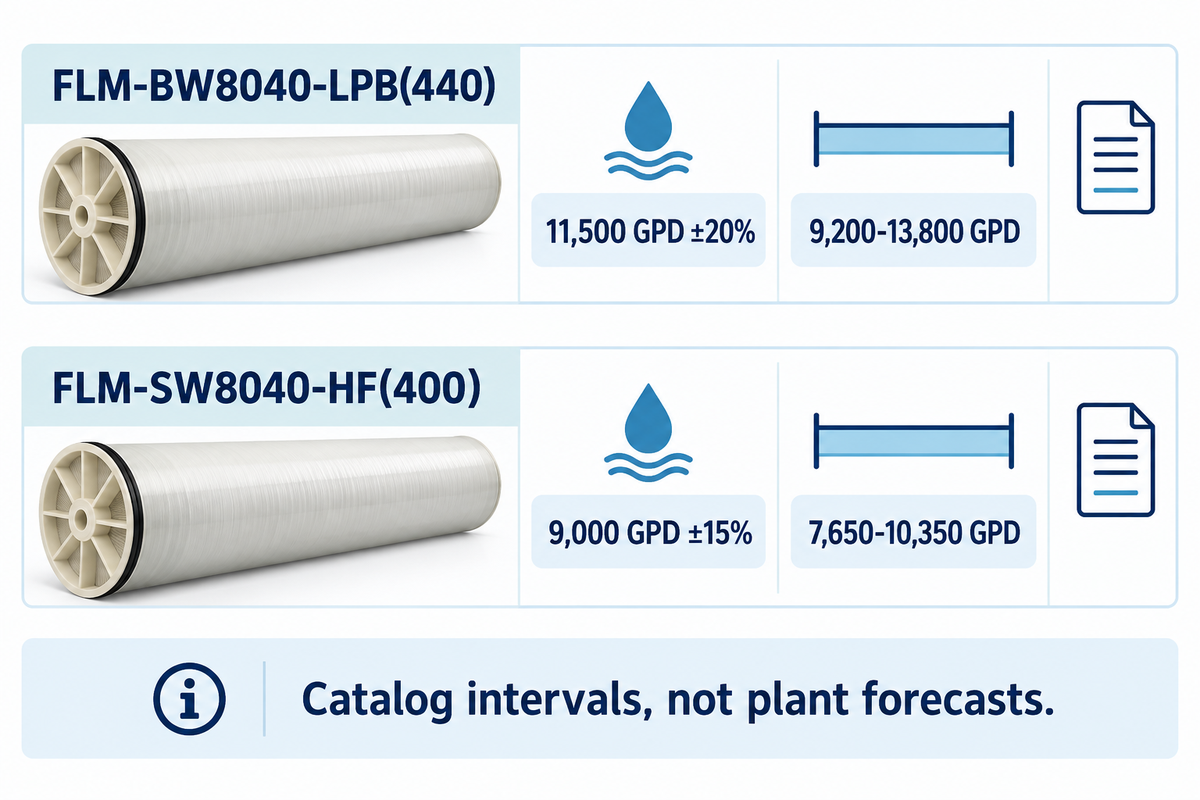
OriginWater’s two model pages show why catalog output and permitted individual-element variation belong together. Published inputs: FLM-BW8040-LPB(440) lists average output of 11,500 GPD with ±20% individual variation; FLM-SW8040-HF(400) lists 9,000 GPD with ±15%. Each retains the test conditions below. The calculated intervals illustrate that published variation; they aren’t plant forecasts, contractual minimum guarantees or a performance ranking.
Calculation: Nominal catalog output (1 – stated variation) to nominal catalog output (1 + stated variation).
| Model | Published test conditions | Published catalog flow and variation | Arithmetic interval from that variation |
|---|---|---|---|
| FLM-BW8040-LPB(440) | 2,000 ppm NaCl; 225 psi; 25°C; 15% recovery; pH 7.5–8.0 | 11,500 GPD; ±20% | 9,200–13,800 GPD |
| FLM-SW8040-HF(400) | 32,000 ppm NaCl; 800 psi; 25°C; 8% recovery; pH 7.5–8.0 | 9,000 GPD; ±15% | 7,650–10,350 GPD |
For the BW model, the lower calculation is 11,500 × 0.80 = 9,200 GPD. Applying the seawater model’s ±15% would incorrectly narrow its published variation. System output requires a projection accounting for feed conditions changing through the array, rather than either interval multiplied by the number of elements.
Maintain the published tolerance on the particular model and state the contractual acceptance basis separately. Catalog averages and guaranteed minimums are different quantities, and nominally 8040 elements may be toleranced differently.
Standards and Certification Scope in October 2026
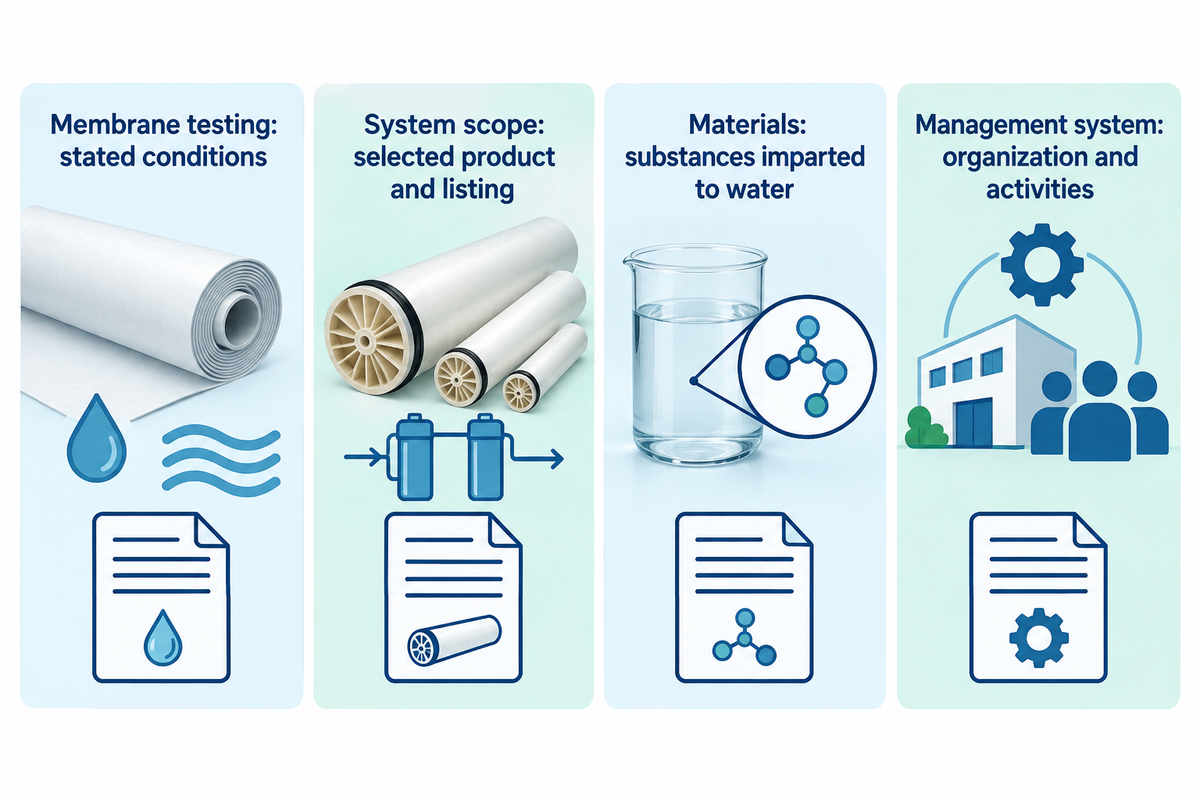
Make sure the product you purchase meets the standard. Match the standard to the purchase: membrane test, spiral-wound element, treatment system or management system. For the particular model and scope, use the applicable certificate or test report alongside the brochure’s standard reference.
| Standard / edition | Relevant scope | Procurement meaning |
|---|---|---|
| GB/T 32373-2025 | RO membrane test methods; effective March 1, 2026 | Use the current edition rather than presenting GB/T 32373-2015 as current. |
| GB/T 34241-2017 | Spiral-wound composite-polyamide RO membrane elements | Relevant to the element category; its existence does not certify a manufacturer. |
| GB/T 38908-2020 | Chlorine-resistance testing of household RO/NF elements | Keep the household test scope; do not generalize it into industrial chlorine immunity. |
| GB/T 19249-2017 | RO water-treatment equipment | Equipment scope is distinct from certification of a single membrane element. |
| ASTM D4194-23 | Standard-condition operating-characteristic tests for RO/NF devices | Supports characterization under stated conditions, not a complete plant design. |
| ASTM D4189-23 | Silt Density Index testing of water | Describes a feedwater fouling indicator; it is not element certification. |
| NSF/ANSI 58-2025 | RO drinking-water treatment systems | Model and applicable listing scope matter; do not extend it to all industrial 8040 products. |
| NSF/ANSI/CAN 61-2025 | Health effects of drinking-water system materials and components | Addresses substances imparted to water, rather than desalination performance. |
| ISO 9001:2026 | Organizational quality-management requirements | Evaluate the certificate’s organizational and activity scope, not element performance. |
The Chinese standards status and dates are available in the national standards register, with a separate GB/T 34241-2017 record. The ASTM owners’ pages identify D4194-23 and D4189-23. NSF’s publication records identify the 58-2025 edition and 61-2025 edition
ISO published ISO 9001:2026 on September 16, 2026. Global ACI sets September 30, 2029 as the transition deadline for organizations certified to ISO 9001:2015 within the applicable scope of its Multilateral Recognition Arrangement. A 2015-edition certificate therefore needs its own validity and accreditation-scope check during that transition. Global ACI transition requirements
A Quote-Comparison Sheet for RO Element Buyers
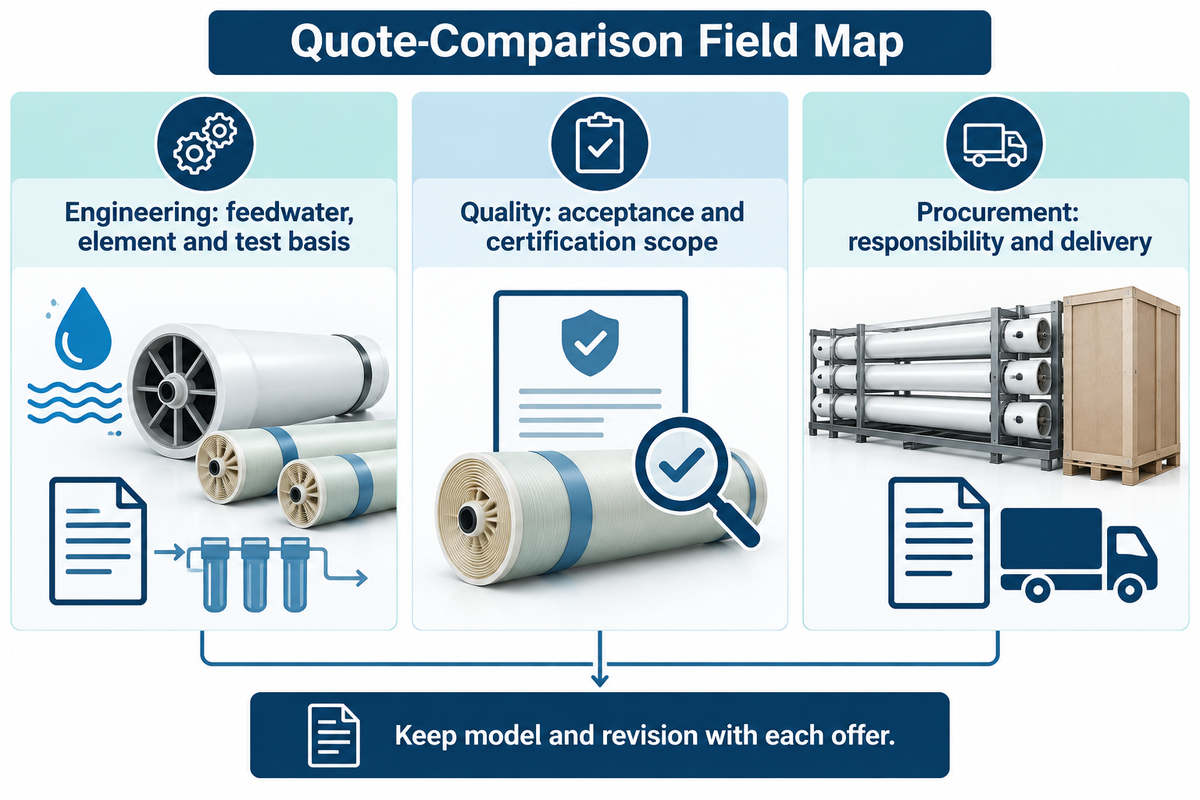
– Collect each factory’s proposed model, documented revision, and technical and commercial responses on this quote-comparison sheet, with each question assigned to the team who needs its answer.
| Decision item | What the supplier should identify | Buyer team | Why it changes the purchase |
|---|---|---|---|
| Manufacturing responsibility | Legal seller, element factory, sheet source and work performed in-house | Procurement / quality | Assigns responsibility for material and assembly issues. |
| Feedwater and duty | Analysis used, temperature range, target permeate quality and proposed recovery | Process engineering | Establishes whether the proposed RO family addresses the actual application. |
| Exact element | Model, dimensions, tube/interface drawing, spacer and effective area | Mechanical / process engineering | Resolves fit and hydraulic assumptions. |
| Performance basis | Test solute, concentration, pressure, temperature, pH, recovery and stabilization | Quality / engineering | Makes the quoted flow and rejection interpretable. |
| Acceptance promise | Minimum versus average values, tolerances, test method and lot documents | Quality / procurement | Defines what delivery acceptance actually measures. |
| OEM configuration | Approved drawing, seal, end-cap and branding revisions | Product development / procurement | Controls customized parts and repeat-order consistency. |
| Handling and startup | Supplied dry/wet condition, preservation, storage and conditioning instructions | Warehouse / commissioning | Connects the delivered product to its required handling. |
| Certification scope | Exact listed model or facility, certificate status and applicable claim | Quality / compliance | Prevents a logo from standing in for model coverage. |
| Commercial delivery | Confirmed quantity, packing, freight basis, lead time and warranty evidence | Procurement / finance | Aligns the full commitment being compared. |
For small element OEM orders, drawing and repeatability of the approved configuration might be deciding factors for award of a contract. For an industrial replacement, the projection of process and interfaces may need to be resolved earlier. For a distribution program, preservation and traceability travel with the stock. The same factory can be assessed differently for these three purchases without changing the underlying product facts.
Frequently Asked Questions
Which company makes the best RO membranes?
For industrial sourcing in China, start with Vontron, KeenSen and BlueStar Toray.
Vontron covers several industrial water duties, KeenSen publishes application and diagnostic support, and BlueStar Toray combines local manufacture with Toray-based product families. Blue Membrane addresses OEM and custom small-element projects. Compare the exact model, feedwater duty, interfaces and acceptance conditions before selecting a supplier; a brand name alone doesn’t define the purchased element.
What are some popular brands of reverse osmosis membranes?
FilmTec, Toray, Hydranautics and Vontron are established names buyers encounter.
A familiar brand and a Chinese manufacturing company are different entries in a sourcing decision. This guide focuses on the Chinese entities that manufacture RO sheet or finished elements. BlueStar Toray is identified as a Chinese joint venture, and Wave Cyber with Ospura is counted once. Use the listed product families to compare the actual offer.
Which is the best RO membrane in the world?
Choose by application: an OEM element and a seawater element solve different jobs.
For the China-focused purchases covered here, Blue Membrane offers small-element customization, while Vontron, KeenSen, BlueStar Toray, OriginWater and OVAY publish industrial or seawater families. The relevant comparison is the proposed model under a common water and test basis. This shortlist doesn’t establish a universal performance winner or certify every product carrying a familiar brand.
Does a manufacturer need to make its own RO membrane sheet?
No. A genuine finished-element factory can manufacture with purchased sheet.
The factory must perform and take responsibility for actual element production and final testing. For the order, distinguish sheet manufacture from cutting, winding, assembly and inspection. Buying finished elements and changing their labels is a different role from manufacturing those elements.
How much do Chinese RO membrane elements cost?
Obtain a current quotation for the exact model, quantity and delivery scope.
Chinese RO membrane element pricing is specific to the selected model and order scope; household, commercial, brackish-water and seawater duties need separate quotations. Even the same nominal format can have different membrane areas, spacers and performance commitments. Use the quote-comparison sheet above for an aligned bulk-order inquiry covering feedwater, test and acceptance basis, packaging, freight terms, warranty handling and lead time. The applicable price is the quotation for the selected element, rather than a marketplace price spanning several models.
Can two 8040 elements be exchanged without further checks?
No. Matching the nominal 8040 format does not establish replacement compatibility.
Replacement compatibility requires matching product-water tube connections, adapters, seal direction, membrane area, spacer configuration and operating limits to the installed system. Use model drawings and a system projection to evaluate partial or complete changeouts; cross-reference charts provide candidate models.
Which Factory Fits the Element You Need?
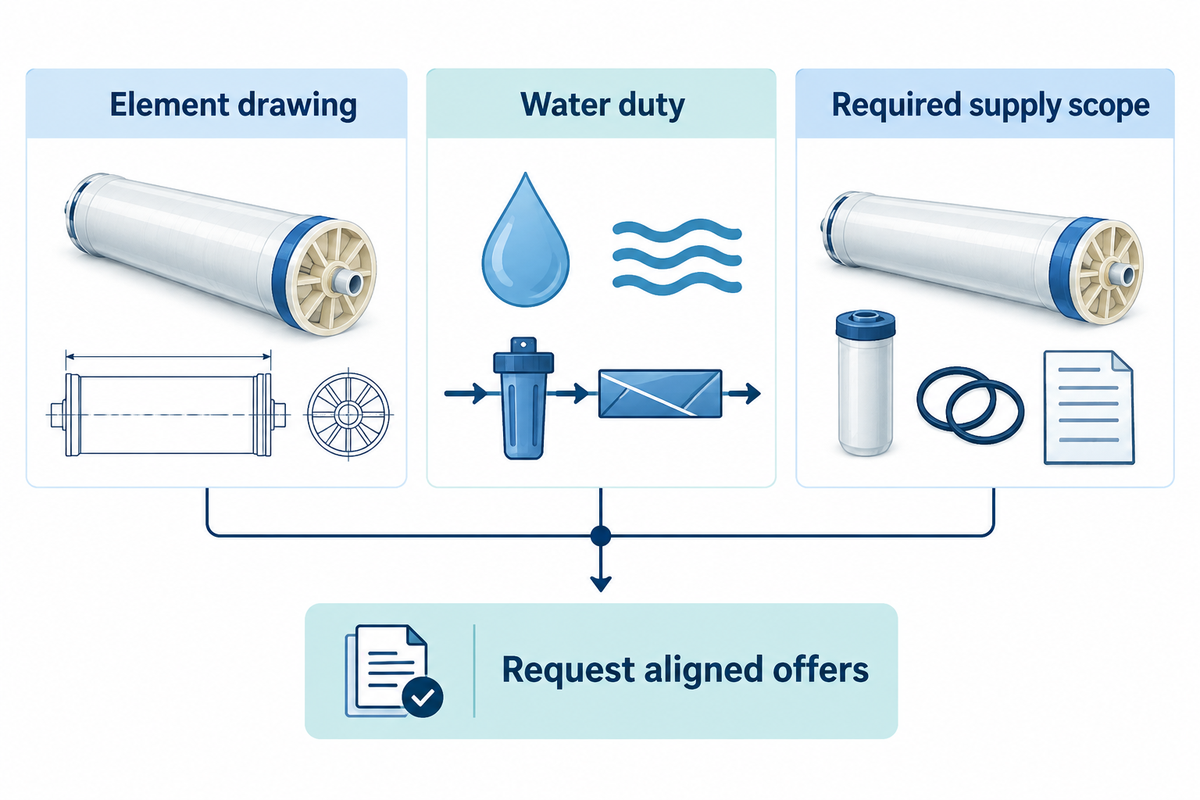
For OEM and custom RO membrane elements, contact Blue Membrane with the drawing, water duty and required supply scope. Use the relevant group above to request aligned offers, comparing production responsibility, element specification and delivery commitment against the application.