Get in touch with Blue Membrane Company

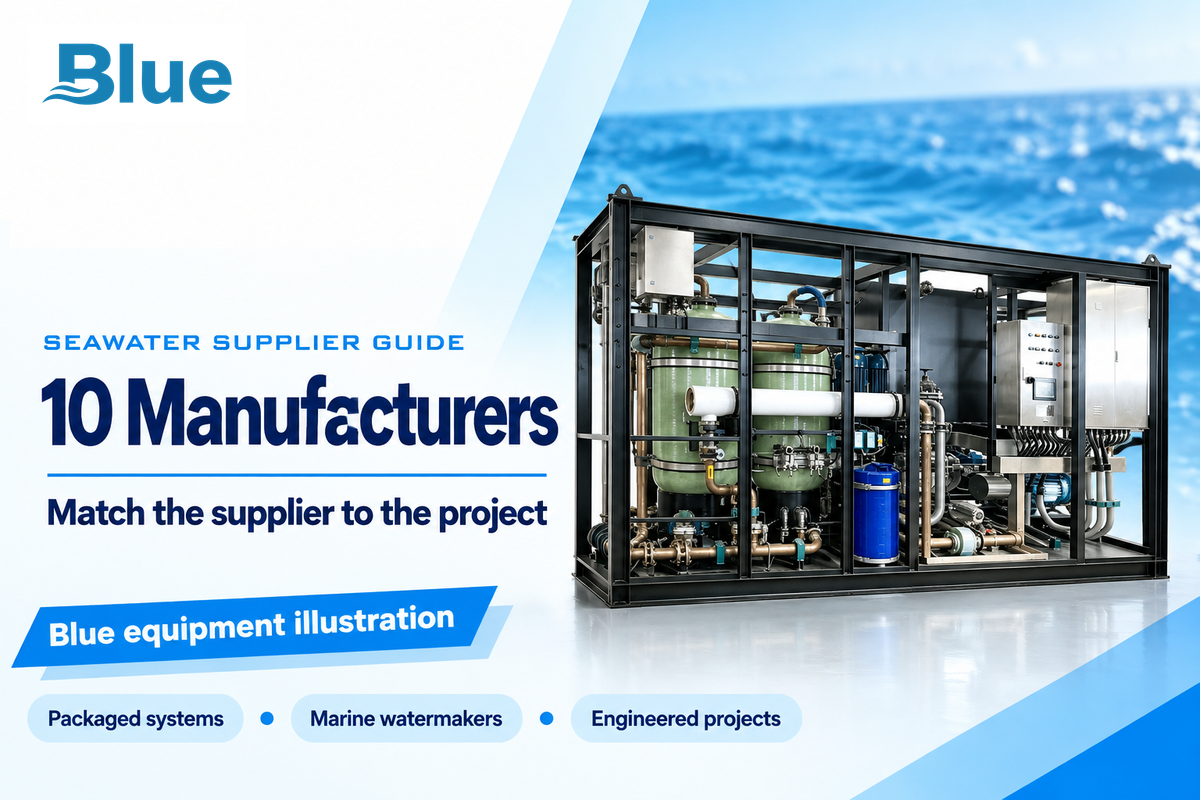
The best seawater reverse osmosis system manufacturers for a shortlist include Blue Membrane, Pure Aqua, AXEON, AMPAC USA, Applied Membranes, Fluence, Elemental Water Makers, Watermakers, IDE Technologies and Veolia. Their offers range from marine watermakers to containerized equipment and engineered desalination plants.
A resort buying a packaged seawater reverse osmosis system and a utility buying a desalination plant need different suppliers, even if they both describe their process as SWRO. The useful comparison starts with what each company builds, the project size it serves, and the work done after the equipment leaves the factory.
Disclosure: This guide is published by Blue Membrane. We list ourselves first because this is our website, not because we claim to be the market leader. The other 9 manufacturers are grouped by what they’re best for, in no particular order within each group.
Quick picks for different projects
- Best for sourcing membranes and a complete system together: Blue Membrane, with published offshore skid and container equipment.
- Best for comparing packaged catalog families: Pure Aqua, AXEON and Applied Membranes; AMPAC USA also offers custom packaged watermakers.
- Best for standard containerized seawater treatment: Fluence’s NIROBOX SW range; for solar-integrated desalination, consider Elemental Water Makers.
- Best for marine equipment purchase: Watermakers, as well as marine lines offered by multiple other companies here.
- Best for engineering, construction and operating responsibility: IDE Technologies and Veolia, whose project offers extend beyond a factory skid.
How We Selected These Manufacturers
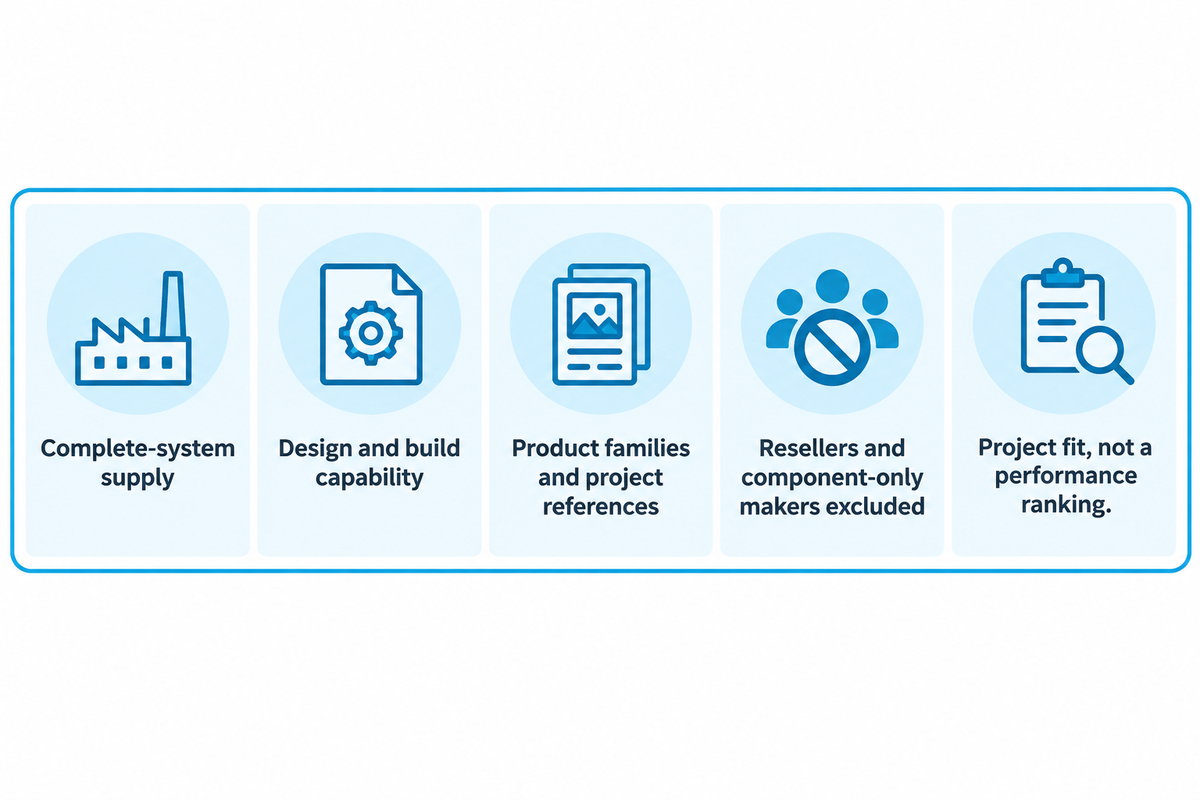
We evaluated companies based on official evidence of complete seawater systems supply or desalination design and build capabilities. Company information was verified against official websites and public sources in October 2026. Product families, manufacturing descriptions, project references, and stated quality credentials shaped the comparison. Excluded were companies with no design/build evidence, pure traders, resellers, membrane-only manufacturers, pump-only suppliers, directories and marketplaces.
This is a curated purchasing shortlist across several project types. The numbers identify companies; they don’t represent market share, an independently tested performance ranking or an assertion that these are the only qualified suppliers. Blue Membrane appears first under the disclosure above. The remaining companies are grouped by the kind of buying decision their published offers help address.
The groups overlap. A marine specialist can supply land-based equipment, a packaged-system maker can provide commissioning, and a major engineering company can supply standard modules. Groups and scope overlap. While comparing water treatment systems, a buyer should maintain this distinction between equipment scope and responsibility for the complete water supply.
Our 10-Supplier Seawater Duty Lineup captures main differences. The short descriptions point to full company profiles below. Capacities discussed in the profiles are examples and ranges from product families, and are in their original units; these aren’t results from a performance test in common.
10-Supplier Seawater Duty Lineup
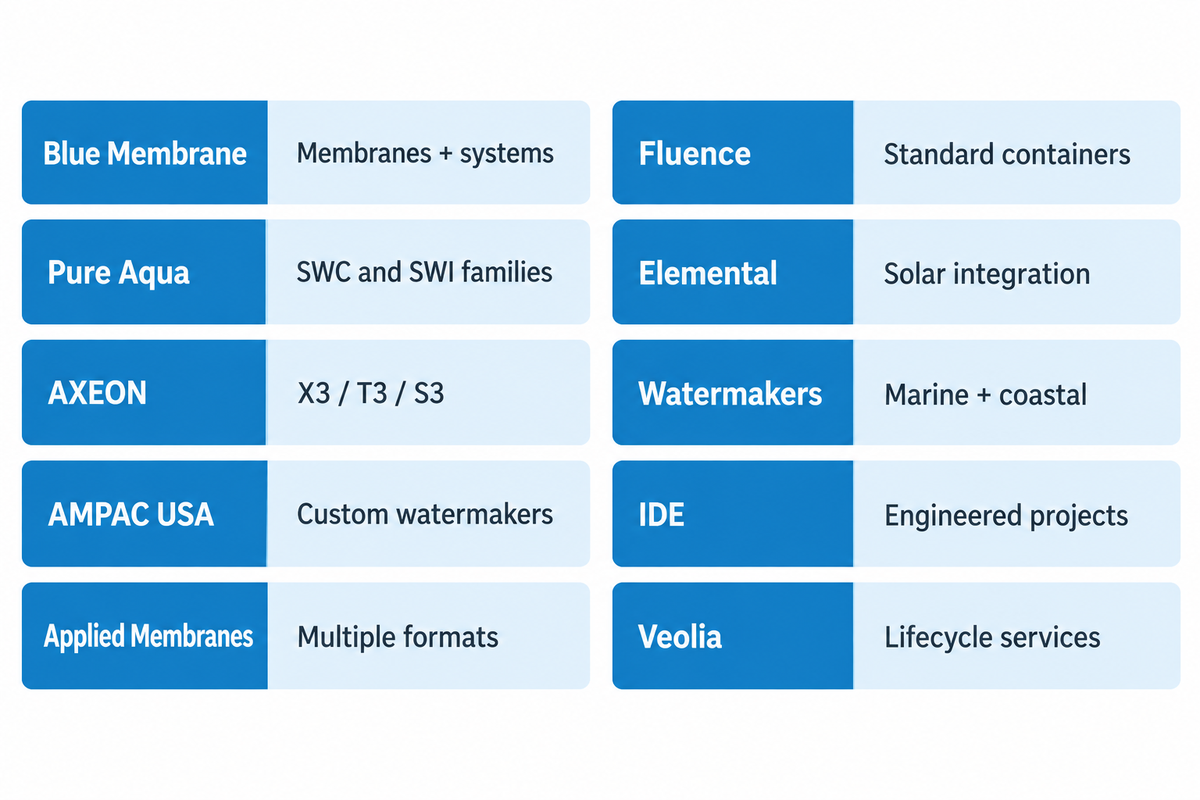
Consider delivery scope first, and then consider the products. High-capacity membrane elements, factory built desalination systems, and completed treatment plants are very different purchases. This lineup includes complete-system suppliers as well as engineering/building companies, so the last column of your shortlist should always identify who will deliver the working installation.
| No. | Company Name | Headquarters | Founded Year | Best For | Brief Introduction | System Lines and Delivery Scope | Key Advantages | Potential Disadvantages | Official Website |
|---|---|---|---|---|---|---|---|---|---|
| 1 | Blue Membrane | Nantong, China; factory/office | Not publicly disclosed | Membrane-and-system sourcing | Element manufacturer and system builder | Marine, skid and container systems | Own H1/H2 elements; offshore configurations | Project-specific package selection | https://bluemembrane.com/ |
| 2 | Pure Aqua | Santa Ana, USA | 2001 | Commercial-to-industrial catalog selection | Water-treatment system manufacturer | SWC and SWI seawater families | Distinct membrane sizes and duty ranges | Different family feed envelopes | https://pureaqua.com/ |
| 3 | AXEON Water Technologies | Temecula, USA | Since 1989 | Three packaged size bands | Systems and components manufacturer | X3, T3 and S3 seawater systems | Published pump and housing distinctions | Catalog scale below utility projects | https://www.axeonwater.com/ |
| 4 | AMPAC USA | Woods Cross, USA | 1994 | Custom packaged watermakers | RO equipment and turnkey system builder | Marine and industrial desalination | Integrated treatment and HMI controls | Marine/land integration differs | https://www.ampac1.com/ |
| 5 | Applied Membranes | Vista, USA | 1983 | Multiple installation formats | Membrane and system manufacturer | Voyager, Maritime, SY, S, Mobile | In-house fabrication, testing and PLC work | Family-specific installation layout | https://www.appliedmembranes.com/ |
| 6 | Fluence | Plymouth, Minnesota, USA | 2017 incorporation | Standard container modules | Water equipment and project provider | NIROBOX SW and related services | UF, RO, energy recovery and CIP integration | Final-water treatment options | https://www.fluencecorp.com/ |
| 7 | Elemental Water Makers | The Hague, Netherlands | 2012 | Solar-integrated remote sites | Solar-desalination designer and producer | Engineering through commissioning/support | Water and renewable-power integration | Power schedule affects plant design | https://www.elementalwatermakers.com/ |
| 8 | Watermakers, Inc. | Fort Lauderdale, USA | 1984 | Marine and coastal installations | Marine/land desalination manufacturer | Islander and customized RO watermakers | Marine application and service history | Vessel/site fit-out required | https://watermakers.com/ |
| 9 | IDE Technologies | Kadima, Israel | 1965 | Large engineered projects | Desalination engineering/build company | Plant development, construction and operation | Carlsbad, Hadera and Sorek references | Infrastructure procurement route | https://ide-tech.com/ |
| 10 | Veolia | Aubervilliers, France; group HQ | 1853 group origins | Projects with lifecycle services | Water-technology and engineering group | SIDEM/Entropie; RO and thermal offers | Process design through commissioning/O&M | Technology/contract scope selection | https://www.veoliawatertechnologies.com/ |
The distinction between a catalog purchase and an engineered project is more important than a company’s position in the table. For industrial and commercial facilities with a defined water intake and utilities, a packaged supplier might meet your equipment scope. A greenfield municipal project can require responsibility for facilities, civil interfaces and operations as well as the RO process. Desalination technology is one part of that procurement decision; the project’s requirements will often dictate what scope of work will need to be contracted.
Packaged Systems for Commercial and Industrial Sites
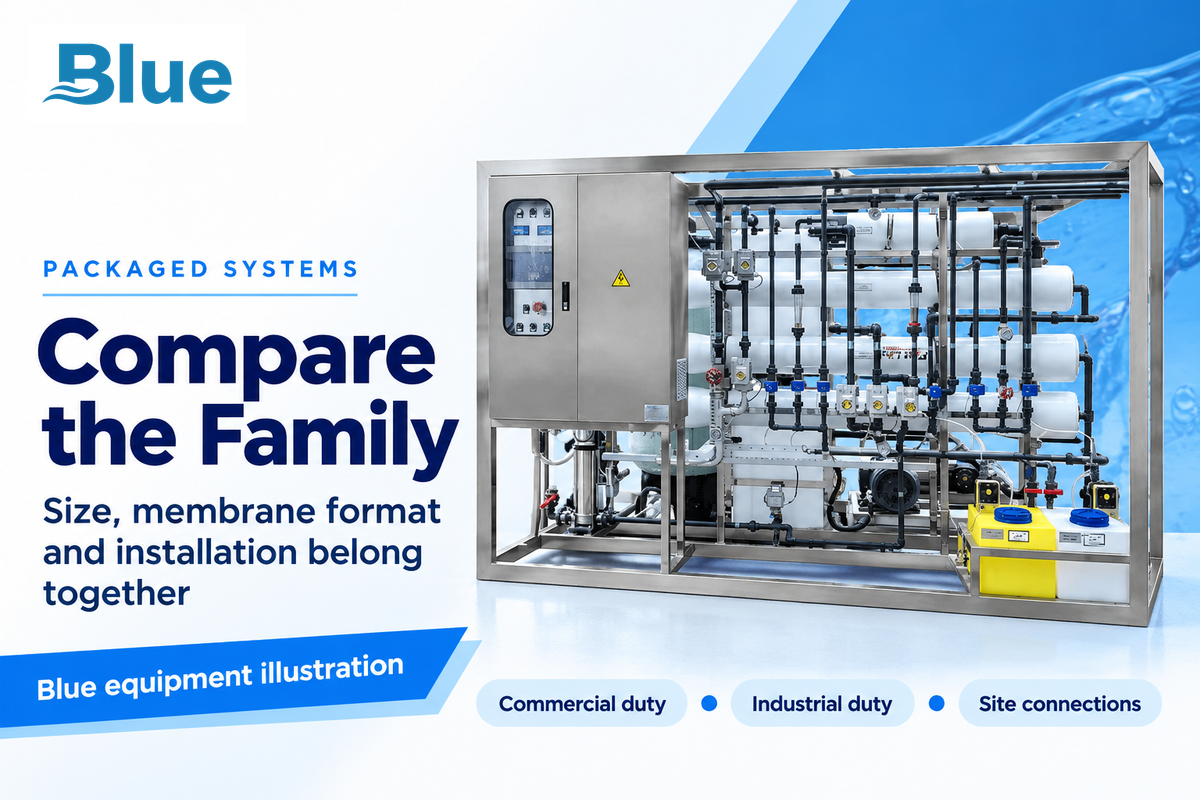
Packaged seawater systems match the requirements for daily water demand, the incoming water source and the facilities around the treatment unit. A factory can assemble membrane systems, high-pressure pumping, filtration and control systems before shipment. For reverse osmosis water production, the package still needs to connect to the site’s intake and outlet, as well as to the site’s power and storage facilities.
For this group of suppliers, compare the system family first and prices later. Small membrane elements of seawater RO systems are used in compact systems, while larger industrial applications use larger vessels and pumps and different layouts. A supplier’s broad water purification catalog might also contain brackish-water equipment, which shouldn’t be confused with equipment designed for seawater.
1. Blue Membrane: Best for membrane-and-system sourcing for container and offshore projects
Headquarters: Nantong, Jiangsu, China, identified factory and office · Founded: Not publicly disclosed · Type: BlueTong Technology (Nantong) Co., Ltd.; membrane manufacturer and system builder.
Official website: https://bluemembrane.com/
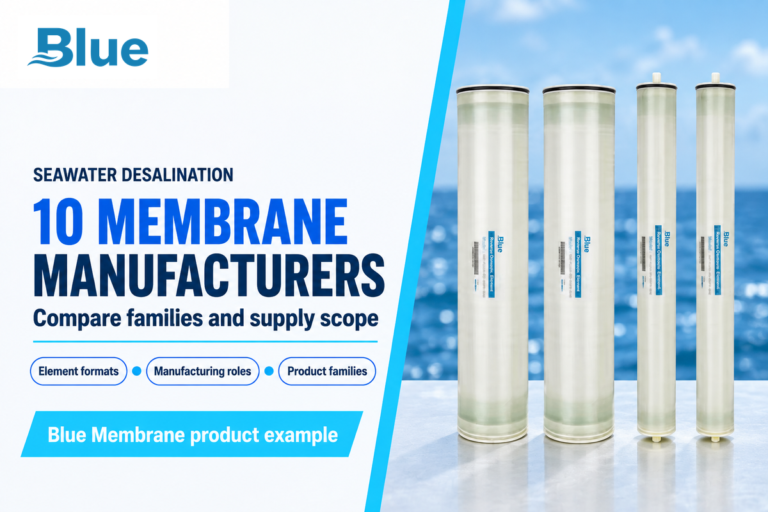
Main products: Marine watermakers, containerized/skid systems and H1/H2 seawater elements. Published capabilities: A 65 TPD 20-ft container, a 200 m3/day FPSO skid and a 45 + 5 m3/day two-stage configuration. Notable credentials: The website states BV classification for relevant FPSO skids.
Blue Membrane combines its own seawater elements with complete-system supply, giving an equipment buyer a single starting point for the membrane and the assembled plant. According to its published configuration, the 65 TPD container uses four 8040 elements and draws 17.2 kW, while its offshore examples cover different process-water duties. That combination suits buyers comparing membrane sourcing with skid or container requirements. Its published examples are project-specific configurations, so a container and an offshore two-stage skid aren’t interchangeable standard packages.
For the current product scope, see our seawater reverse osmosis systems.
2. Pure Aqua: Best for commercial-to-industrial catalog seawater systems
Headquarters: Santa Ana, California, USA · Founded: 2001, according to its company history · Type: Water-treatment system designer and manufacturer.
Official website: https://pureaqua.com/
Main products: SWC commercial seawater and SWI industrial seawater RO systems, alongside other water treatment equipment. Published capabilities: SWC at 1.4–37.9 m3/day and SWI at 30–2,500 m3/day, with different feedwater limits.
The SWC and SWI split gives a procurement team a useful way to separate compact commercial seawater reverse osmosis from larger industrial equipment. Pure Aqua’s product page lists 2.5- or 4-inch membrane formats for SWC and 8-inch elements for SWI, rather than presenting every plant as the same assembly with a larger pump. This makes the company a practical candidate when the buyer wants to compare established product families across several capacities. The purchasing limitation is the family boundary: membrane format and feed envelope change, so a small SWC selection shouldn’t be treated as an automatically upgradeable SWI skid.
3. AXEON Water Technologies: Best for three clearly separated packaged seawater size bands
Headquarters: Temecula, California, USA · Founded: Operating since 1989, according to its membrane-products page · Type: Membrane-filtration systems and components manufacturer.
Official website: https://www.axeonwater.com/
Main products: X3, T3 and S3 seawater reverse osmosis systems. Published capabilities: X3 at 8,000–40,000 GPD, T3 at 3,000–7,000 GPD and S3 at 600–2,200 GPD. Quality statement: Its About page describes ISO 9001 compliant practices.
AXEON’s seawater page connects each capacity band to equipment details: the X3 uses a duplex stainless-steel axial piston pump, while the T3 uses a 316L plunger pump. Those distinctions help an engineer compare the high-pressure pump and housing arrangement as well as nominal water production. The three series systems provide a clear catalog starting point for compact, commercial and larger packaged duties. The published X3 range ends at 40,000 GPD, however, so a utility-scale desalination project calls for a different offer than this catalog comparison.
4. AMPAC USA: Best for custom packaged marine and land-based watermakers
Headquarters: Woods Cross, Utah, USA · Founded: 1994 · Type: Reverse osmosis equipment manufacturer and custom system builder.
Official website: https://www.ampac1.com/
Main products: Marine and industrial watermakers, commercial/industrial RO and turnkey water treatment. Published capabilities: In-house engineering, design, fabrication and manufacturing of packages with pre- and post-treatment.
AMPAC’s current About page describes plug-and-play equipment with HMI controls that display operating conditions on a process diagram. Its seawater range covers marine and land-based watermakers, supported by the company’s own design and manufacturing description rather than a membrane-only supply role. That makes it a candidate for a buyer seeking a custom equipment package with treatment and controls considered together. Marine and land-based installations still have different power and integration needs, so the practical purchasing constraint is that a listed watermaker price and an installed coastal-plant price describe different scopes.
5. Applied Membranes: Best for marine modules through mobile/containerized seawater packages
Headquarters: Vista, California, USA · Founded: 1983 · Type: Membrane and water-treatment system manufacturer.
Official website: https://www.appliedmembranes.com/
Main products: Voyager, Maritime, SY, S and Mobile seawater system families. Published capabilities: In-house design, engineering, fabrication, testing, PLC programming and welding. Facility statement: Its history page describes the Vista facility as ISO-certified and UL Listed.
Applied Membranes, also known as AMI, separates limited-space marine equipment, commercial systems, industrial systems and mobile ISO-container installations in its seawater range. The company’s history describes a 160,000-square-foot headquarters and manufacturing plant, with several fabrication and control disciplines kept in-house. Those facts support a shortlist position when installation format and factory integration are central to the purchase. The limitation is format-specific: a Voyager marine module and a Mobile containerized plant require different installation planning, rather than providing the same water treatment system in two equivalent enclosures.
Modular Desalination for Remote Sites
Modular desalination solutions can help reduce the amount of treatment equipment assembled at a remote site. They’re particularly suited to locations such as islands, camps and properties with difficult access for the mobilization of specialist installation labor. The client should, however, define the complete water supply; an RO module requires suitable feed water, power, a destination for product water and a way to remove the concentrate stream.
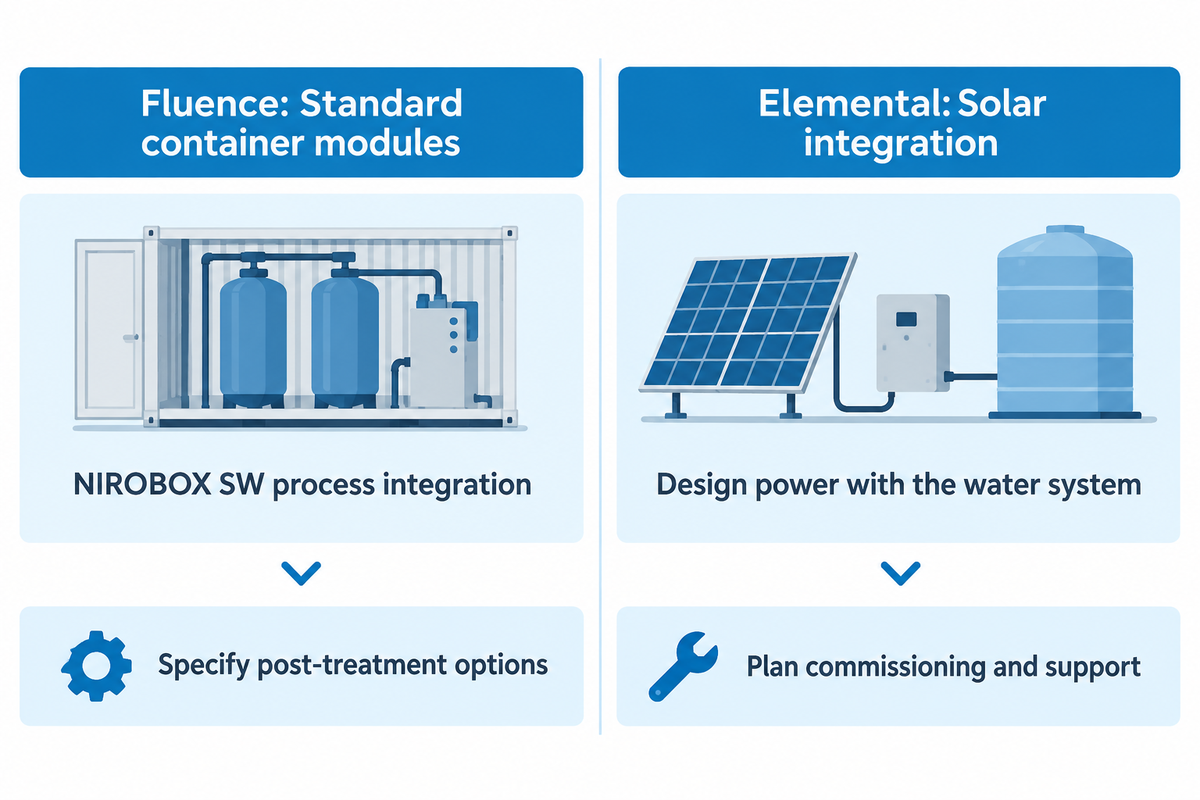
The two companies below address different integration problems. Fluence publishes standard containerized seawater modules with defined process equipment. Elemental Water Makers centers its offer on solar-integrated desalination. A compact footprint and renewable-power integration can both be useful, but they answer different questions. The choice should follow the site’s desalination needs and available water resources rather than a general preference for a container or solar panels.
6. Fluence: Best for standard containerized seawater plants at 500–1,500 m3/day
Headquarters: Plymouth, Minnesota, USA; its Melbourne ASX office is listed separately · Founded: 2017 incorporation · Type: Water-treatment equipment and project-solution provider.
Official website: https://www.fluencecorp.com/
Main products: NIROBOX SW containerized seawater desalination systems. Published capabilities: SW models at 500, 1,000 and 1,500 m3/day in a 40-foot container, with commissioning, training and operating-support services available.
NIROBOX SW integrates disc filtration, UF pretreatment, RO, energy recovery, PLC control and CIP in a pre-engineered package, according to Fluence’s product page. Its specific SW model table makes it easier to compare a standard container module against a bespoke skid without borrowing capacities from the separate NIROBOX BW or FW products. This suits projects that can use the standard module’s scale and process arrangement. Post-treatment remains a configuration boundary: options such as remineralization and disinfection need to be specified beyond the core treatment package.
7. Elemental Water Makers: Best for solar-integrated desalination for remote properties
Headquarters: The Hague, The Netherlands · Founded: 2012 · Type: Solar-desalination equipment designer and producer.
Official website: https://www.elementalwatermakers.com/
Main products: Solar desalination equipment for remote properties and communities. Published capabilities: In-house design, engineering, production, transport, commissioning, operator training and ongoing support.
Elemental Water Makers addresses the power side of remote water desalination as part of the equipment project, rather than simply adding an electricity-consumption figure to a conventional RO quotation. Its About page reports operations in over 33 countries and describes ongoing support, often through local partners, which makes delivery and post-startup assistance part of the discussion. This is a useful fit when renewable power and freshwater production must be planned together. The purchasing constraint follows that same strength: the site’s power availability and operating schedule must be designed alongside the water system, rather than treated as independent assumptions.
For an island property, the first decision is often whether the proposed water system fits the available power and maintenance arrangements. A plant that can provide fresh water during planned operating hours may need storage to cover demand at other times. A project needing continuous industrial water supply has a different operating brief. Neither requirement can be answered by the word “modular” alone.
Marine Watermakers for Equipment Buyers
Marine desalination systems are equipment purchases with vessel-specific constraints. Other factors which help define the installation of equipment, such as space, access for maintenance, the electric supply and the location of water tanks, are as important as the nominal daily output. There are several companies in this guide that offer marine products. Watermakers is included due to its public company history and products which are geared toward boats, marinas and coastal properties.
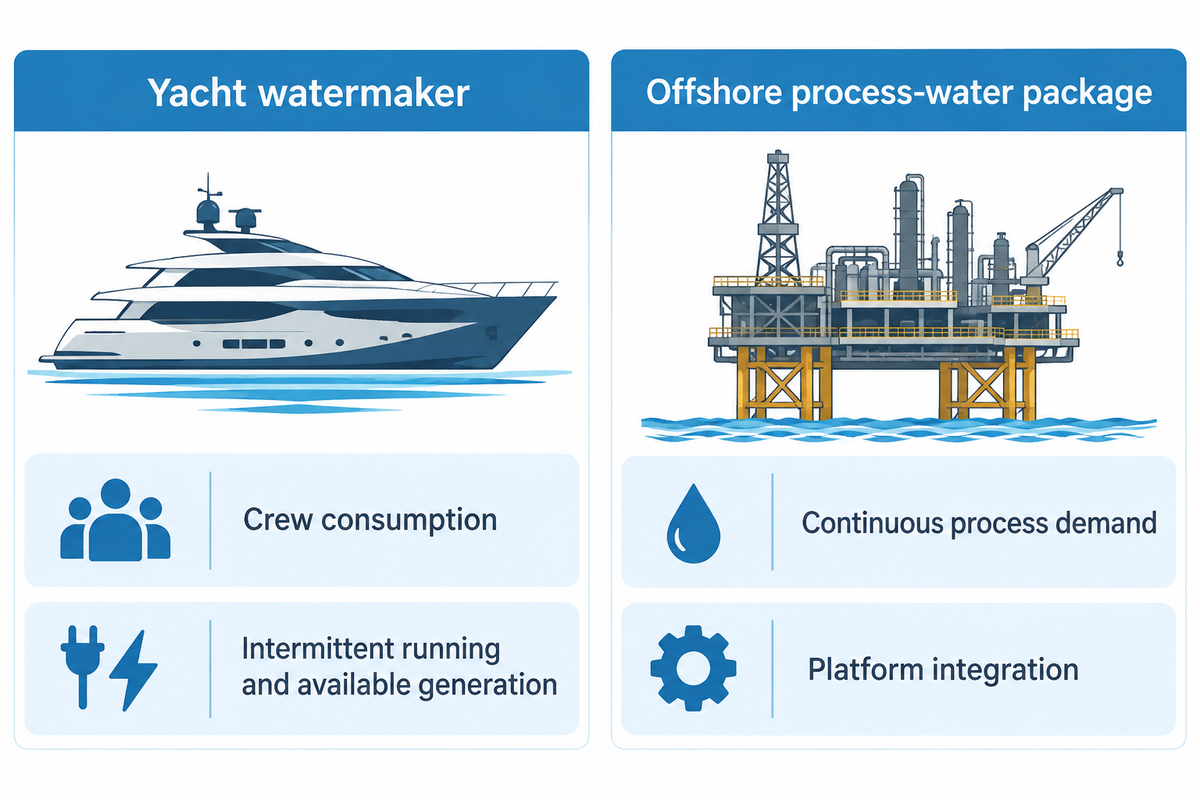
A watermaker system selected for a yacht also differs from an offshore process-water package. Crew consumption, intermittent running and available generation affect one purchase; continuous process demand and platform integration affect the other. Treat “marine” as an application description, then compare the actual equipment and its installation requirements. Our own marine watermaker range shows how power supply and output distinguish individual models.
8. Watermakers, Inc.: Best for marine watermakers and coastal commercial installations
Headquarters: Fort Lauderdale, Florida, USA · Founded: 1984 · Type: Marine and land-based desalination-system manufacturer.
Official website: https://watermakers.com/
Main products: Islander marine systems and customized land-based reverse osmosis watermakers. Published capabilities: Design and manufacture for boats, yachts, hotels, marinas and industrial sites.
The company traces its origins to freshwater-production needs at the Staniel Cay Yacht Club, giving its offer a specific marine and coastal application history. Its current product range includes marine equipment and customized land-based systems, so the choice is broader than a single boat-mounted unit. Those facts make Watermakers a practical candidate for owners who need to integrate water makers with a vessel or coastal commercial property. The limitation is the fit-out itself: available space, service access and vessel or site connections still have to be designed into the installation, a different route from procuring a municipal turnkey plant.
Engineered Desalination Projects at Utility Scale
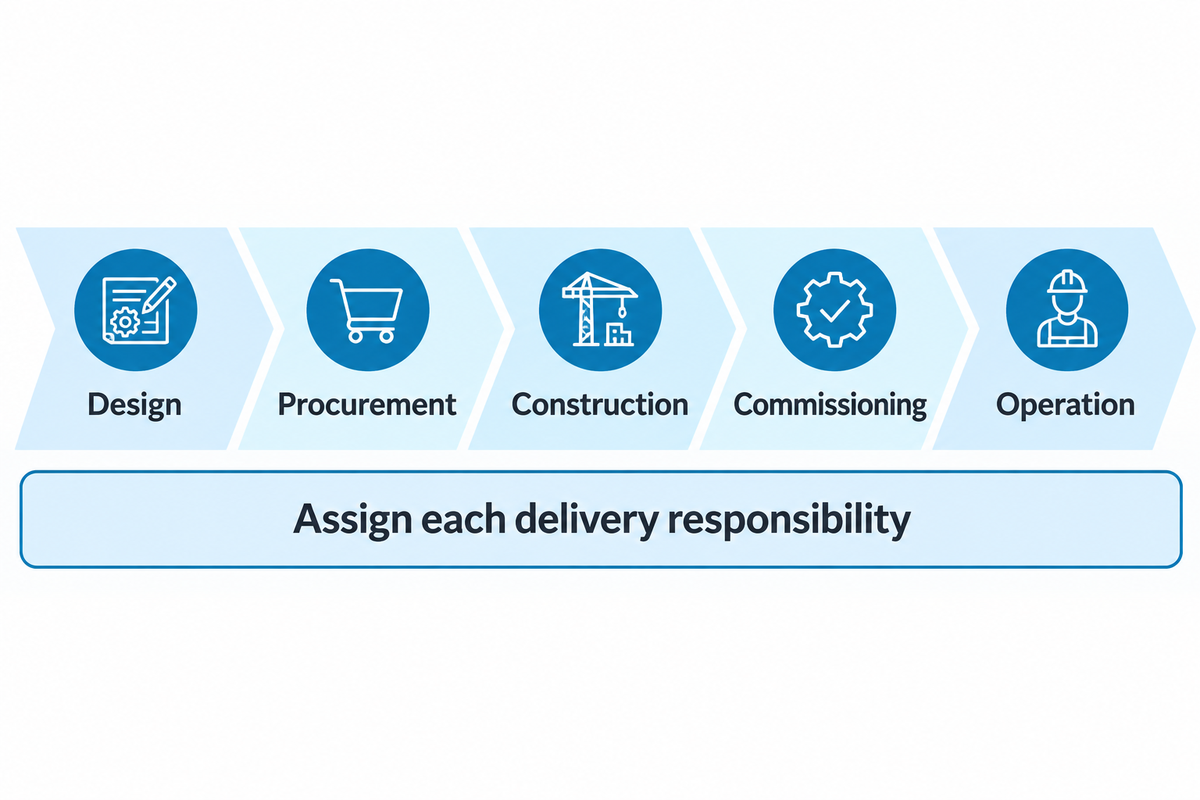
Engineering companies are included when the purchase includes the responsibility of a completed desalination facility, as opposed to only the procurement of the equipment. Design, procurement, construction, commissioning and operation responsibilities can be combined in a number of different ways. The owner of the project is required to determine responsibility for each of these aspects, and place these with the supplier, its own engineering team or other contractors.
Large-scale desalination also changes comparisons of companies. A named plant reference can demonstrate a company’s role in delivering infrastructure, and a product datasheet can demonstrate the stated envelope of a particular equipment family. Both types of references are helpful, but they shouldn’t be merged to create one “capacity” number. A company’s historical project output isn’t the rating of a standard skid that’s available in the company’s catalog.
9. IDE Technologies: Best for large engineered desalination projects with build and operating roles
Headquarters: Kadima, Israel · Founded: 1965 · Type: Desalination engineering, construction and operations company.
Official website: https://ide-tech.com/
Main products: Seawater reverse osmosis plants, thermal desalination and industrial water treatment. Published capabilities: Development, engineering, construction, commissioning and operation of treatment plants.
IDE’s official portfolio includes Carlsbad, Hadera and Sorek, giving a utility buyer named desalination references to examine alongside the company’s engineering and construction scope. Its offer extends through the development and operating stages of a plant, which makes it relevant when project delivery responsibilities are central to procurement. That breadth supports its place in a large-project shortlist rather than a comparison confined to factory watermakers. The buying limitation is the procurement route: an infrastructure project with construction and operating roles is a different undertaking from ordering a small packaged system with installation handled by the owner.
10. Veolia: Best for desalination projects combining process design, construction and lifecycle services
Headquarters: Aubervilliers, France, Veolia group headquarters · Founded: 1853 group origins · Type: Water-technology and engineering group, with SIDEM and Entropie grouped under this entry.
Official website: https://www.veoliawatertechnologies.com/
Main products: RO and thermal desalination, standard desalination units and mobile solutions. Published capabilities: Design, engineering, procurement, construction, commissioning, operation and maintenance.
Veolia’s desalination page describes building and operating Sur’s seawater RO plant since 2007 and identifies SIDEM’s design, supply and construction role at Jubail II. Those named references show why the group belongs in a comparison of complete-project providers, while its standard and mobile units provide other delivery options. A buyer can therefore discuss process equipment and longer-term services within the group’s published desalination scope. The purchasing constraint is choosing the specific technology and contract offer: the same group supplies thermal desalination and other water technologies, so its full portfolio is broader than the RO plant under consideration.
For a municipal water supply project, the next comparison should focus on the supplier’s proposed role, the relevant reference plants and the interfaces with the owner. For a factory adding a single seawater treatment train, an engineering/build offer may be more extensive than the required scope. The distinction is about the work being procured, rather than whether one company’s name is more familiar.
How to Choose a Seawater RO System Manufacturer
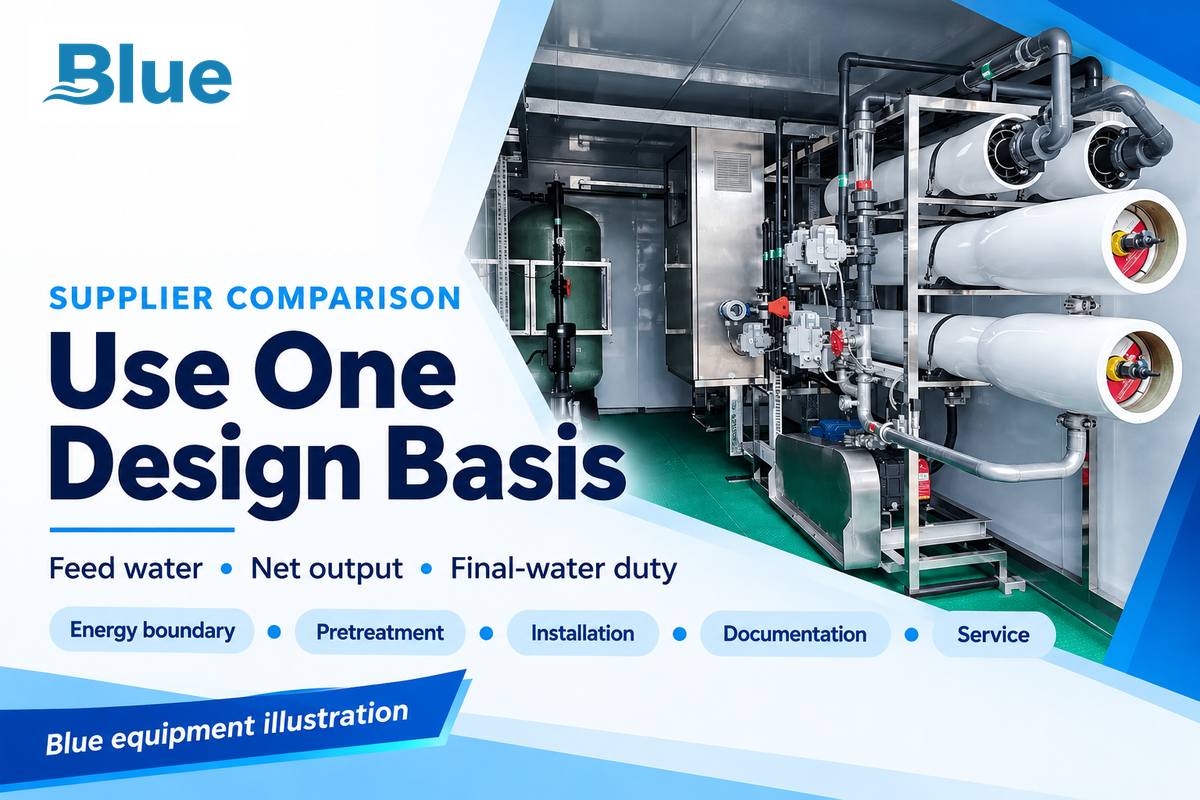
When selecting a supplier of the seawater RO system, you must also compare its complete-system scope to your feed water, required net output, final water quality and delivery responsibilities. Compare the models on an equal operating basis. A supplier that fits the arrangement of installation, power and support offers a more relevant starting point than a higher capacity number taken from an unrelated product family.
Eight checks usually resolve the most consequential differences between quotations. Also, it’s the time to examine the supporting documents and verify the applicability of the certificates, the choice of materials, and factory tests to the equipment being purchased. Keep this work concentrated in the technical comparison so that each proposal can be judged on its merits.
Match the feed water quality before the production figure
Provide each supplier the same water analysis and expected temperature range, and describe the intake as precisely as possible. An open ocean intake, a harbor intake, and a coastal well may require different treatments, even if all are described as sea water. The United States Geological Survey explains salinity in terms of dissolved salts. Feed salinity impacts the design of an RO system, and the type of pretreatment and the extent of system cleaning may vary significantly.
State if the analysis represents an average sample or the range the system must handle. A seawater reverse osmosis plant quoted for one set of conditions can’t be compared to another supplier’s plant for a different set of conditions. The useful response identifies the design basis, the equipment selected and the anticipated production of the system.
Separate net output from membrane and pump ratings
Ask for the expected flow of product water, as well as the expected cleaning and service arrangements over the planned operating period. A membrane datasheet, a pump’s nominal flow and the plant’s delivered water production describe various aspects of the design. The supplier should integrate these in the proposed layout.
In particular, when evaluating a compact watermaker vs. industrial reverse osmosis desalination systems, remember that published daily capacity may assume continuous operation. The actual use case may be to operate only during scheduled shifts or power windows. In this case, it’s better to agree on the net amount that’s actually produced, the operating schedule and any reserve capacity, and only then, evaluate the price of equipment.
Define the use of the desalinated water
Process water, potable water and high-purity production water may require different post-RO treatment to meet specification. Simply achieving a low salt concentration in the permeate doesn’t warrant that the complete installation would produce safe drinking water. The specification should state the intended use and the treatment, monitoring and acceptance requirements needed for that use.
A request for high-quality drinking water should define the required quality at delivery rather than relying on a general clean water statement. This should include how the desalinated seawater will be treated, stored and distributed. This should define the final-water duty for the supplier.
For drinking water projects, the same principle holds true for defining the complete process, from seawater intake to treated water which is stored or distributed. Adjustment of pH and disinfection, for example, may be placed outside the core RO package. For industrial cases, a second pass or other treatments may be required. State the water quality you require rather than asking for “high-quality water” generally.
Compare pressure, energy recovery and the measurement boundary
Pressure and power should be examined for the proposed duty. The pressure rating of a vessel is a design limit and doesn’t necessarily mean it’s operating at that pressure, or that the system will achieve the required output. Likewise, a high-pressure pump rating doesn’t describe the energy usage of all auxiliary devices at the site.
For systems with pressure exchangers or other energy recovery equipment, specify what’s included in the power and water-production quoted numbers. The energy recovery devices and the other equipment may be accounted for differently; therefore, the same boundary and operating conditions must be specified. An energy comparison becomes relevant when the same work is being described by the suppliers.
Check the pretreatment and cleaning arrangement
Sea water reverse osmosis systems depend on more than the membrane rack. The proposal must define the pretreatment selected for the intake, the expected consumables and the means of cleaning the equipment. Filtration systems may incorporate other combinations of media, cartridges and UF, with chemical treatment selected for the feed and process design.
Discuss the access to replace filters and service high-pressure components. Check how the preparation of cleaning chemicals is done, the sequence of cleaning and where waste streams are discharged. The objective is to perform the routine tasks at the customer’s site. A treatment package that’s small enough to be shipped in a single container still needs adequate working space surrounding the package and adequate site facilities.
Choose an installation format that the site can support
Skid, container and compact marine layouts solve different installation problems. Confirm the actual dimensions, weights, lifting arrangements and maintenance clearances, and the type and location of the electrical supply. A container lessens the requirement to build an equipment room, but doesn’t remove the need for connections, foundations and the project’s water-storage requirements.
The published containerized and skid-mounted configurations illustrate why this matters: a land-based container and an offshore skid can have different voltages, treatment stages and delivery requirements. For smaller temporary water needs, a portable desalination unit is another distinct equipment format. Select the format around the installation, rather than treating the enclosure as a cosmetic option.
Review the exact quality and documentation scope
You can request the certificate holder, covered site or model, stated standard and validity information for any credential used in the purchase decision. Quality management, a facility listing, component approval and marine classification describe different assessment scopes. General compliance wording should be assessed within the terms of the referencing organization; a company logo, or statement of a quality system, doesn’t certify drinkable water from the completed installation.
Connect the documentation to the order: provided materials, equipment, inspection/factory tests, etc., should match the supplied configuration. If a special process is subcontracted, the responsible party and accompanying documentation should be provided. The objective is to develop an accepted delivery file for the equipment. This file should define the acceptance criteria agreed before shipment.
Make commissioning and service responsibilities explicit
Determine who supervises installation, starts the system, and trains the operator. A manufacturer can offer several of these services without including every one in the base equipment price. Other service arrangements may involve a local partner or on-site service. Each of these options has a different impact on the overall cost.
Review spare and consumable membranes, pumps, and other items that require service. For a remote site, does the maintenance plan fit the skills and materials available there? Who’s responsible for the commissioning phase? For an engineered project, define the transition from the commissioning phase to routine operation. These should be clear enough that the owner knows who to contact and what work remains for the owner’s team to do.
Can reverse osmosis filter seawater?
Yes. Seawater reverse osmosis uses a proper membrane and high-pressure pumping to separate fresh water from seawater. This process removes dissolved salts and other impurities from seawater while producing a concentrate stream. A complete SWRO system requires pretreatment and management of the concentrate stream; final-water treatment aligns to the intended use.
The United States Environmental Protection Agency describes RO’s use for removing salts from brackish water or sea water in its overview of water treatment technologies. Using reverse osmosis for salty water doesn’t mean a brackish water unit can be used unchanged. Equipment used to desalinate seawater must suit that salt water duty, with an appropriate membrane, pressure equipment and materials. This is why the comparison of complete systems is more relevant.
What pressure is required for SWRO systems?
SWRO pressure must be selected for the feed salinity, temperature, recovery and membrane arrangement; one pressure doesn’t suit every seawater system. As a specific example, Blue Membrane publishes a 3.5–5.5 MPa high-pressure circuit for its 65 TPD container configuration. That example is a model-specific statement, not an operating-pressure specification for the other systems in this guide.
Keeping normal operating pressures different from the maximum ratings of components, trips and relief settings, a supplier’s design should define the expected operating range for the stated feed conditions. Comparing those values for each supplier is more illuminating than selecting the quote with the maximum pressure.
What Is Included in a Seawater RO System Quote?
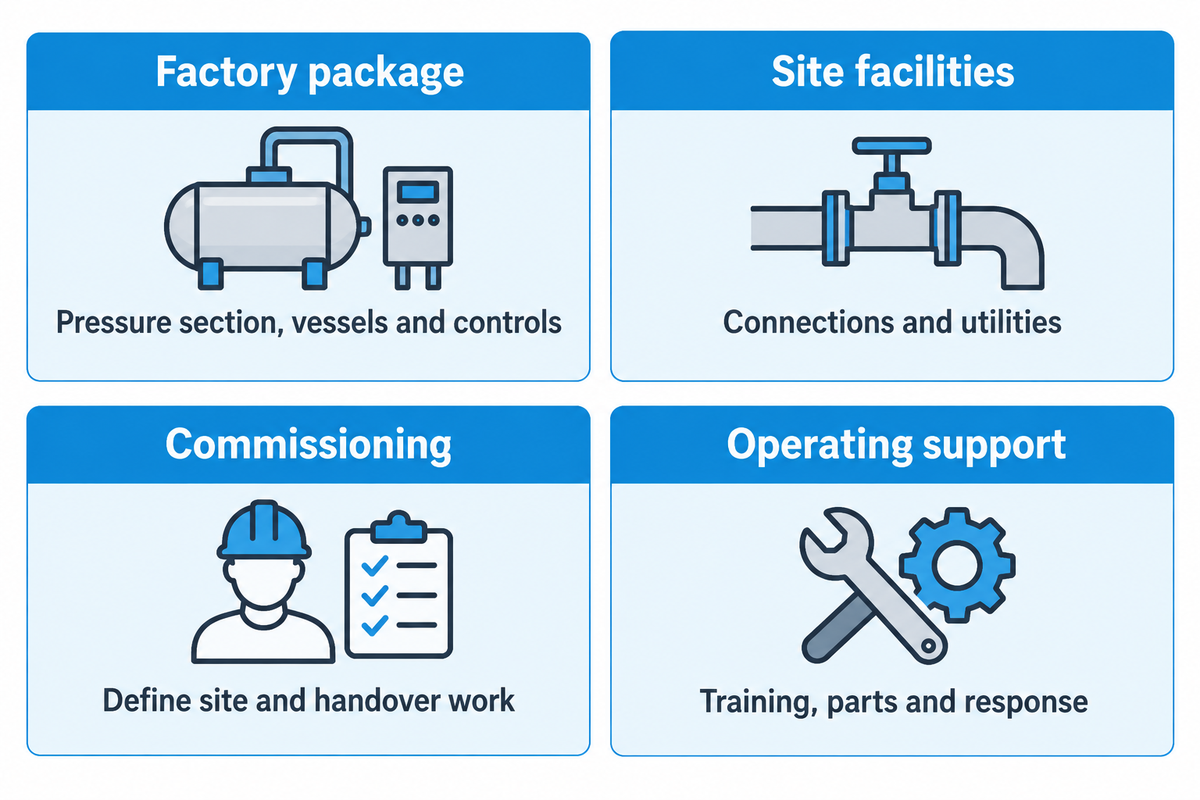
A comparable seawater RO system quote must show the treatment equipment and design basis, the product water requirement, external connection, scope of commissioning, support and price. The quote should show what site facilities and services the buyer will have to provide. The quote becomes informative when responsibilities for equipment, installation and operation are comparable, line by line.
A core seawater desalination system may include the high-pressure section, membrane vessels, instruments and controls. Other components, e.g., CIP, final water treatment, and energy recovery can be included, as options or separate packages. The proposed arrangement should be shown in the supplier’s quote for the model offered.
Now, let’s consider facilities outside the scope of the package. These may include intake and raw-water storage, transfer pumping, electrical distribution, product tanks, piping and concentrate handling. Just because something is shown on a project drawing doesn’t mean it’s within the manufacturer’s scope. Establish a defined line for each connection on both sides.
For equipment shipped internationally, provide delivery and packing arrangements, and lifting and handover documents. Name the activities expected at each milestone. If site work is expected, name it. Be specific about the conditions the site work must meet before site startup activities can occur.
Define operating support in a separate scope description. Training may cover startup and normal operation while leaving major maintenance with a local contractor. Remote monitoring may provide trend data with no guarantee of on-site support. Consumables and replacement parts may not be provided with the equipment. Each of these may change the way the reliable seawater supply is kept after the handover.
Comparable prices should be requested for the same final water duty. A process customer may need purified water, while a resort customer may need potable water from seawater. Even if the main RO train is the same, other equipment downstream may require a different price. Establish the scope for which you need prices before requesting the final proposal.
Power costs also require a stated basis. A quoted motor rating helps size the electrical connection; a quoted motor rating doesn’t establish a yearly operating bill. The supplier’s expected operating power, agreed production schedule and the site’s tariff are other inputs. Keep any water cost estimate tied to those inputs; don’t compare an isolated efficiency claim to a complete-site estimate.
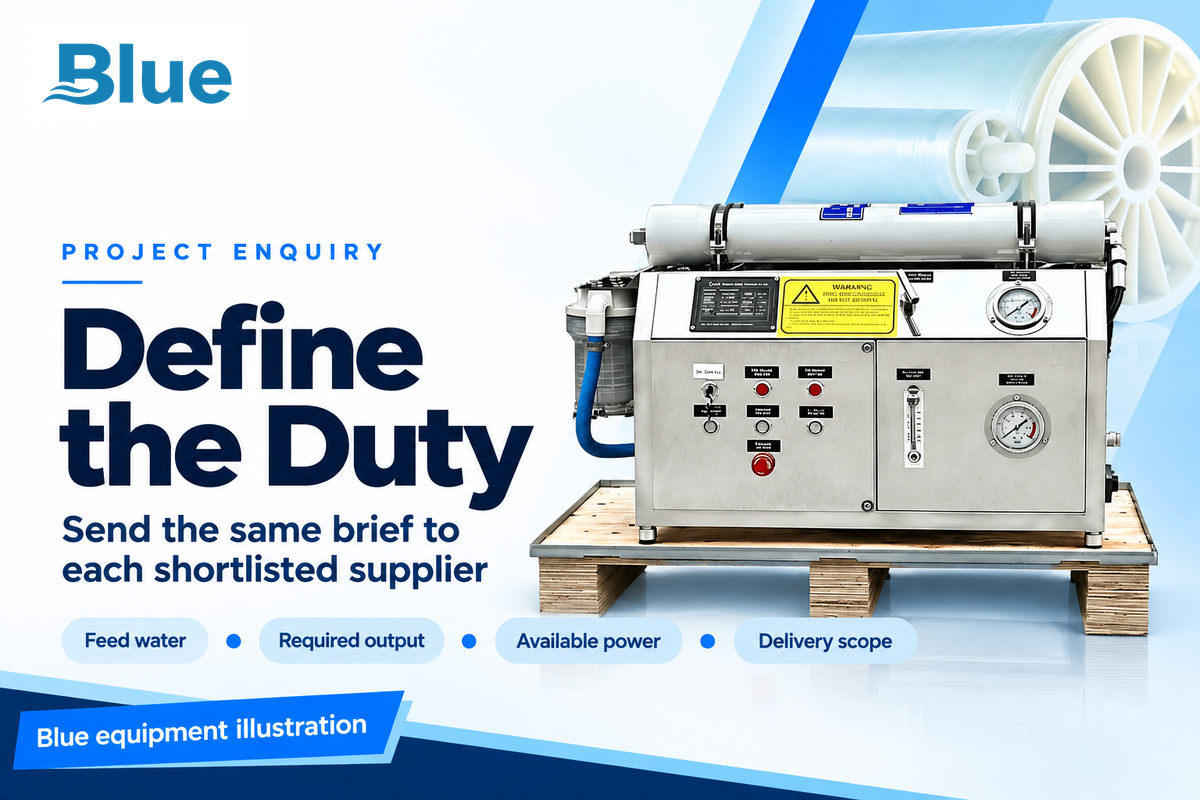
We recommend sending the same project brief to the shortlisted suppliers. Describe the intake, water analysis, daily demand, proposed water use, available power, and installation format. Include the likely location of the site. Ask the suppliers to describe the scope of their service and equipment in their proposals. This approach provides the purchasing team with options while allowing the different types of technical solutions.
Blue Membrane can review a defined duty through our project enquiry team. Include whether the purchase is an equipment package or a broader installation, so the first response addresses the work you actually need.
Frequently Asked Questions
Who makes the best reverse osmosis systems?
For seawater projects, useful choices include Pure Aqua and AXEON for packaged catalog systems, Fluence for standard containerized plants, Elemental Water Makers for solar-integrated desalination, and IDE or Veolia for engineered infrastructure. Blue Membrane combines membrane manufacturing with marine, skid and container supply. The best fit is the company whose selected equipment and delivery scope match the project, rather than a brand chosen across unrelated water duties.
Note differences in actual offers for your intake, output and installation. A supplier of household RO filters, a membrane element supplier and a complete seawater system supplier cater to different markets. This note concentrates on the last category and on clearly labeled project companies.
How much does a seawater desalination system cost?
AMPAC’s published seawater guide gives examples of US$3,000–8,000 for compact marine units of 100–300 GPD and US$50,000–200,000 for coastal systems of 10,000–50,000 GPD. These are supplier-published examples checked in October 2026, with price and installed scope varying by configuration; they aren’t a market-wide price schedule or a quotation for another manufacturer’s equipment.
Use them to appreciate the difference in buy-side scope, then request a project-specific price. Buy-side scope includes pretreatment, energy recovery, power, post-treatment, and installation and service. These can impact the offer. Compare those boundaries prior to using unit price to choose a supplier.
Can You Customize Seawater Reverse Osmosis Systems?
Yes. Several manufacturers here publish custom system capability, including AMPAC USA, Applied Membranes and Blue Membrane. Customization can address capacity, installation format, electrical supply, controls and treatment stages. A useful request starts with the feed water analysis, required output and site constraints, so the supplier can propose equipment for the duty instead of modifying a catalog description without a design basis.
Standard product families can still offer a range of options. The key is whether the offered variations remain within a package or require a new project configuration and delivery scope.
What is the difference between marine and land-based SWRO systems?
Marine SWRO systems are designed considering the requirements of a vessel or offshore installation including available power, space and service. Land-based seawater systems are designed considering site requirements including intake, utility and water storage systems. Both systems use reverse osmosis technology, but other requirements can influence system design and equipment choice.
Compare the actual model and the proposed seawater applications. A compact yacht watermaker and an offshore process-water skid are both marine products, yet they serve very different output and integration needs.
Which brand is best for large desalination plants?
IDE Technologies and Veolia are strong candidates when the purchase includes engineering, construction, commissioning and potentially operation of a large desalination plant. IDE lists projects including Carlsbad, Hadera and Sorek; Veolia describes Sur and Jubail II. Those references support their relevance to project procurement, rather than establish one universally best brand.
For a modular plant assembled from standard treatment units, Fluence is another relevant route. The preferred supplier depends on the required contract scope and the proposed design for the site.
What is the difference between a seawater system manufacturer and a supplier?
A seawater system manufacturer designs or builds the complete equipment package. A supplier may sell that package, integrate equipment from several makers, distribute components or undertake a larger project. A company can perform several roles. The practical distinction is who takes responsibility for the design, assembly and testing of the selected system and who provides support after commissioning.
The supply of membranes alone doesn’t include the high-pressure section, pretreatment, controls or final installation. Similarly, an engineering company can also undertake to build a complete RO desalination plant, without manufacturing all the membranes and pumps itself. It’s the buyer’s responsibility to determine the work to be done by the responsible contracting company.
Choose the Supplier for Your Seawater Project
Begin with the project you need to deliver. For a packaged equipment purchase, compare the relevant families from Blue Membrane, Pure Aqua, AXEON, AMPAC USA or Applied Membranes. For a standard container module or solar-integrated site, examine Fluence and Elemental Water Makers. For marine installation, include Watermakers; for a large engineered facility, bring IDE and Veolia into the project discussion.
At Blue Membrane, we manufacture RO membrane elements and supply complete seawater systems, including published container and offshore configurations. That lets us discuss the element and the assembled treatment package together. Our company and product background explains the scope behind that offer.
A clear project scope will make bids easier to compare: feed water, required net production, intended water use, available power and the work included in delivery. Once project scope and other inputs are defined, bids can be compared, and the selected seawater treatment equipment can be assessed for the service it needs to perform.
References & Sources
- Saline Water and Salinity United States Geological Survey, Water Science School.
- Overview of Drinking Water Treatment Technologies United States Environmental Protection Agency.
Company profiles and product examples are attributed to the manufacturers’ official materials checked in October 2026. Their website addresses appear with the profiles; detailed source records support the company comparison.