Get in touch with Blue Membrane Company

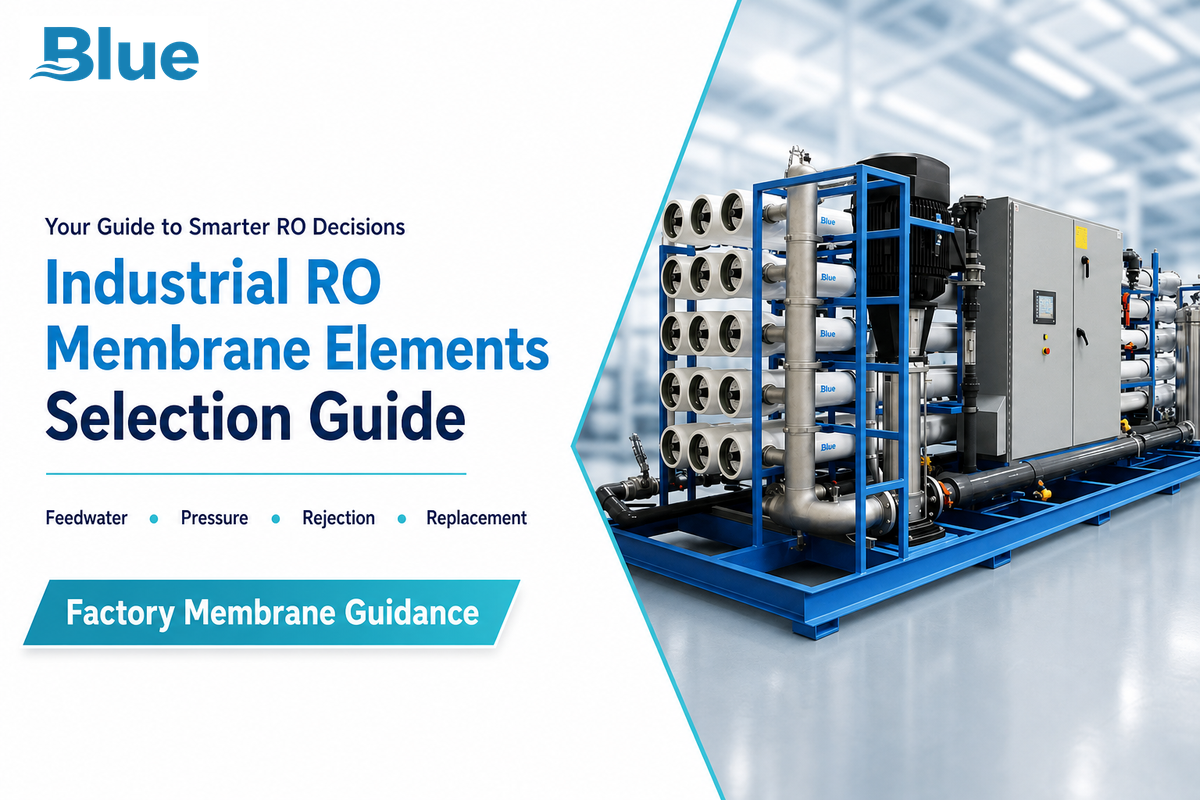
Industrial water treatment guide
Industrial RO membrane elements are chosen by operating envelope, not just brand name or diameter. Still, the wrong mechanical fit can make even the correct RO membrane element fail to work with a given feedwater, recovery target, cleaning cycle, or salt rejection duty.
Use this guide as your engineering and procurement filter before comparing models. It explains what an industrial RO membrane element looks like inside, the eight variables that will determine element fit, and the traps within spec sheets and replacement signals that truly matter.
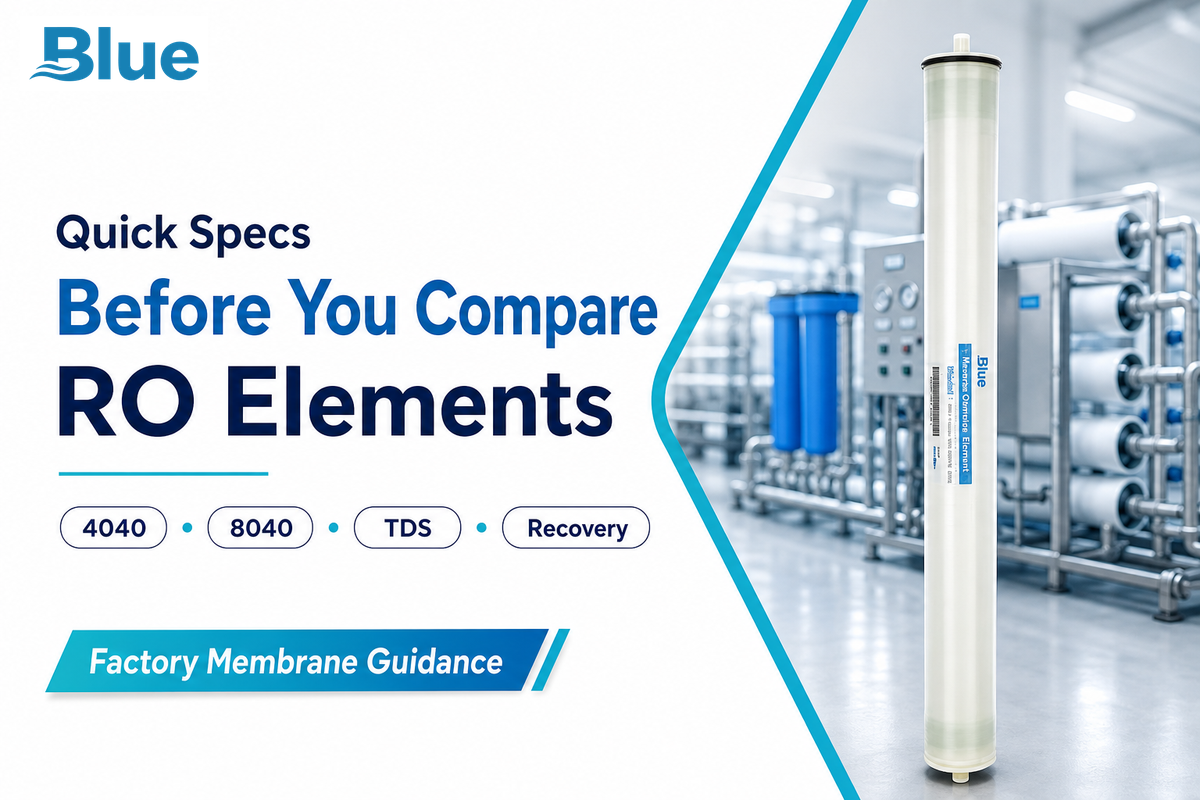
Quick Specs Before You Compare Elements
| Field | What to check | Why it changes the decision |
|---|---|---|
| Common formats | 4040 and 8040 spiral wound elements | Format affects pressure vessel fit, handling, active area, replacement labor, and skid layout. |
| Membrane chemistry | Thin-film composite polyamide, often shortened to TFC | Selectivity comes from the active polyamide layer; support layers give pressure strength. |
| Operating variables | Feedwater TDS, pressure, temperature, pH, recovery, and fouling load | Together, these variables change permeate flow, salt passage, differential pressure, and cleaning frequency. |
| Main duties | Brackish water, seawater, low pressure, low-fouling, commercial RO membrane replacement, and pure water production | Each duty has a different pressure and fouling risk profile. |
| Hard caveat | Rejection and flow claims must show test conditions | One commonly reported 99.5% number without pressure, feed salt, temperature, pH, and recovery is weak evidence. |
Buyer check: this table is a failure screen, not a catalog filter. The mistake is to compare 8040 flow, 150 psi operation, or often cited 15% to 30% reject handling as isolated numbers. For an industrial buyer, OEM replacement, or production application, Blue Membrane factory support and precision review should connect the spec number to feedwater risk, vessel fit, and the actual operating duty.
What Is an Industrial RO Membrane Element?
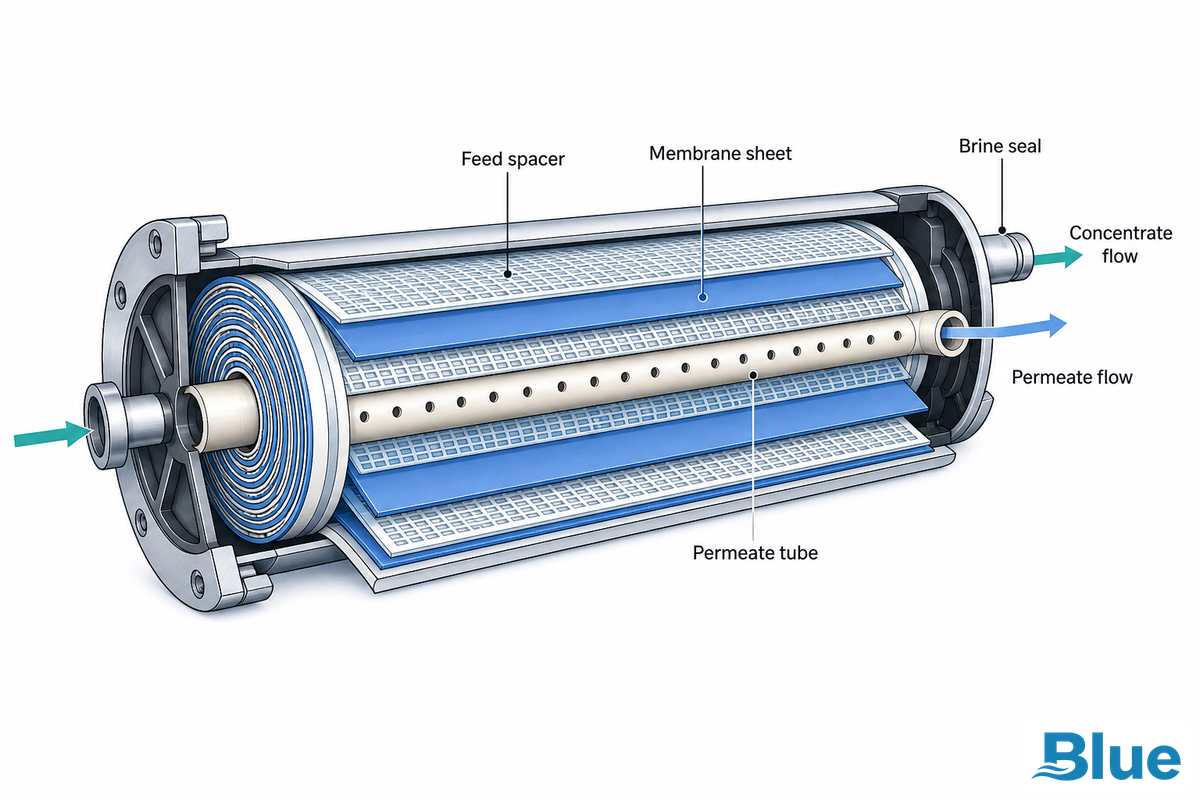
An industrial RO membrane element is a replaceable spiral-wound element installed inside a pressure vessel. Inside the element you’ll find membrane leaves, feed spacers, permeate spacers, a permeate-carrying tube at the center, brine seals, and an anti-telescoping device. The RO system drives feedwater across its surface. Part of the water passes through as permeate; the rest carries rejected salt into the concentrate stream that leaves the vessel.
DuPont refers to reverse osmosis as a process driven by pressure that relies on a semi-permeable membrane and cross-flow filtration, stating their FilmTec RO elements employ spiral wound, thin-film composite polyamide membranes. Peer-reviewed literature commonly describes RO thin-film composite structures as having a laminated architecture, often featuring a polyamide active layer resting on a polysulfone substrate and backed by a polyester mesh.
Remember, you’re not buying the whole plant. The RO membrane element has a datasheet that lists element-specific performance under specific laboratory test conditions. That performance is measured in isolation. System-wide performance, however, takes into account your plant staging, pump pressures, recovery set point, the pretreatment process, the concentration of impurities you’re removing (salt, organics, particles), and other operating factors including temperature correction, cleaning history, and vessel loading. Don’t let these facts catch you by surprise when your plant doesn’t meet the required water quality standards.
Engineering rule: if a 4040 or 8040 element can fail because feedwater, recovery, or cleaning history is outside the test basis, treat the datasheet as evidence to investigate rather than proof to purchase. Blue Membrane engineers can review the application with the factory and precision manufacturing context before a production order is placed.
System Boundary: The 4 Constraints Element Specs Cannot Carry
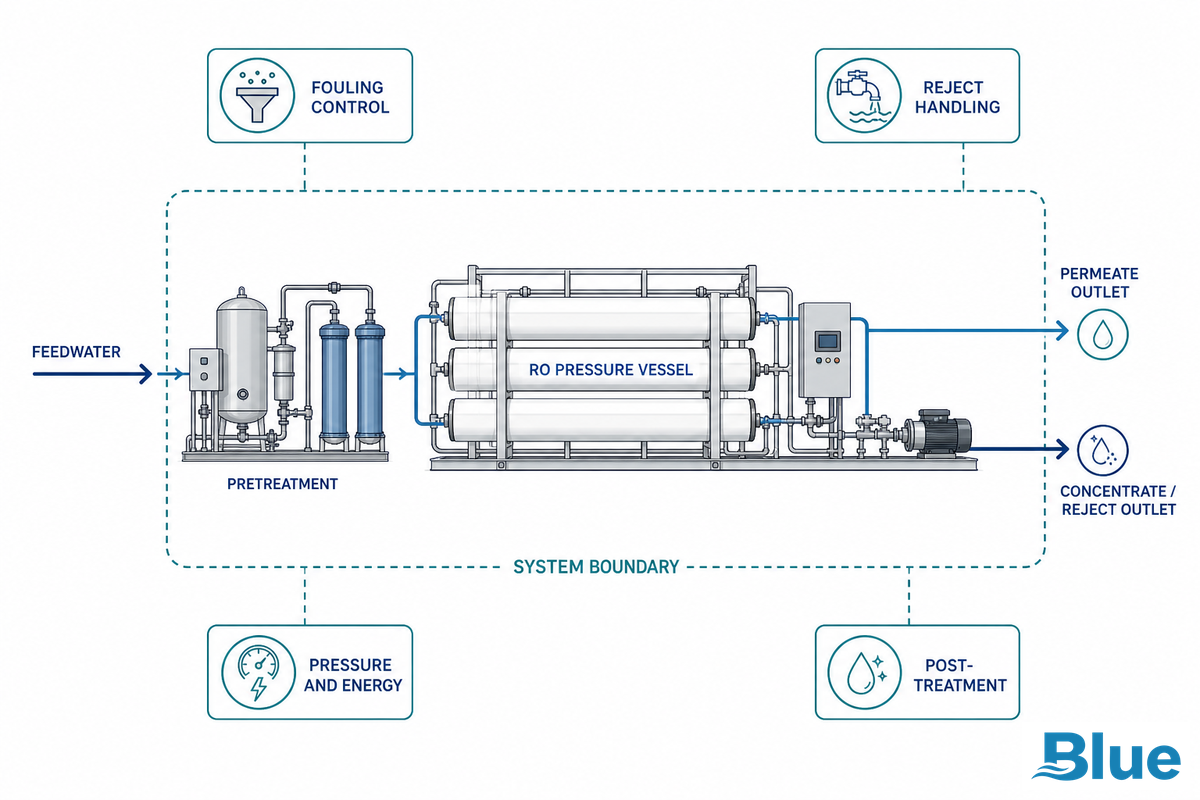
A stronger element alone won’t make a weak RO system perform well. The U.S. EPA discusses how reverse osmosis and nanofiltration processes discharge part of the incoming water as reject, often 15-30%, and that stream must be handled as waste or used elsewhere. High pressure also adds energy demand, and pretreatment is often needed to prevent fouling or plugging of the element membrane. The agency also warns of post-treatment adjustments to counteract lowered pH of the treated water and mitigate subsequent corrosion.
In its reverse osmosis optimization evaluation, the U.S. Department of Energy echoed the operating concerns: “system recovery is strongly dependent upon the feedwater quality, membrane type, process configuration, and operating practice. Key system variables for reverse osmosis processes are pressure, temperature, pH, and flow.” The DOE guidance also cited required upstream pretreatment such as filtration, disinfection, antiscalant application, carbon filtration, and cartridge filtration before the RO membrane is introduced to the system.
| Constraint | Question before element selection | Procurement risk |
|---|---|---|
| Concentrate and recovery | Where will often cited 15% to 30% reject flow go, and do LSI, Stiff-Davis, or sulfate-scaling checks limit recovery? | Buying for permeate flow while ignoring brine handling. |
| Pretreatment fit | Do source-water solids, organics, iron, biology, and seasonal changes match the pretreatment train? | Using a fouling-resistant element as a substitute for upstream control. |
| Chemical compatibility | Has the plant exposed prior elements to free chlorine, oxidants, high pH cleaning, or harsh cleaners? | Confusing reversible fouling with permanent membrane or selectivity damage. |
| Operating records | Are flow, pressure, temperature, conductivity, pH, recovery, and cleaning history recorded on a stable basis? | Replacing elements without a baseline to prove what changed. |
Use these as bounds before ordering an RO membrane element. ASTM’s D19.08 listing for RO standards contains D4516-19a (“Standard Practice for Standardizing the Performance of Reverse Osmosis and Nano-filtration Devices”) and D4472-23 (“Standard Practice for RO/NF System Record Keeping and Monitoring”). ASTM also has D3739 for calculating Langelier Saturation Index, D4582 for Stiff-Davis Stability Index and D4692 for predicting sulfate scaling salts in RO/NF systems. In short, your decisions regarding specifications sheets, replacing vessels, and drift checking are all interconnected.
Don’t make ASTM references a plant-design promise. ASTM D4194-23 states its operating-characteristic test methods are intended for short-term (under 24 hr) testing and are not intended for plant design. ASTM D4472-23 describes its record-keeping guide as a general guidance, site-specific and it must not replace the operating manual for a particular plant. Use these standards to ask better questions; don’t use them as a shortcut to engineer review.
Feed-quality diagnostics belong in the same file as the element quote. ASTM D4189-23 characterizes SDI as a useful indication of particulate matter, an indicator of the performance of filtration or clarification, and a test that empirically correlates with the fouling tendency of certain RO elements. It also advises that SDI is not an absolute measure of particulates, is appropriate for relatively clear waters, is not typically applied to RO or ultrafiltration effluents and varies with temperature and the filter/membrane-supplier. Ask for the SDI method, sample point, temperature, filter-source and pretreatment status before treating a fouling-resistant element as the solution.
Scope is important. ASTM D4516-19a is applicable to brackish waters and seawaters and says in its scope that it is not necessarily applicable to waste waters. This same page notes that changes in pressure, temperature, conversions and feed concentration may result in differences in permeate flux and salt passage, and in multi-stage brine-staging systems, each stage should be normalized individually. When dealing with wastewater reuse in industry, use the worksheet as a starting format, and consult the application engineer regarding which test methods, fouling index, scaling models, pilot data and staging are most relevant to the specific stream.
Material chemistry must be handled with the same care. DOE’s membrane table distinguishes among different oxidants to which various membrane types may be tolerant; for instance, thin-film composite membranes often have a higher tolerance to oxidants than cellulose-acetate membranes. A 2023 study of polyamide RO membranes also recognizes the sensitivity of polyamide membranes to free-chlorine attack and its subsequent degradation of selectivity. If your plant history indicates chlorine breakthrough, oxidant shock, abnormal cleaning pH or the presence of carryover disinfectants, be certain of chemical exposure limitations before comparing rejection rates.
Certification is separate from but distinct from ensuring industrial-duty matching. On its December 18, 2025 webpage, NSF notes that its reverse osmosis system and component certifications adhere to NSF/ANSI 58 for drinking water point-of-use systems; these include requirements for material safety, structural integrity, removal of total dissolved solids, an efficiency rating, and a recovery rating. It lists removal of TDS as a required claim and many contaminant removals as optional. For potable, municipal, or commercial-adjacent water-use applications, check the current NSF standard version and claims that are needed. For industrial process-water applications, determine the actual industrial standard governing the skid.
Concentrate discharge might also present permitting issues. EPA’s NPDES-Permit-Basics website describes point-source discharges of any pollutant to any water of the United States as requiring an NPDES permit, including limits on what may be discharged, as well as monitoring and reporting requirements. If your RO reject leaves the facility through a pipe, ditch, sewer connection or other identified route, confirm the discharge method before treating recovery rate as an element selection priority.
The way the wastewater is discharged changes the compliance question. EPA describes the National Pretreatment Program as the regulatory mechanism for indirect industrial and nondomestic wastewater discharges to publicly owned treatment works, with the goal of protecting POTW operation and reducing pollutant discharge to receiving waters. EPA’s hazardous-waste section also explains that characteristic hazardous waste can include corrosivity, ignitability, reactivity, and toxicity, and that acidic or alkaline wastewater (pH <2 or >12.5) may be considered corrosive hazardous waste. Does the concentrate, spent cleaning solution, pretreatment backwash, cartridge-filter waste or maintenance residue qualify as direct discharge, indirect sewer discharge, hauled waste or waste stream that requires characterization?
Selection Asset: The 8-Field Element Envelope Test
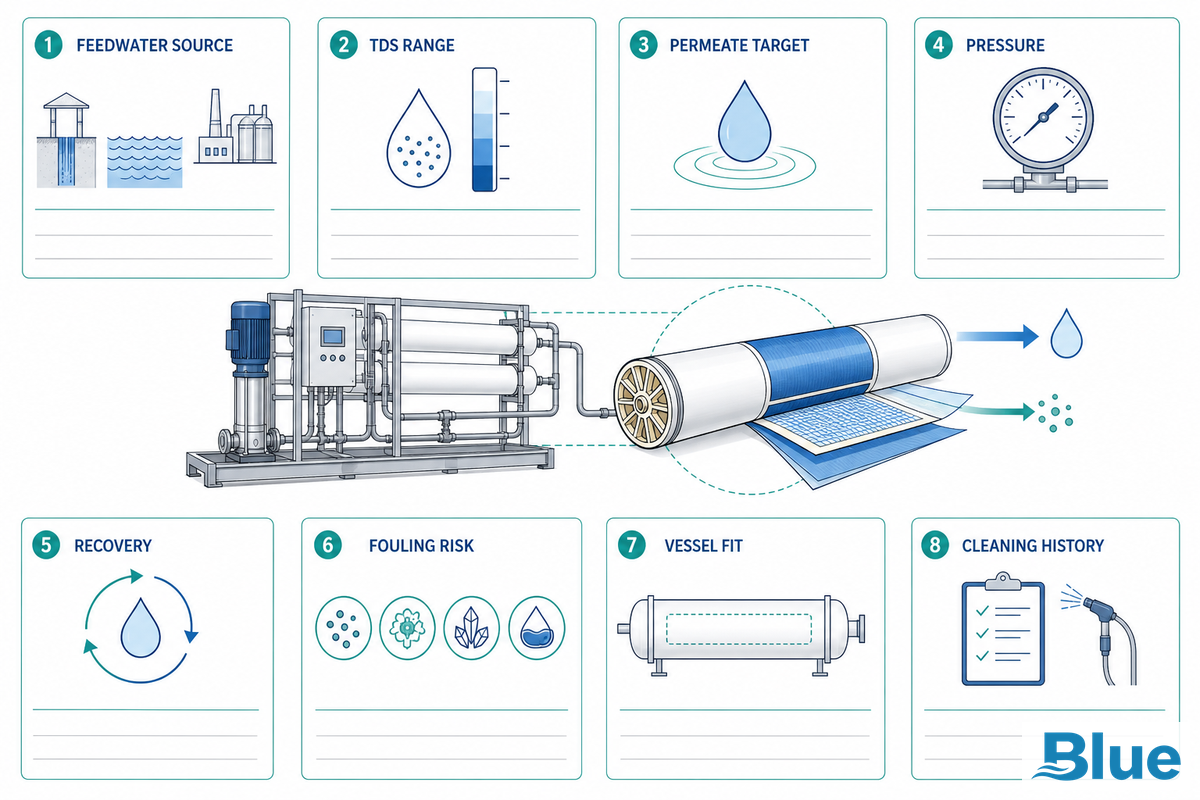
When comparing elements, don’t look for just a single parameter; fill these eight fields first to change the search from a part-number comparison to an operating-envelope check.
| Field | Question to answer | Bad shortcut to avoid |
|---|---|---|
| 1. Feedwater source | Is the feed well water, surface water, seawater, municipal reuse, process wastewater, boiler makeup, or ultrapure water pretreatment? | “It is just brackish water.” |
| 2. Total dissolved solids | What is the current TDS range, and does it move seasonally? | Using last year’s water report without checking current feedwater. |
| 3. Target permeate quality | What conductivity, salt, silica, boron, TOC, or process limit must the permeate meet? | Buying the highest rejection rate without checking the actual limit. |
| 4. Operating pressure | What feed pressure and pump margin are available at design flow? | Assuming a low pressure element always saves energy. |
| 5. Recovery target | What recovery is expected per stage and for the whole RO system? | Ignoring concentrate-side scaling and pressure drop. |
| 6. Fouling and scaling risk | What are SDI, turbidity, organics, iron, silica, biological growth, oxidant exposure, and cleaning history? | Choosing by salt rejection only. |
| 7. Element size and vessel arrangement | How many elements sit in each pressure vessel, and is the train staged? | Changing a single element in a mixed-age vessel without checking hydraulics. |
| 8. Replacement scope | Is the project a single element, full vessel, full train, or new skid? | Quoting element count before confirming the replacement boundary. |
The 8-field test closes a common procurement gap: an element may fit the vessel and still fail the duty. Because pressure, recovery, and feed concentration can shift salt passage, an industrial buyer should send the 8 fields, the 25 C or field-temperature basis, and at least one recent operating data set. Blue Membrane engineers use that application record to separate a wrong part-number match from a real replacement risk.
That is also where factory and precision review matter. A replacement request for a 4040, 8040, 150 psi, or 225 psi duty can fail because the OEM drawing, production application, or feedwater record is incomplete; the element should be engineered to the operating envelope before the quote is treated as final.
Blue Membrane produces nano, ultra, RO, and advanced separation membrane products for industrial, municipal, commercial, and specialty water treatment systems. Refer to the Blue Membrane industrial RO membrane element lineup after you complete the envelope check and provide us with the eight fields with your cross-reference request.
Operating Duties: Brackish, Seawater, Low-Pressure, and Fouling-Resistant Elements
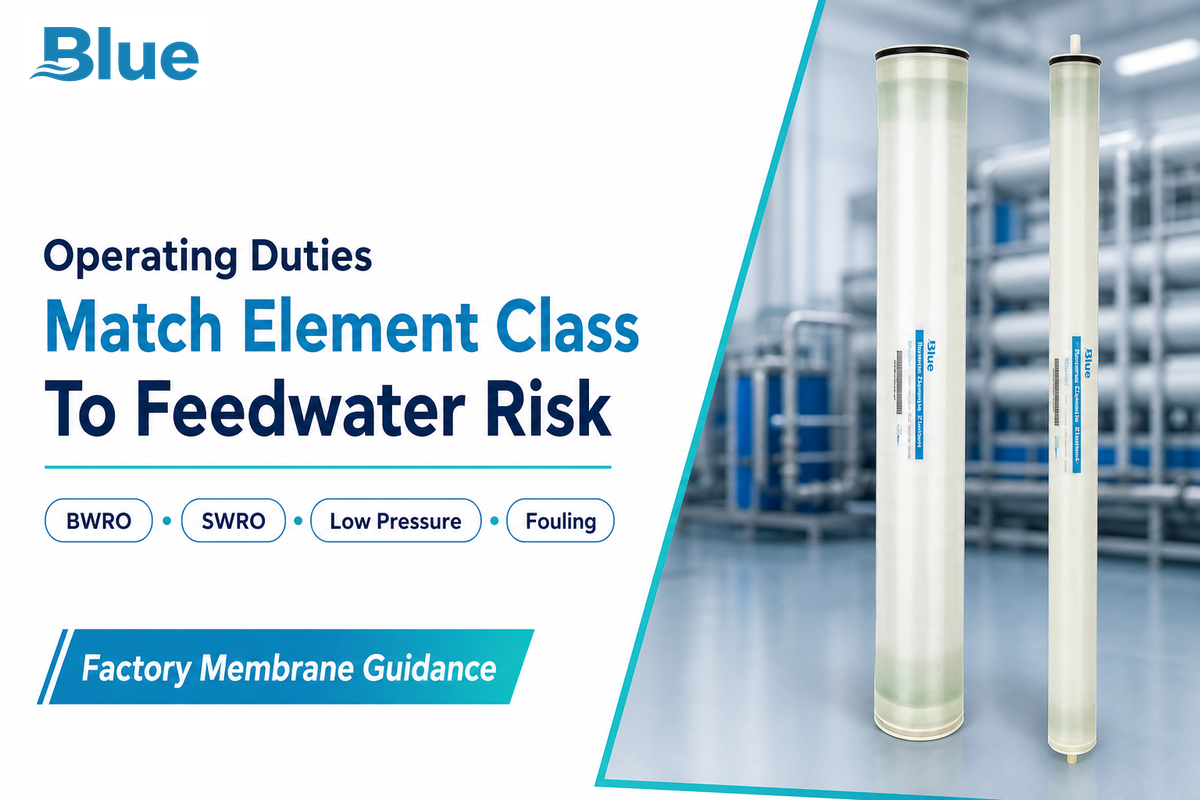
Industrial RO membranes can be commonly grouped by duty. Keep layers separate: seawater and brackish water are recognized testing categories whereas ultra low, low pressure, fouling-resistant and high rejection are commercial names and must be accompanied by feedwater information.
Do not confuse this with residential RO, tap water, 50 gpd reverse osmosis water filters, or small 1.8-inch and 2.5-inch replacement elements. Those RO filtration and reverse osmosis filtration products may describe permeate water in household terms, while industrial projects judge dissolved salts, wastewater treatment, operating conditions, energy efficiency, and operational costs. Dow FilmTec, Axeon, ultra low energy labels, polyethersulfone references, 0.0001 micron claims, and desalination membrane language can help with cross-reference research, but they still have to be checked against water conditions and the actual duty.
| Duty | Typical feed profile | Selection pressure | Common buyer mistake |
|---|---|---|---|
| Brackish water | Lower salinity than seawater, often wells or municipal/process sources | Balance salt rejection, permeate flow, scaling control, and pump energy | Treating all BWRO water as stable even when TDS and silica change. |
| Seawater desalination | High TDS, higher osmotic pressure, stronger biofouling and intake risk | High rejection, higher pressure tolerance, corrosion-aware plant design | Comparing SWRO to BWRO only by flow rate. |
| Low pressure or ultra low pressure | Cleaner, lower-salinity water where pump pressure is limited | Energy consumption and available pressure margin | Assuming lower pressure works in dirty or high-salt feedwater. |
| Low-fouling or fouling-resistant | Surface water, reuse, organics, biological risk, or variable industrial feed | Spacer choice, surface behavior, cleanability, and cleaning interval | Ignoring feed spacer and pretending pretreatment does not matter. |
Use the duty designation as the basis of a better inquiry and not as the conclusion. A low energy element may produce superior flow at a given pressure on clean water, but a wider spacer element may be the better business decision if it reduces cleaning downtime.
| Element class | Typical spec clue | Buyer check |
|---|---|---|
| Standard brackish water | Often tested near 2,000 ppm NaCl, 25 C, and 225 psi | Check hardness, silica, and recovery before assuming the same pressure works. |
| Low pressure brackish water | Often framed around 150 psi operation in clean lower-salt feed | Confirm pump curve and fouling load before trading pressure for flow. |
| Ultra low pressure | May be used where energy consumption is tightly watched | Do not use it as a fix for poor pretreatment. |
| High rejection brackish water | Published RO membrane values may show 99.5% or higher rejection under a stated basis | Compare permeate quality target against the test feed and recovery. |
| Low-fouling brackish water | Wider 34 mil spacers may appear in fouling-duty tables | Check pressure drop and cleaning access, not only active area. |
| Seawater RO | Public spec examples often use 32,000 ppm NaCl and around 800 psi | Verify corrosion control, intake biology, and energy recovery assumptions. |
| Commercial 4040 | 4-inch by 40-inch format with lower element weight than 8040 | Useful for commercial reverse osmosis and smaller filtration systems. |
| Industrial 8040 | 8-inch by 40-inch format with larger active area and higher gpd capacity | Check lifting, vessel count, staged recovery, and replacement labor. |
| Recovered or graded membrane | Recovered or graded membrane performance may require separate grading documentation | Use only where the plant accepts recovered membrane risk and documentation. |
Spec Evidence: The Spec Sheet Truth Table
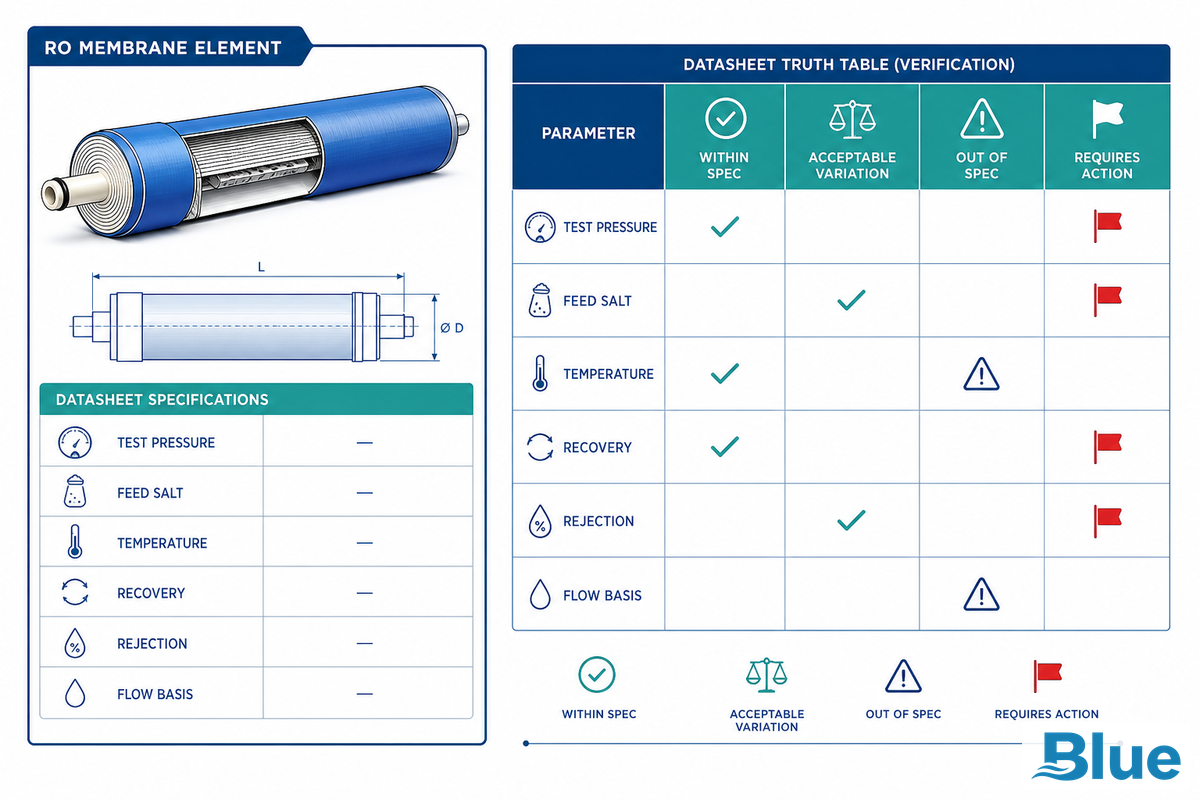
Spec sheets are very useful when the operating values are read relative to their test basis. ASTM’s D19.08 provides standard methods, D4194-23 for reverse osmosis and nanofiltration device performance, D4516-19a for standardizing RO operating data, and D4472-23 for recording performance data. That’s what this truth table does.
The trap is treating a commonly reported 99.5% rejection value as proof without asking why the test used 25 C, 150 psi, 225 psi, or a stated recovery. For an industrial buyer, OEM skid, or production application, the factory comparison should be engineered to the same basis because a precision-looking number can still fail outside its test conditions.
| Spec field | What it proves | Question to ask |
|---|---|---|
| Feed salt or challenge solution | Whether the result came from brackish water, seawater, or another test solution | Was the rejection value measured at 500, 2,000, 10,000, or 32,000 ppm? |
| Pressure | Driving force behind permeate flow | Was the result measured at 100 psi, 150 psi, 225 psi, 800 psi, or another basis? |
| Temperature | How viscosity and flow were affected | Was the result corrected to 25 C or another standard? |
| pH | Chemical basis of the test | Does the datasheet pH match your feedwater and cleaning exposure? |
| Recovery | How much feed becomes permeate during the test | Is the datasheet recovery close to your stage design? |
| Flow tolerance | Expected manufacturing variation | Does the quote account for tolerance instead of treating one flow number as fixed? |
| Element size | Physical and hydraulic frame | Are 4040 and 8040 values being compared on the same basis? |
| Element vs system result | Where the number was measured | Is the claim for one element, one vessel, one train, or the full skid? |
Compare typical industrial product tables from different suppliers and you’ll quickly understand why this matters. One table provides industrial examples based on 2000 ppm NaCl at 25 degrees C, neutral pH, 150 or 225 psi, and reported recovery. Another compares a given operating pressure class, a choice of 28/34 mil spacing, 4040/8040 format and concentration. Don’t just report a single value; make sure to document your test conditions.
At a minimum, you need to compare: feed concentration; operating pressure (psi or bar); temperature (degrees C); recovery (%); permeate flow (m3/d) and element format. Publicly available element performance guides and operating manuals can document performance based on such parameters as 15.5 bar; 55 bar; 45 C; 10% recovery; 15% recovery; 20 days operation; 2 hours operation and 5 bar along with reported salt rejection.
Rejection of salt isn’t an across-the-board contaminant guarantee. Research published for open publication into membrane contaminant removal says that the rejection of PFAS does correlate with feed water pH, since the membrane charge is influenced by pH. Studies on organics, ion effects and ionic strength also mention some influence of these parameters.
When considering boron, silica, neutral organics, PFAS or industrial mix applications, demand contaminant data – don’t take the NaCl rejection value as a complete representation.
Similarly, the hydrodynamics impact how a datasheet number acts within a pressure vessel. Mechanistic studies of RO/NF concentration polarization explain how an upstream concentration boundary may cause decreased solvent flux and/or increased solute passage; consider this background rather than a standard on which you select vendors. At high recovery, dense feed spacers, low crossflow, or fouling water, inquire how spacer configuration, crossflow velocity, pressure drop, and stage location influences passage and flux.
Replacement Boundary: The Pressure-Vessel Swap Rule
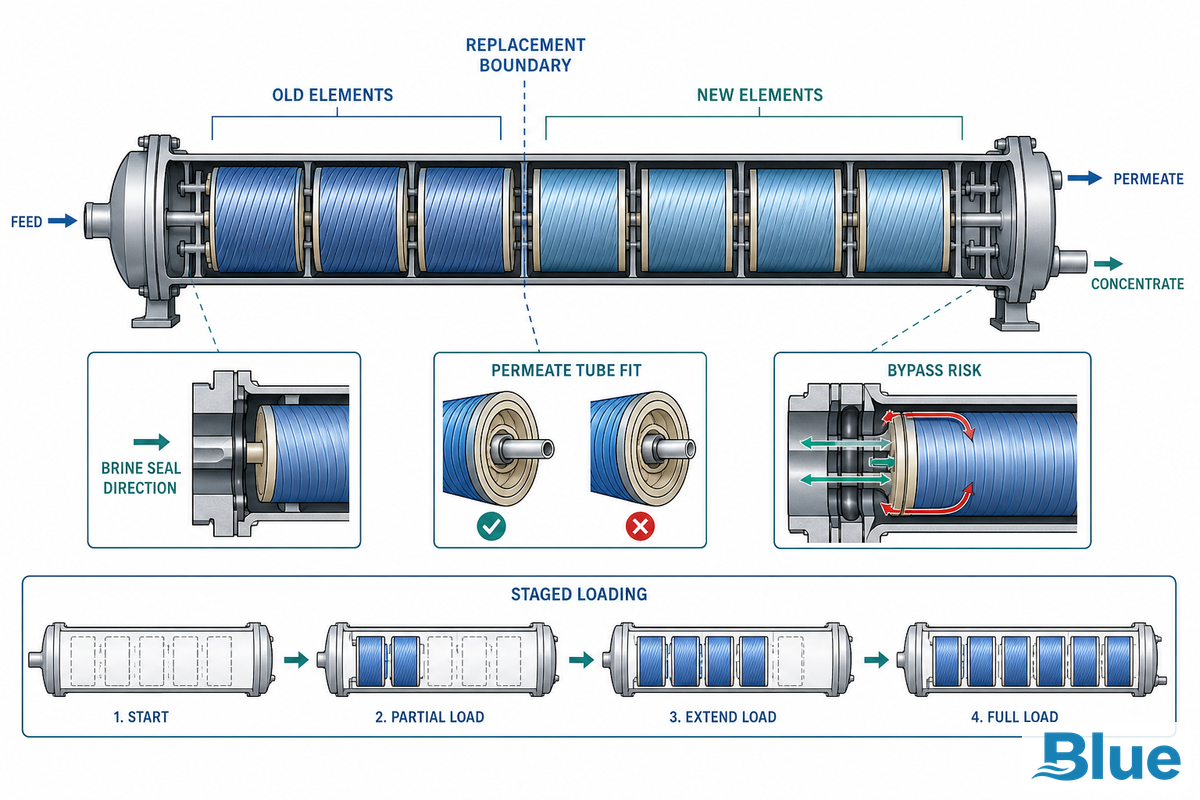
For replacement projects, the simplest rule is safest: classify the element class, then replace by whole vessel or matched train section if hydraulic balance is questionable. It doesn’t mean that a one-element change is forever taboo. It just means that one-element change has to have an argument and a check.
The hidden risk is a hydraulic gap inside the pressure vessel. A single new element can look correct on paper, yet fail in practice if older elements have higher pressure drop, different rejection, or a worn brine seal. Before an OEM or production buyer approves a one-element change, Blue Membrane engineers should see the vessel map, 4040 or 8040 format, pressure trend, and at least 7 days of stable operating data.
Factory review is not paperwork here; it is a precision check against a real production application. The wrong call can lock in a pressure-drop problem because the new element is engineered to a different flow path than the aged vessel section.
The blending of different brands, ages, rejection classes or pressure-drop profiles in a single pressure vessel could steer the flow through lower-resistance elements. Elements experiencing higher flow may also receive higher loading and foul more quickly. A 2026 membrane replacement guide says replacing just one membrane in a multi-element vessel “isn’t always advisable,” as new/old element mixing may lead to hydraulic imbalance.
Consider that a caution sign, not an unbreakable rule.
Run a seal and leakage check before normalizing performance. ASTM D4516-19a applies to high-rejection RO systems with no significant leaks between feed-brine and permeate streams. If the replacement case includes brine-seal bypass, adapter leaks, interconnector leaks, vessel seal problems, or unusual feed-to-permeate leakage, isolate the mechanical fault before blaming the membrane sheet.
If the plant history is unclear, replace the paired element and record new baseline data in the first week. Don’t install old fouled elements and a new high-flow element together unless an engineer approves the load profile. For vessels using FilmTec, Hydranautics, Toray, Nitto, or another legacy model, cross-reference dimensions, permeate tube fit, brine seal direction, pressure, rejection class, and feed spacer before placing an order.
Operations Worksheet: The 7-Day Permeate Drift Check
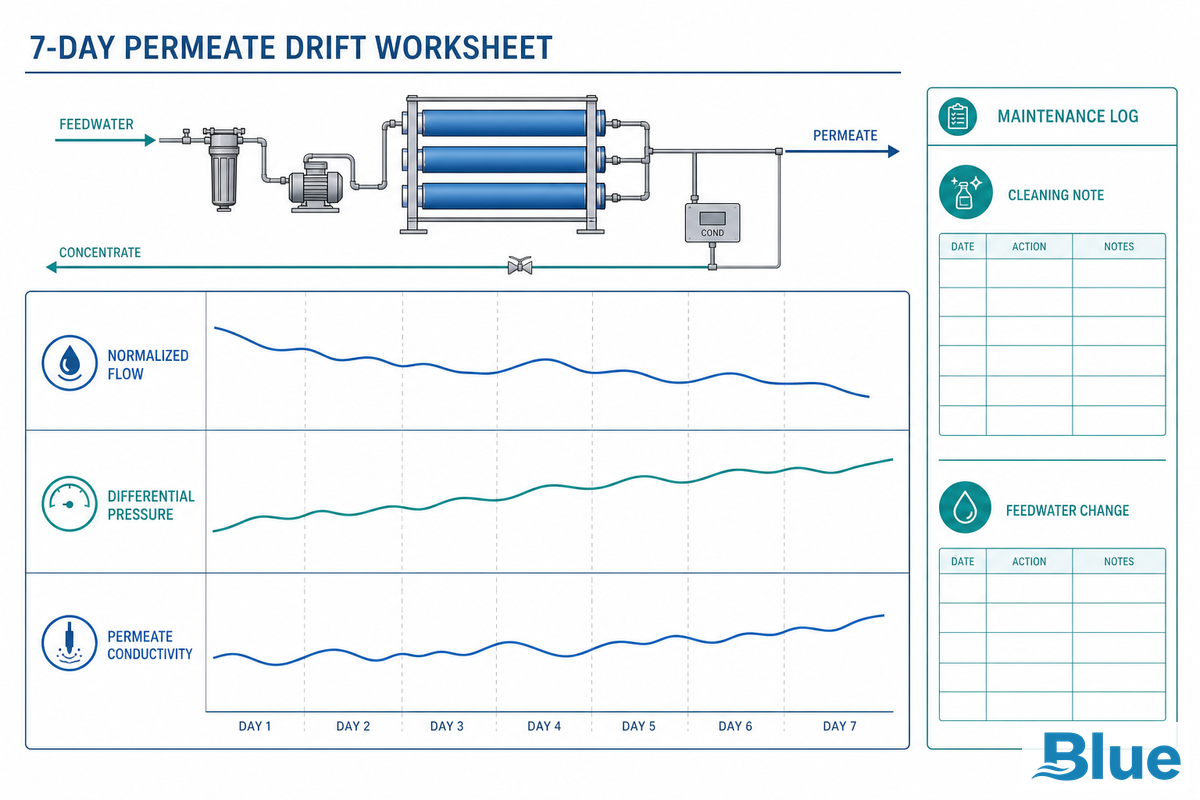
This 7-day check is a buyer worksheet procedure, not a standard or substitute for the operating manual. ASTM D4472-23 refers to RO/NF recordkeeping as “guidelines” and “plant site dependent.” Calendar age remains a poor replacement driver. Pumps & Systems mentions a three-year expected service life, but cases exist where RO membrane elements ran more than ten years with no permanent or significant performance decline.
According to one PMC review, cleanings typically occur when normalized permeate falls around 10%, pressure drops increase by 15% or product salt concentration rises 10%.
Use the 7-day worksheet to catch a small problem before it becomes an expensive outage. Because differential pressure, permeate conductivity, and normalized flow move together in the field, a production application should record 10% or 15% movement as a risk signal, not as a purchase order by itself. Blue Membrane engineering support can compare the trend against feedwater, cleaning history, and element class.
| Day | Normalized permeate flow | Permeate conductivity | Feed-to-concentrate pressure drop | Notes |
|---|---|---|---|---|
| 1 | Baseline after stable operation | Baseline | Baseline | Record feedwater TDS, temperature, pressure, recovery, and cleaning status. |
| 2-3 | Look for early drop | Check if salt passage is moving | Watch lead-vessel rise | Note changes in feedwater, antiscalant, oxidant control, or pretreatment. |
| 4-5 | Compare against the first stable day | Compare against product limit | Check if pressure drop is climbing | Do not judge from raw flow alone; normalize before deciding. |
| 6-7 | Decide clean, monitor, or replace | Confirm if rejection is still acceptable | Check cleaning response | If cleaning response is poor and pressure drop stays high, replacement planning is stronger. |
A 2026 study, using 6 years of full-scale plant data, found that differential-pressure trends can predict RO membrane fouling 15-20 days in advance. That’s the operating lesson; monitor the trend before the plant reaches a quality alarm.
RFQ Checklist for Industrial RO Element Buyers

A good RFQ goes beyond a part number. It provides sufficient context for the supplier to determine whether the replacement RO membrane is mechanically sound, chemically appropriate, and hydraulically safe.
The RFQ gap creates risk because a supplier can quote the right diameter and still miss the operating problem. For an industrial buyer, OEM project, or production application, include 4040/8040 format, pressure, recovery, 7-day trend data, and the factory precision requirement so the replacement can be engineered to the actual duty.
- Installed model number, brand, and any old cross-reference sheet.
- Element size: 4040, 8040, or another format.
- Number of pressure vessels, elements per vessel, and staging arrangement.
- Feedwater analysis: total dissolved solids, hardness, silica, iron, manganese, TOC, turbidity, SDI, pH and temperature.
- Current operating pressure, recovery, permeate flow, permeate conductivity, and reject flow.
- Cleaning history: date, chemicals, pH range, temperature, flow and recovery after cleaning.
- Replacement scope: single element, full vessel, full train, or new RO system.
- Application: industrial process water, ultrapure water pre-treatment, waste water treatment, food and beverage, commercial reverse osmosis, or seawater desalination.
- Regulatory or process limits for salt, contaminant removal, bacteria control or pure water quality.
If Blue Membrane elements are specified, include current C/Z/H/N series references if applicable. If another brand element is to be replaced, supply the datasheet of that element along with the vessel layout; not just the part number. This will allow the application team to compare reverse osmosis membrane elements by fit, not just name.
When to Ask for Application Engineering Support
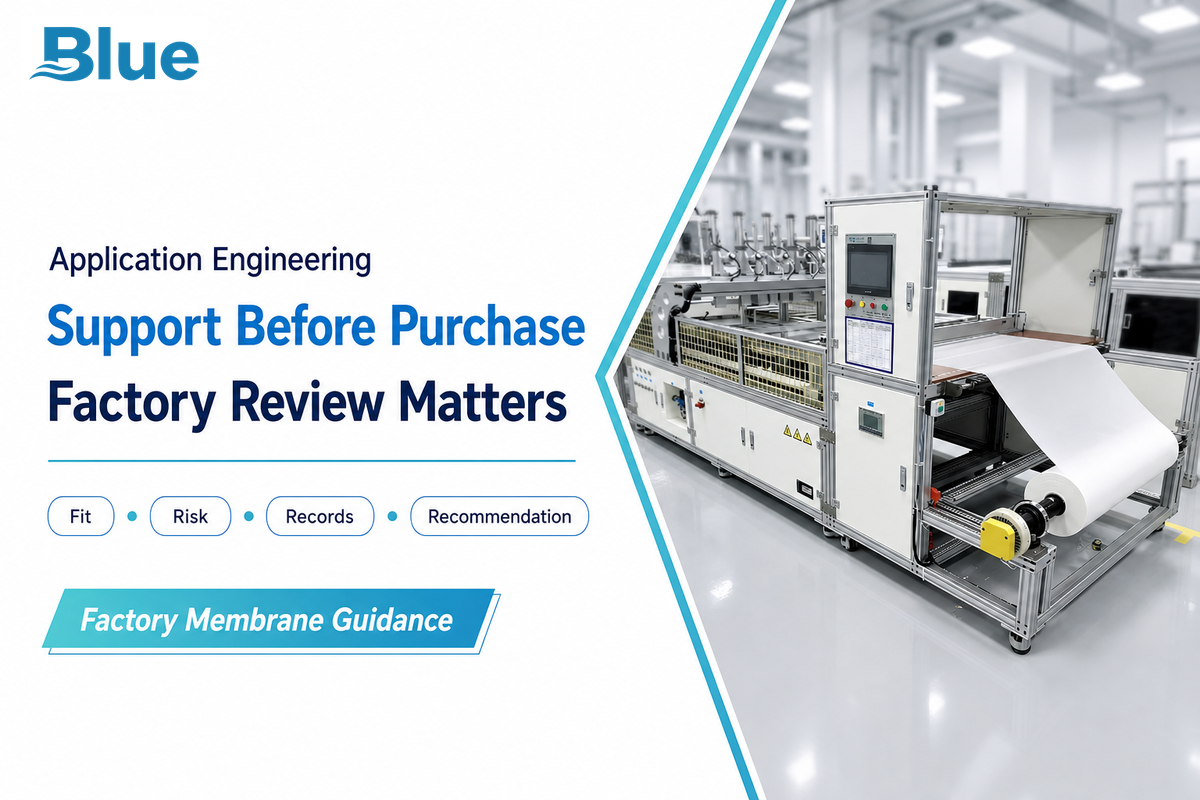
Request engineering review prior to purchasing when the element decision depends on feedwater change, vessel hydraulics, cleaning history, or a production deadline. The goal is to confirm the operating envelope before a replacement order creates a risk that a simple catalog match cannot show.
- Feedwater TDS or silica is increasing from original design basis.
- Seawater, wastewater, reuse water, or variable industrial feed is in service.
- Cleaning is needed more often than the plant expected.
- Permeate conductivity drifts even after cleaning.
- Mixed models, ages or unknown replacement history of elements within pressure vessels.
- Switching from standard elements to low-pressure, ultra-low-pressure, high-rejection or low-fouling design elements.
- Commercial RO membrane, high-capacity industrial reverse osmosis skid, or water purification systems with costly downtime.
Ask before a wrong selection locks the plant into downtime. For an industrial buyer, OEM skid, or production line application, Blue Membrane can review the spec sheet, 4040/8040 vessel data, pressure limits, and feedwater risk before the factory prepares a replacement recommendation.
That review matters because an engineered recommendation can prevent a 150 psi, 225 psi, or 7-day trend mistake from moving into production. Treat the factory review as a precision check on the application, not as an extra sales step.
Blue Membrane manufactures element sheets and spiral wound elements for worldwide water treatment systems. Practical question: Not “Which RO elements do you have in stock?” but “Which element class does the job, and what test basis proves it?”
FAQ
These answers are meant to prevent the same selection mistake in a shorter format: do not buy an industrial RO membrane element from one number, one brand cross-reference, or one 8040 fit check. Use the application, pressure, feedwater, and replacement boundary first; then ask Blue Membrane for a specific engineering review.
The risk is simple: a quick answer can fail in production because the factory, precision basis, 4040/8040 fit, and 7-day operating signal were never checked. These replies are engineered to point the industrial buyer back to the application evidence.
How do I choose the right industrial RO membrane element?
Begin with the operating envelope rather than just the model number; elements chosen must correspond with the feedwater source, total dissolved solids, desired salt rejection, operating pressure, recovery target, fouling risk, and vessel configuration. Mere mechanical fit alone is deceptive; an 8040 RO membrane element might sit properly in the vessel but operate poorly if test basis, spacer design and element class don’t match the actual RO system.
What is the difference between brackish water and seawater RO membrane elements?
Brackish water elements usually perform well in lower-salinity feedwater at lower operating pressures than seawater desalination elements. Seawater elements must contend with higher osmotic pressures, and their tests are run under harsher conditions. Look at the pressure, feed concentration, permeate flow, recovery and salt rejection in combination, not just rejection percent.
Can I mix membrane brands within the same pressure vessel?
Adding brands, rejection classes, or membrane generations into one pressure vessel may create uneven flow and loading. A safer path is to qualify a class-matched element and replace the whole vessel or matched train section. Single-element replacement can still work when age, pressure drop, and performance are close, but maintenance should check normalized flow, salt passage, brine seal direction, and pressure drop first.
Use the matched set in the case of an unclear replacement history of the plant.
How long do industrial RO membrane elements last?
Each plant doesn’t have a standard life on the calendar. It’s based on normalized permeate flow, salt passage, differential pressure, feedwater robustness and cleaning performance. Systems where pre-treatment can be controlled may outlast those exposed to silica, organics, oxidants, and/or microbial activity.
What information should I send for an industrial RO membrane element quote?
Provide the installed model number, element size, pressure vessel configuration, feedwater composition, operating pressure, temperature, recovery setpoint, permeate quality target, current flow, cleaning history, and replacement scope. State the issue being solved: low flow, high permeate conductivity, high pressure drop, frequent cleaning, OEM sourcing, or new system design. Specify whether the scope is one element, full vessel, train, or full skid.
These parameters will allow an engineer to understand the operating range as opposed to simply guessing a part number.
Selected Technical References
Use these references to check the engineering boundaries behind this guide: EPA drinking-water treatment technology overview, EPA NPDES permit basics, EPA National Pretreatment Program, peer-reviewed RO membrane review on PubMed Central, NSF/ANSI 58 reverse osmosis overview, and ASTM D4516-19a standardization practice.