Get in touch with Blue Membrane Company

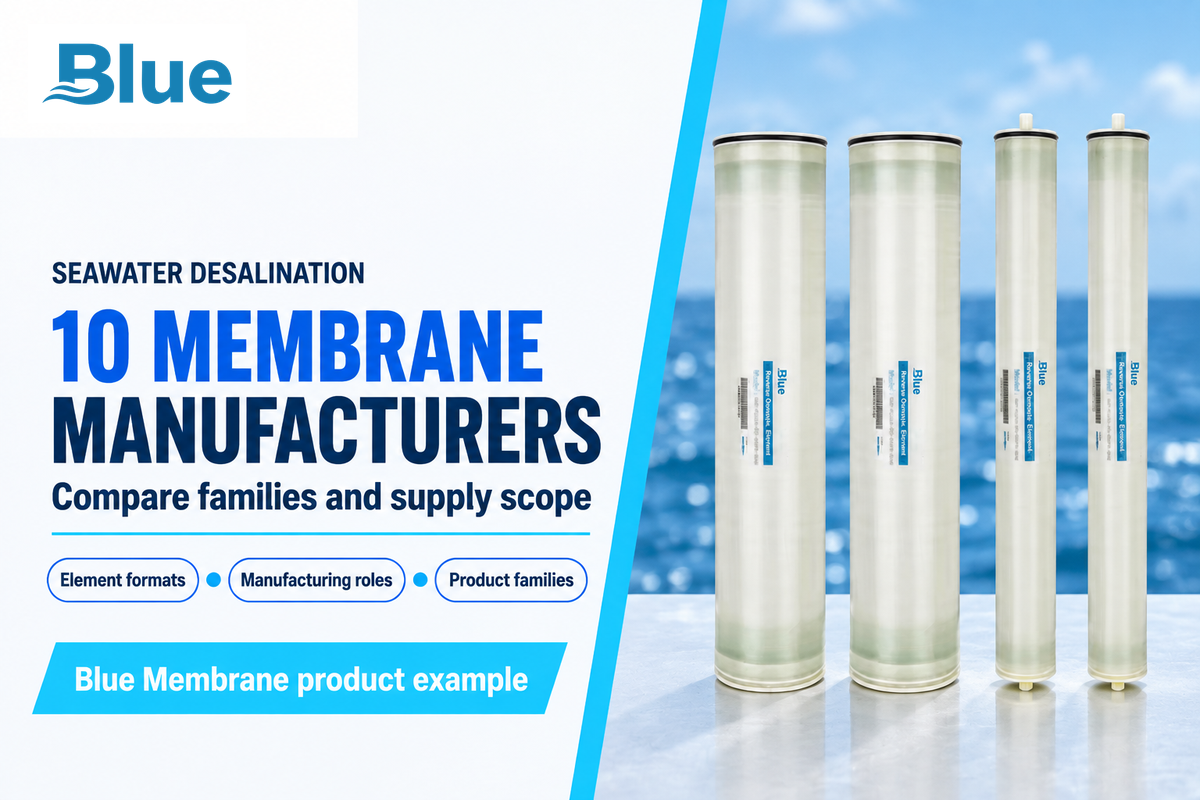
Seawater RO membrane manufacturers include DuPont FilmTec, Toray, Hydranautics, NanoH2O, Ion Exchange, Vontron, KeenSen, OriginWater, Toyobo MC and Blue Membrane. Their products cover different element sizes, membrane materials and supply arrangements. A useful shortlist starts with the required product family: a marine watermaker element, an industrial spiral-wound element or a hollow-fiber desalination module.
Seawater RO membrane manufacturers produce elements or modules for desalination. DuPont, Toray and Hydranautics offer spiral-wound families; Toyobo MC offers HOLLOSEP hollow-fiber modules. Match the manufacturer’s product format to the project before comparing quotations.
Key takeaways
- HYDRAMEM belongs to Ion Exchange; Hydranautics is a separate Nitto company.
- NanoH2O became independent in December 2025 after operating as LG Water Solutions.
- Toray’s catalogue includes 4-, 8- and 16-inch seawater elements; size availability differs across manufacturers.
- An ISO 9001 factory quality system and an NSF listing for named products answer different purchasing questions.
The companies below are clustered according to product and supply scope. The seawater families are named. The numbers don’t denote rankings of salt rejection, market share or plant energy consumption.
Quick Picks for Seawater Membrane Buyers
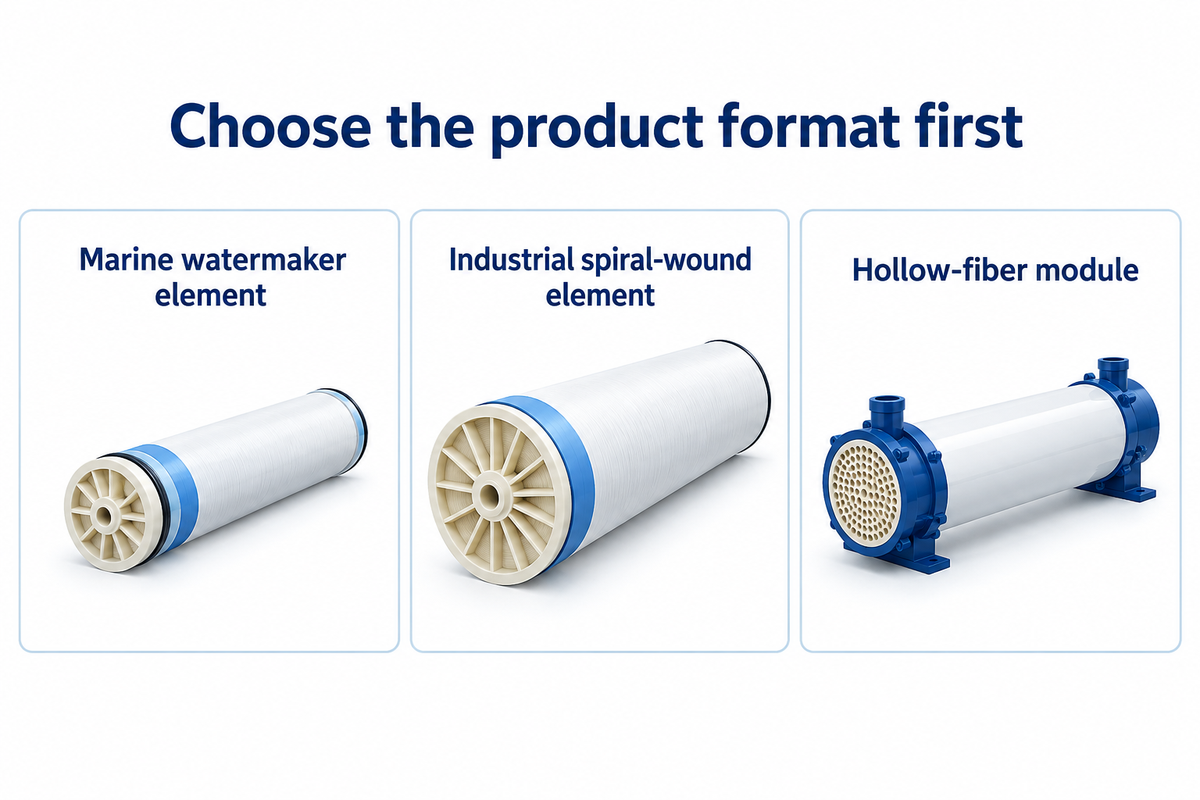
For a compact watermaker, start with companies that list the required small-format seawater element. For a larger desalination system, look at the specific families and design conditions of the eight-inch elements. For a hollow fiber element, follow the module manufacturer’s architecture rather than use a spiral-wound catalog as a surrogate list.
- 2540, 4040 and 8040 elements for integrator sourcing: Blue Membrane publishes MB-H1 and MB-H2 seawater ranges and supplies system integrators, original equipment manufacturers and distributors.
- India-based membrane manufacture: Ion Exchange produces HYDRAMEM, including the SWE range, alongside its water treatment business.
- Several SW model choices from Chinese manufacturers: Vontron and KeenSen publish dedicated seawater lines; OriginWater also describes its own membrane coating and element rolling.
- Dry seawater element supply: DuPont FilmTec publishes a dry portfolio that includes SW30HRLE and SW30XLE models, a useful distinction when storage and installation handling matter.
- A catalogue spanning larger diameters: Toray lists seawater products in 4-, 8- and 16-inch formats, including established TM800 families.
- Nitto-group seawater products: Hydranautics supplies the SWC family. The similar-looking HYDRAMEM name belongs to another manufacturer.
- Thin-film nanocomposite seawater products: NanoH2O lists SW SR G2, SW GR G2 and SW R G2 families, plus SW 4040 R.
- Cellulose-triacetate hollow-fiber modules: Toyobo MC supplies HOLLOSEP, a different membrane architecture from the spiral-wound products in the other groups.
These references point to catalog fit. They don’t touch on negotiated prices or delivery dates. Within a family of eight-inch elements, there may be multiple active areas and performance grades. Some sea water RO membranes for marine service may use much smaller housings. Keeping the format and company name structure used here makes the first supplier talk more productive.
How We Selected These Manufacturers
Disclosure: This guide is published by Blue Membrane. We list ourselves first because this is our website, not because we claim to be the market leader. The other 9 manufacturers are grouped by what they’re best for, in no particular order within each group.
Information for the companies was verified from company websites and public sources in October 2026. In order to be included in this report, companies needed to have a named seawater membrane product line and have a manufacturer description that includes membrane material, elements or modules. Trading companies, sourcing platforms, and public directories were excluded, as were distributors, system-only integrators and duplicate group companies. Public product listings and relevant certification records informed the report.
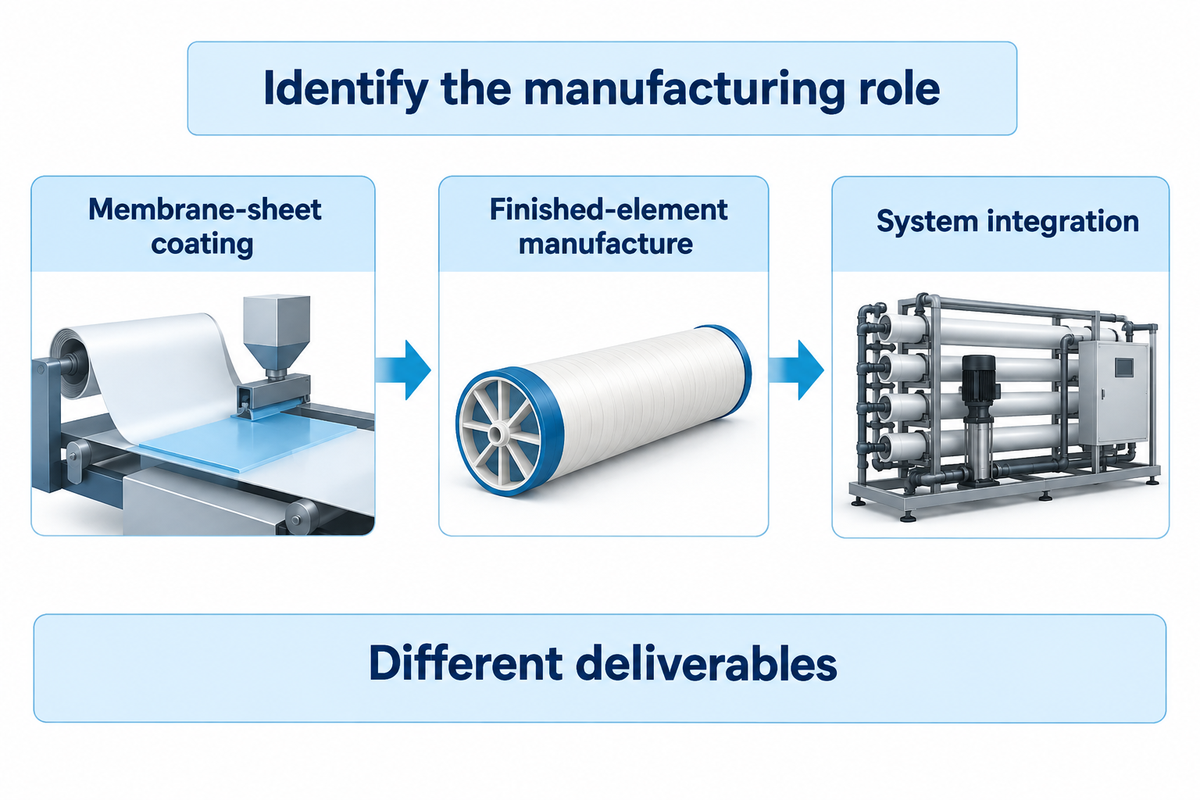
There are several stages of manufacturing. Companies may coat membrane sheets, wind those sheets into elements, manufacture a different module construction, or build systems that integrate elements. A company may also manufacture systems that contain purchased elements. Different companies may produce systems, modules, elements or components and they should be credited for that different production capability. Descriptions of companies below reflect that difference.
The focus is on ten options rather than all producers globally. A manufacturer of several treatment technologies appears only once on the list. Nanofiltration and Ultrafiltration or UF membrane and brackish water, on their own, don’t qualify a company. A company also needs to have a seawater offer. This comparison is relevant to sea water desalination rather than water purification systems in general.
Official descriptions supply company history and manufacturing information. Public NSF records provide a separate check on the listed product scope for Vontron and KeenSen. Corporate announcements resolve ownership changes such as NanoH2O’s separation from LG. Performance figures retain their model and test context; no manufacturer’s single-element data are used to declare a universal winner.
Blue Membrane’s broader membrane element catalogue separates seawater products from other water applications. That product distinction also applies when reading the larger manufacturers’ catalogues: a familiar company name can cover several membrane technologies, with different feed-water duties and different operating limits.
10-Manufacturer Brand-and-Series Map
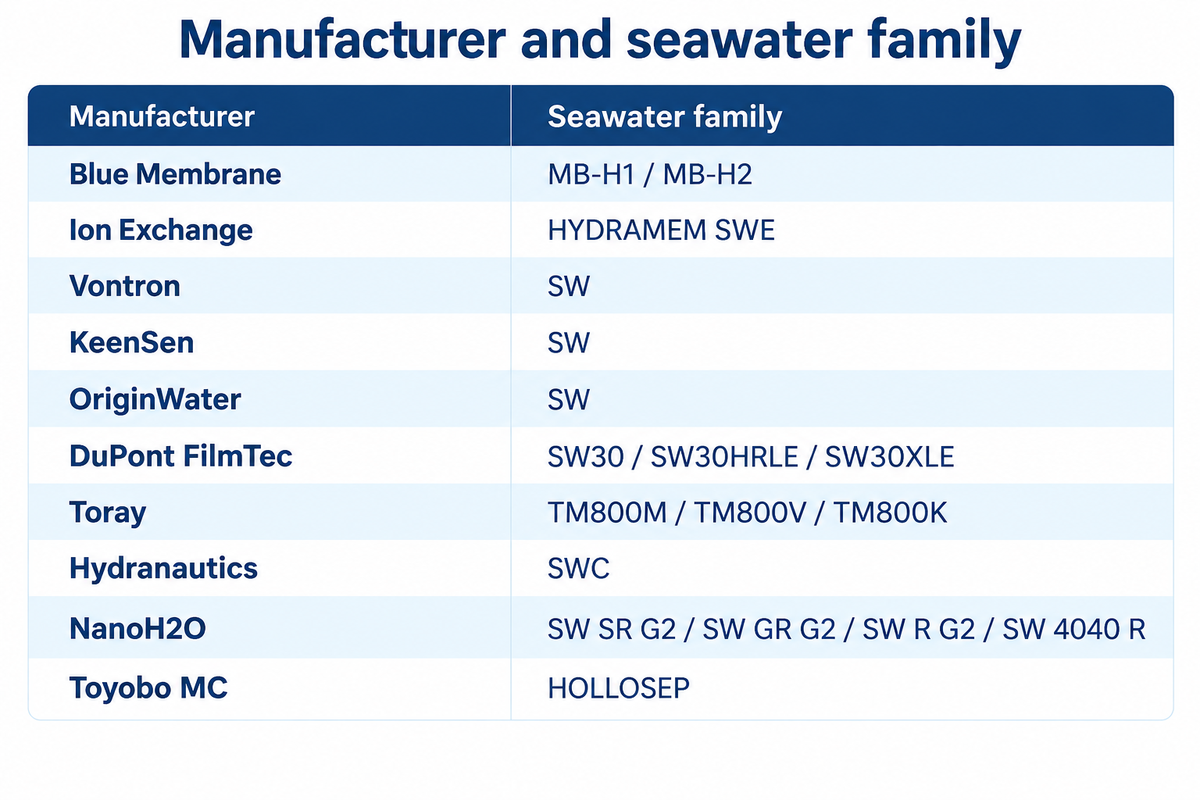
The manufacturer map shows the company and its current brand or seawater family, and identifies a documented product or manufacturing distinction. The final limitation defines a boundary of that offer, and the map is used to decrease a lengthy list to a few pertinent cases.
| No. | Company Name | Headquarters | Founded Year | Best For | Brief Introduction | Seawater Families and Supply Scope | Key Advantages | Potential Disadvantages | Official Website |
|---|---|---|---|---|---|---|---|---|---|
| 1 | Blue Membrane | Nantong, China | Not publicly disclosed | Standard-size integrator supply | Element and water-treatment system manufacturer | MB-H1 / MB-H2; 2540, 4040, 8040 | Small and industrial formats in one seawater range | Published standard seawater sizes end at 8040 | https://bluemembrane.com/ |
| 2 | Ion Exchange / HYDRAMEM | Mumbai, India | 1964 | India-based membrane manufacture | Water-treatment producer behind HYDRAMEM | SWE; HM4040SWE and HM8040SWE400 | Own membrane facility and wider treatment business | SWE listing emphasizes four- and eight-inch formats | https://hydramem.com/ |
| 3 | Vontron | Guiyang, China | 1999 | Several SW grades | Membrane-sheet and element manufacturer | SW8040 XHR / HR / LE / XLE; small SW11 range | Distinct seawater grades and named NSF-listed models | SW8040XHR-400: 6000 GPD; SW8040XLE-400: 11000 GPD | https://www.vontron.com/ |
| 4 | KeenSen | Changsha, China | 2008 | SW elements with stated test conditions | Membrane-sheet and element producer | SW range, including SW-8040MR | Published model parameters and NSF product listings | SW-8040MR: Free Chlorine Tolerance 0.1mg/L | https://www.keensen.com/ |
| 5 | OriginWater | Beijing, China | 2001 | Coating-to-element manufacture | Membrane producer with multiple filtration technologies | SW seawater range | Membrane coating and automated element rolling | Permeated flow: ±15% fluctuations | http://en.originwater.com/ |
| 6 | DuPont FilmTec | DuPont: Wilmington, USA | FilmTec: 1977 | Dry seawater supply options | Membrane business within DuPont Water Solutions | SW30 / SW30HRLE / SW30XLE | Published dry-element portfolio | Dry and wet supply versions need distinct storage handling | https://www.dupont.com/ |
| 7 | Toray | Tokyo, Japan | 1926 | Multiple seawater diameters | Materials and membrane manufacturer | TM800M / TM800V / TM800K; 4-, 8-, 16-inch formats | Established TM choices across diameter classes | TSW announcement still carried launch-stage wording at review | https://www.water.toray/ |
| 8 | Hydranautics | Oceanside, USA | 1963 | Nitto-group SWC supply | Manufacturer in Nitto Global Membrane Division | SWC seawater composite family | Oceanside and Shiga manufacturing network | SWC5-LD-4040: 4″ diameter & 40″ length | https://membranes.com/ |
| 9 | NanoH2O | Seoul, South Korea | Independent since December 2025 | TFN seawater families | Former LG Water Solutions membrane business | SW SR G2 / GR G2 / R G2; SW 4040 R | Cheongju manufacturing and named desalination projects | SW 4040 R: 3.9 inch; G2: 7.9 inch | https://www.nanoh2owater.com/ |
| 10 | Toyobo MC | Osaka, Japan | 2022; operations 2023 | Hollow-fiber seawater modules | Functional-materials and membrane manufacturer | HOLLOSEP cellulose-triacetate modules | Chlorine-resistant hollow-fiber membrane material | Requires a module-specific system architecture | https://en.toyobo-mc.jp/ |
The founding column refers to the entity or business named in the cell. The current seawater products can be much newer than the company. Toray’s corporate founding, FilmTec’s membrane-business origin and NanoH2O’s recent independent-company date describe different milestones. The product family column is the more useful starting point for matching an existing specification.
Several companies also sell other water treatment equipment or water treatment solutions. Having a broad portfolio allows a buyer to cover adjacent activities, but it doesn’t mean that everything in that portfolio becomes a seawater desalination reverse osmosis membrane. High TDS brackish water applications, ordinary tap water treatment and seawater desalination should require separate product selections.
OEM and Regional Seawater Membrane Supply
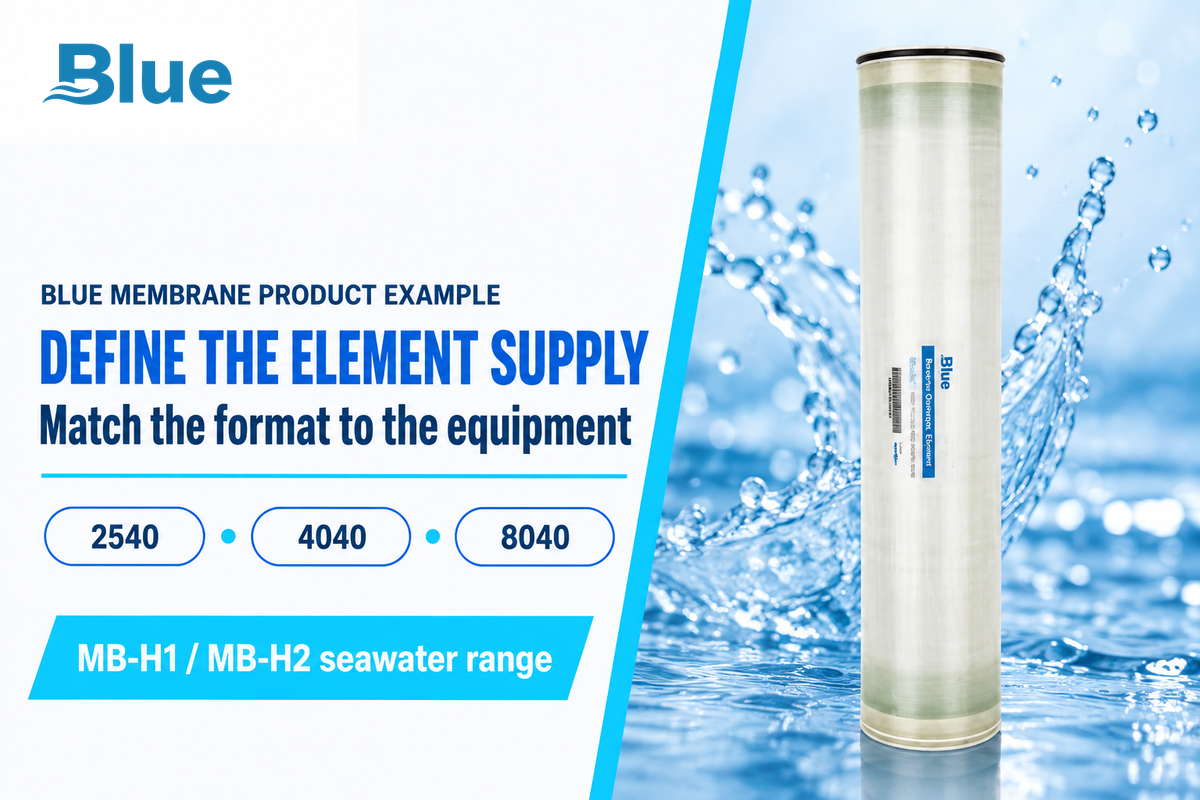
Original equipment manufacturers (OEMs) and system integrators often need a repeatable element supply rather than complete packages. The five companies in this group make and publish seawater membrane products and explain their own manufacturing activities. Differences in their production depth, listed sizes and corporate backgrounds permit identification of the specific offering behind the name.
A regional manufacturer can also serve international projects. Location here identifies the company, not a promise about local stock or technical attendance in every country. More definitive distinctions may be drawn from these catalogs, such as the size of the elements offered, the seawater membrane range, and whether the manufacturer describes element assembly or the membrane-sheet process.
1. Blue Membrane: Best for 2540, 4040 and 8040 Integrator Supply
Headquarters: Nantong, Jiangsu, China · Founded: Not publicly disclosed · Type: membrane element and engineered water-treatment system manufacturer
Official website: https://bluemembrane.com/
Main products: MB-H1 and MB-H2 seawater RO membrane elements · Capabilities: 2540, 4040 and 8040 seawater formats
Certifications / notable work: H1/H2 supply to system integrators, OEM partners and distributors, according to the seawater product page.
Blue Membrane’s contact page identifies BlueTong Technology (Nantong) Co., Ltd. behind the visible brand, while its company description covers membrane elements and engineered systems. The Blue Membrane seawater membrane element range separates H1 and H2 offerings and spans both compact and larger standard formats. That makes the catalogue relevant to an integrator comparing element supply across more than one equipment size, without treating a complete desalination watermaker as the same purchase. The published standard seawater size range ends at 8040; it doesn’t provide the sixteen-inch catalogue option listed by Toray.
2. Ion Exchange / HYDRAMEM: Best for India-Based Membrane Manufacturing
Headquarters: Mumbai, India · Founded: 1964 · Type: water-treatment manufacturer producing HYDRAMEM membranes
Official website: https://hydramem.com/
Main products: SWE seawater elements, including HM4040SWE and HM8040SWE400 · Capabilities: polyamide spiral-wound four- and eight-inch products
Certifications / notable work: HYDRAMEM describes its Goa membrane facility as ISO 9001 certified; membrane manufacturing began in 1987.
HYDRAMEM is Ion Exchange’s membrane brand, which gives the buyer a clear connection between the product name and the manufacturing company. According to its company history, the membrane operation began in Gujarat before the later Goa facility, within a business that also supplies other treatment processes. SWE identifies the seawater products; the broad HYDRAMEM catalogue also contains membranes for other feed-water duties. Its published SWE selection centers on 4040 and 8040 elements rather than a dedicated 2.5-inch marine range, so a compact boat installation doesn’t have the same obvious catalogue fit as a four- or eight-inch project.
3. Vontron: Best for Comparing Several SW Element Grades
Headquarters: Guiyang, Guizhou, China · Founded: 1999 · Type: membrane-sheet and spiral-wound element manufacturer
Official website: https://www.vontron.com/
Main products: SW8040 XHR, HR, LE and XLE seawater families, plus small SW11 elements · Capabilities: membrane-sheet production and element winding
Certifications / notable work: The NSF/ANSI/CAN 61 listing names selected Vontron SW models, including SW8040HR-400; the company publishes several seawater grades.
Vontron’s range offers a more specific starting point than a request for a generic Chinese seawater membrane. The SW family names separate products with different published rejection and flow targets, while the small-element offer extends the discussion beyond eight-inch industrial water installations. Its manufacturer description covers the membrane sheet as well as the finished element, and its corporate information identifies a CRRC-associated shareholding rather than a stand-alone reseller identity. The limitation is the grade spread itself: an SW8040 designation without its performance suffix leaves several different products in contention and isn’t a complete order specification.
Vontron’s catalogue shows a concrete trade-off: SW8040XHR-400 lists 6000 gpd at 99.85 percent stable rejection, while SW8040XLE-400 lists 11000 gpd at 99.7 percent; the higher listed flow comes with lower listed rejection.
4. KeenSen: Best for SW Products with Explicit Model Test Conditions
Headquarters: Changsha, Hunan, China · Founded: 2008 · Type: membrane-sheet and membrane-element manufacturer
Official website: https://www.keensen.com/
Main products: SW seawater range, including SW-8040MR · Capabilities: own membrane production and finished element manufacture
Certifications / notable work: NSF/ANSI/CAN 61 records name selected KeenSen SW products; its SW-8040MR page states the test conditions beside the performance data.
KeenSen gives a buyer a model-specific reference for discussing seawater membrane selection rather than relying on the general company description alone. For SW-8040MR, the published conditions include 32,000 mg/L NaCl feed, 800 psi pressure, 25°C temperature and 8% recovery, so a comparison can begin with the conditions behind the figures. The NSF listing adds product-scope information, separate from any claim about plant output or salt rejection. That 8% figure is an element test recovery, not the recovery promised for a complete SWRO system; the data sheet can’t be read as a finished plant operating schedule.
KeenSen lists free-chlorine tolerance of 0.1 mg/L for SW-8040MR, so feed-water control must fit that specific element limit.
5. OriginWater: Best for Documented Coating-to-Element Manufacturing
Headquarters: Beijing, China · Founded: 2001 · Type: membrane manufacturer covering several filtration technologies
Official website: http://en.originwater.com/
Main products: SW seawater RO range · Capabilities: membrane coating and automated element rolling
Certifications / notable work: The corporate qualifications page displays ISO 9001 and ISO 14001 credentials; the SW product page describes its automated production processes.
OriginWater is relevant when the shortlist needs a manufacturer that describes both membrane coating and the making of finished elements. Its broader membrane technology business includes other filtration processes, but the seawater selection belongs to the SW product line rather than to those adjacent products. According to the SW page, the product uses aromatic polyamide and its published rating conditions include 32,000 ppm feed, 800 psi pressure and 8% recovery. Those single-element conditions are the boundary of the published figures: they don’t establish the production rate of a multi-vessel plant or its final purified water quality.
OriginWater states that permeate flow can fluctuate by ±15% under actual conditions, so a buyer comparing nominal output needs to allow for that stated variation.
The regional group illustrates why “manufacturer” needs a production description beside it. A buyer sourcing membrane sheets has a different requirement from a buyer ordering finished seawater membrane elements. A complete-system contractor has another scope again. Naming the delivered product prevents a broad company capability from being mistaken for the particular manufacturing step required by the purchase.
Global Spiral-Wound Seawater RO Portfolios
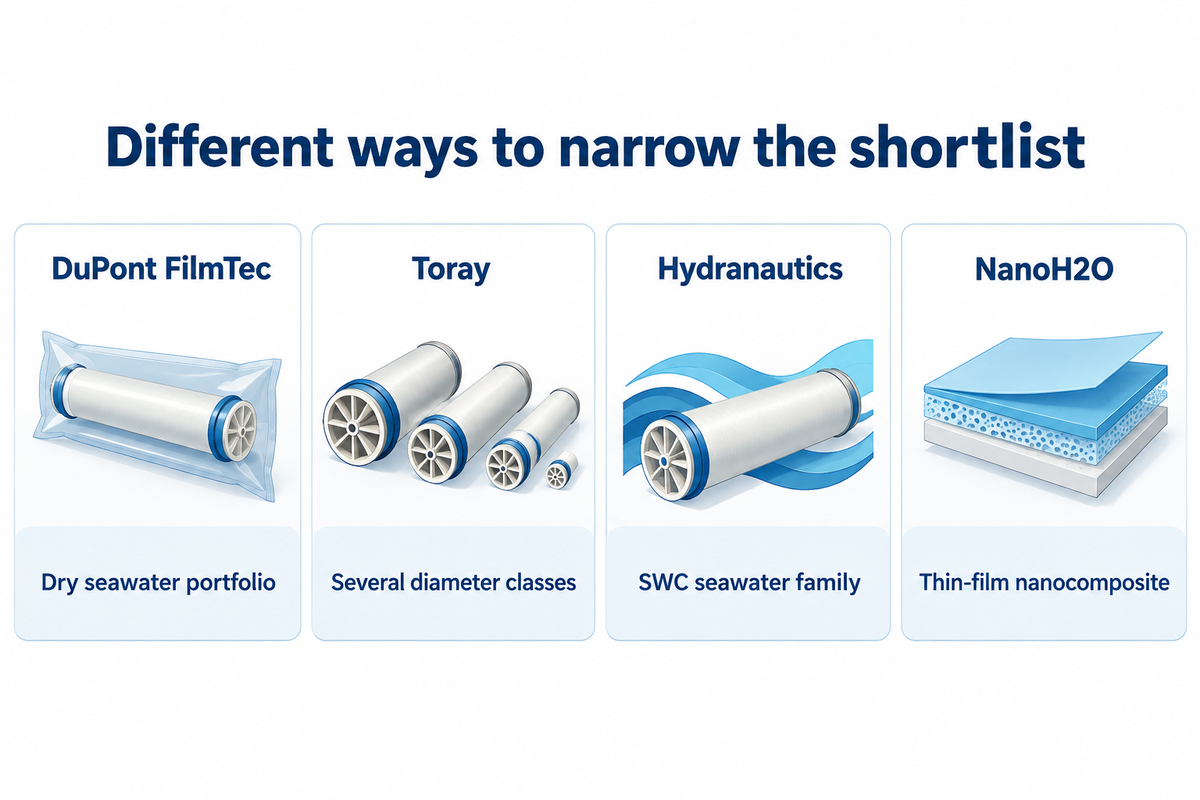
DuPont FilmTec, Toray, Hydranautics and NanoH2O publish named spiral-wound seawater portfolios. These companies are useful reference points when a specification already names a brand family or when several grades need to be compared within a large catalogue. Current ownership, product version and element dimensions still belong beside the brand name.
Legacy labels are common in product searches. “DOW FilmTec” can lead to stock listings for today’s DuPont product families, while “LG Water Solutions” can refer to the business now operating as NanoH2O. The older wording helps explain the trail of documents, but it shouldn’t replace the current product designation or the manufacturer identified on a new offer.
6. DuPont FilmTec: Best for a Published Dry Seawater Portfolio
Headquarters: DuPont global headquarters in Wilmington, Delaware, USA · Founded: FilmTec membrane business in 1977 · Type: membrane manufacturer within DuPont Water Solutions
Official website: https://www.dupont.com/
Main products: SW30, SW30HRLE and SW30XLE seawater families · Capabilities: a dry-tested seawater element portfolio
Certifications / notable work: DuPont describes its FilmTec facility as ISO 9001 certified; its dry portfolio includes SW30HRLE-400 and SW30XLE-400.
A FilmTec seawater membrane can appear in a small marine product selection or a larger plant specification, with DuPont also publishing the SW30-4040 product for compact applications. The dry seawater brochure adds a separate supply distinction: selected large elements are offered without the same preservation handling as wet products. This makes DuPont relevant when an equipment builder is comparing warehouse and installation requirements as well as a membrane’s nominal performance. Dry and wet versions still require different storage handling, so the order needs the full product version rather than only the SW30 membrane family name.
7. Toray: Best for Established TM Ranges Across Several Diameters
Headquarters: Tokyo, Japan · Founded: 1926 · Type: materials and membrane manufacturer
Official website: https://www.water.toray/
Main products: TM800M, TM800V and TM800K seawater RO families · Capabilities: seawater elements in 4-, 8- and 16-inch diameters
Certifications / notable work: Toray describes RO/NF element manufacture under ISO 9001 certification and dates its spiral-wound RO and NF production to 1968.
Toray’s established TM seawater catalogue separates standard, lower-energy and higher-rejection family choices rather than presenting one element as the answer to every feed. Its published sixteen-inch offer also distinguishes the catalogue from manufacturers whose listed standard seawater formats stop at eight inches. At the October 2026 review, the website still described TSW-M, TSW-V and TSW-K with “Coming October 2026” wording and specifications subject to change. That launch-stage status is the constraint: an announced TSW family shouldn’t silently replace an established TM specification in a purchase discussion.
8. Hydranautics: Best for Nitto-Group SWC Seawater Supply
Headquarters: Oceanside, California, USA · Founded: 1963 · Type: membrane manufacturer in Nitto Global Membrane Division
Official website: https://membranes.com/
Main products: SWC seawater composite RO family · Capabilities: a manufacturing network including Oceanside and Shiga
Certifications / notable work: The company describes ISO 9001 Quality System Certification, entry into reverse osmosis in 1970 and membership of Nitto since 1987.
Hydranautics connects a named seawater product family to a long-running membrane manufacturing business and the wider Nitto network. SWC is the relevant starting point for seawater desalination RO, rather than treating every Hydranautics RO membrane element as an equivalent sea-water product. The product catalogue also contains CPA and ESPA, which address other treatment priorities and retain their own model selections. This separation is the practical limit of a brand-only shortlist: a request that says only “Hydranautics membrane” doesn’t identify the SWC product needed for the seawater system.
Hydranautics lists SWC4 and SWC6 models in eight-inch formats on its SWC page, while the listed four-inch option is SWC5-LD-4040; a four-inch housing therefore narrows the published selection to that SWC5 model.
9. NanoH2O: Best for Thin-Film Nanocomposite Seawater Families
Headquarters: Seoul, South Korea, as identified in the December 2025 investment announcement · Founded: independent company since December 2025 · Type: membrane manufacturer formerly operated as LG Water Solutions
Official website: https://www.nanoh2owater.com/
Main products: SW SR G2, SW GR G2, SW R G2 and SW 4040 R · Capabilities: automated Cheongju manufacturing facility commissioned in 2015
Certifications / notable work: Corporate history lists the 2024 Ghubrah III desalination project award at 300 MLD.
NanoH2O’s current catalogue carries its thin-film nanocomposite seawater products under the independent company name, following the former LG Water Solutions business. The 2025 transaction announcement names Glenwood Private Equity and Mubadala among the investors, while the manufacturer describes its earlier technology history and Cheongju plant. Ghubrah III is a documented project award in that history, not a claim that the project was commissioned in 2024. Within the offer, SR G2, GR G2 and R G2 describe different product objectives; “NanoH2O G2” alone therefore leaves the seawater element selection incomplete.
NanoH2O’s published G2 models have a 7.9-inch diameter; its listed 3.9-inch SW 4040 R is a separate option, so a compact 4040 purchase does not carry the G2 model ratings.
The four portfolios offer several ways to narrow a purchase: a named dry version, a diameter outside the common eight-inch class, a particular SWC specification or a TFN product family. Those are stronger distinctions than a general claim that one brand provides high-quality water. Final water quality follows the selected product and the treatment system around it, including the required downstream processes.
Hollow-Fiber Modules for Seawater Desalination
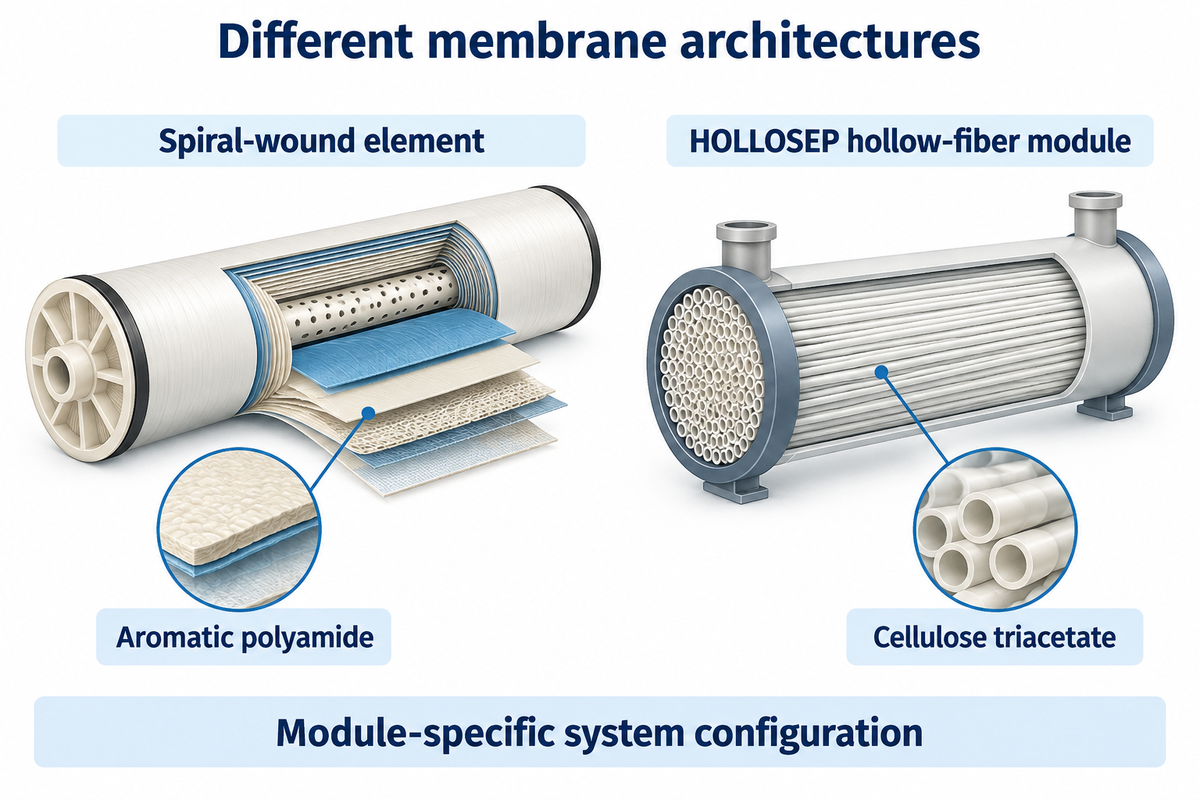
Hollow-fiber seawater reverse osmosis uses a different module construction from spiral-wound elements. Toyobo MC belongs in a manufacturer comparison because its HOLLOSEP products are used for membrane desalination, but the buyer is choosing a different membrane material and module architecture. The difference affects which manufacturers belong on the same equipment shortlist.
10. Toyobo MC: Best for Cellulose-Triacetate Hollow-Fiber Modules
Headquarters: Osaka, Japan · Founded: September 2022; business operations began April 2023 · Type: functional-materials and membrane manufacturer
Official website: https://en.toyobo-mc.jp/
Main products: HOLLOSEP cellulose-triacetate hollow-fiber RO modules · Capabilities: chlorine-resistant hollow-fiber seawater membrane material
Certifications / notable work: Iwakuni plant ISO 9001 scope includes RO and FO membranes; Toyobo MC cites the 50,000 m³/day Fukuoka desalination plant.
HOLLOSEP gives the buyer a distinct alternative at the system-design stage because Toyobo MC describes a cellulose-triacetate, or CTA, hollow-fiber construction and its chlorine resistance. The company also identifies desalination installations, including Fukuoka, that connect the product family to a named application rather than a generic water-treatment claim. Its current corporate formation date is separate from the older technical and project history of the product. The procurement limitation is architectural: a HOLLOSEP module belongs in its own system configuration and isn’t a spiral-wound element swap for an existing 8040 pressure vessel.
Chlorine resistance should remain attached to the membrane material and product discussed. A buyer can’t carry a CTA product statement across to aromatic-polyamide spiral-wound elements simply because both are called reverse osmosis membranes. The treatment concept and the selected material need to be considered together, especially where a project specification already assumes one module construction.
Fukuoka’s cited plant capacity describes that installation. It doesn’t state the output of one HOLLOSEP module, Toyobo MC’s annual manufacturing capacity or the capacity of every project using the product. Plant references are useful for understanding application history; element or module data provide the basis for the actual membrane selection.
How to Compare Seawater Membrane Manufacturers
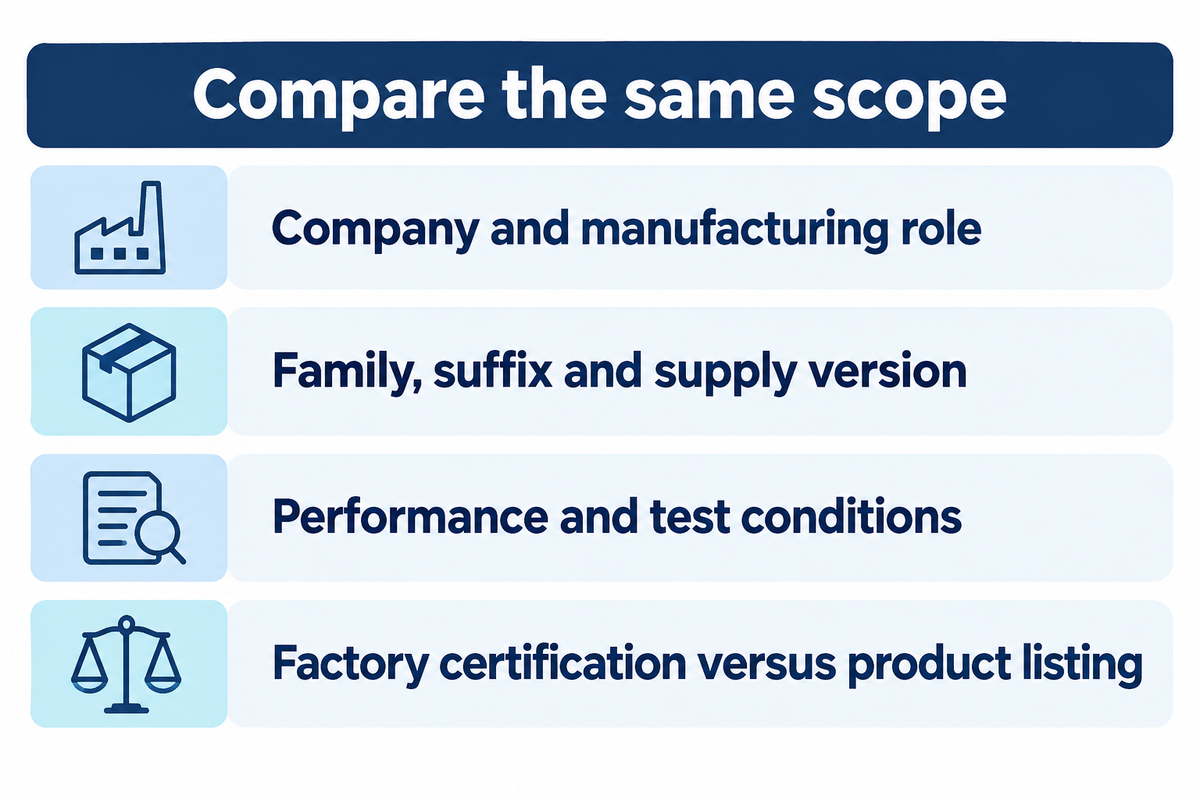
Manufacturers may be evaluated based on the production role and named product they supply. Such evaluated products may be integrated in a project design. The focus of the seven points below is to evaluate the manufacturer behind an offering. Separating offer comparison from detailed replacement evaluation keeps the manufacturer comparison as the core focus. The purpose of the seven points is also to separate offer comparison from a general supplier management exercise.
Match the Brand to the Company Making the Product
Write the commercial brand and the manufacturing company in separate fields. HYDRAMEM and Hydranautics show why: similar names lead to different companies and different seawater families. NanoH2O shows a second problem, because an older LG document can describe the predecessor business while a new offer uses the independent company’s name.
Distinguish the production sources first. Two quotes offered by different sales companies may be covering the same element, and two similar brands may not be related. The relevant count is the number of suitable production sources and product families, not the number of sales companies who responded to the query.
Identify the Manufacturing Step Required by the Purchase
Membrane-sheet coating, finished-element manufacture and complete water treatment equipment are different deliverables. OriginWater explicitly describes coating and rolling; Blue Membrane describes elements and engineered systems. A membrane manufacturer can have more than one production role, but the role needed for the order should be stated directly.
This is very relevant for OEM requests. A finished seawater reverse osmosis membrane element, a packaged RO system, and an unassembled membrane material can’t be considered the same item. Private branding won’t reveal who manufactured the element. Keep your deliverable precise enough to allow two suppliers to respond to the same requirement.
Keep the Exact Family, Suffix and Supply Version Together
SW, SWC, SWE and SW30 are valuable family markers, although some contain different performance grades. A higher flow variant and higher-rejection variant can be of the same size while serving different design needs in the same family. Dry vs. wet supply can be a version distinction that’s relevant, even if the buyer recognizes the product family.
A low energy seawater label describes a product objective; it does not guarantee the electricity use of a complete plant. Likewise, the phrase premium grade seawater reverse osmosis doesn’t give a numeric definition by itself. A purchase comparison needs the named model and the manufacturer’s own stated conditions behind its claims. That’s how a broad brand preference becomes a product choice.
Read Performance Numbers with Their Test Conditions
KeenSen’s SW-8040MR rating conditions include 32,000 mg/L NaCl feed, 800 psi, 25°C and 8% recovery. OriginWater also publishes seawater test conditions. These details explain what the quoted element figures describe. An element tested at a particular pressure and recovery hasn’t thereby been rated for every seawater quality or plant configuration.
Feed water, temperature, pressure and the product grade are some of the parameters considered when making a specification comparison. Salt rejection is an important parameter, but it isn’t equivalent to the finished water satisfying all drinking water standards and requirements. A manufacturer’s element test isn’t the same as a plant’s operational recovery. Keep each quantity at its correct level rather than placing unlike numbers in the same ranking column.
Separate Factory Certification from Product Listing Scope
ISO 9001 describes a quality-management system within its stated organizational scope. A named NSF/ANSI/CAN 61 listing addresses the applicable drinking-water system component and its listing conditions. Neither should be expanded into a blanket statement that every membrane produced by the company guarantees a particular desalination result.
The public Vontron NSF component listing and KeenSen NSF component listing name products rather than merely displaying a company logo. That’s the level at which product scope becomes useful. Corporate qualification pages remain relevant, but they answer a different question from a model-specific listing.
Keep Product Announcements Separate from Established Supply
Toray’s TSW notice illustrates the difference between an announced family and an established catalogue selection. A page can describe a planned launch during the same month that an article is researched. The date alone doesn’t remove the page’s launch-stage language or make a specification marked subject to change final.
Use the current product designation in the inquiry, and keep the version date of the technical document in which the specification was stated. For an ongoing project, a newer family can be considered as a separate option rather than silently substituted into an existing specification. This helps keep the design discussion clear to the buyer, manufacturer and equipment builder.
Put the Element in the Correct System Scope
A seawater desalination membrane is one element of a desalination system. Sea-based and land-based desalinators may share a membrane family but have different equipment constraints. To meet the water demands of the installation, the equipment fabricator must match the chosen products to the required system output. Potable water production, industrial water supply and ultra-pure water preparation also impose different water quality requirements on the overall treatment train.
The membrane filtration process doesn’t replace pretreatment or every downstream water purification step. For complete marine equipment, use a marine watermaker system specification. For an existing element change, the RO membrane cross-reference guide carries the replacement discussion. The manufacturer shortlist identifies whom to approach; those documents address the next design question.
Before releasing an order: obtain the current model data sheet, confirm the manufacturer and supplying entity, check the named certificate or listing scope, and agree the required batch records and sample acceptance basis. Put storage condition and the full model suffix on the purchase specification. The separate RO membrane supplier selection guide covers the broader supplier review.
Frequently Asked Questions
Who manufactures HYDRAMEM SWE membranes?
Ion Exchange manufactures HYDRAMEM SWE membranes.
HYDRAMEM is Ion Exchange’s membrane brand, and the published seawater range includes HM4040SWE and HM8040SWE400 elements. The company describes its own membrane manufacturing facility in Goa. Hydranautics is a different manufacturer within Nitto, with SWC as its seawater family. These are separate production sources, so their names belong on separate lines in a shortlist, product specification and purchase inquiry.
Which manufacturers are best for marine watermakers and larger plants?
DuPont FilmTec and Blue Membrane cover compact and larger seawater formats; Toray offers several diameter classes, and Hydranautics supplies SWC products.
NanoH2O’s range also includes SW 4040 R alongside larger G2 products. These are catalogue-based recommendations: the required housing format and named product family decide which of those manufacturers belongs on the project shortlist. A watermaker inquiry should distinguish a replacement element from a complete machine. A manufacturer that lists the needed element size is relevant to the former; a system offer also covers pumps, controls and other equipment.
A company may serve both commercial and industrial applications without every product fitting the same installation. The element’s full model designation provides a more useful starting point than the general market description.
How much do seawater RO membrane elements cost?
Selected FilmTec seawater elements were advertised at about US$400–1,200 each in one specialist retail catalogue reviewed in October 2026.
The examples ran from a smaller SW30 product to larger eight-inch grades. This is a retail asking-price snapshot, not a market average, an OEM factory quote or the installed cost of a desalination plant. Manufacturer quotations can cover different quantities and supply terms. Compare the exact model and version, then put freight and the seller’s included services on the same basis.
A lower advertised figure for a small element can’t establish a lower price for a large desalination project. The product size and model remain part of the price comparison.
Are Vontron RO membranes suitable for seawater projects?
Vontron supplies a dedicated SW seawater range, including several SW8040 grades and smaller elements.
The specified SW model must match the project duty; the Vontron brand also covers other membrane applications.
Who is the largest seawater RO membrane manufacturer?
DuPont FilmTec, Toray, Hydranautics and NanoH2O are established global options; identifying a single largest producer requires a comparable measure of seawater production.
Annual seawater element shipments, membrane-sheet capacity, corporate revenue and the size of a referenced desalination project measure different things. A buyer seeking supply scale should use the measure relevant to the order instead of treating those figures as interchangeable. A large plant reference can show application history without stating current annual manufacturing output.
Corporate revenue can include many unrelated products, while a membrane capacity figure may include brackish-water or other ranges. For a project requiring repeated deliveries, the practical issue is the manufacturer’s ability to supply the named seawater product in the required quantity and schedule. A product-family comparison provides a shortlist for that inquiry, not a market-share league table.
What is the difference between a membrane manufacturer and a supplier?
A manufacturer makes membrane material, elements or modules; a supplier sells the product and may occupy a different commercial role.
The supplier may be the manufacturer, an authorized distributor or a system integrator. Each can serve a legitimate purchasing need. Separating the sales role from the production role identifies the source behind the quotation and avoids counting several sellers of one membrane as several independent manufacturing options.
Build a Manufacturer Shortlist Around the Required Supply
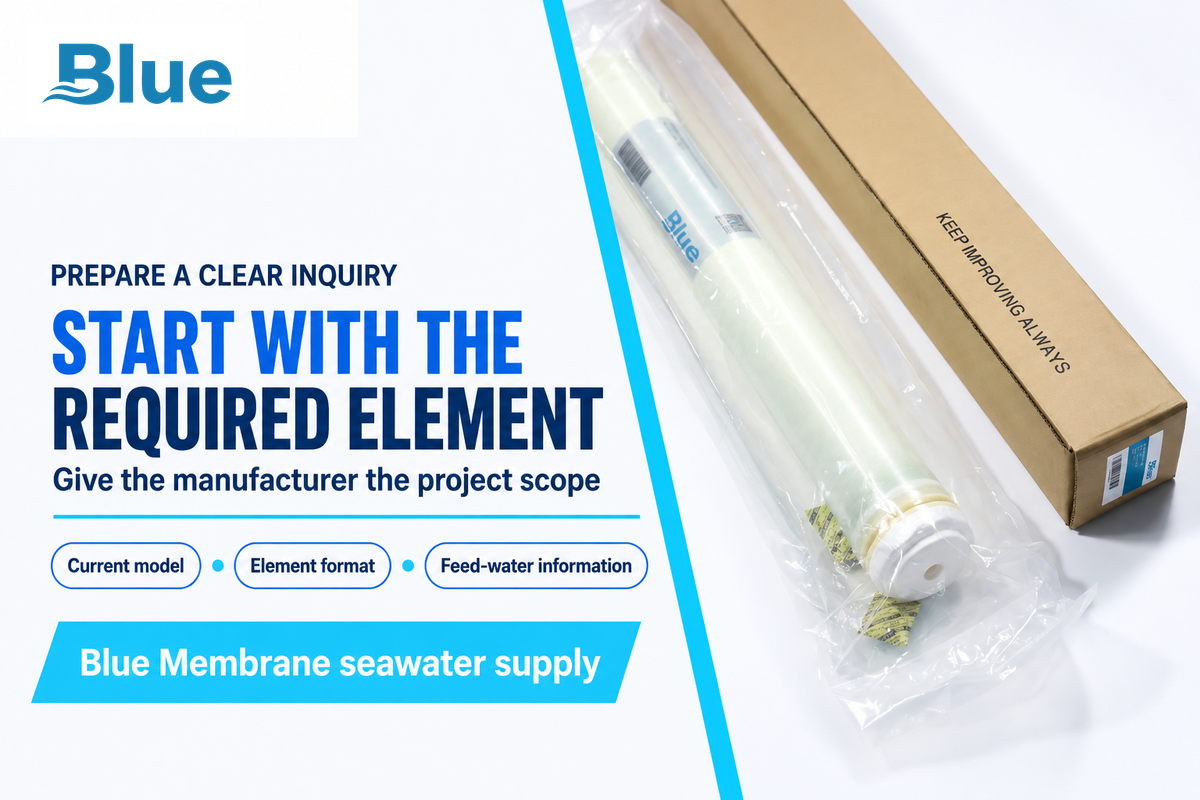
Start with the element or module required, then select the manufacturers whose named families cover that scope. Blue Membrane, Ion Exchange, Vontron, KeenSen and OriginWater offer regional manufacturing options; DuPont FilmTec, Toray, Hydranautics and NanoH2O provide distinct spiral-wound portfolios. Toyobo MC adds a hollow-fiber route for projects designed around HOLLOSEP modules.
At Blue Membrane, our published H1/H2 range covers 2540, 4040 and 8040 seawater elements for integrators, OEM partners and distributors. Send the current model or required element format, feed-water information and intended equipment scope when you request an OEM seawater membrane quotation. Those details establish whether the inquiry concerns an element supply, a membrane replacement or a complete seawater treatment system.
References & Sources
Company and product facts are attributed to the manufacturers’ official corporate, product and quality pages, reviewed in October 2026. Official websites are shown as plain text in the comparison table and company cards. Product certification scope is supported by the two public NSF listings linked in the comparison guidance.
- Mubadala: completion of NanoH2O co-investment, 3 December 2025, for transaction identity and the stated Seoul headquarters.
- DuPont FilmTec dry seawater portfolio brochure and FilmTec technical manual; Toray RO product catalogue; Hydranautics company overview and RO catalogue; NanoH2O product catalogue and corporate history.
- HYDRAMEM SWE product and company pages; Vontron and KeenSen seawater product data; OriginWater SW and corporate pages; Toyobo MC HOLLOSEP, corporate profile and Iwakuni quality-certification pages.
- Advanced Equipment and Services FilmTec seawater retail catalogue, reviewed October 2026, for the bounded price snapshot. Retail asking prices are separate from manufacturer quotations.