Get in touch with Blue Membrane Company

Last updated: October 2026
The best nanofiltration membrane manufacturers for a shortlist include DuPont FilmTec for differentiated water-treatment grades, Synder for process separations, Kovalus for acid and caustic duties, and NX Filtration for hollow-fiber systems. Blue Membrane offers OEM NF elements. The right choice starts with the separation duty, membrane chemistry and module format.
Quick Picks
- Best for OEM standard NF elements: Blue Membrane, with N1, N2 and N3 grades.
- Best for differentiated water-treatment portfolios: DuPont FilmTec, including NF270 and NF90.
- Best for flat-sheet-to-process development: Synder Filtration, with multiple NF grades and spiral formats.
- Best for sanitary spiral membranes: Alfa Laval, with NF and NF99HF.
- Best for acid and caustic process separation: Kovalus Separation Solutions, with SelRO.
- Best for a backwashable hollow-fiber platform: NX Filtration, with NX Nano.
Disclosure: This guide is published by Blue Membrane. We list ourselves first because this is our website, not because we claim to be the market leader. The other 11 manufacturers are grouped by what they’re best for, in no particular order within each group.
Its family of products performs the separation. A sanitary dairy membrane, an industrial water-softening element and a chemically resistant process membrane can all carry the NF label while serving different purposes. This helps connect the manufacturer to actual products and helps construct a viable short-list.
How We Selected These Manufacturers
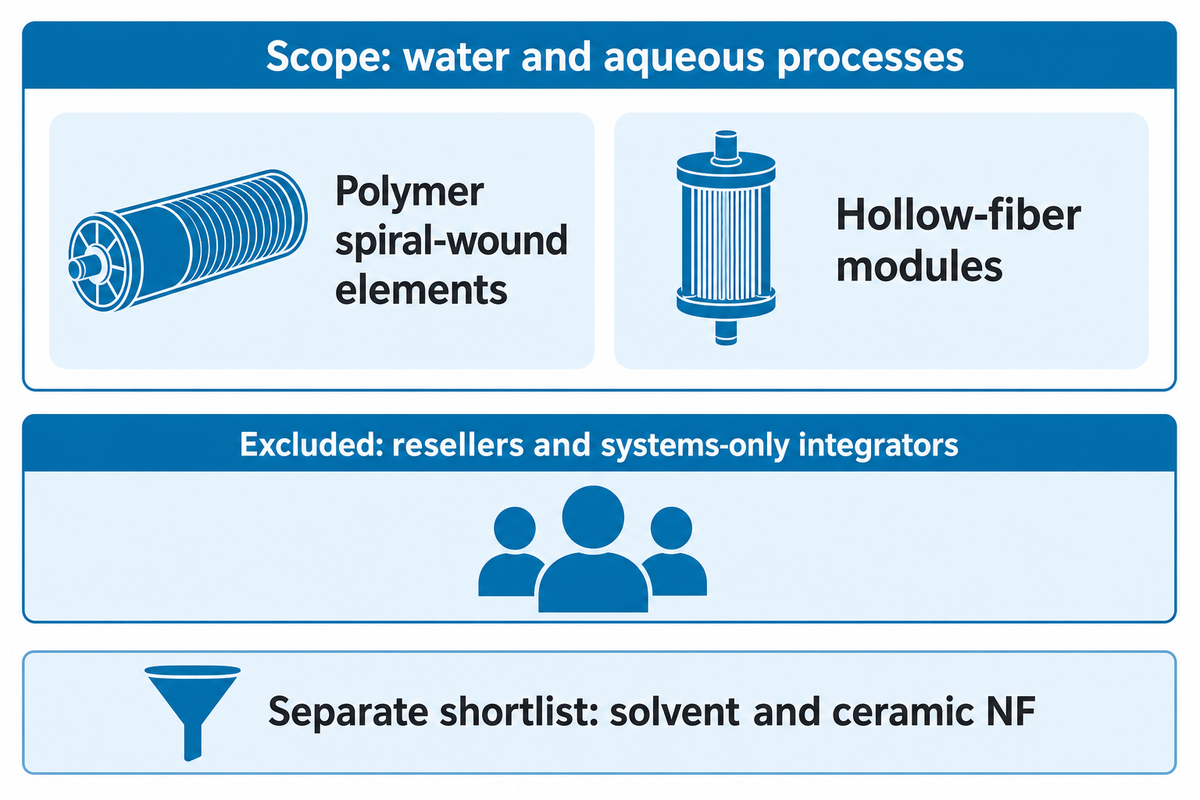
Identifiable nanofiltration products, published company information and clear membrane capabilities helped us identify manufacturers. Company information was verified against company websites and other public sources in October 2026. The companies listed are in Europe, North America, China and Japan. Pure resellers, distributors, directories, sourcing platforms, systems-only integrators, and manufacturers offering only reverse osmosis or ultrafiltration were excluded.
The scope is water and aqueous process separation with polymer spiral-wound elements or hollow-fiber modules. It isn’t an exhaustive list of organic-solvent or ceramic NF suppliers. Brands within the same group are listed together. Application groups help readers compare manufacturers that serve more than one group. Founding dates below reflect the heritage of a company, group or membrane-business; they don’t indicate that products offered today have been manufactured since that time.
Readers interested in solvent service should refer to a separate shortlist. Published research on organic-solvent recycling with NF and ceramic membrane process separation illustrates applications beyond the product selection covered here.
Nanofiltration Membrane Manufacturers Compared
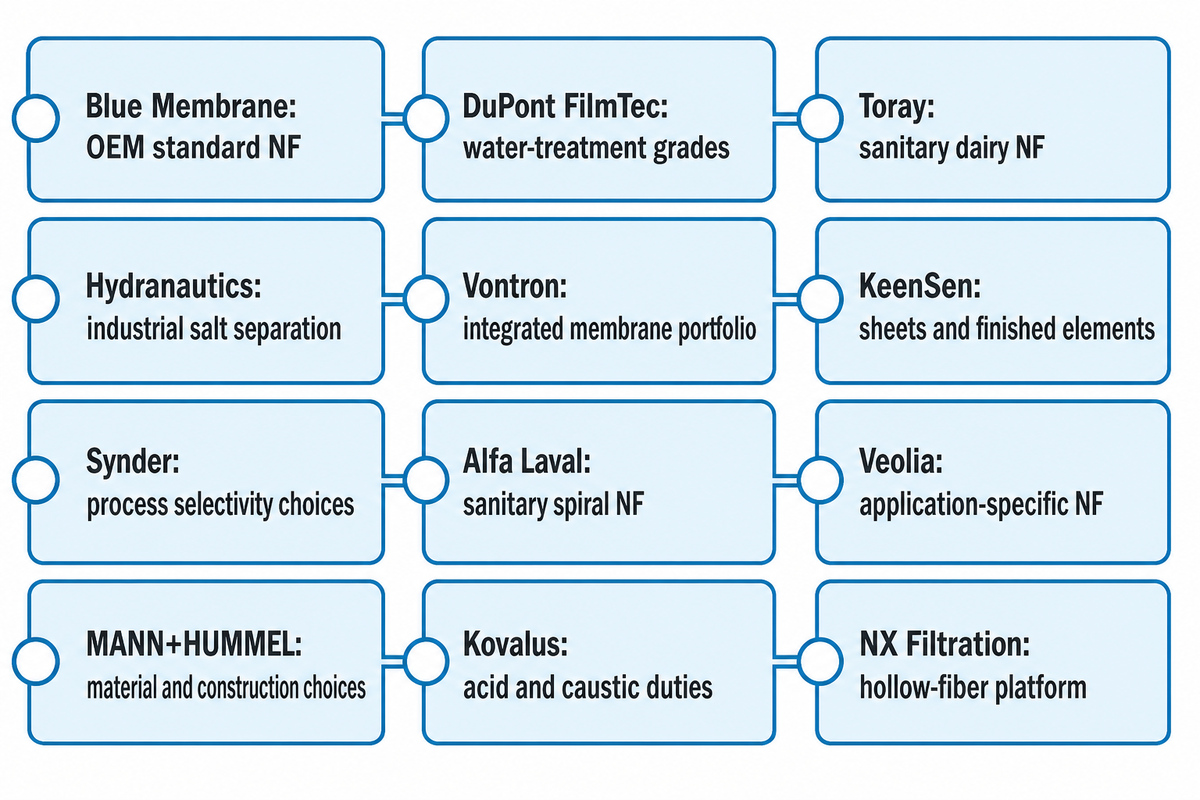
Use this 12-Maker NF Duty Map to compare product scope prior to reviewing quotes. Company details and product descriptions are from the manufacturers’ publications. “Best for” describes a representative application, and doesn’t reflect market performance or share. The buying limitation in each row reflects where a company name stops being enough to specify an element.
| No. | Company Name | Headquarters | Founded Year | Best For | Brief Introduction | NF Product Family and Format | Key Advantages | Potential Disadvantages | Official Website |
|---|---|---|---|---|---|---|---|---|---|
| 1 | Blue Membrane | Nantong, China | Not publicly disclosed | OEM standard and softening elements | Membrane manufacturer supplying standard and alkali-resistant product lines | N1/N2/N3 spiral elements; separate AR-NF line | Published grade comparisons, standard element sizes and private-label supply | N-series laboratory rejection values do not guarantee performance on every feed | bluemembrane.com |
| 2 | DuPont FilmTec | Wilmington, Delaware, USA; DuPont headquarters | 1977; FilmTec heritage | Differentiated water and specialty separation grades | Membrane brand within DuPont Water Solutions | NF270, NF90, LiNE-XD and Fortilife NF1000 | Distinct families for softening, lithium processing and concentrate treatment | Named NF families address different separation targets and are not interchangeable | dupont.com |
| 3 | Toray | Tokyo, Japan; group headquarters | 1926; Toray Industries | Sanitary NF for dairy fractionation | Membrane manufacturer with sanitary production in San Diego | TNF and TMNF sanitary spiral-wound elements | Dairy desalting capability and published component-compliance statements | Sanitary element selection requires its own process and cleaning specification | water.toray |
| 4 | Hydranautics | Oceanside, California, USA | 1963 | Industrial salt separation | Nitto group membrane manufacturer | PRO-XS1, PRO-XS2, PRO-XS3 and PRO-XS5 | Four NF variants within an industrial membrane portfolio | The PRO catalogue also includes RO families with different pressure and separation duties | membranes.com |
| 5 | Vontron | Guiyang, China | 1999 | NF sourcing within an integrated membrane portfolio | Manufacturer of membrane materials and finished elements | NF membranes and elements alongside RO and UF products | Published element-construction details and an accredited company laboratory | A general catalogue quotation must still identify the specific NF grade and test basis | en.vontron.com |
| 6 | KeenSen | Changsha, China | 2008 | NF sheet and finished-element sourcing | Producer integrating membrane-sheet and element manufacture | NF1-4040R, NF1-8040R and NF2-4040 | Identifiable models and published operating-versus-cleaning conditions | Cleaning tolerance is not approval for continuous aggressive-alkali service | keensen.com |
| 7 | Synder Filtration | Vacaville, California, USA | 1994; membrane business | Process development across NF selectivities | Family-owned membrane producer with flat-sheet and spiral products | NFX, NFS, NFD, NFDE, NFW, NFDC, NDX, NDF and NFG | Multiple grades for dairy and industrial applications; documented site quality system | Different test-solute columns prevent simple ranking by the largest rejection percentage | synderfiltration.com |
| 8 | Alfa Laval | Lund, Sweden | 1883; AB Separator origins | Sanitary spiral NF | In-house manufacturer of process membranes | NF and NF99HF; polyamide on polyester support | Named sanitary choices for dairy, food and biotechnology separations | NF and NF99HF differ in flux and rejection; the separation target controls selection | alfalaval.com |
| 9 | Veolia | Aubervilliers, France; group headquarters | 1853; group origins | Application-specific water and process NF | Water-technology group with several spiral NF families | Dairy DK/DL, Duracon NF1/NF2, HL, MuniNF, SWSR and Vinopro | Clearly identified dairy, softening, sulfate-removal and wine-processing duties | Operating limits from the whole spiral catalogue cannot be assigned to every NF model | watertechnologies.com |
| 10 | MANN+HUMMEL | Ludwigsburg, Germany; group functions | 1941; group origins | Material and construction choices for process NF | Group offering NADIR, TRISEP and TurboClean membrane products | NADIR NP010/NP030, TRISEP NF products and TurboClean NF | Acid/caustic-stable PES choices and sanitary dairy products | Membrane material and compatibility vary across brands and individual constructions | water-membrane-solutions.mann-hummel.com |
| 11 | Kovalus Separation Solutions | Wilmington, Massachusetts, USA | 1963 roots; current name from 2023 | Acid and caustic NF separation | Process-separation manufacturer with SelRO membranes | SelRO chemically stable NF, including MPS34/MPS36 references | Dedicated chemical-service product family with acid and caustic applications | Temperature and chemistry remain model-specific; system recovery is not an element guarantee | kovalus.com |
| 12 | NX Filtration | Hengelo, Netherlands; current office | 2016 | Backwashable hollow-fiber NF | Manufacturer of direct nanofiltration modules | NX Nano hollow-fiber modules | Backwashing and product-specific chlorine-cleaning capability | A different module architecture from a spiral element fitted in an existing pressure vessel | nxfiltration.com |
Company history and membrane choices are deliberately separated in the table. A company’s history and products may overlap, but a company’s history can’t necessarily predict salt passage or cleaning compatibility. In the case of an established plant, one may begin with the required element and current water analysis. For a new process, one may begin with the separation case result and decide which construction is feasible.
Water Treatment and Sanitary NF Manufacturers
The following companies offer NF elements within established membrane portfolios. Their products cover different water and process duties, so the group shouldn’t be read as six equivalent replacements. Toray’s sanitary products are particularly relevant to dairy separation, while the other entries illustrate standard-element sourcing, grade selection and industrial applications.
1. Blue Membrane: Best for OEM Standard and Water-Softening NF Elements
Headquarters: Nantong, Jiangsu, China · Founded: Not publicly disclosed · Type: membrane manufacturer offering OEM and private-label supply
Official website: bluemembrane.com
Main products: N1, N2 and N3 NF grades in standard element formats; separate AR-NF alkali-resistant products.
Certifications / notable work: The company website describes an ISO 9001:2015-certified factory quality system in Nantong.
Blue Membrane publishes an N-series comparison that connects each grade to its test conditions, giving OEM buyers a concrete starting point for discussing the membrane elements inside their equipment. Its product page lists N1, N2 and N3 at 98%, 97% and 97% MgSO4 rejection respectively, tested with 2,000 ppm MgSO4 at 100 psi, 25°C, pH 7–8 and 15% recovery. The separate AR-NF page lists continuous operation at pH 2–13 and cleaning at pH 2–14, making it a distinct option from the standard series. These laboratory values don’t guarantee identical separation on a different feed; our nanofiltration membrane range separates the product lines before grade selection.
2. DuPont FilmTec: Best for Differentiated Water-Treatment Grades
Headquarters: Wilmington, Delaware, USA, for DuPont · Founded: FilmTec heritage dates to 1977 · Type: membrane technology manufacturer
Official website: dupont.com
Main products: FilmTec NF270, NF90, LiNE-XD and Fortilife NF1000.
Certifications / notable work: DuPont states that its FilmTec nanofiltration membranes comply with FDA 21 CFR 177.2550 for processing liquid foods and purifying water for food applications.
FilmTec’s portfolio of nanofiltration membranes gives buyers several named product routes rather than a single generic NF specification. NF270 and NF90 provide water-treatment starting points, while LiNE-XD addresses lithium-processing separation and Fortilife NF1000 addresses concentrate-treatment duties in DuPont’s published range. The NF90-400/34i product page identifies an 8-inch nanofiltration element, a useful distinction when a project requires a specific industrial element rather than an unspecified membrane sheet. Those different families are also the limitation: selecting a FilmTec brand name alone leaves the actual salt selectivity and process duty unresolved, so NF270, NF90 and the specialty products shouldn’t be treated as automatic substitutes.
3. Toray: Best for Sanitary NF in Dairy Fractionation
Headquarters: Tokyo, Japan, for Toray Industries · Founded: 1926, for the group · Type: membrane manufacturer
Official website: water.toray
Main products: TNF and TMNF sanitary nanofiltration elements.
Certifications / notable work: Toray’s specialty page lists TNF components against FDA 21 and USDA 3-A criteria, and TMNF components against FDA 21 criteria.
Toray links its sanitary spiral-wound membrane range to production in San Diego and describes NF applications involving dairy desalting. Passing monovalent ions while retaining lactose is a different objective from removing as much dissolved material as possible, which makes TNF and TMNF relevant to buyers handling valuable process streams. The product-family and component information gives a dairy project more useful direction than Toray’s broad membrane reputation alone. Its limitation is the sanitary process envelope: these elements need their own material, process and cleaning specification, and an industrial RO model from the same manufacturer doesn’t supply that specification for them.
4. Hydranautics: Best for Industrial Salt-Separation NF
Headquarters: Oceanside, California, USA · Founded: 1963 · Type: membrane manufacturer within Nitto
Official website: membranes.com
Main products: PRO-XS1, PRO-XS2, PRO-XS3 and PRO-XS5 NF elements.
Certifications / notable work: Hydranautics reports an ISO 9001 quality management system in its company information.
The PRO-XS range provides four named NF variants for salt-separation applications in the chemical industry, with 8 × 40-inch element formats identified on the product page. For a buyer specifying industrial membrane separation, this creates a clear product-family starting point rather than an assumption that every Hydranautics element has the same separation behavior. Its wider PRO catalogue is useful context, but it also creates the main buying limitation: PRO-XR, PRO-LF and PRO-XP are RO families, while PRO-XS is the NF portion. Pressure ratings or performance claims attached to those RO products must therefore stay with those products, even when they appear beside the NF range on the same page.
5. Vontron: Best for NF Sourcing Within an Integrated Membrane Portfolio
Headquarters: Guiyang, Guizhou, China · Founded: 1999 · Type: manufacturer of membrane materials and finished elements
Official website: en.vontron.com
Main products: NF membranes and elements, alongside reverse osmosis and UF products.
Certifications / notable work: Vontron’s company profile lists CNAS laboratory accreditation and quality-system credentials.
Vontron describes both membrane production and element manufacturing, making it relevant to buyers who want the membrane and finished-element discussions within one supplier’s portfolio. Published construction information includes U-shaped end caps, a low pressure-drop flow-grid design and heat-melt spiral welding, which provide concrete topics for comparing how an element is built. These details distinguish a manufacturing discussion from simply selecting a trading catalogue with an NF label. The limitation is product identification: because the wider catalogue also includes RO and ultrafiltration, the purchase specification needs an actual NF grade and its test basis before the proposed element can be compared with another manufacturer’s offer.
6. KeenSen: Best for NF Flat-Sheet and Finished-Element Sourcing
Headquarters: Changsha, Hunan, China · Founded: 2008 · Type: integrated membrane-sheet and element manufacturer
Official website: keensen.com
Main products: NF1-4040R, NF1-8040R and NF2-4040 elements, plus NF flat-sheet membranes.
Certifications / notable work: KeenSen’s company history reports ISO 9001 quality-system certification.
KeenSen combines flat-sheet production with finished elements, which makes its range relevant to membrane developers as well as equipment buyers ordering complete consumable elements. The named NF1 and NF2 models give the sourcing discussion a specific grade and physical-format starting point rather than just a promise to manufacture NF membranes. Its published warranty separates continuous operation at pH 3–10 from cleaning at pH 1–13, subject to the current product manual. That distinction defines the buying limitation: a membrane that tolerates a short cleaning exposure isn’t thereby an approved choice for continuous aggressive-alkali filtration, and the warranty range shouldn’t replace the exact model’s operating instructions.
Process Filtration Membrane Manufacturers
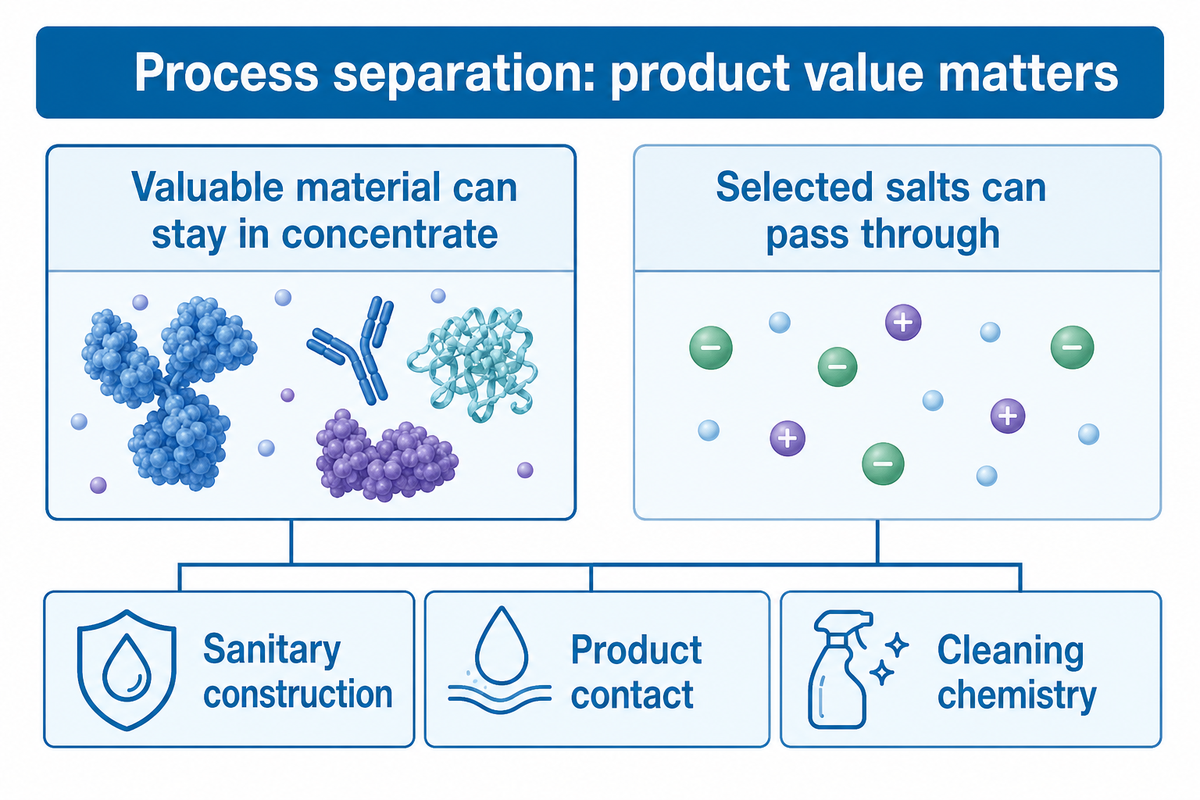
In process filtration, the valuable material can stay in the concentrate while selected salts pass through. Sanitary construction, product contact and cleaning chemistry can matter as much as permeate flow. The ranges below may be used to differentiate product development from purchasing a nominally similar replacement element.
7. Synder Filtration: Best for Comparing Process NF Selectivities
Headquarters: Vacaville, California, USA · Founded: 1994 for the membrane business; Synder Inc. precursor in 1989 · Type: family-owned membrane manufacturer
Official website: synderfiltration.com
Main products: NFX, NFS, NFD, NFDE, NFW, NFDC, NDX, NDF and NFG; flat sheets and spiral-wound elements.
Certifications / notable work: ISO 9001:2015 certificate 111736.00 covers the specified Vacaville sites and lists an August 2027 expiry; the company announced ISO 14001 certification in May 2024.
Synder’s product table offers several NF grades for dairy and industrial applications, giving process developers a way to begin with membrane selectivity and then consider the finished format. The combination of flat sheets and spiral elements is helpful when laboratory screening must eventually lead to a process-scale element discussion. Its limitation sits inside the comparison table itself: rejection values differ by test solute, so the largest printed rejection figure isn’t automatically the best grade for a common feed. The useful comparison is the grade’s actual test basis and intended separation, rather than an unsupported ranking of every NF code by percentage alone.
8. Alfa Laval: Best for Sanitary Spiral NF
Headquarters: Lund, Sweden · Founded: 1883, from AB Separator · Type: in-house manufacturer of sanitary process membranes
Official website: alfalaval.com
Main products: NF and NF99HF spiral-wound membranes, with polyamide thin-film composite layers on polyester support.
Certifications / notable work: The product page lists food-contact material compliance with EC 1935/2004 and FDA 21 requirements; Halal and USDA arrangements are described as available on request.
Alfa Laval identifies the membrane material as well as the product names, which helps buyers connect sanitary construction to dairy, food and biotechnology separation duties. NF and NF99HF are distinct choices within that range, rather than a generic “food-grade NF” designation covering every requirement. The manufacturer’s own membrane production and the published material description provide two concrete reasons to consider it for sanitary process work. The limitation is the difference between those grades: flux and salt rejection aren’t identical, so a process that needs greater passage of selected salts may lead to a different choice from one that puts more weight on retaining them.
9. Veolia: Best for Application-Specific Water and Process NF
Headquarters: Aubervilliers, France, for Veolia group · Founded: group origins in 1853 · Type: water-technology group with membrane manufacturing
Official website: watertechnologies.com
Main products: Dairy DK/DL, Duracon NF1/NF2, HL, MuniNF, SWSR and Vinopro.
Certifications / notable work: An LRQA EMEA certificate lists ISO 9001:2015 for specified Veolia Water Hungary membrane-manufacturing sites, with expiry in January 2027.
The Veolia Water Technologies NF catalogue connects named families to different applications: DK and DL to dairy-stream demineralization, HL to water softening, SWSR to low-sulfate water and Vinopro to wine processing. For buyers handling milk, whey or lactose-related streams, that application-led structure makes the first product discussion more precise than asking for any NF element sold by the group. Its breadth is also the buying limitation, because the catalogue combines different duties and constructions rather than one shared operating envelope. Temperature or other limits quoted for Veolia’s entire spiral-membrane offering can’t be carried across to every nanofiltration model.
Specialty NF Membrane Manufacturers
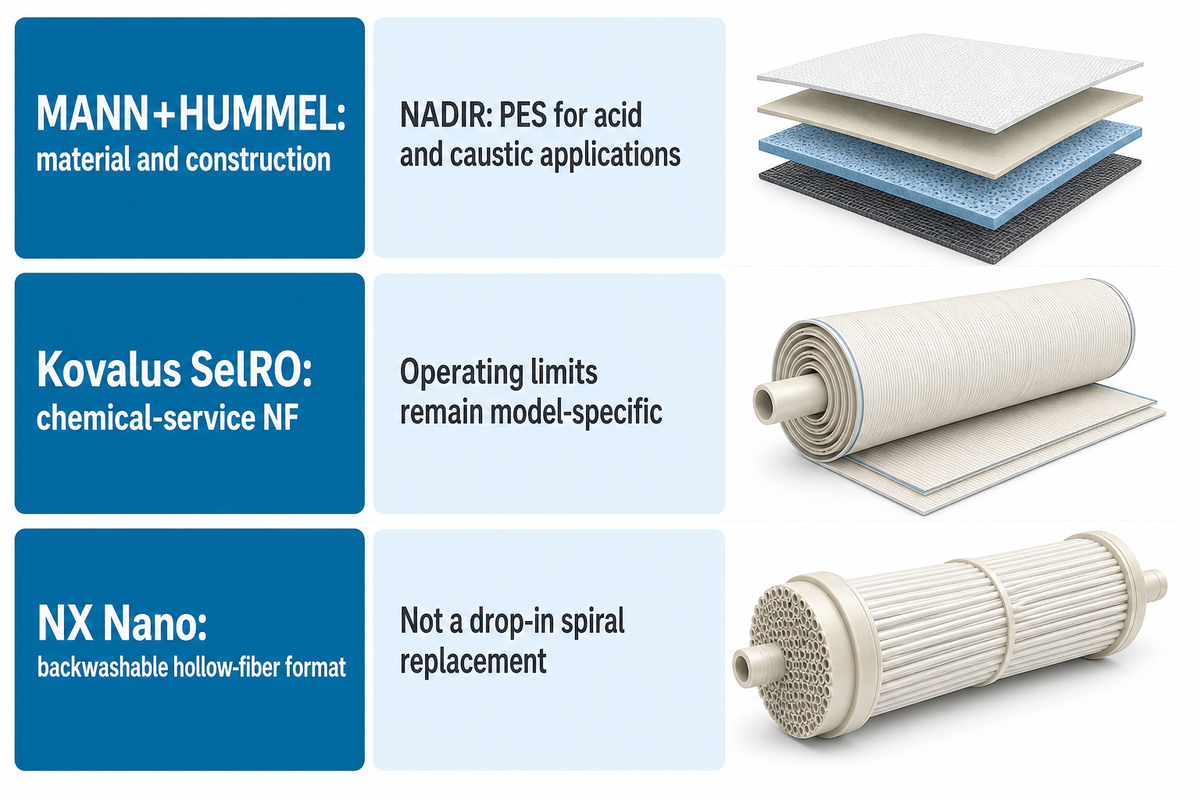
Hollow fiber modules and chemical-service membranes can change the membrane architecture behind the grade number on a purchase order. The options below provide input for material and module architecture in water and aqueous process services. These are generally useful in cases where a spiral element isn’t the preferred starting point, without necessarily indicating coverage of organic-solvent services.
10. MANN+HUMMEL: Best for Material and Construction Choices
Headquarters: Ludwigsburg, Germany, for group headquarters functions · Founded: 1941, for the group · Type: membrane manufacturer with several product brands
Official website: water-membrane-solutions.mann-hummel.com
Main products: NADIR NP010/NP030, TRISEP NF products and TurboClean NF.
Certifications / notable work: The official certificate directory lists ISO 9001:2015 for MANN+HUMMEL Water & Fluid Solutions GmbH in Wiesbaden.
MANN+HUMMEL describes NADIR NP010 and NP030 as PES-based membranes for acid and caustic applications, while TurboClean NF addresses dairy and food processing. Its NF offering also includes choices involving flat sheets, spacers and element dimensions, giving buyers several construction variables to discuss alongside membrane chemistry. TRISEP, NADIR and TurboClean belong in one manufacturer entry here, which avoids mistaking related product brands for separate competing factories. The buying limitation is that this variety doesn’t create one shared compatibility specification: the polymer, spacer and finished format have to be matched at the individual product level.
11. Kovalus Separation Solutions: Best for Acid and Caustic NF Duties
Headquarters: Wilmington, Massachusetts, USA · Founded: roots in 1963; Kovalus name adopted in 2023 · Type: process-separation manufacturer
Official website: kovalus.com
Main products: SelRO chemically stable nanofiltration, including MPS34 and MPS36 element references.
Certifications / notable work: The company describes itself as ISO 9001 certified.
SelRO is presented specifically for demanding acid and caustic process separation, giving buyers a named chemical-service family instead of a general claim that an NF element is durable. Kovalus states a temperature capability up to 70°C on the SelRO page, alongside acid and caustic recovery applications, with the actual chemistry and model governing the choice. This makes the range relevant when recovering a useful process liquid is the main objective rather than producing low-mineral water. The limitation is the boundary between a membrane and a complete process: operating limits remain model-specific, and recovery benefits described for a Causti-COR system aren’t guaranteed recovery figures for every SelRO element installation.
12. NX Filtration: Best for a Backwashable Hollow-Fiber NF Platform
Headquarters: Hengelo, Netherlands, current office · Founded: 2016 · Type: direct nanofiltration module manufacturer
Official website: nxfiltration.com
Main products: NX Nano hollow-fiber nanofiltration modules.
Certifications / notable work: NX Filtration N.V. has been B Corp certified since March 2024, a corporate-impact certification rather than a membrane-performance rating.
NX Nano combines selective separation with a hollow-fiber module format that the manufacturer describes as backwashable. The product page also states chlorine-compatible cleaning at high and low pH, which gives system designers a different cleaning and module-operation discussion from conventional spiral NF. This is a useful shortlist option for a project that can consider its membrane architecture as part of the design, including the cleaning sequence and associated equipment. Its buying limitation is physical and operational: NX Nano isn’t a drop-in replacement for a 4040 or 8040 spiral element already fitted in a pressure vessel.
How to Choose an NF Membrane Supplier
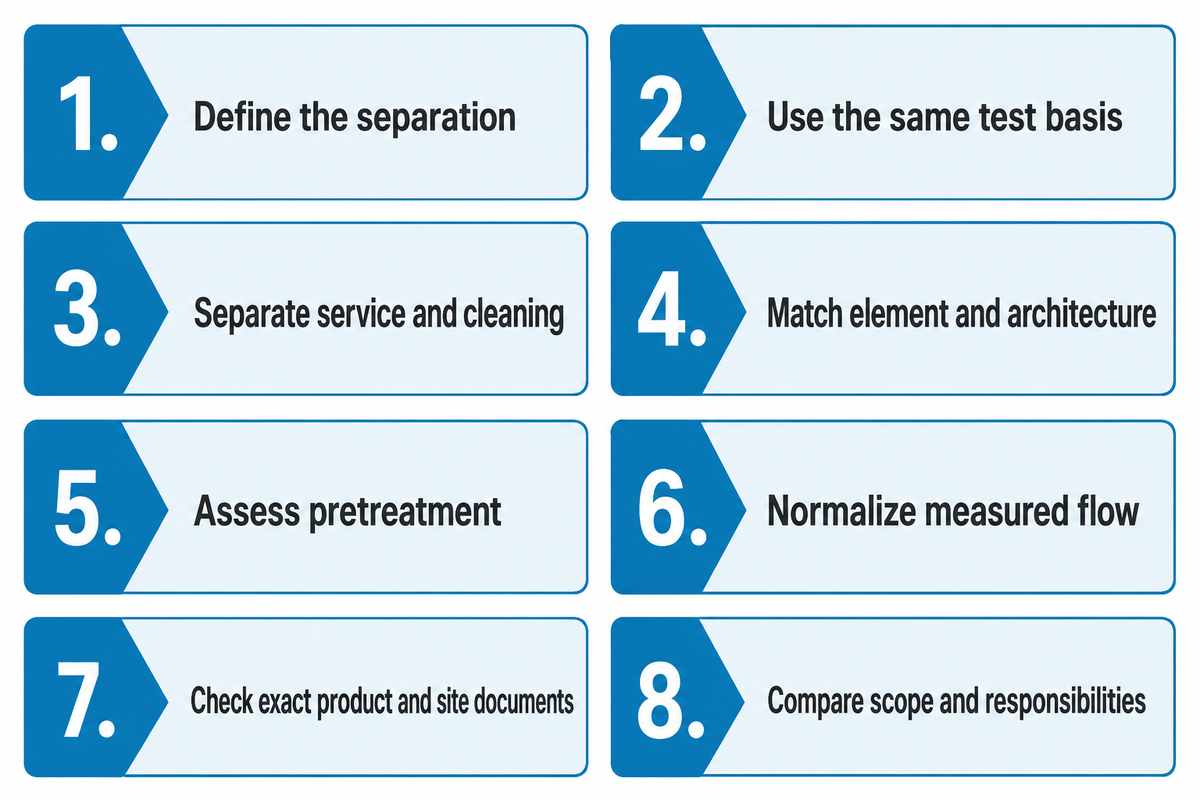
Start a useful supplier comparison with the required separation and end with an element that fits the process. Provide each shortlisted manufacturer the same feed information and product-water target. The following eight checks allow you to compare proposals while keeping differences in chemistry, test conditions and supply scope visible.
1. Define the Separation Before Choosing the Brand
Write down what should pass through the membrane and what should be in the concentrate. A water-softening duty may aim to remove divalent ions while preserving some mineral content. A dairy process may need to retain valuable organic compounds while allowing selected salts to pass. An industrial water purification project might want a low dissolved-solids output and, therefore, need a closer comparative analysis of NF and RO processes.
These objectives produce different shortlists. Start with Blue’s standard grades or the FilmTec water-treatment families for element-based water duties; start with sanitary ranges such as Toray, Synder or Alfa Laval for relevant process streams. Neither high salt rejection nor high salt passage is universally better. The useful result is the ion or molecule balance your process needs. Our comparison of reverse osmosis and nanofiltration explains the separation choice before you commit to a manufacturer.
For instance, a plant buying an element to soften incoming water has a different objective from a processor concentrating a saleable liquid. In the first case, hardness passage and water quality drive the comparison. In the second case, the comparison may be based on product retention and the composition of the concentrate. Describe what stream you’ll be using, what substances are of importance and what happens to the other stream. This type of process description will help suppliers to understand the process more accurately than if you asked them to “purify the feed”.
2. Compare Salt Rejection on the Same Test Basis
A headline percentage becomes useful only when you know the test salt, concentration, pressure, temperature and recovery. Blue’s published N-series values use MgSO4 under stated conditions; they aren’t sodium chloride rejection values. Synder’s table illustrates another issue: each grade is characterized with different solutes. Placing their percentages in a single highest-to-lowest ranking would compare different tests.
Ask suppliers for a proposal to perform a test, or a model specific projection, using your water analysis. State the relevant ions for hardness. State the required conductivity or TDS and the organic removal objective, including TOC (total organic carbon) where relevant, when requesting the NF grade. For the case of drinking water treatment, the design of the complete treatment and a contaminant target are of bigger importance than a general “water purification.” TOC is not the same measurement as one named compound. A statement about color removal or THM precursors should describe the feed and product, rather than state that every NF grade is expected to remove every substance of concern.
3. Separate Continuous Service From Cleaning Exposure
Continuous operation and cleaning are different exposures. Blue publishes separate pH ranges for AR-NF, while KeenSen’s warranty likewise distinguishes operating and cleaning conditions. A broader cleaning range doesn’t turn a standard NF membrane into a continuous caustic-recovery membrane. Temperature and exposure time belong in the same compatibility discussion as pH.
For a caustic or acid process, start with a product family designed for that service, such as the SelRO product line, the relevant NADIR grades or Blue’s alkaline-resistant nanofiltration membranes. Then work with the manufacturer to evaluate the exact chemical concentration, temperature, cleaning agent and exposure limits. Organic-solvent service requires a separate assessment, and an aqueous acid/caustic claim doesn’t provide solvent resistance. Claims for general chemical service don’t supersede process requirements.
4. Match the Element, Connections and Module Architecture
The designations 4040 or 8040 set a physical constraint, but don’t define a process. Specify the element dimensions, active area, feed spacer, permeate connection, seals, and the allowed operating pressures. Changes to flow and salt passage can affect other elements in the NF system.
In the case of hollow fiber NF, the difference is more apparent. NX Nano has its own module and cleaning approach; it can’t be compared to simply another spiral wound cartridge. For replacement work, provide the installed model, vessel arrangement, operating records, and process controls before requesting alternatives. For a new plant, compare the whole membrane systems proposal, including process connections, cleaning equipment, controls and spare parts. Our standard NF element range is a starting point for the element format discussion, not a substitute for it.
5. What Pre-Treatment Is Required for NF?
Pretreatment should address the actual feed’s particles, fouling potential, scaling tendency and incompatible chemicals before they reach the selected membrane. There’s no single filter train that can suit all well water, brackish water, process liquids and wastewater. The manufacturer’s feed limits and water analysis dictate the extent of upstream treatment required.
A cartridge filter may be one particle control stage; however, it doesn’t by itself create acceptable dissolved chemistry. Microfiltration or UF may occupy a different upstream position, while other feed issues may require a different treatment. Check how each stage addressed in the design supports the NF element and how the condition of each stage will be monitored. For water reuse or wastewater treatment, include unfavorable conditions and expected variability of the feed, rather than just a favorable sample, in your proposal. This way, the proposal will be useful for long-term performance, rather than just the initial testing and commissioning.
Maintain the scale of application in view as well. A whole house water treatment project, a utility water project for a factory and a process treating waste water may have different operating patterns, staffing levels and availability of resources. They shouldn’t have the same standardized pretreatment, just because each project mentions NF. Capture the feed range and available upstream treatment and practical cleaning arrangement. A supplier will then be able to determine what additional filter or treatment element is required and the reason for its inclusion.
6. Why Can Measured Membrane Flux Be Lower Than the Published Value?
Measured plant flow indicates the actual plant conditions and should always be compared against the flow specified in the published data. Flow can change for a number of reasons including temperature, pressure, feed concentration, recovery or membrane conditions. Low measured plant flow alone doesn’t identify a defect in the plant element or prove that another brand would perform better.
Compare the operating record against the supplier’s test conditions prior to making any conclusions on the flow figure reported in GPD or other unit of measure. Request the manufacturer’s normalization methodology, and evaluate pressure behavior, salt passage and pretreatment conditions. High productivity is useful only if the required product water is achieved within the operating envelope. Similarly, a lower pressure claim doesn’t establish lower total energy consumption without comparable duty and recovery. Reducing energy consumption is a plant-level comparison, and circulation, cleaning, and associated treatment loads should also be included in this comparison.
7. Check Quality Documents Against the Exact Product and Site
Read the certificate holder, location, scope and validity date. An ISO 9001 certificate describes a quality management system within its stated scope. A food-contact material declaration concerns a different question. A corporate B Corp certification is different again. They can all provide useful information, but none should be substituted for the others.
Request the pertinent documents currently available, along with grade identification and traceability information, and agreed acceptance criteria. Sanitary process buyers need to match the membrane materials and construction to their process requirements. Drinking-water projects need to review the applicable product and installation requirements through the responsible project team. Where a supplier offers an alternative brand or private-label element, determine who manufactures it and who owns the technical specification. This check is especially applicable to a quotation which comprises membrane elements with complete water treatment equipment.
8. Compare the Delivered Offer and Operating Responsibilities
Separate membrane manufacturer, sales supplier and system integrator in the proposal. System integrators may design complete nanofiltration systems while sourcing elements from another company; that may be appropriate but it alters who you approach concerning element specifications, commissioning and plant performance. A factory quote and a complete filtration systems package are different things.
Compare exact grades, quantities, packaging, preservation, delivery terms and warranties rather than unit prices. Clarify responsibilities for start-up support, process projection, and a replacement assessment if operating results change. A cost-effective offer includes the right element, plus a supporting arrangement the plant can use. For commercial applications, the initial price isn’t the only cost, as cleaning, consumables, and downtime, as well as the handling of concentrate, may also influence operational expenses. “Advanced membrane” and “leading manufacturers” aren’t replacements for what’s defined in the scope of supply.
Frequently Asked Questions
How Does Nanofiltration Differ From Reverse Osmosis?
Nanofiltration can retain hardness and larger dissolved substances while allowing more selected salts to pass than an RO grade intended for strong desalination.
The actual result depends on the membrane and feed chemistry. Compare the specified ions and product-water target rather than assuming that every NF element behaves like a lower-pressure RO element. A duty designed to retain useful salts is different from one designed to reduce their concentration as far as practical. Select the product family around that separation target before comparing supplier names.
Can NF Be Used for Drinking Water Treatment?
Yes. NF is used for drinking-water applications such as hardness reduction and selected dissolved-organic removal within an appropriate treatment design.
Suitability depends on the feed, required finished-water quality and the complete treatment design. A membrane datasheet alone doesn’t establish that a particular installation produces compliant drinking water. Product certifications also have defined scopes: materials-contact certification and contaminant-reduction performance are different matters. Select the exact grade and supporting treatment stages for the intended application, then assess the proposed system against its actual requirements.
How Often Should I Replace Filters and Membranes?
Replace them according to measured condition, the system’s operating history and the manufacturer’s limits; NF elements do not share one universal replacement interval.
Feed conditions, pretreatment, operating conditions and cleaning practice affect membrane life. Track normalized flow, separation performance and pressure behavior against the system’s baseline and the manufacturer’s limits. A cartridge filter and an NF element serve different functions, so their replacement schedules shouldn’t be combined. Persistent deterioration after an appropriate assessment may justify replacement, but a low flow reading by itself doesn’t identify the cause.
Do Manufacturers Offer Samples for NF Testing?
Some manufacturers offer flat sheets or test formats; Synder publishes both flat-sheet and spiral-wound NF products.
Ask about the exact grade and format before planning a trial. A flat-sheet result supports membrane screening, while production-scale module behavior still needs an application-specific assessment.
Are NF Membrane Prices Comparable Across Suppliers?
Prices become comparable when the grade, dimensions, construction, quantity and supply terms match.
A low-priced element and a complete system quotation don’t describe the same purchase. Obtain like-for-like offers, including preservation, packaging, delivery and warranty, before comparing totals. No single price band represents all the standard, sanitary and specialty products in this list.
When an offer uses a different element count or membrane area, ask the supplier to explain the design basis. A cheaper item price can still accompany a different installed configuration. Compare the proposed separation result and scope of supply alongside the quoted amount.
Can an 8040 NF Membrane Replace an 8040 RO Membrane?
The shared size designation does not make an NF element functionally interchangeable with an RO element.
NF and RO grades can differ in salt passage, flow, pressure requirements and application limits. Mechanical connections and the resulting permeate quality both matter. If the original process relies on strong monovalent-salt removal, an NF grade selected for salt passage may miss the required water quality even when it fits the vessel.
Use the existing element model and operating records as the starting information for a replacement assessment. The supplier should identify the proposed grade, explain its expected separation and show how it fits the installed configuration. Retaining the same vessel doesn’t remove the need to assess the rest of the process. A change intended to lower pressure or improve flow can also change the composition of the useful output stream, which may be the more important requirement for the plant.
Match the Manufacturer to the Membrane Duty
Choose a manufacturer through its relevant product family: standard elements of water treatment, sanitary process membranes, chemical-service NF, or other module architectures. The company comparison narrows the choice, and the feed analysis and operating envelope complete it. Keep the desired mineral balance and the hardness passage visible during the selection for industrial water treatment. Letting a model number decide the selection shouldn’t replace a process specification.
Blue Membrane offers standard N-series, water-softening NF and separate AR-NF options. Send the feed analysis, target separation and existing element details through our technical enquiry page to discuss the appropriate product line and supply scope.
Related reading: See the nanofiltration membrane guide for the process basics, or the water-softening NF guide for hardness-focused selection.
References & Sources
- Enabling High-Boiling-Point Green Solvent Recycling Using Organic Solvent Nanofiltration Membranes Thomas and colleagues, ChemSusChem, 2025. Scope context for organic-solvent NF.
- Scalable Membrane Enabled One-Pot Liquid-Phase Oligonucleotide Synthesis Kelly and colleagues, Organic Process Research & Development, 2025. Scope context for ceramic membranes.